The circular economy and Industry 4.0 – a new production paradigm
The transition towards the circular economy is closely linked to the concept of the ‘fourth industrial revolution’. The technology solutions discussed in the circular economy context include digital technologies such as blockchain applications, 3D printing and automation, cloud computing and big data analytics all of which are often summarized under the umbrella term ‘Industry 4.0’. These are considered to be key enablers for circular business models, allowing the use of information flows and analytics to reduce waste and to close material loops through reusing and recycling materials, as well as employing more efficient manufacturing processes and reverse logistics. Below are examples of how Industry 4.0 can act as a catalyst to promote circularity practices:
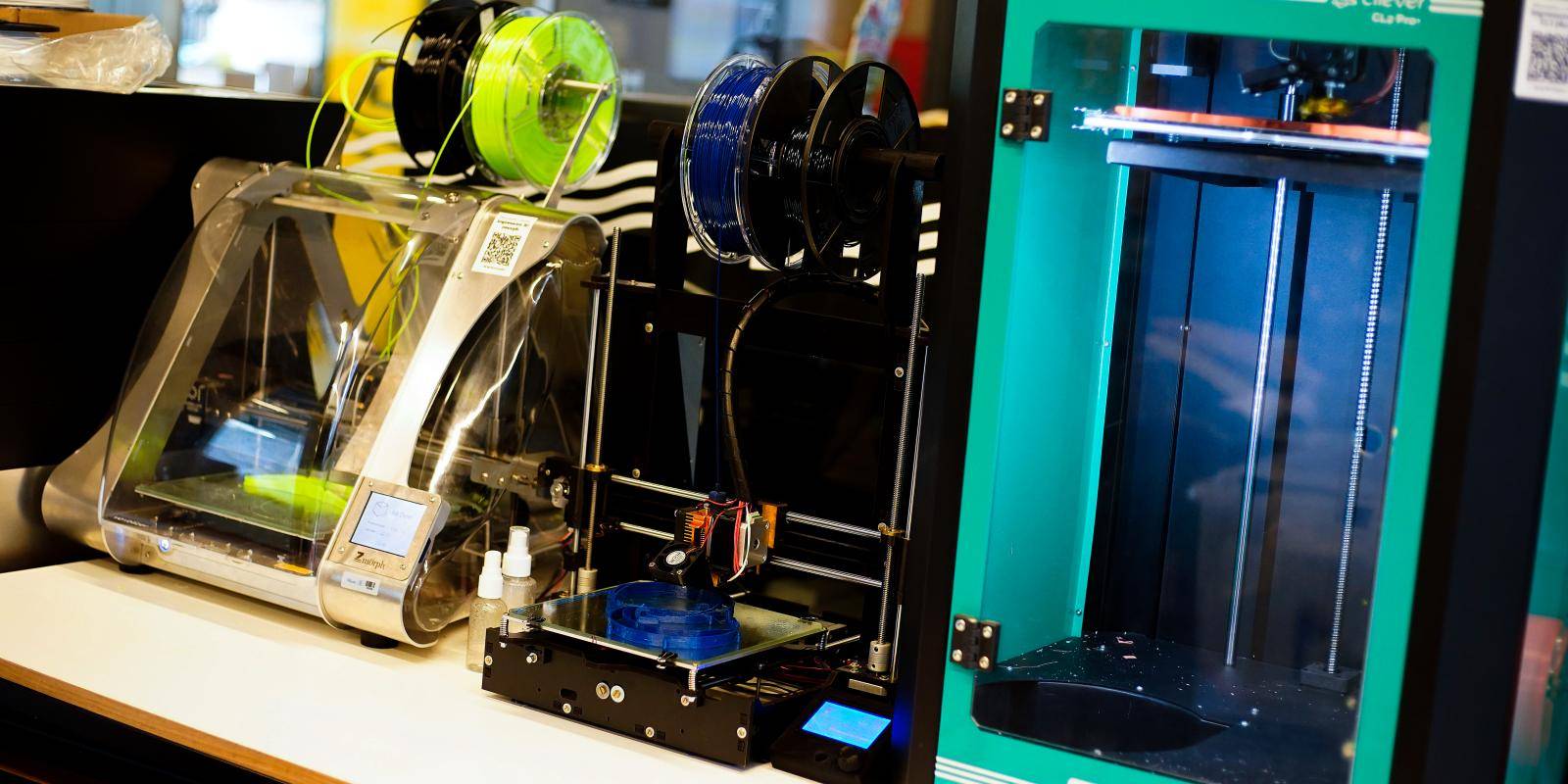
- In the manufacturing sector, 3D printing can eliminate waste in the design process by minimizing material excess in production through prototyping. It also facilitates easy disassembly for the later reuse or recycling of materials.
- In the construction sector, building information modelling (BIM) can be used to simulate building performance from the inception stage of a project, in order to minimize the use of material and human resources during construction, thus enabling the efficient and functional use of space and recovery of materials that are reusable.
- In order to collect, sort and distribute waste, intelligent waste management systems necessarily rely on sensors, big data analytics and cloud computing. Therefore, information generation and sharing of waste flows, facilitated through Industry 4.0 technologies, is of vital relevance to increase recycling shares over solutions such as landfills and incineration.
- The shift towards servitization requires new ‘product-as-a-service’ models, such as the provision of mobility services alongside, or instead of, one-off sales of passenger cars. This trend is strongly supported by circular economy advocates as a trigger for more sustainable consumption patterns. It requires fundamental changes in the way businesses and consumers understand and value ownership. This shift can only be understood in a context of interconnectivity between consumers and producers, and between producers and suppliers of materials and services. Selling services, rather than products, requires the use of smart sensors, location detection technologies, big data and multilevel customer interaction platforms to analyse information on consumers’ preferences and habits.
In the context of the COVID-19 crisis, which will result in a major economic slowdown for the region in 2020 and 2021, and the environmental challenges ahead, Industry 4.0 and the circular economy are at the heart of the productive transformation debate in Latin America. Countries in the region have historically shifted from the primary to the manufacturing sector as their economies have developed, given the risks of commodity price fluctuations and the difficulty of increasing productivity and value addition in the extractive and agriculture sectors. While this shift continues to be important, three current trends need to be taken into account: the commoditization of manufacturing, which has led to prices of manufactured goods reaching historic lows; the growing demand for certain specific minerals and primary goods; and the productivity gap and environmental pressures faced by most Latin American countries.
In the context of the COVID-19 crisis, which will result in a major economic slowdown for the region in 2020 and 2021, and the environmental challenges ahead, Industry 4.0 and the circular economy are at the heart of the productive transformation debate in Latin America.
With the above trends in mind, Industry 4.0 and the circular economy may downplay intersectoral transformations while putting a stronger focus on how to strengthen intrasectoral dynamics. For instance, the future competitiveness of Chile’s mining sector relies on the application of advanced technologies for value addition while reducing the environmental impact of mining activity. The country plans to apply Industry 4.0 and circular economy technologies to become a global supplier of lithium batteries for electric cars, making better use of its mineral resources. In agriculture, traditionally considered a low productivity sector, the application of digital technologies has the potential to increase productivity and yields while reducing inputs of chemical fertilizers, enabling the sector to experience its own revolution, the so-called ‘Agriculture 4.0’. The adoption of precision agriculture using, for example, drone technology, climate and crop monitoring and precision farming software has certainly raised the profile of agriculture in some parts of the region. Brazil, for example, has gone from being an importer of agricultural technologies to becoming one of the leaders in research and innovation, developing Agriculture 4.0 technologies and processes.
While research on the circular economy is gathering pace in LAC, investment in science and technology is still comparatively low, on average equating to just 0.66 per cent of GDP in the region. Moreover, only 36 per cent of that share is financed by enterprises (public and private), which demonstrates the limited capacity of individual firms to absorb Industry 4.0 technologies. Most countries aiming to have technologically advanced circular economy models linked to Industry 4.0 have research and development (R&D) investment rates exceeding 2 per cent of GDP and a higher level of participation of enterprises in the financing and execution of R&D. Both governments and the private sector in the LAC region must, therefore, invest more in R&D in order to ensure the region is able to take full advantage of Industry 4.0 technologies and apply them to a circular economy transition.
Digital inclusion and employment in the circular economy
Making use of digital innovation will be key to realizing circular economy opportunities. It has been estimated that by 2022, the number of internet-enabled devices in LAC will reach 100 million, growing at an annual rate of over 20 per cent. Chile, Costa Rica, and Brazil are considered the three countries most ready to participate in the Industry 4.0 market and benefit from its opportunities. According to Digital Evolution Index 2017, ‘Mexico, Colombia, Brazil and Bolivia are considered “break out” countries that are rapidly evolving to widespread digitally-driven innovation’. However, it is important to note that without appropriate policy, fiscal support and skills development initiatives, Industry 4.0 technologies are likely to be taken up disproportionately by larger companies, leaving small businesses at a disadvantage. Making Industry 4.0 technologies accessible to small businesses, and up skilling workers, is key to ensuring a just transition.
While the digital infrastructure coverage gap in LAC is relatively small, with just 10 per cent of the population living outside the reach of 4G or even 3G networks, the usage gap is much larger, with 57 per cent of the population not using mobile broadband, despite network availability. The biggest barriers to uptake of mobile broadband usage are the lack of relevant local content (including content in Spanish), followed by digital literacy and affordability. Only a small percentage of teachers in the region are trained to teach digital literacy, while the cost of mobile services (measured as a percentage of the income of the poorest 40 per cent of the population in each country) varies between 5 per cent (Uruguay) and 42 per cent (Guatemala).
Successfully navigating the digital transformation is as much about technology and infrastructure policy as it is about social welfare and education policy – ensuring that opportunities are accessible to communities at all socio-economic levels and that they contribute to development objectives. It is crucial that Industry 4.0 technologies be affordable and made available at scale, both by design and through financial policy support; that digital literacy be prioritized in the region; and that national information and communications technology (ICT) development plans include the prioritization of locally relevant content, to enable the skills training and accessibility to technology needed for the circular economy transition.
Differing levels of participation by gender in the use of personal technology, and in employment in the technology sector, are also likely to present an issue in LAC. In terms of mobile internet usage the overall gap is small, with just a 2 per cent difference between men and women at regional level, though this varies widely by country; in Guatemala, for example, there is a 15 per cent difference. The difference is more pronounced overall when we look at employment. Since 2017, the proportion of women in employment has stagnated across the region, with only half of women participating in the labour force compared to 74.4 per cent of men. In 2018, according to ECLAC figures, 77.6 per cent of women were employed in low productivity sectors (agriculture, commerce and services) against 55.4 per cent of men. Sectors with average productivity (manufacturing, construction, transport) account for only 13.8 per cent of employed women but for 35 per cent of employed men. One of the factors contributing to women’s study and employment choices across the region is the persistence of gender stereotypes concerning the role of women in families. The adoption of Industry 4.0 technologies could deepen the existing gender gap in the region, as the overall proportion of the population employed in low productivity sectors continues to shrink.
Specifically encouraging female entrepreneurship in technology-driven high-productivity sectors is one way to bridge the employment and salary gap. This pattern is reflected in the type of entrepreneurship generated by women in LAC, with a focus on ‘triple bottom line’ (social, environmental and financial) impacts. One example from Argentina is Daravi, a female-led enterprise founded in 2016 that creates sustainable products, reusing waste materials and prioritizing the design of products with an extended lifespan, generating job opportunities for the community with a focus on women.
The shift to a circular economy must aim to redefine growth, leaving no one behind. Addressing gender stereotypes, promoting technical training for women and female entrepreneurship will be critical to mitigate unequal impacts of the digital transformation on women and, ultimately, to help achieve the SDGs.
COVID-19 impact and recovery
The COVID-19 health crisis has shaken the foundations of the linear economic model. The dramatic slowdown of global production, which started in China, the site of the first major outbreak of coronavirus in 2020, brings into question the supposed benefits of an economic model governed by global value chains (GVCs). ECLAC estimates that the region’s exports to China in 2020 could fall by as much as 10.7 per cent in value terms, exposing the reliance of countries such as Chile, Peru and Brazil on the Chinese market. In addition, the disruption of trade flows, in combination with countries’ lack of productive capacities, has caused major havoc in supply chains and in the provision of essential healthcare items such as protective masks and respirators, not only in developing but also in developed countries. GVCs are primarily organized around economic drivers such as specialization, costs, market access and economies of scale that rarely take into account environmental considerations such as carbon footprint and resource usage. In summary, GVCs have failed to take account of the interdependencies binding the environmental, social and economic systems.
ECLAC estimates that the region’s exports to China in 2020 could fall by as much as 10.7 per cent in value terms, exposing the reliance of countries such as Chile, Peru and Brazil on the Chinese market.
A special report from ECLAC states that efforts to create a new economic model are more important than ever. The COVID-19 outbreak unfolding in the LAC region is likely to precipitate the largest economic and social crisis in decades. On average, GDP is expected to contract by 5.3 per cent in 2020 across Latin America, which will have devasting consequences in terms of job losses and increased poverty and inequality. Issues that existed before the crisis, such as low levels of investment in public services and weak social safety nets, coupled with the vast and particularly vulnerable informal sector, make it even more difficult for LAC governments to find ways of combating the economic effects of the pandemic.
In the context of the COVID-19 pandemic, and the widespread questioning of the existing economic model that the crisis has prompted, the circular economy offers a framework for Latin America to rethink its future. Economic recovery in the post-COVID-19 period will call for an economic model that supports well-being, increases resilience and benefits business, people and the environment by decoupling socio-economic development from resource consumption. The circular economy presents an attractive alternative to the prevailing linear model in the developed world.