Box 5. Circular economy frontrunners in LAC
The following case studies highlight the leading proponents of the circular economy in the region. Their experiences shed light on the current state of policy design, implementation challenges and sectoral opportunities.
Colombia
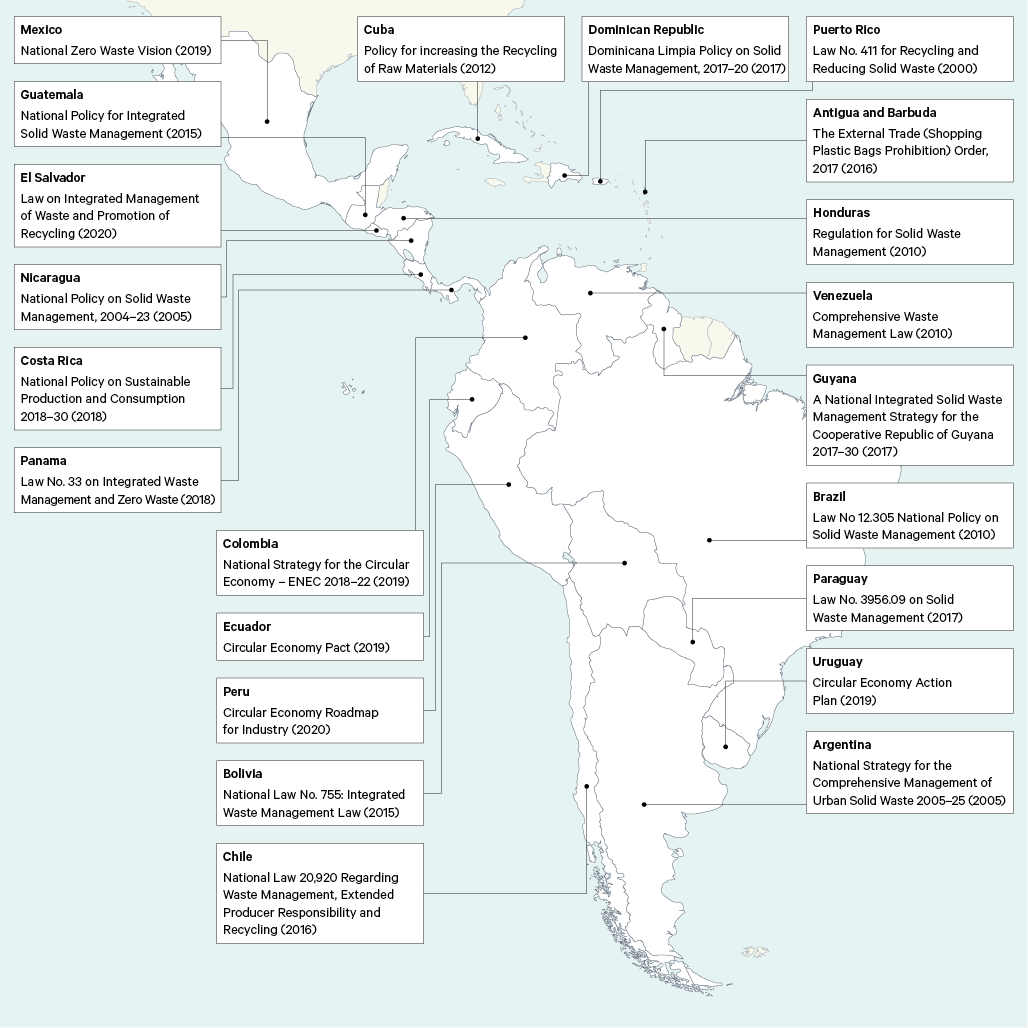
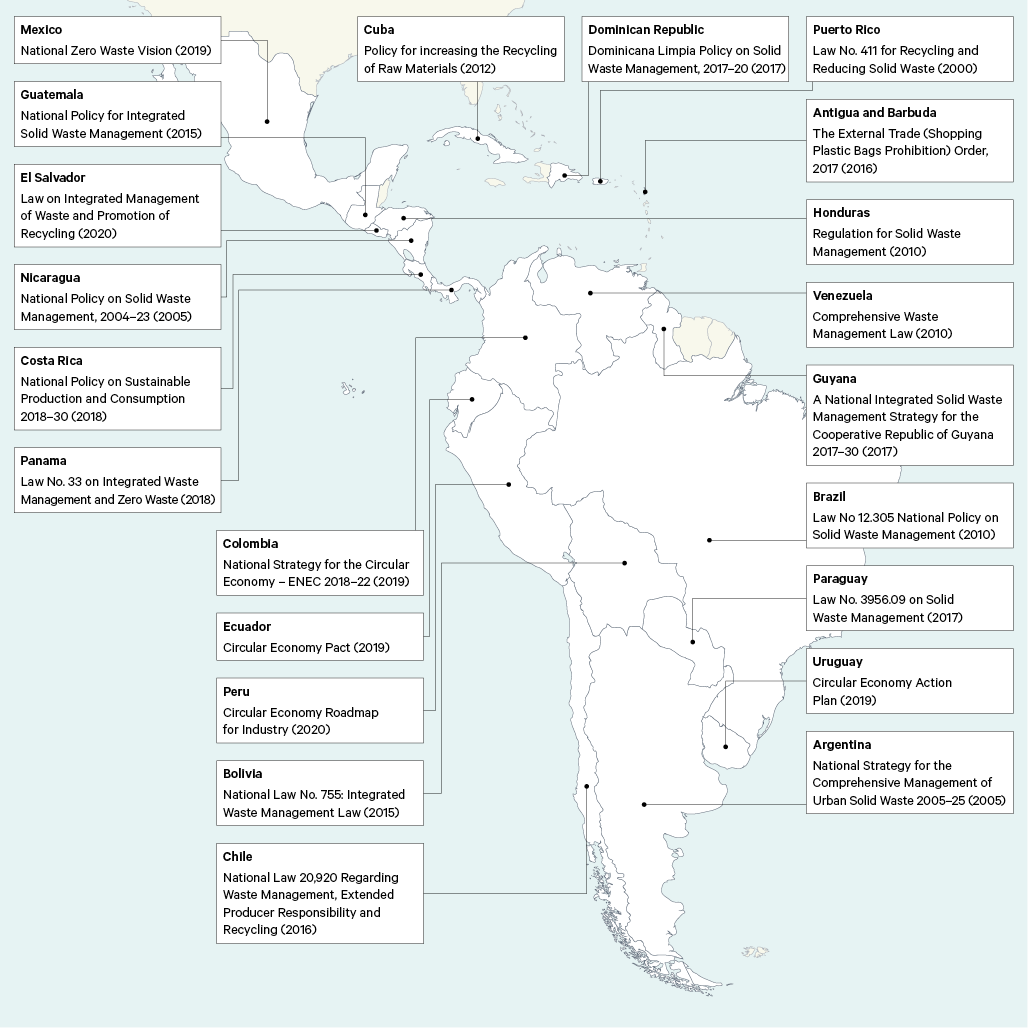
After hosting the first Circular Economy Forum of the Americas in 2017, Colombia launched its National Strategy for the Circular Economy 2018–22 in November 2018 (Estrategia Nacional de Economía Circular– ENEC), with an updated version published in July 2019. The strategy aims to increase the rate of recycling and reuse of waste materials from 8.7 per cent in 2019 to 17.9 per cent by 2030. While this is the first strategy explicitly focusing on the circular economy in Colombia, this is not the first time that the country has created strategies and policies on green growth, sustainable production and waste management. The government produced a National Policy on Sustainable Production and Consumption in 2010 and green growth components – transforming the economy, generating low-carbon public policies and incentives, and increasing the involvement of the private sector – were included in its National Development Plan for 2014–18. A commercial carbon tax was passed into law in 2017; in October of that year, within months of its implementation, one of the country’s largest producers of concrete, Cemex, announced that it had become carbon neutral.
Colombia was one of the first countries in the region to adopt EPR policies, introducing EPR into its first national policy on hazardous waste management, Decree 4741 of 2005, which regulates the prevention and management of hazardous residue and waste. In 2007, Colombia started implementing an EPR scheme to manage several end-of-life products containing hazardous waste materials, such as pesticide containers, expired medicines and lead-acid batteries. Light bulbs, small batteries, computers, mobile phones, and other household products as well as used tyres were added in 2010. The EPR scheme aims, in particular, to deal in an environmentally appropriate way with the estimated 110,000 tonnes of e-waste generated annually. However, the effective implementation and administration of the EPR system requires further improvement of the legal framework by defining clear targets. It also requires the active participation and collaboration of key actors in the product chain through legal requirements and economic instruments.
Colombia has also been developing several strategies around the bioeconomy. At the World Economic Forum in 2016, the country announced its strategy for economic development, based on agro-industry, the service sector and tourism. In addition, the country’s National Planning Department conducted a Green Growth Mission, which proposed a shift to more socially inclusive, and resource-efficient, sustainable production processes.
Chile
In recent years, the Chilean government has introduced several policies and strategies aiming to promote the transition to a circular economy. Among LAC countries, Chile has the most public initiatives devoted to the circular economy. In 2016, the country adopted Framework Law No. 20,920 for Waste Management, Extended Producer Responsibility and the Promotion of Recycling. It aims to protect public health and the environment by reducing the generation of waste as well as promoting recycling, reuse and other forms of valorization. The law established an EPR scheme and sought, inter alia, to enhance the inclusion of unofficial ‘waste pickers’. In 2018, Chile banned the commercial use of plastic bags, despite fervent efforts by the national plastics industry to block the process. Other examples of Chile’s engagement include the programme Construye 2025 (Build 2025), which seeks to promote sustainability and circularity within the construction sector, and the National Programme on Sustainable Consumption and Production, which covers areas such as sustainable construction, sustainable industry, sustainable lifestyles and waste management. The implementation of the latter is supported by the National Action Plan on Sustainable Consumption and Production (2017–22). Finally, the Chilean Plastics Pact initiative (Circula El Plástico, since 2019) brings together stakeholders from a range of sectors to promote a circular economy for plastics.
Uruguay
In 2016, Uruguay established the National System for Productive Transformation and Competitiveness (Transforma Uruguay), approved through Law 19472, with the commitment to promote productive and innovative economic development in the country. Participation in the design and implementation of Transforma Uruguay was not limited to government, it also included other public and private stakeholders, and incorporated social dialogue.
The final result of this process was the creation of a Circular Economy National Action Plan, which aims to strengthen human capacity; increase productivity and net savings in production costs; increase green job opportunities; achieve a greater visualization of initiatives and citizen participation; introduce greater innovation; and to bring about a reduction in CO2 emissions and negative impacts on watercourses and soil. Four ministries were involved in the design, and advisory councils were created to integrate workers, entrepreneurs, and academic institutions in the process.
The National Action Plan is made operational through projects such as Biovalor, which is funded by the Global Environment Facility (GEF), implemented by the UN Industrial Development Organization (UNIDO) and executed by three Uruguayan ministries. It aims to generate value from the waste derived from agro-industrial activities. Biovalor supported the Uruguayan National Development Agency (Agencia Nacional de Desarrollo – ANDE) in the design and implementation of the Oportunidades Circulares programme, which provides funding and other forms of support to circular economy start-ups. Biovalor has also developed its own project, Circularidad de Nutrientes en Tambos, an initiative to restore nutrient circularity in dairy farms.
The Uruguayan government is also developing a national strategy for the bioeconomy, and recently launched a road map for Uruguay’s forestry sector. Since 2014, ECLAC, the World Bank and the World Wildlife Fund have identified Uruguay as a ‘green energy leader’. As early as 2004, its government introduced a law with the purpose of promoting reuse, recycling and recovery of packaging. The promotion of the circular economy and the bioeconomy are included in Uruguay’s national development plan.