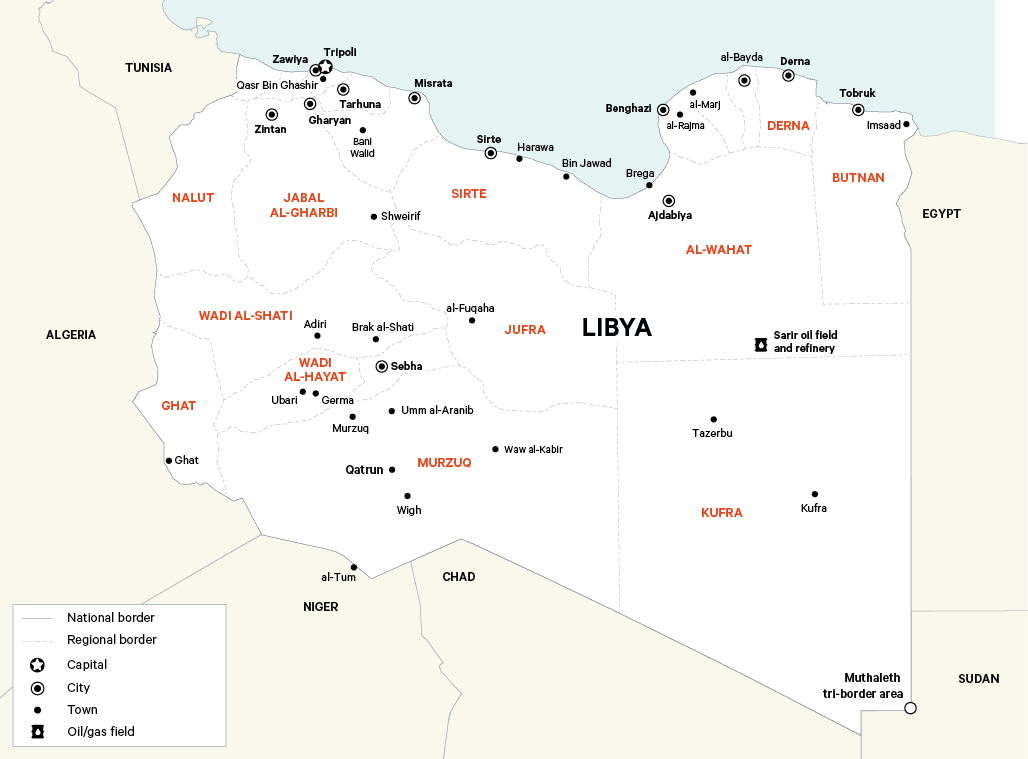
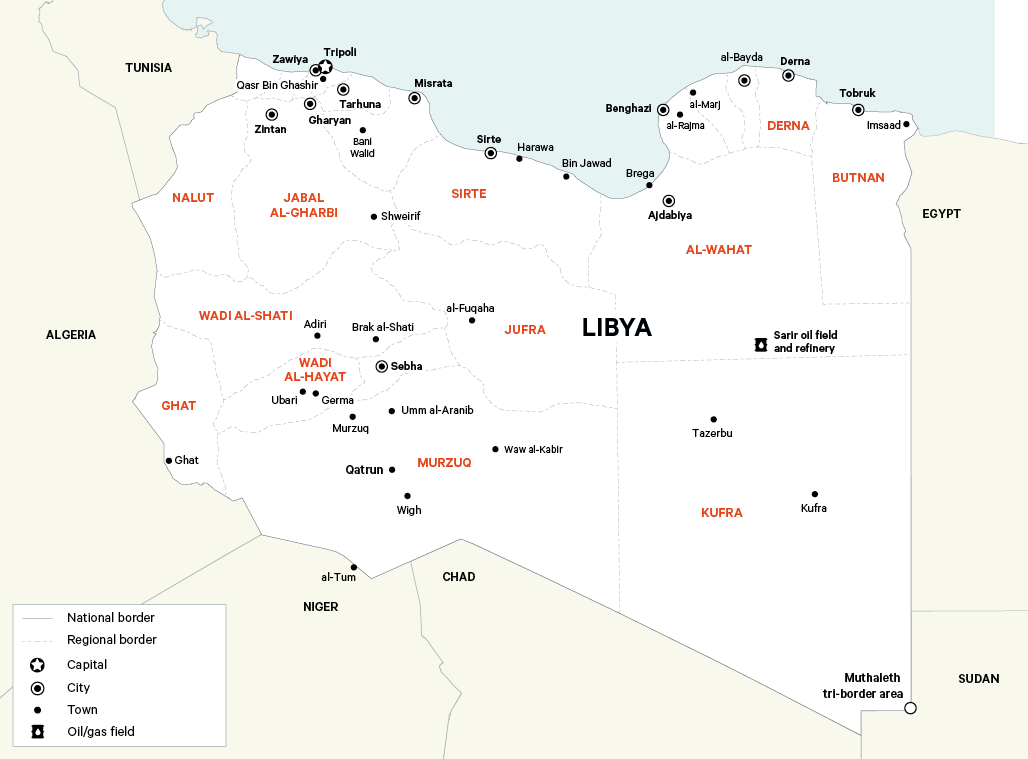
To do this, the paper presents systems analyses of the evolution of irregular migration of migrants and refugees, via smuggling and TIP, in three locations in Libya: Kufra, Sebha and Zawiya. The findings of these analyses illustrate how the second-order effects of violent conflict in Libya have reshaped the process of migration in these transit hubs, stimulating a surge in smuggling activities that, in turn, has exacerbated conflict in Libya.
The paper illustrates that violent disputes over authority in Libya have had a pronounced impact on the smuggling sector, exacerbating other violence through a series of systemic transformations. Assessing the impact of violent conflict over a period of a decade is a complex task, requiring an inter-disciplinary and flexible approach. Giorgio Gallo criticizes simplified assessments of conflict and strategies that adopt linear forms of reasoning as unfit for purpose, arguing that conflict is best understood as a complex system that contains adaptive structures and evolutionary mechanisms. Systems analysis seeks to plot these structures and their evolution, through the qualitative identification of causal relationships, feedback mechanisms and boundaries. It should be noted that the systems created are social constructs that are defined by the researchers, and it is for the researchers to define the system and its boundaries.
A range of academic studies have deployed systems approaches to model conflict dynamics. However, the development and application of the approach with relation to conflict remains largely qualitative and based on participation and debate among practitioners and researchers. Practitioners adopt a community-led approach to understand community perspectives with the goal of supporting peacebuilding. It has been used by peacebuilders to understand how to reveal the structures of conflict, including the hidden aspects, in order to support systemic conflict transformation. This is the approach adopted in this paper, albeit with the supplement of quantitative data in the form of satellite and economic analysis (as laid out in the methodology statement).
About this paper
Forming part of the Cross-Border Conflict Evidence, Policy and Trends (XCEPT) research programme funded by UK International Development, this paper is the third in a series of publications that looks at the transnational connections of conflict in Libya with the proliferation and evolution of migrant smuggling and TIP across the African continent. The first two papers of the series looked at the growth of these practices in Agadez, Niger – a critical transit point in the movement of people to Libya – and in Edo State, Nigeria – which is a key point of origin for many who have travelled to Libya, and on to Europe since 2011. This paper will draw upon the findings of those papers to illuminate the complex transnational interconnections between these contexts. The overall findings is presented in an interactive visualization on the Chatham House website.
This paper is structured as follows: the subsequent sections present systems analyses of migrant smuggling and TIP ecosystems in Kufra, Sebha and Zawiya. These sites were selected as they are significant hubs of migrant smuggling and TIP activity in Libya. These analyses are then abstracted into a national-level systems analysis, and the final section discusses the implications of the study’s findings for policymakers, identifying access points for policy interventions to support systemic change.
Methodology
This paper pairs a political economy of conflict approach with systems analysis concepts to produce an assessment of the development of migrant smuggling and TIP. Research for the paper has been the product of a multi-year effort, beginning in 2021.
Data on the development of illicit economies are notoriously hard to collect, particularly in difficult to access locations. Chatham House worked with a team of local researchers, who preferred to remain anonymous, to undertake more than 30 semi-structured key informant interviews in Kufra (in person), Sebha (in person/remotely) and Zawiya (remotely) to build an understanding of dynamics in the illicit sector and to seek public perceptions of migrant smuggling and TIP activities, conducted in 2021–24.
The relative absence of data at the subnational level in Libya, with respect to analysis of local economies, provided a further challenge. To address this gap, Chatham House worked with XCEPT to commission local economic assessments for Kufra, Sebha and Zawiya through field data collection organization Emani (now known as Nurai Global). The effort combined a structured survey collected in-person (1,276 responses across the three sites) alongside 60 semi-structured interviews with consumers and key informants (20 per site) to understand local perceptions of shifts in the local economy since 2010. The sampling approach was quasi-representative of the local populations. Respondents were 79 per cent male and 21 per cent female, with 23 per cent describing themselves as internally displaced. Emani’s report was delivered in June 2022. In addition, Chatham House worked with XCEPT and Satellite Applications Catapult to commission satellite data analysis of change (2010–2022) in agricultural areas and security checkpoints and, through Emdyn, to monitor signals data on patterns of movement (2020–2022). The reports were delivered in 2023.
The research team, headed by Tim Eaton, convened an in-person workshop in May 2024 to analyse the data collected, as well as discuss and formulate the systems analysis. The authors of the paper have developed the systems analysis, drawing on a systems mapping approach developed by Gallo, that emerged from that conversation.