At the same time, many countries, particularly in the Global South, strive to remain neutral in the growing geopolitical competition but are critical of sanctions. This includes Brazil, India and South Africa, which are ostensibly supportive of the liberal international order in general but also both wary of the unilateral weaponization of sanctions and committed to maintaining a strategic neutrality in rising global tensions.
The growing categories of sanctions include: targeted bans on exports and imports, including military and dual-use products and increasingly products that are used exclusively or primarily in commercial/civilian contexts; restrictions on the provision of certain types of technical, financial and other professional services to restricted jurisdictions; broad prohibitions on direct and indirect dealings with designated persons and entities; prohibitions on investments; and Global Magnitsky-type sanctions that target individuals or entities for corruption or human rights abuses. The EU alone has 54 categories of sanctions, for example.
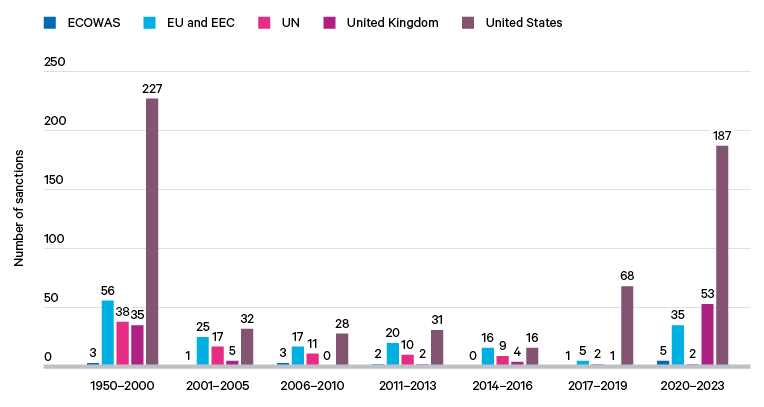
Of the ‘sanctioners’ mentioned above, the US has historically been the most aggressive, imposing three times more sanctions than any other country or international body. The reasons vary, but the following goals are often used as primary, secondary or tertiary justifications for sanctions: global terrorism, illicit commerce, narcotics trafficking, corruption, proliferation of weapons of mass destruction, cybercrime, efforts by states or organizations to destabilize the international order, violation of human rights or democratic norms, and foreign interference in US elections. Sanctions-applying entities also often cite deterring or reversing conflict or war as a justification for sanctions.
The 2024 election of US president Donald Trump has raised new challenges in understanding and managing sanctions cooperation and their application for policy change. Despite re-applying ‘maximum pressure’ sanctions to Iran, Cuba and Venezuela, which were among the 5,000 sanctions he levied in his first term, President Trump has in his second term focused more on tariffs than sanctions, such as shifting US sanctions on Venezuelan oil and gas production and sales to a 25 per cent tariff rate on countries that buy Venezuelan oil and gas exports. Nevertheless, bilateral negotiations with Iran over its nuclear programme and Trump’s promises to unilaterally lift sanctions on Russia to eventually ease the path to a peace deal with Ukraine raise problems of unpredictability and coordination with other sanctioning countries on their liberalization and collective policy objectives.
The Trump administration’s unilateral embrace of tariffs as a new economic weapon has extended also to sanctions, raising further questions about coordination and policy goals. On 24 March 2025, the US Office of Foreign Assets Control announced that the Trump administration was placing a 25 per cent tariff on imports from any country that imported Venezuelan oil. The policy was intended to complement a wind-down of licences that the administration of President Joe Biden had granted to Chevron, Repsol and other US, UK and European oil and gas companies to operate in Venezuela. Trump’s use of this new policy of ‘secondary tariffs’ will mostly affect China, Turkey and India. Secondary tariffs raise questions regarding their relationship with the broader reciprocal tariffs imposed by Trump on 2 April 2025 – and later increased against China – in the interest of US exports. Could the Venezuela-related tariffs be negotiated away in return for greater market access of US exports to Chinese or Indian markets? How would they be coordinated with other tariffs and existing targeted sanctions that had been previously imposed on Venezuela by the EU, UK and Canada?
The wide-ranging sanctions imposed in response to Russia’s full-scale invasion of Ukraine in early 2022 are an important recent example of coordination between the UK, EU and US on imposing and enforcing broad sanctions to deter and later punish Moscow for its invasion of Ukraine – though since January 2025 the Trump administration has stalled updating sanctions enforcement on third parties.
At the same time, other jurisdictions – including the EU, UK and other countries – are also using sanctions measures as a primary foreign policy tool to further government objectives such as deterring conflict, promoting and protecting human rights and democracy, or encouraging policy change in areas such as trade, often in close coordination with the US. The wide-ranging sanctions imposed in response to Russia’s full-scale invasion of Ukraine in early 2022 are an important recent example of coordination between the UK, EU and US on imposing and enforcing broad sanctions to deter and later punish Moscow for its invasion of Ukraine – though since January 2025 the Trump administration has stalled updating sanctions enforcement on third parties.
While some sanctions regimes target specific countries and sectors, some sanctions apply across countries and jurisdictions in relation to identified categories, for example terrorism, narcotics trafficking and corruption.
Geopolitical fragmentation has also led to sanctions being imposed by non-Western countries. Belarus, China and Russia have started imposing their own sanctions on trade, individuals and entities – an indication that sanctions are no longer just the domain of liberal democratic governments. In some of these cases, these new-sanctioning countries use existing laws on health and safety standards – in what has been termed ‘conversion’ – to limit trade and punish specific economic sectors or countries.
The risk is an escalation of sanctions for different reasons, with their use sometimes outside the boundaries of violations of international law or norms. This was the case when China applied limited sanctions on Norwegian salmon imports after the Norway-based Nobel committee awarded the Nobel Prize for peace to a Chinese dissident, or when Moscow sanctioned Ukraine before the Russian invasion. As the UN Security Council becomes divided with China and Russia holding veto power over broad UN sanctions, the era of UN sanctions on countries like Iran or North Korea may have become a thing of the past. The result is that unilateral sanctions are likely to become more prevalent in the future, not just by developed countries in the West and/or Global North, but also by China, Russia and others in a fragmenting global environment.
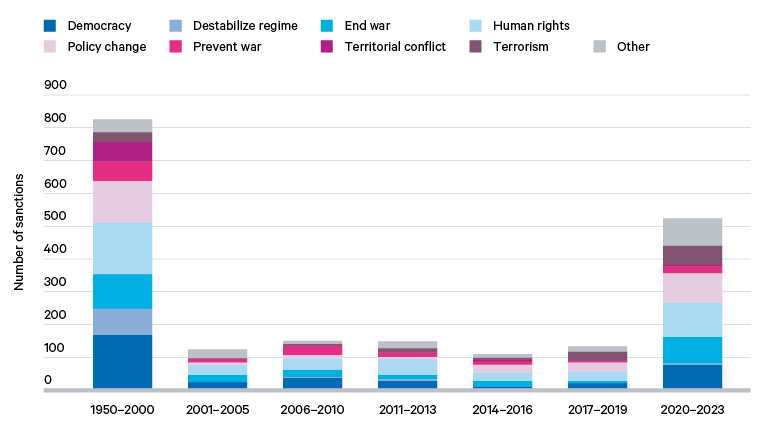
Even excluding these new sanctioning governments, the stated reasons for sanctions vary, as do the countries or entities targeted. The most common stated objective is protecting against threats to democracy and human rights; this was cited among the primary, secondary or tertiary reasons for more than 367 of the sanctions. Preventing or ending war accounted for more than 153 of the measures.