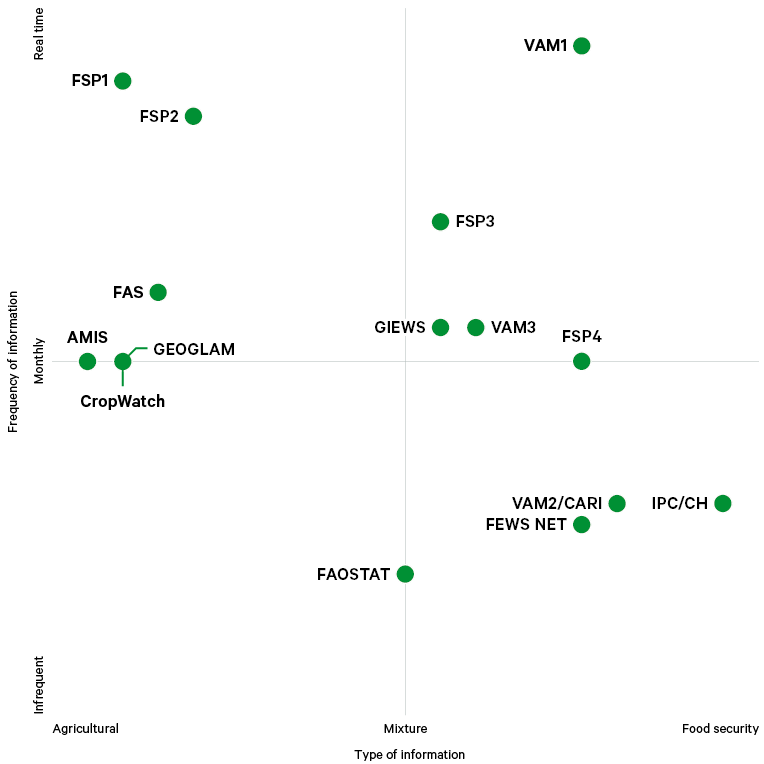
Communities facing threats to food security often encounter intersecting and cascading risks that do not occur in isolation. To be effective, food security early-warning systems must go beyond single-hazard analysis and integrate these risks, vulnerabilities and socio-economic dimensions.
Evaluating food security early-warning systems requires a clear understanding of the factors affecting food-system resilience and how cascading risks impact food security outcomes. This chapter explores the current landscape of early-warning systems, highlighting their often-siloed nature and assessing progress towards more integrated, multi-hazard approaches. By mapping transmission dynamics of risks and response archetypes as well as critical stakeholders and institutional partners, the analysis provides a holistic framing for considering the adequacy of early-warning systems to anticipate the cascading risks to food security.
Food security and resilient food systems
At the core of food systems are the activities and actors involved in the production, supply and consumption of food through multiple interacting value chains. But rather than considering these elements in isolation, it is important to examine these activities in a systemic context, focusing on their interactions with each other, and the broader drivers of the socio-economic, political and environmental landscapes in which they occur. With this in mind, it is clear that food security can only be sustained when indirect and systemic risks are effectively managed together with more direct risks to agricultural production and specific communities’ access to food. Food security – ‘when all people, at all times, have physical, economic and social access to sufficient, safe and nutritious food to meet their dietary needs and food preferences for an active and healthy life’ – is commonly distilled into four components:
- Availability: achieved when there is a reliable supply of food of sufficient quantity and quality (from production, stocks, trade and food aid). Disrupted weather patterns hampering agricultural production, inadequate food reserves and trade dislocations all make food less available.
- Access: achieved when there are adequate resources to obtain appropriate food (dependant on affordability, purchasing power, equitable distribution and market access). Rising food prices (e.g. from production shocks or trade dislocations), social inequalities and poor or hazard-impacted infrastructure all worsen food accessibility.
- Utilization: ensured when food is nutritious and can be metabolized and used by the body (dependant on food safety, quality, preparation and sanitation). Climate-induced health and sanitation issues such as vector-borne diseases, lack of climate-controlled food storage and erosive coping strategies that impair future resilience can all compromise the ability to utilize nutritious food.
- Stability over time: achieved when there is permanent and durable availability, access and utilization. Fluctuating incomes and harvests and disrupted supply chains make food systems less stable.
When food security is threatened, it can disrupt social cohesion and stability. In 2007–08, rapidly rising staple food prices triggered a wave of so-called ‘food riots’ around the world, as (mainly) urban populations experiencing rapid increases in the cost of living protested at both the failures of governments to stabilize prices and the withdrawal of consumer subsidies. In some cases, these protests contributed to broader political instability such as during the ‘Arab Spring’.
Cascading and compound risks
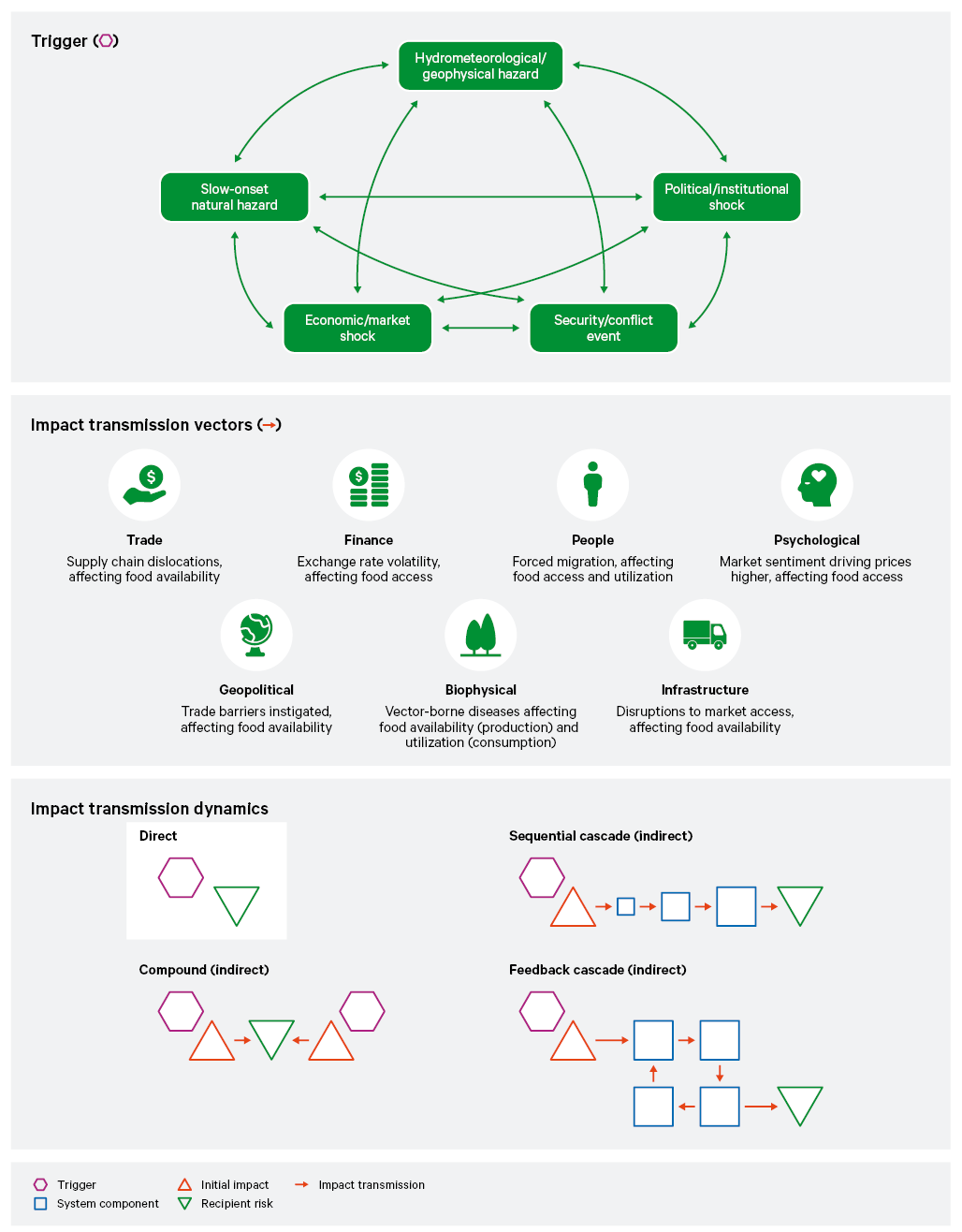
Cascading and compound risks develop from the interactions between direct hazards, such as extreme weather events, and the actions or inactions in response. These interactions and responses may, in turn, have potential knock-on impacts for different segments of society or socio-economic or political systems, which may be far removed – geographically or by sector – from the location of the initial hazard. These novel interactions and confluences of risks and responses can lead to further, sometimes systemic, risks to other peoples and to the supply networks on which those people depend.
The complexity and global connectivity of food systems today, coupled with the non-linear ways in which they interact with other human and natural systems, creates significant potential for localized risks to affect nutrition outcomes for people and societies in distant locations. For example, in 2007–08 and 2012, after a build-up of structural weaknesses in the food system, a series of relatively localized droughts in global breadbasket regions (particularly Australia in 2006, and the US Midwest and the Black Sea region in 2012) precipitated two global food crises. More recently, in 2021, the Ever Given container ship ran aground in the Suez Canal, blocking the vital maritime passage for six days, disrupting an estimated $9.6 billion of trade per day. As around 15 per cent of global grain trade passes through the Suez Canal, had the interruption lasted longer, the impacts on many countries’ food security could have been much worse – both for those with directly affected import orders and more generally, as disruptions are reflected in international market prices. Similarly, Russia’s invasion of Ukraine disrupted both the availability and affordability of food, with historically high prices affecting some of the world’s poorest and most food-insecure countries in 2022.
The complexity and global connectivity of food systems today, coupled with the non-linear ways in which they interact with other human and natural systems, creates significant potential for localized risks to affect nutrition outcomes for people and societies in distant locations.