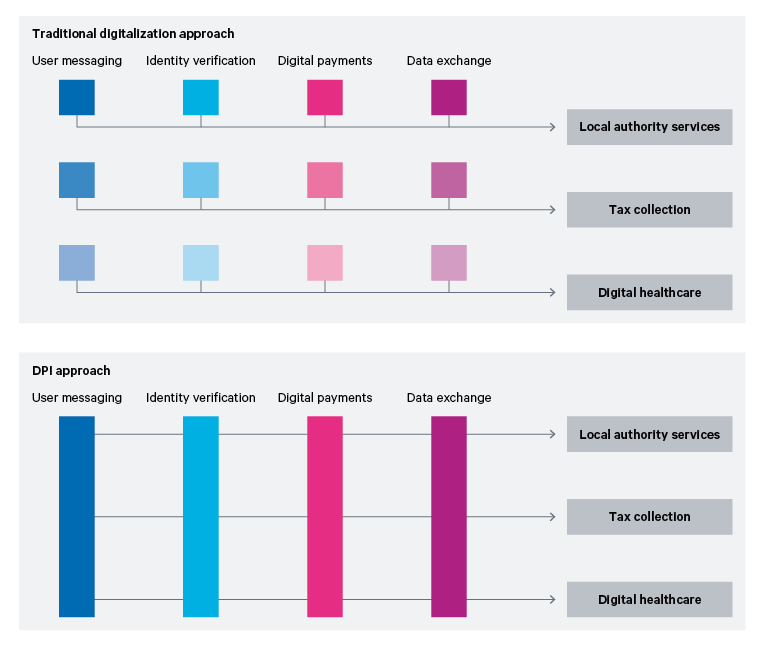
In the US, COVID-19 pandemic relief was hampered by siloed state systems, some of which were nearly 50 years old, leading to ‘rampant fraud’ and delays in aid. Meanwhile, the commissioning of a healthcare portal by the state of Oregon encapsulates the challenge of traditional approaches to digitalization: not only did the provider fail to deliver a functioning service, but the siloed solution was only understood by that single provider, leaving the state locked into that vendor.
The DPI approach, by contrast, requires solutions that are interoperable, that can be built upon, and that enable data to be shared. While this more comprehensive approach is favoured for sovereignty, resilience, security, international cooperation, modernization and economic gains, it does require large-scale data collection and storage, which poses inevitable but preventable risks to digital privacy and rights protection. To combat these risks, facilitators must support and implement strong legal and policy safeguards, privacy-enhancing technology, governance mechanisms for accountability, bias and inclusion provisions, and global standards.
India’s Aadhar digital identity system is an example of the DPI approach to creating robust systems for public service provision. Rather than commissioning a single vendor to provide a digital ID solution, the Unique Identification Authority of India (UIDAI) created an open system. As a result, a range of public and private actors can complete the task of verifying a citizen’s identity and providing users with a 12-digit ID number. That number can then be used for various other services, both public (e.g. tax filings, welfare payments and vaccination roll-outs) and private (e.g. the verification of ID by banks and telecoms providers, employee background checks and digital payments). Critically, this allows any future public or private services to forgo building an ID solution from scratch, piggybacking instead on Aadhar.
While initially coined to describe a handful of technologies built in this open way, the definition of the term DPI has expanded to also include global digital infrastructure like the internet and GPS. What one government or business considers a vital piece of digital infrastructure might differ from another: critical to the DPI approach is providing solutions that are open and available for others to use. Switching from siloed solutions to digital services built from interoperable blocks represents a sea change in how nation states are able to shape and exercise sovereignty over the technology on which their citizens, economies and systems of government depend.