The US has effectively withdrawn or greatly diluted its support for global public goods in four critical areas: the net zero transition, energy security, monetary and financial stability, and international aid and development. So far, the response of other countries has been partly acquiescent, and largely piecemeal and uncoordinated.
Measures affecting trade and investment are at the core of the Trump administration’s new approach to global economic governance. But a very broad range of US international economic policies have been radically disrupted, and to some degree reshaped, through actions internationally and at home.
One way of looking at the impact of these other changes is to see them in aggregate as a withdrawal of US support for the provision of non-military global public goods. This is different from the administration’s specific trade and investment policies, which are essentially about seeking to advance US prosperity through trade protection measures, economic coercion and the exploitation of security guarantees.
Four of the most important public goods for which the US has withdrawn or greatly diluted support are: the net zero transition; worldwide energy security; international monetary and financial stability; and global poverty reduction. The impact of US policy changes varies from one public good to another. This also affects the way other countries or economic actors may need to respond.
This chapter looks in more detail at each policy area and discusses how other countries and economic actors have so far responded. The four areas discussed are by no means an exhaustive list of the public goods affected, but they help to illustrate the challenges facing non-US policymakers in responding to US actions. The challenges include, in some areas, the need to deal with concerted efforts by the Trump administration to disrupt collective policies after the US has opted out from the mechanisms or agreements designed to advance them.
3.1 Net zero transition
In one of its most consistent and dramatic policy shifts, the Trump administration has stopped US support for climate action at home and abroad, while attempting to block pro-climate initiatives by other countries.
Key international actions by the US in this area include withdrawing from the Paris Agreement on climate change, and announcing the US’s withdrawal from the UN Framework Convention on Climate Change (UNFCCC), the Intergovernmental Panel on Climate Change (IPCC), and many other climate-related international organizations and agreements. The administration has stopped US international climate finance, including withdrawing $4 billion in pledges to the Green Climate Fund (GFC). It has sought to make the IMF, World Bank and Financial Stability Board (FSB) scale back or stop climate-related analysis, policy development and financing. It has also been reported as using extraordinary ‘bullying’ tactics to force other countries to delay for a year (and probably indefinitely) the proposed levy negotiated by the International Maritime Organization (IMO) on highly polluting vessels.
The Trump administration has stopped US support for climate action at home and abroad, while attempting to block pro-climate initiatives by other countries.
Domestically, the Trump administration has cancelled at least $29 billion in Biden-era funding, enshrined in the Inflation Reduction Act (IRA), that had been intended to incentivize the net zero transition, and has cut a wide range of federal support for scientific research. The administration has revoked the US Environmental Protection Agency’s landmark ‘endangerment finding’, a 2009 scientific ruling determining that greenhouse gases endanger public health, which is the legal basis underpinning US climate regulation. It has also sought to block all offshore wind projects on national security grounds (although this action has been overturned by federal courts). Republicans in Congress are planning legislation that would shield oil and gas producers from liability for damages and injury caused by their products, in a similar manner to the liability protections enjoyed by gun manufacturers.
The administration and its allies have also threatened US and foreign banks, asset managers and insurers with legal action in an effort to force them to roll back policies designed to restrict financing for hydrocarbon assets. A number of international alliances have stopped or sharply curtailed their operations as a result. Notably, the Glasgow Financial Alliance for Net Zero (GFANZ), an independent private sector umbrella body made up of representatives of financial institutions, has changed its structure and operational focus.
The US administration has maintained or initiated some policies that are potentially helpful to the net zero transition, such as in efforts to secure supplies of critical minerals, but the alignment is only incidental.
President Trump has called climate change a hoax, and administration statements attack climate policies as ‘radical’. In international contexts, administration officials have argued that ‘enough has been done’ (in relation to the work of the FSB on the financial risks arising from climate change) and that the climate work of the IMF is ‘non-core’. The main motivations for the US administration’s actions seem to be political (appealing to the president’s MAGA base), a response to lobbying by the US hydrocarbon industry, and a belief that pursuing climate change mitigation policies will limit economic growth by increasing energy costs in the short term. This is particularly important in the context of the enormous spike in demand for electricity from the AI industry.
But given the consensus among climate scientists, along with the growing incidence of extreme weather events, it is hard to believe that some administration officials are not aware of the medium-term threat that climate change poses both to the US and the global population. It is also highly likely, even if one discounts their damaging global consequences, that the administration’s fossil fuel-focused energy and economic policies will over the long term tend to weaken US growth, reduce the competitiveness of US industry, increase risk in the US financial system and reduce US energy security.
The extent to which these negative outcomes occur will depend in large part on the response of US companies, states and consumers, and on whether they pursue the net zero transition independently despite the efforts of the federal government to discourage them. Some companies are clearly continuing with their net zero plans, but are simply not talking about the subject in public. This may reflect longer-term perspectives, or the recognition that markets outside the US are unlikely to follow the same route. Other companies, particularly in the energy sector, have slowed their transitions, although it is unclear how far this is in response to the Trump administration’s actions (including the cancelling of IRA subsidies) or how far it mainly reflects the increased up-front costs of relatively capital-intensive renewable energy projects following the rise in long-term interest rates. In the latter case, the rise in oil and gas prices and their likely future volatility following the US attack on Iran should help restore the relative attractiveness of renewable energy.
So far, non-US countries have applied two main strategies in responding to the dramatic shift in US policy on climate change.
Firstly, when the US has stayed engaged with an organization, other countries have generally sought to avoid direct confrontation while maintaining a pro-climate-action approach. For example, non-US shareholders in the IMF and World Bank have been willing to compromise with the US on the public narratives of the two organizations (where there is now little overt mention of climate change). Instead, these shareholders are relying on existing strategies, funding allocations, work programmes and staff to carry climate-related work forward. The World Bank’s board successfully resisted US efforts to dilute the sustainability focus of the International Development Association (IDA) – an arm of the bank that focuses on development finance – following the latter’s December 2024 funding replenishment. There is also a hope that some key pillars of net zero policy can be reframed in a way that will appeal to the US administration without mentioning the word ‘climate’ – one example is the World Bank’s emphasis on job creation. In the case of the FSB, other members initially objected to the US push to scale back climate-related financial stability work. However, they have now accepted that the FSB will not for the time being integrate any further climate-related policy initiatives into its supervisory and regulatory work. A key question therefore is whether this work will be picked up by other organizations from which the US has withdrawn, such as the Network of Central Banks and Supervisors for Greening the Financial System (NGFS).
Underlying this first strategy is the concern that confronting the US on climate issues would lead either to its complete withdrawal from a given institution or to future funding restrictions that would damage other work on which a consensus remains. However, it is hard to see how such a strategy will maintain the urgency of action and policy momentum required to avoid the worst impacts of climate change, or how such an approach might overcome the conflict inevitably caused when one member of a group is actively trying to undermine the goals of the group as a whole. A key test will come in the summer of 2026, when the World Bank’s existing climate action plan comes to an end and the bank’s board will need to decide on whether there should be a new one – or, if not, what should replace it.
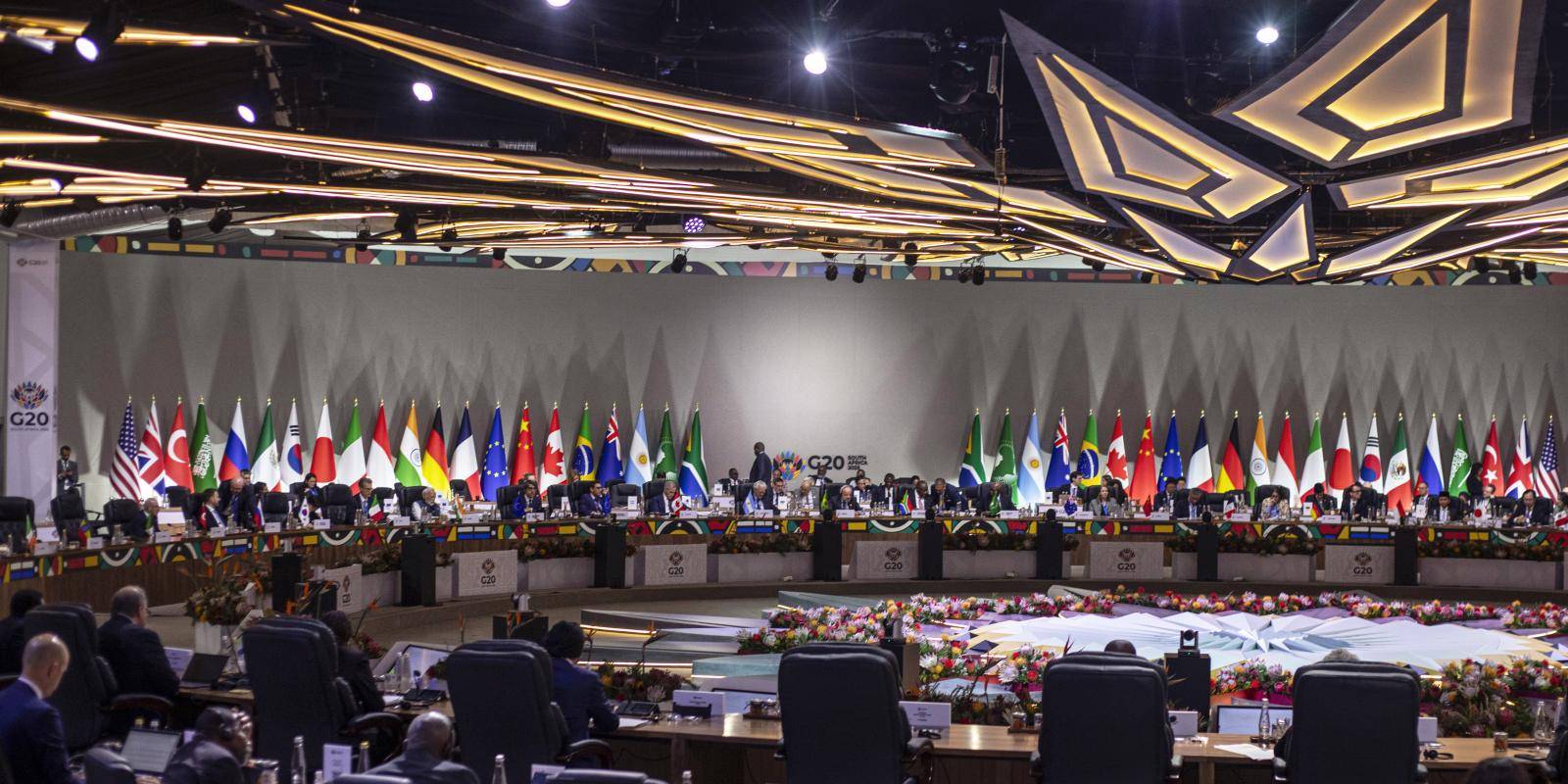
The second strategy for dealing with the Trump administration’s antipathy to climate action has been applied where the US has formally withdrawn from an organization or simply not attended critical meetings. This entails ignoring the US absence and continuing to seek to advance climate action. In the case of the South African G20 summit in November 2025, which Trump refused to attend, the G20 presidency negotiated a statement among those member countries ‘that were present’ reiterating support for climate action and green finance (among other issues). Similarly, the Brazilian presidency of COP30 in 2025 negotiated a declaration that – while disappointing many participants – strongly reasserted the importance of tackling climate change, reasserted the financing commitments made at COP29, and framed the challenge in the context of ensuring social protection and protecting vulnerable communities.
In both instances, President Trump reacted fiercely, and in the case of South Africa the declaration has probably contributed to his unprecedented decision to exclude the country from the US-hosted G20 summit scheduled to be held in Miami in December 2026.
In April 2026, Colombia and the Netherlands co-hosted a free-standing summit, attended by some 57 countries (without the US, China, Russia or Saudi Arabia), which focused on maintaining progress in transitioning away from fossil fuels. This had the advantage of not being part of any formal structure involving the US, making it harder for the administration to interfere in the outcomes or retaliate against those attending.
The demonstration effect of US opposition to climate action and the cover this provides to those who would wish to delay the transition can be strong.
Words clearly matter, and in this respect the second strategy has clear advantages in helping to push back against the development of a false narrative globally, and to oppose the rollback of climate policies and strategies under pressure from the US administration.
However, as can be seen from the nature of debates within the EU on policies such as the phasing-out of hydrocarbon-powered vehicles, or the simplification of sustainability reporting by companies, the demonstration effect of US opposition to climate action and the cover this provides to those who would wish to delay the transition can be strong. So far, EU authorities have made some adjustments but have not fundamentally weakened the framework guiding the impetus for the net zero transition. However, the situation is fragile.
The weakness of both strategies is reflected in the handling of new or emerging issues, such as governance of tools to address ‘climate overshoot’ (that is, the risk of global warming exceeding the 1.5°C target in the Paris Agreement). In particular, the question of how to govern controversial techniques proposed for solar radiation management – the impacts of which would likely transcend borders – urgently needs a cooperative response. Yet the current US administration appears unwilling to address this issue. Even if it were to do so, its approach would likely be clouded by the president’s view that climate change is ‘the greatest con job ever’. At the same time, if the subject were to be tabled in a group like the G7 or G20, the US would be unlikely to remain passive.
3.2 Worldwide energy security
President Trump’s ‘energy dominance’ policy has not been clearly defined by the administration. Nonetheless, it is generally understood to mean making the US a dominant force in global hydrocarbon markets through a mix of domestic deregulation and foreign policy. The goal seems to be to increase US energy security and the US’s ability to leverage fossil fuel exports for geopolitical gain.
In reality, the administration’s actions over the past 16 months or so have led to the sharpest reduction in worldwide energy security – and, linked to that, in the US’s own effective energy security – since the Arab oil embargo of the 1970s.
The most critical step has been Trump’s decision, with Israel, to attack Iran in what has been widely described as a ‘war of choice’. The military operation that began on 28 February 2026 has failed in its apparent objective of triggering a collapse in the Iranian regime, which in turn has responded by attacking the Gulf oil states and closing the Strait of Hormuz through military action and threats. As a result, oil producers in the region have been forced to cut production by more than 14 million barrels a day (b/d), a volume equivalent to nearly 15 per cent of worldwide consumption. Liquefied natural gas (LNG) shipments by Qatar and the UAE have also been cut by 300 million cubic metres per day, equivalent to 20 per cent of worldwide consumption.
In response, crude oil and LNG prices on 15 May had risen by more than 50 per cent since the war started. And a full reversal is unlikely in the near term. Even if the current negotiations maintain a ceasefire and restore reasonably free access through the strait, the threat of sudden closure in the future would remain, adding a risk premium to oil and gas prices. In addition, damaged oil and gas facilities in the Gulf states will take months, and in some cases more than a year, to be fully restored, partially continuing the constraints on supply.
The timing of the UAE’s withdrawal from OPEC on 1 May 2026 was certainly influenced by the war in the Gulf, but the causes pre-dated the US and Israeli attack on Iran. Moreover, it is unclear what the move will mean for the security of oil and gas supplies in the long term, as the prospect of increased supplies of low-cost oil from the UAE may help deter investment in hydrocarbon supplies elsewhere.
Elsewhere, the Trump administration’s actions in Venezuela in removing President Nicolás Maduro and working with his acting successor, Delcy Rodríguez, may eventually increase total world supplies of oil. But given the dilapidated state of Venezuelan oil infrastructure, the impact will only become significant over many years, and only then if energy companies are sufficiently reassured about the long-term security of any potential investments. At the same time, the US administration has stepped up efforts to limit the growth of renewable energy in the domestic US market, seeking instead to redirect investment into hydrocarbons. It has removed subsidies for renewables, attempted to block nearly complete wind farms and maintained the previous administration’s effective ban on low-cost imported EVs from China. In an extraordinary move, the administration recently agreed to pay TotalEnergies, a French multinational energy company, $1 billion to abandon offshore wind projects in the US.
Even when measured against the narrow goal of strengthening US (not global) energy security, these actions have three critical flaws:
Since crude oil and LNG are traded on global markets, the US is just as vulnerable to the price effects of global shortages as many other countries are.
First is the apparent belief that US energy security can be met simply by the US producing enough oil and gas to meet its own demand. Thus, despite US actions being overwhelmingly responsible for the closure of the Strait of Hormuz, President Trump has on more than one occasion argued that the US itself didn’t need the strait to be reopened and that its efforts to do so were a public service to other countries.
However, since crude oil and LNG are traded on global markets, the US is just as vulnerable to the price effects of global shortages as many other countries are. Moreover, even if the administration somehow managed to delink domestic US markets completely from international markets (e.g. by expanding restrictions on US oil and gas exports and by instituting domestic price controls), the US would still face very serious economic consequences because of the way constraints on global oil and gas supplies would affect its main trading partners. Such a delinking would also undermine incentives for energy companies to invest in the US.
Second, the administration apparently believes that private companies will be willing to commit investment (whether in Venezuela or, as was once even implied, in Iran) without a reasonably secure political and legal framework. This fails to understand how multinational energy companies make decisions.
Third, the administration seems determined to ignore the evidence that renewable energy is one of the most cost-effective ways of boosting US energy security for the long term.
Faced with this fundamentally flawed approach, other countries have moved cautiously. Although there was unanimous agreement in March 2026 among the 32 members of the International Energy Agency (IEA), including the US, on the emergency release of 400 million barrels of oil from energy stocks, alignment with the US on other aspects of the policy response has been absent. European NATO members have made clear that they will only become involved in arrangements to reopen the Strait of Hormuz once the fighting has stopped. It also seems likely that the war and the increased long-term risk to Gulf oil and gas supplies will give further impetus to the low-carbon energy transition in many countries. This, of course, will put such countries even more at odds with the US.
3.3 International monetary and financial stability
Several Trump administration policies risk disrupting the international monetary and financial system. These policies have been far-reaching already, although in contrast to the administration’s approach on climate, they reflect no single, well-defined objective and are at times contradictory. Nonetheless, the net effect has been to weaken the system in four critical and closely related areas: protection against risks to financial stability; control of inflation; support for the free movement of capital; and the role of the US dollar as the international reserve currency. This section looks at each of these areas in turn.
The administration’s loosening of prudential regulations that were put in place after the global financial crisis of 2008–09 is expected to reduce US bank capital requirements by some $140 billion and allow as much as $2.6 trillion in extra lending. This opens the way for a repeat of what happened nearly 20 years ago when loose regulation designed to stimulate growth ultimately resulted in disaster. At the same time, the administration has promoted a light-touch regulatory regime designed to encourage the use of crypto assets – in particular, US dollar stablecoins – in the US and abroad. However, the new regulatory regime and the way it is being applied seem set to bring a significant increase in financial risk in the US and potentially abroad. Stablecoin issuers are in many respects like banks, but are not being regulated as strictly as banks. Moreover, special regulatory provisions which might in part justify differences from bank regulation, such as the ban on stablecoins paying a return, are not being enforced. Stablecoins and other crypto assets are also helping to facilitate money laundering and tax evasion. This, together with the administration’s announcement that it will no longer enforce the Foreign Corrupt Practices Act (the precursor for the OECD Anti-Bribery Convention) or rules designed to ensure beneficial-ownership transparency, weakens governance and adds to financial stability risk.
The administration’s rollback of policies for achieving net zero will increase the likelihood of hydrocarbon-based assets being created in the US economy which subsequently become ‘stranded’.
In addition, the administration’s rollback of policies for achieving net zero will increase the likelihood of hydrocarbon-based assets being created in the US economy which subsequently become ‘stranded’ – i.e. value impaired – or that investors will suffer uncovered losses due to extreme weather. Similarly, the US-Israeli war with Iran, if prolonged, can be expected to trigger a sharp increase in financial stability risks: both in the GCC countries (due to the impact on these countries’ ability to export oil and gas), and in consumer nations facing sharply higher energy prices or even a cut-off in supplies.
Trump has increased perceived inflation risk in the US and more widely by repeatedly stating his determination to control Federal Reserve monetary policy and deliver lower interest rates. He appears to believe this will boost the US economy and reduce the cost of servicing the federal debt, and seems little concerned about the long-term impacts on inflation and central bank credibility. From the summer of 2025 onwards, the administration took a series of concrete legal steps that appeared designed to strengthen the president’s influence on the Federal Reserve Board by attempting to remove Lisa Cook and Jerome Powell (the then Fed chair). Both actions were initially stalled in the federal court system, and that against Powell was ultimately dropped to smooth the passage of Kevin Warsh, Trump’s nominee to replace Powell as chair, through the Senate. However, the action against Cook was still pending as of mid-May, while Powell has taken the unusual decision to remain on the Fed’s board after stepping down as chair, an indication of his concerns about the future independence of the central bank.
Fear of inflation has also been increased by the administration’s apparent lack of concern about the current unsustainable path for federal debt. Projections by the non-partisan Congressional Budget Office (CBO) show sustained and growing deficits will – if nothing is done – result in federal debt held by the public reaching 156 per cent of GDP by 2055, with a fiscal deficit of 7.3 per cent of GDP in the same year. The administration’s request for $200 billion in supplemental funding to meet the costs of the war against Iran, and its proposal for a $1.5 trillion national security budget in the 2027 financial year (a 44 per cent increase on the 2026 financial year), add further to general concerns over fiscal sustainability. Meanwhile, in emerging economies, there is serious concern that the administration’s push to encourage the international use of US dollar stablecoins (which Scott Bessent, the Treasury secretary, believes will create additional demand for US Treasury securities) will lead to increased dollarization and reduce the effectiveness of domestic monetary policy.
An increasing number of administration policies are interfering, or threatening to interfere, in the free flow of capital and earnings on capital. This applies not only to flows of funds into and out of the US but also more broadly. For example, the OBBB Act imposes a 1 per cent excise tax on remittances made after 31 December 2025. Another element, known as Section 899, in an early draft of the bill would have imposed taxes on companies originating from countries which the administration determined were discriminating against US companies. This was only dropped after the G7 granted the US an exemption from a previously agreed OECD global minimum tax deal.
The administration is also distorting the way economic and financial sanctions operate, increasing their scope to disrupt global financial flows. Thus, the US has effectively endorsed the authoritarian leadership that for the time being has succeeded Maduro in Venezuela, and eased sanctions to allow Venezuela to sell oil to US companies and on the global market provided the revenues go to an account controlled by the US administration. However, the Venezuelan government’s human rights abuses, the target of the original sanctions, continue. This is not how the sanctions regime was intended to work, and it raises fundamental questions for other countries with sanctions in place on Venezuela as to whether they wish to be part of such a mechanism.
Lastly, there is a concern that the US government might target foreign-owned assets in the US in pursuit of political goals. In August 2025, the administration issued a ‘stop work’ order with respect to the 80 per cent complete Revolution windfarm, part owned by Denmark’s Ørsted. The order, which was publicly justified on national security grounds, was subsequently overturned in federal court. But in so far as the action may have been linked to the US administration’s campaign to take control of Greenland or opposition to net zero, it sets a worrying precedent for foreign investors in the US.
The administration’s overall stance towards the dollar’s dominant role in the global financial system is at best uncertain. Treasury Secretary Bessent has said that the administration favours a strong dollar and supports the currency’s global role, including as the major international reserve asset. However, Stephen Miran, until May 2026 a governor at the Federal Reserve and until September 2025 the chair of the Council of Economic Advisers, argued before the administration took office that the dollar’s reserve asset role placed an unwanted burden on the US economy. More generally, Trump’s willingness to use economic coercion to achieve both political and economic goals is causing other countries to question the international system’s heavy dependence on the dollar. For example, in the event of another global financial crisis, would Trump agree to the Fed providing unlimited dollar swap lines to other major central banks without conditions? And following the precedent set in February 2022 when the G7 froze Russian state assets in response to Russia’s full-scale attack on Ukraine, would Trump be ready to deploy the same instrument but without the justification that the target country had committed a major breach of the UN Charter and without support and parallel action by other convertible-currency issuers?
Both concerns, plus the experience that Trump is generally unconcerned about the longer-term effects of deploying coercive policies, give countries a strong incentive to move away from the dollar as a global reserve asset and denominator for international banking flows. But this is hard to implement because of the underlying attractions of the dollar – although, ironically, Trump’s threats to impose tariffs on countries that reduce their holdings of US dollar assets only serve to strengthen the case for diversification.
The most important risk for international monetary and financial stability, affecting all four areas discussed above, comes from the threat President Trump has made to seize Greenland (the sovereign territory of a NATO ally), refusing to rule out armed force. It is impossible to place a probability on this happening. But, following the events in Venezuela, statements by the administration in the run-up to the World Economic Forum meetings in Davos in early 2026, and the US-Israeli attack on Iran, it is clearly non-zero.
The consequences – both military and economic – of a US attempt to seize Greenland would be seismic. European states would no longer be able to rely on US military commitments under NATO, and would have to move within months to form an independent military alliance. The EU would have little choice but to respond with economic and financial sanctions, both to demonstrate its rejection of US aggression and to limit future exposure to US actions. Sanctions would likely include selling official holdings of US dollar assets. Some experts have argued that the EU would not risk retaliating against the US, given the damage that the US could inflict on the EU in response through its own economic sanctions, including denial of access to dollar clearing. But even if that were the case, or if the split were to be papered over temporarily in some way, European states would want to move as rapidly as possible to limit their exposure to future hostile US actions.
Other countries have so far responded to the administration’s specific measures on monetary and financial stability in a piecemeal fashion. Some are following the US in partially loosening regulation put in place to reduce systemic risks after the 2008–09 global financial crisis, but most governments and regulators outside the US have held the line so far. This could become more difficult if US banks use their increased capital headroom to step up competition internationally. Other major economies have also been more cautious than the US in regulating private crypto assets, while the European Central Bank (ECB) has accelerated its plans to issue a euro-denominated central bank digital currency and has stated (for the first time) that it views positively the development of the euro as an international reserve asset. In January 2026, 11 leading central bank heads made a statement in support of Jerome Powell and Fed independence.
The US dollar’s share of global foreign exchange reserves fell from nearly 60 per cent in 2016 to 46 per cent at the end of 2024, underpinned by rises in holdings of non-traditional reserve currencies and in prices and physical holdings of gold. This trend, particularly the rise in the share of gold in countries’ foreign reserves, has accelerated since the start of President Trump’s second term and seems to reflect a clear desire to diversify away from the dollar. There is further support for this in the way the exchange rate of the dollar has sometimes behaved under the Trump administration. First after the ‘Liberation Day’ tariff hikes of 2 April 2025, and then again during the heightened tension over Greenland in early 2026, the US dollar fell along with US equities and bond prices. Normally one would expect the dollar exchange rate to rise during periods of stress.
The US dollar’s share of global foreign exchange reserves fell from nearly 60 per cent in 2016 to 46 per cent at the end of 2024. This trend seems to reflect a clear desire to diversify away from the dollar.
The French 2026 G7 presidency is seeking to engage the US administration in a discussion about the causes and consequences of rising global economic imbalances. This agenda should in principle provide a forum in which to discuss the implications of all the administration’s actions for international monetary and financial stability. But given Trump’s determination to maintain a historically high degree of protection for the US, and given China’s desire to reduce its own dependence on other countries and increase other countries’ dependence on China, the likelihood of a frank discussion of the subject, let alone a cooperative and mutually beneficial outcome, appears slim.
3.4 International development and poverty reduction
The Trump administration’s wider policies on trade and net zero, and the economic fallout from its attack on Iran, are all hurting (or stand to hurt) low-income countries. In addition, the US has rolled back a wide range of policies which have directly supported international development and poverty reduction over many decades.
Most importantly, the administration has argued that past aid spending has been wasteful and inconsistent with US interests (in part because recipient countries may not support US policies). In response, the US Agency for International Development (USAID) has been shuttered, with its residual security-related functions allocated to other government departments. US international aid, which stood at $60 billion a year before Trump took office, has been cut by almost 40 per cent. Traditional development assistance programmes have been replaced by the much smaller ‘America First Opportunity Fund’ of $2.9 billion a year. Expenditures from this fund must directly advance US economic and national security interests and focus on objectives such as securing critical mineral supply chains, investing in strategic infrastructure, and assisting selected partners where there are clear benefits to US industries or defence planning.
In addition to cutting expenditure, the administration has stopped supporting global standards which help sustain good governance and development in poor countries. As previously mentioned, this includes withdrawing from, or no longer complying with, agreements on global minimum taxes, on prevention of bribery of foreign public officials, and on combating money laundering. The administration has argued that these agreements impose unacceptable regulation on US companies.
The administration’s withdrawal from the World Health Organization (WHO) and international climate change institutions will reduce global resilience and very likely increase the threats from pandemics and extreme weather. The poorest countries are typically the most vulnerable to these threats. Similarly, the administration’s domestic policies on migration have reduced net migration to the US from 2.7 million in 2024 to 1.3 million in 2025. This, combined with the new tax on remittances, will limit a critical safety valve for the poor in developing countries.
In a few areas the administration appears to be maintaining a positive approach to international development. These include efforts to enhance and speed up the G20 ‘common framework’ for negotiating debt relief in countries facing extreme debt distress or default. The US has also not withdrawn from any of the multilateral development banks (MDBs), which continue to contribute to international development, as seen with the World Bank’s new focus on job creation. However, as discussed earlier, the administration is seeking to reduce or eliminate the contribution of MDBs to tackling climate change, arguably the most important threat to poverty reduction.
The Critical Minerals Ministerial organized by the US State Department on 4 February 2026 illustrates the likely shape of the future US approach to international development finance. At the ministerial meeting, the US announced a suite of bilateral memorandums of understanding (MoUs) and public and private financial commitments. While substantial portions of this funding are focused on the US, some of the beneficiaries will be low-income mineral producers. However, there is no mention of safeguarding the environment or governance in these countries. The administration’s overriding goal is to strengthen US security of supply ‘driven by America First values’.
A further example of the evolving US approach to aid is provided by the American AI Exports Program, under which a range of US development finance institutions will provide financing to developing economies to enable the latter to import US-made AI technology. While the initiative has been presented as empowering developing countries to develop their own AI capabilities, it is strongly focused on promoting the US as the ‘undisputed leader in AI’ and on expanding markets for US products. Commentators have already highlighted that use of American AI technology in this way would simply serve to increase US leverage on the importing country in the event of an economic or political dispute.
The response by other countries to the Trump administration’s withdrawal of support for international development has been weaker and less coordinated than their responses in the other three categories of public goods assessed in this chapter. Countries have generally not sought to replace US aid funding. Nearly 150 countries have also granted the US an exemption from the OECD global minimum tax agreement. Fifty-four countries attended the 2026 Critical Minerals Ministerial. However, it is uncertain whether the advanced economies which attended the meeting will ultimately participate in proposed initiatives such as setting a price floor for certain minerals, given the level of trust in the US that this would require. No action has been taken in relation to the US withdrawal from enforcement of anti-corruption laws. However, other countries have not on the whole followed suit, and the UK is hosting a bilateral summit on combating illicit finance in December to shore up support for domestic and international action in this area.
The lack of a concerted international response partly reflects the fact that a number of other advanced-economy donors are also cutting development assistance, although this is typically not because they philosophically reject the importance of spending on international development. The situation also probably reflects unresolved tensions between advanced economies and developing ones over what are reasonable expectations for the levels of official aid to tackle climate change and support the Sustainable Development Goals (SDGs), given low productivity growth and tight fiscal constraints in many advanced economies.
In these circumstances, the response to the following three questions will be critical for the future of international development assistance:
How far will recipient countries be willing to engage with the US’s new aid strategy where financial support is highly conditional, explicitly targeted towards US rather than common interests, and likely to raise the recipient country’s exposure to US economic coercion? The practical responses to the administration’s new critical minerals strategy and AI exports programme will be a key early test.
What is the scope for the rest of the world to improve the effectiveness of the official aid it continues to provide, and to find new sources of aid funding (e.g. from faster-growing emerging economies such as China, India and the Gulf states)?
How will non-US countries deal with competition from US companies that are not required to follow the same global standards as domestic firms on issues such as fighting corruption or payment of tax? Or will US companies continue to maintain such standards even though not forced to do so?