The key to improved veteran services in Ukraine is to make a success of the government’s desired shift from a post-Soviet model of state handouts to a modern, needs-focused system that integrates rehabilitation, targeted support and economic opportunity.
Ukraine faces an unprecedented challenge in caring for its military veterans: it must design and deliver a comprehensive veteran support framework amid huge demographic pressures and fiscal constraints while withstanding a high-intensity war against Russia. Central to this task is the need to overhaul a Soviet-era system of privileges and cash benefits for veterans. Although reform is under way – involving a shift away from a model in which veterans were largely treated as passive benefit recipients to one in which targeted assistance is matched to individual needs, and allied with active promotion of social and economic reintegration – continued work is needed to ensure that veterans receive appropriate support in a fiscally sustainable manner.
The pre-existing model has not only proven ineffective but is also unaffordable given the burden the war has placed on Ukraine’s public finances, and given the certainty that the costs of post-war recovery will be monumental. Continuing to provide veterans with lifelong benefits – including annual cash handouts, utility subsidies and free public transport – would hugely strain the national budget at a time when the country needs to fund the ongoing war effort and plan for economic recovery. Ukraine’s GDP is 21 per cent lower in real terms than in 2021, before Russia’s full-scale invasion. Given its inability to make significant territorial gains, Russia has intensified air attacks on ports, railways, warehouses and steel plants to effectively destroy the Ukrainian economy.
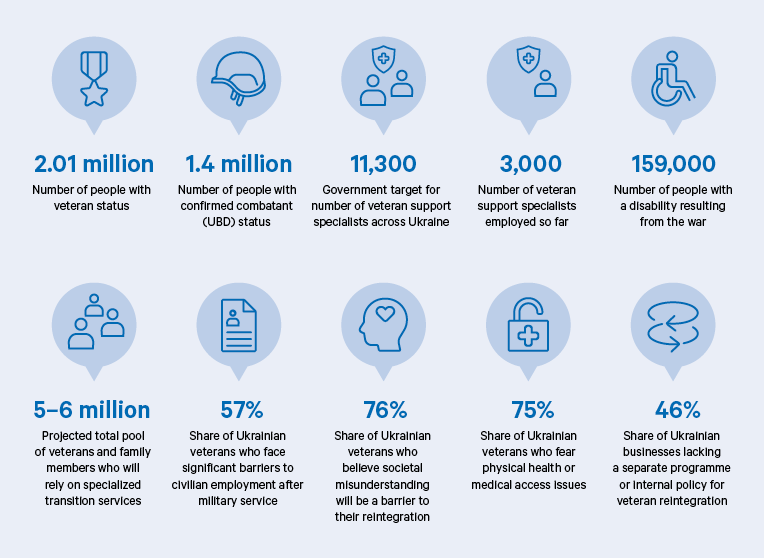
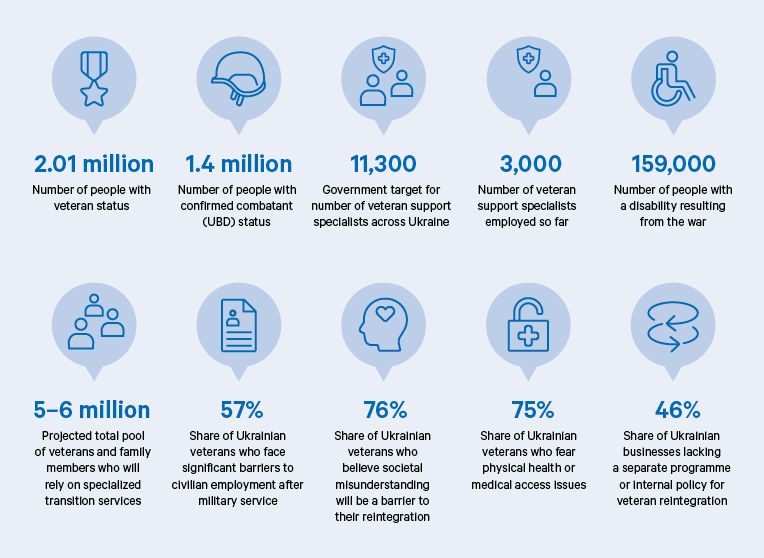
Moreover, the number of veterans and their family members needing support will only grow. As of September 2026, the number of registered veterans had reached over 2 million, with over 1.4 million individuals having confirmed combatant status and more than 159,000 individuals suffering from service-induced disabilities. Projections indicate that upon eventual demobilization, the country will need to support between 5 million and 6 million people – including both veterans and their family members; this number would be equivalent to roughly 15 per cent of Ukraine’s current (greatly reduced) population.
This paper argues that supporting the transition of Ukrainian veterans to civilian life is essential for Ukraine’s long-term economic recovery, social cohesion and national security, and that it will yield significant spillover benefits for Europe as a whole.
In terms of their potential contribution to the economy, returning service members possess critical technical skills, crisis management experience and operational leadership capabilities; they also have skills directly applicable to high-priority sectors such as construction, logistics, energy, engineering, IT and military technology.
Having earned widespread public trust on the battlefield, Ukrainian veterans will also be central to political renewal once martial law ends and democratic processes resume.
On a societal level, facilitating veterans’ successful return to civilian life honours the sacrifices of those who put their lives on hold to defend the nation, and fulfils a crucial moral obligation that will be indispensable to maintaining social cohesion once hostilities end. Having earned widespread public trust on the battlefield, Ukrainian veterans are not only uniquely positioned to spearhead societal demands for political accountability under the current conditions of martial law; they will also be central to political renewal once martial law ends and democratic processes resume.
Structured support for veterans is also critical to Ukraine’s long-term security, as inevitably it will need to be veterans who form the backbone of a highly trained reserve capable of ensuring force rotations in the military and deterring future Russian aggression. Experienced Ukrainian service personnel – whether those in active service or combat veterans – are already utilizing their front-line expertise to train armed forces in NATO countries.
Significantly for the prospects of reforming veteran care, the points outlined above chime with much of the Ukrainian government’s own veterans’ strategy for the period to 2030. The strategy, launched in 2024, includes the following goals:
- Restoring Ukraine’s much-depleted human capital, and boosting the well-being of veterans and their families, by providing veterans with comprehensive physical and psychological rehabilitation, housing support, re-skilling and employment pathways.
- Fostering a culture of honour and respect for defenders of Ukraine by preserving the memory of the fallen and recognizing their contribution to Ukrainian security and society.
- Strengthening national security by integrating veterans into national defence, increasing their civic engagement, and bolstering their contribution to broader societal resilience.
The stakes are high not only because a failed veteran reintegration policy would threaten Ukraine’s own recovery, but also because it would carry consequences for European security. If robust support structures and viable economic prospects are lacking, a sense of marginalization and grievance among Ukrainian veterans is likely to increase. This could create fertile ground for internal polarization, extremist recruitment and Russian destabilization tactics. In a country already facing an existential demographic crisis (with millions of citizens displaced abroad), disillusioned veterans might choose to emigrate upon demobilization. This brain drain would undermine Ukraine’s post-war recovery and give political ammunition to populist forces across the continent.
This paper examines the structural barriers Ukrainian veterans face in their transition to civilian life – including physical and psychological health needs, social stigma, a lack of access to professional up-skilling or retraining resources, and difficulties adjusting to civilian culture – and the ways to address these challenges.
The paper evaluates the current interventions being deployed by different stakeholders: national ministries, regional and local authorities, civil society organizations (CSOs), private businesses and higher educational institutions. Together, these efforts constitute what could be deemed an emerging ‘Ukrainian model’ of veteran reintegration. This model differs significantly from those identified in Europe and other contexts, which often involve professional soldiers returning from overseas combat deployments to peacetime conditions in their home countries. Ukraine’s evolving veteran reintegration model is distinct for four key reasons:
- It is being developed during an ongoing, large-scale, interstate war.
- It anticipates fluid, repeated transitions between military and civilian life, driven by a protracted conflict and the persistent threat from Russia.
- It delivers support services through a cross-sectoral network of state agencies, local communities, private businesses and civil society.
- It operates at an unprecedented scale, offering holistic support that extends beyond veterans to include their families.
In addition, the paper examines the potential risks and benefits for Europe that are contingent on the success or failure of Ukraine’s veteran reintegration policy. Finally, the paper outlines actionable policy recommendations for enhancing coordination among stakeholders and scaling up high-impact programmes of proven benefit. In doing so, the paper seeks to elaborate on the proposed ‘whole-of-society’ approach to Ukrainian recovery articulated in a recent Chatham House Ukraine Forum research paper, published for the 2026 Ukraine Recovery Conference (URC), and addresses in particular how that model can be applied to veteran policy. According to survey results reported in the URC-related paper, 73 per cent of CSOs involved in recovery efforts identify veterans’ reintegration as the top social challenge.
This research draws on 25 semi-structured interviews with Ukrainian national government officials, members of regional and local authorities, civil society leaders, business representatives, healthcare providers, social case managers, and independent experts specializing in the military-to-civilian transition of Ukrainian veterans. Of these, seven interviewees were veterans themselves. The interviews were conducted in Kyiv, Lviv and Gdansk in June 2026, and online in July and August 2026. Bringing together these perspectives helps to illustrate how different stakeholders are already contributing in some ways to a ‘whole-of-society’ approach to veteran care.
However, as the analysis will also make clear, Ukrainian state and non-state actors must coordinate more closely in helping veterans return to communities. According to unpublished data collected as part of the above-mentioned survey of CSOs, 48 per cent of respondents working with veterans and their families rate their collaboration with local authorities positively, but 58 per cent report that civil society remains sidelined in broader recovery planning. In addition, 60 per cent believe that the lack of political will from the top levels of government is one of the main obstacles to strengthening civil society’s engagement in recovery.
While the term ‘reintegration’ appears selectively throughout the text for ease of reference, it is worth emphasizing that the term itself is widely disfavoured in Ukraine, where ‘transition’ [perekhid] or ‘return’ [povernennya] is strongly preferred as a more neutral term. ‘Reintegration’ [reintehratsiya] is seen as problematic because the term can be interpreted, some argue, as placing the burden of adaptation too much on veterans. This in turn can foster the misleading notion that veterans are somehow maladapted to a static, ‘normal’ society, and ignores how war has permanently changed both veterans and the society they have fought to protect. To be successful and fair, the military-to-civilian transition will require adaptation on the part of veterans and wider society alike.
Figure 1 illustrates the scale of this challenge, with data from the Ukrainian government and other public sources.