The state’s attempts to improve, and widen access to, veteran services are complicated by the fact that Ukraine is still at war, by the fiscal and operational challenges of meeting diverse veteran needs, and by insufficient coordination among the many actors with a stake in veteran care.
Ukraine’s veteran policy faces three structural challenges. The first is that unlike in some traditional post-conflict scenarios (in which, for example, US or UK soldiers might return home from combat zones overseas), Ukrainian veterans are not coming back to a peaceful society. They are transitioning back into civilian life within a nation still actively under fire, facing massive infrastructural destruction and deep economic uncertainty.
A ceasefire and negotiated settlement with Russia remain unlikely for the foreseeable future. It is also worth remembering that general demobilization remains formally suspended under martial law, meaning that mobilized personnel face potentially indefinite periods of service. These circumstances are radically different from those sometimes encountered by Western professional militaries, for example, where service members complete deployment rotations in a combat zone, return to a peaceful home base, and are eventually discharged after completing their period of service.
Ukraine’s current military reserve system places a disproportionate burden on combat veterans instead of evenly distributing mobilization duties across the broader eligible population.
Under the current conditions of martial law in Ukraine, an individual’s discharge from active duty does not automatically mean they are retired from military service. The only grounds on which an individual can permanently leave the military include severe medical unfitness/disability or when a person reaches the maximum age limit for service (60 years). Other statutory grounds, such as caring for three or more dependent children under the age of 18 or for disabled relatives, provide conditional discharge from active duty, meaning the individual concerned remains liable for service. Although compulsory mobilization itself applies exclusively to men aged 25 to 60 (for women, military service is strictly voluntary), the above-mentioned rules apply to any man or woman who is already in the military. Under peacetime conditions, Ukrainian service personnel who completed their active duty would simply be discharged into the country’s general reserve. During periods of national crisis or martial law, discharged service members, particularly those with recent combat experience, are automatically enrolled in a high-readiness operational reserve. This allows the Armed Forces of Ukraine to rapidly recall experienced veterans to their assigned units if needed. Given these circumstances, as Ukrainian human rights group Pryncyp puts it, ‘a full transition to civilian life for the majority of those discharged from service is conditional and often temporary’. In other words, Ukraine’s current military reserve system places a disproportionate burden on combat veterans instead of evenly distributing mobilization duties across the broader eligible population. Moreover, veterans are often called back without sufficient time for physical recovery, psychological rehabilitation or readaptation to civilian life. Human rights advocates are calling for structural reforms that would introduce adequate recovery times, legal protections for veterans facing recall, and financial incentives for returning to active duty.
The second challenge is that not all veterans face the same problems after their discharge. While it may be important, from a policymaking point of view, to articulate a relatively standardized indicative model of what a successful transition looks like, a veteran’s path is shaped by their specific military experience and individual attributes. Providing the targeted support strategy this implies is difficult within a severely resource-constrained fiscal environment such as Ukraine’s. The state budget for 2026 allocated UAH 18.9 billion (roughly £315 million) to veteran policy. This represents an increase of UAH 6.3 billion on the allocation in 2025, but still accounts for only 0.4 per cent of the national budget. While additional funding for veteran-related support comes from healthcare, social security and defence budgets, the above figures highlight a stark reality: without sustained international assistance, Ukraine’s domestic financial capabilities cannot meet the immense costs of veteran care and reintegration.
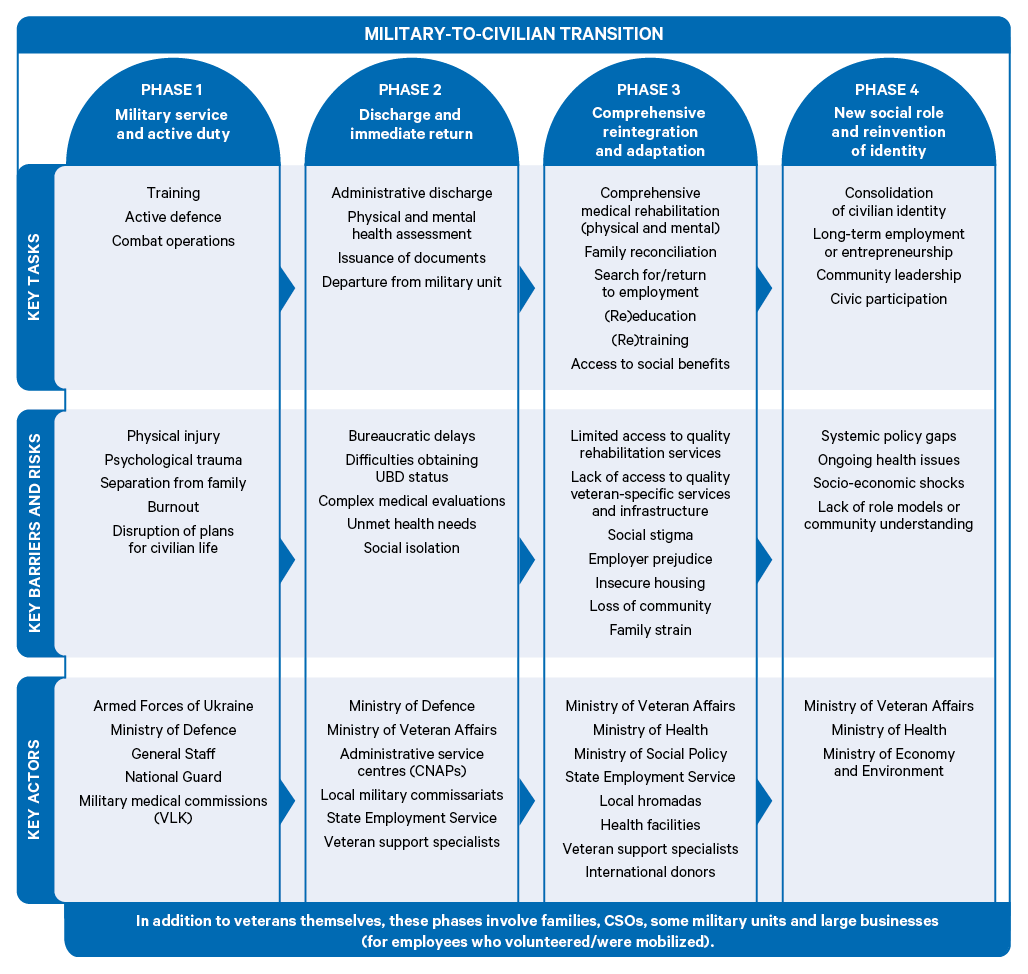
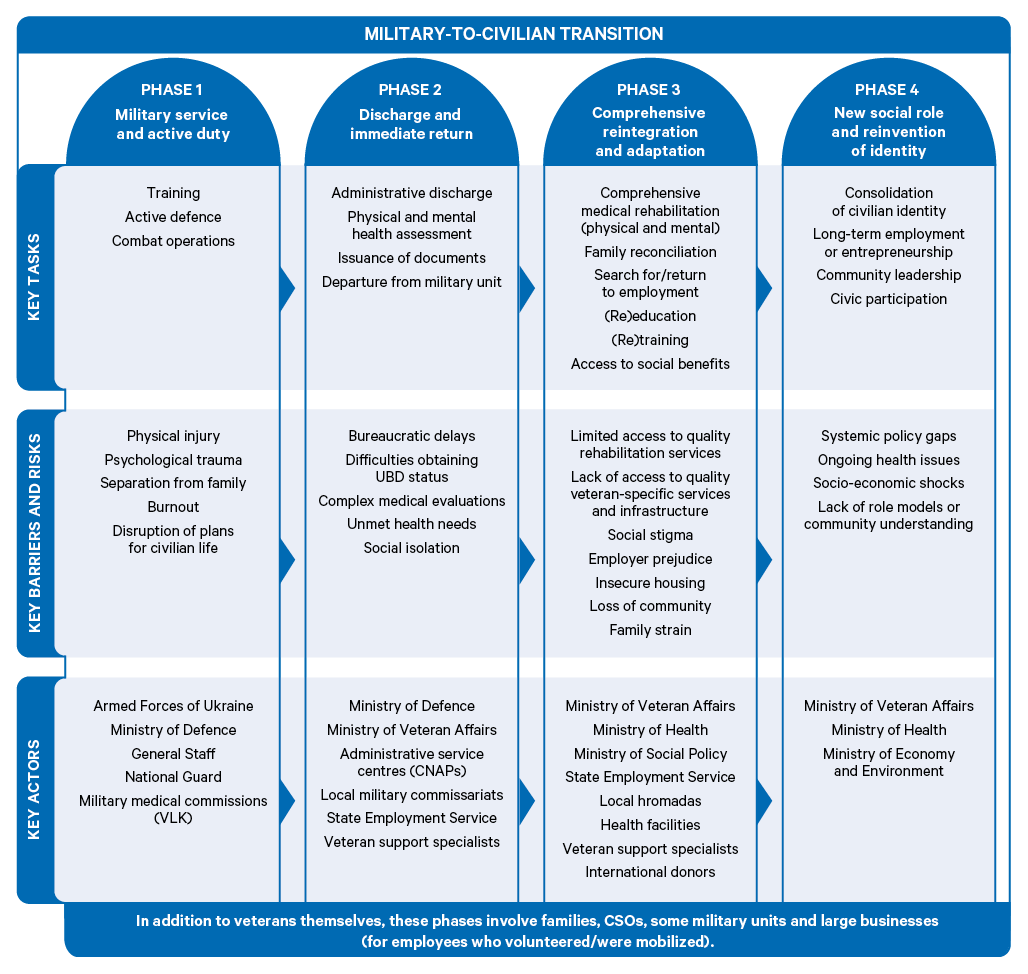
The third structural challenge is that veteran policy is inherently cross-sectoral (touching on medical care, mental health, social benefits, employment, housing, etc.). While the Ministry of Veteran Affairs (MoVA) both coordinates veteran policy and directly implements aspects of it, many of the actual services and resources associated with veteran reintegration fall under the responsibility of other line ministries, primarily the Ministry of Defence (MoD), the Ministry of Social Policy (MoSP), the Ministry of Health (MoH) and the Ministry of Economy and Environment (MoEE). Cross-ministerial (i.e. ‘horizontal’) coordination remains ineffective, negatively impacting policy quality and the overall experience for veterans and their families.
In addition to its coordination role, the MoVA is responsible for overall policy direction, maintaining veteran status registries and overseeing veteran-specific initiatives. The MoD controls medical military commissions (VLK – bodies that assess a person’s fitness for military service), military discharge paperwork and service logs. The MoH manages long-term medical rehabilitation and prosthetics certification. However, prosthetic provision, disability classifications, housing allowances and direct financial assistance are the responsibility of the MoSP. The MoEE leads job-placement incentives, vocational retraining and entrepreneurship grants (e.g. through the eRobota platform).
While the central government sets national policies and statutory benefits, regional and local authorities are tasked with delivering many state-mandated benefits. A key issue is that national legislation sets uniform expectations but overlooks the uneven financial, technical and administrative capacities of different regional centres and hromadas (a Ukrainian term translating roughly as ‘communities’). Larger urban hromadas often have robust budgets, specialized staff and active civil society partners, enabling these administrations to offer comprehensive veteran support. However, smaller, rural communities frequently lack sufficient resources. In addition, municipal budgets in front-line communities have contracted drastically as mass displacement and Russia’s destruction of industrial assets have drained local tax bases. This pattern was also observed in a study by Ukraine’s National Institute for Strategic Studies: despite veteran policy transitioning towards a more structured national framework, policy execution remains highly uneven across communities.
While non-state actors play a vital role in filling capacity gaps and driving service innovation, this loosely structured ecosystem can be confusing for beneficiaries, ultimately leaving successful reintegration to chance rather than institutional design.
Navigating this framework is additionally complicated by the proliferation of services and programmes independently offered by civil society and the private sector. Data collected in March 2026 for the Chatham House survey revealed that 58 per cent of veteran-focused CSOs provide mental health services, while 35 per cent are dedicated to veteran socialization and running community centres. While non-state actors play a vital role in filling capacity gaps and driving service innovation, this loosely structured ecosystem can be confusing for beneficiaries, ultimately leaving successful reintegration to chance rather than institutional design. In a 2025 survey by IREX, a US-based international non-profit organization, 41 per cent of veterans reported being unsure as to which benefits they are entitled to. A further source of confusion is the fact that veterans’ families are not typically categorized as service providers, even though they often assist with paperwork and fulfil care responsibilities.