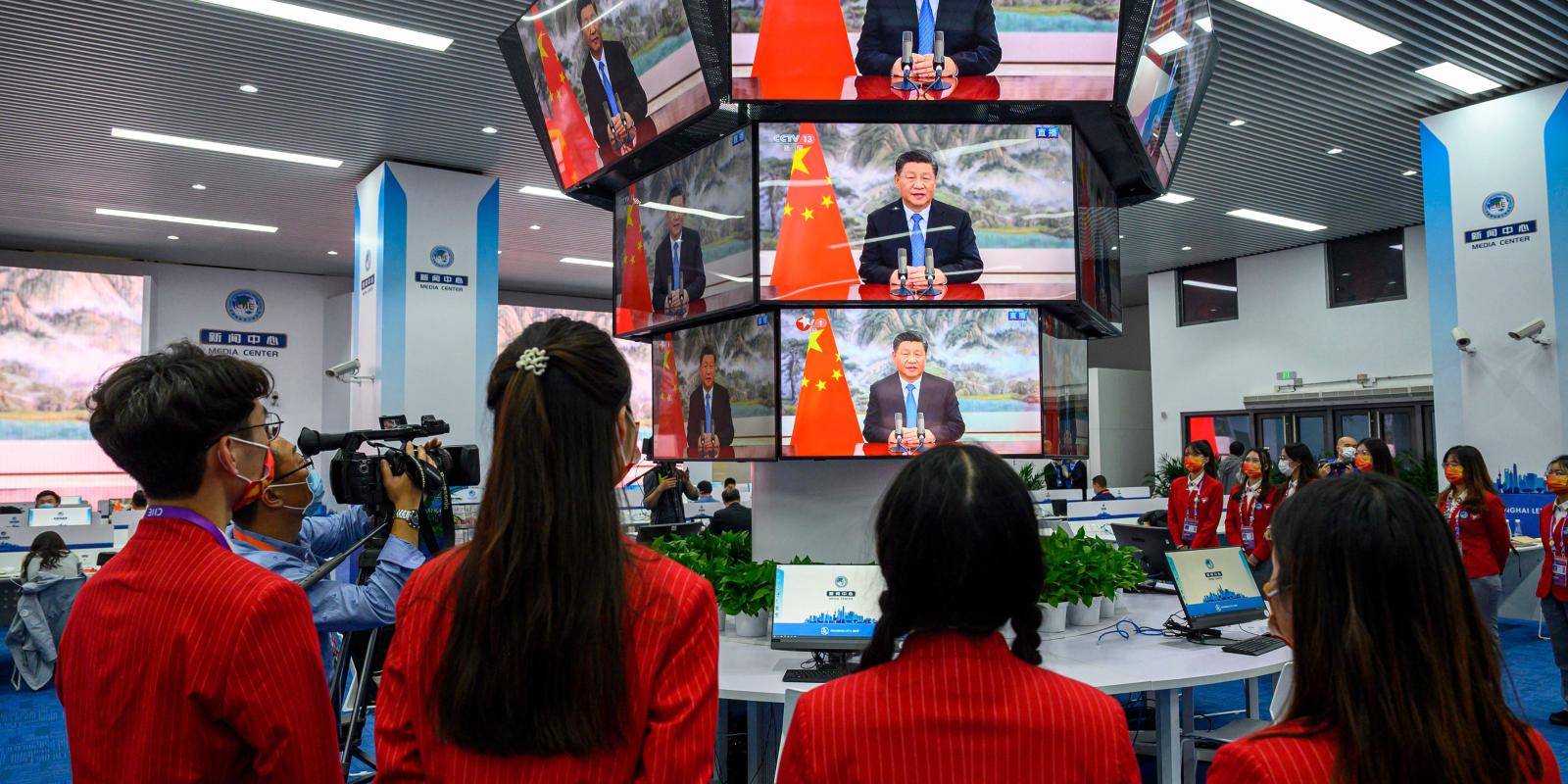

The Five-Year Plan has long been a defining feature of China’s economy. As Beijing prepares to unveil the 15th iteration – its latest roadmap for economic and industrial development, from 2026 to 2030 – the world is watching closely. And with good reason: early indications are that the new plan is breaking with decades-long strategy and taking the world’s second-largest economy in a new direction.
In late October, China’s leadership published the framework for its next Five-Year Plan, which will be formally approved in March 2026 during the National People’s Congress. Reading the document is a formidable task even for native Chinese speakers: its 16,000 words, which spread across 15 chapters and 61 sections, address everything from technological innovation and foreign policy to social welfare.
Global observers may question the usefulness of a detailed blueprint intended to guide a country as large as China for as long as five years. But the Five-Year Plan is far more than a bureaucratic exercise. Since the founding of the People’s Republic in 1949, these plans have served as the bedrock of national policies, outlining how the leadership intends to steer the economy and project China’s power worldwide.
The new plan marks the final consolidation of China’s shift towards making technology the engine of economic growth. Beyond that, its central themes represent a clear break from every plan issued since the era of ‘Reform and Opening Up’ under Deng Xiaoping, which began in 1978. From Deng to President Xi Jinping, the Five-Year Plans have prioritized nominal economic growth. No longer. In the next plan, economic security stands alongside the generation of prosperity as an equal priority.
Beijing has long been worried about China’s dependence on foreign suppliers of high-end technologies, such as semiconductors and aircraft engines – a concern reflected in the plan’s intense focus on related chokepoints. The watchwords that illustrate these new economic priorities are ‘technological self-reliance’ and ‘economic resilience’.
As such, the framework reveals that China’s leadership wants to decisively change how the country grows. It envisions a more resilient economy rooted in domestic innovation and strengthened manufacturing supply chains capable of withstanding, as the proposal puts it, ‘even dangerous storms’. That phrase is striking, reflecting the experience of China’s leadership in dealing with the rollercoaster of US President Donald Trump’s tariff war and his explosive commentary on social media.
Though the framework emphasizes ‘economic security’, it also attempts to address how Beijing may tackle weak consumer confidence and youth unemployment – issues that have held back the economy in recent years. It outlines initiatives to deal with China’s demographic decline and the profound economic effects of its ageing society, though many economists may question how effective these measures may be.
Underlying the new plan is a perennial dilemma: limited resources versus numerous challenges. Policymakers and economists agree that rising household incomes and increasing consumption will accelerate China’s economic growth. The key question is how to stimulate both. China’s leaders aim to elevate China’s per capita GDP, currently $13,800, to the level of a mid-tier developed nation. This Five-Year Plan is intended to act as the booster. To achieve that, the Chinese economy needs to grow at around 5 per cent over the next five years (its GDP growth rate was 5.4 per cent in 2023 and 5 per cent in 2024). Reaching that target will be difficult. China may want advanced manufacturing to power growth, but the big challenge is to do so without strangling wider economic expansion in ways that constrict the wealth of Chinese households.
A manufacturing superpower
The primary aim of the next Five-Year Plan is to make China a global leader in technological innovation by 2030, not only in production but also by defining technological frontiers and standards. Innovation should be widely deployed in advanced manufacturing. As the framework urges, ‘the share of advanced manufacturing in the national economy should be kept at an appropriate level.’
Low-cost manufacturing is now a thing of the past. Instead, Chinese leaders want to see its companies dominate global markets through innovation. The previous plan aimed to secure breakthroughs in sectors such as artificial intelligence (AI), robotics and quantum computing. Over the next five years, Beijing expects its companies to capitalize on those gains by scaling up high-end manufacturing and building integrated industrial systems.
A key phrase throughout the framework is ‘New Quality Productive Force’, coined to describe this shift in Beijing’s industrial strategy. Previous industrial policies largely focused on expanding global market share for China’s own exports. The next plan calls for the government and business to lead industries of the future, such as wider societal applications of AI and low-altitude flight.
To do so will require central government intervention, with capital and policy support for strategic and high-tech sectors. Beijing will continue to pool national resources to advance home-grown success stories, such as the semiconductor sector. It’s worth noting that the framework does not go into detail on the threat of ‘involution’. The term refers to fierce competition among rival manufacturers that leads to price wars and oversupply that hit tech sector profits, forcing some companies to repeatedly turn to state-run banks for bailouts. The framework advises that each province must avoid repetition in industrial sectors.
Another notable phrase is ‘new national system’. This refers to an even stronger centralized control over the allocation of national resources and capital to sectors with strategic significance. As the plan states: ‘We must significantly strengthen our capacity for basic research and original innovation, achieve faster progress in securing breakthroughs in core technologies in key fields, and see that China keeps pace or even leads the way in many more fields.’ Underlying this statement is geopolitics. China’s worsening relations with the West have already restricted its access to markets and new technology. The ‘national system’ is how Beijing hopes to secure home-grown technology advances and the self-reliance they bring despite external constraints.
The balancing act
The challenge for policymakers lies in balancing the drive towards technological self-reliance with job creation and income growth for younger workers who have endured high levels of unemployment since the Covid pandemic. Yet the framework offers little detail on where employment growth will come from.
What does emerge is that Beijing is avoiding conventional western-style stimulus tools, such as consumer subsidies, in favour of a more structural approach – accelerating investment in both digital and physical infrastructure. At first glance, this may look like China’s 4 trillion renminbi (£426 billion) stimulus programme following the 2008 financial crisis. But this time, the intent appears more targeted. The idea is that infrastructure spending won’t just stabilize growth, it will also improve household incomes thanks to job creation and rising salaries.
Much of this investment will prioritize social and public infrastructure for the benefit of the population, such as upgrading mobile phone connectivity and improving utility networks in cities. This change will probably require central and provincial governments to redirect fiscal resources towards sectors that can replace employment lost in the struggling property and service sectors.
Notably, Beijing is also opening infrastructure investment to private companies – a sector once reserved for state-owned firms. If private firms find these projects financially viable, they could stimulate job growth and broaden participation in national development. The framework also highlights the ‘AI Plus’ initiative, which aims to integrate AI into all facets of the economy and social governance. This may foster new job opportunities for AI engineers, data specialists and content creators. But a crucial question remains: will these new jobs match the skill sets of China’s young workforce? The push towards high-tech specialization risks leaving behind workers whose skills were developed for the property and service sectors.
Another recommendation suggests that AI could be a tool for the care of the elderly. But this addresses only one symptom of China’s ageing population. Regarding population decline, the framework hints only vaguely at incentives for young couples to have more children and improved maternity provision and job security.
Beijing appears aware of these tensions. Its renewed emphasis on ‘common prosperity’, first introduced in 2021, underscores a continued focus on social stability and equitable growth. Whether the expansion of infrastructure spending and digital capability can improve job prospects remains uncertain, but the approach is more socially conscious than that of the previous Five-Year Plan. One thing is clear: this new plan is not being crafted to fit into western economic theories. It reflects China’s own priorities and pace – an inward-looking strategy designed to secure its economic future on its own terms.
Economic change and political jeopardy
China’s trade battles with the United States and Europe continue, yet Beijing has shown how its integrated manufacturing base and near-monopoly over critical minerals give it clout in negotiations. The forthcoming Five-Year Plan appears ready to formalize this approach into a strategy for managing what Beijing calls its ‘great-power competition’ with Washington.