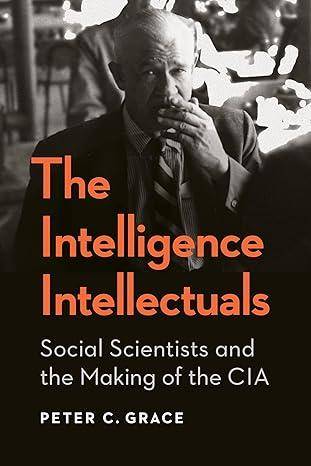
The Intelligence Intellectuals: Social Scientists and the Making of the CIA
By Peter C Grace, Georgetown University Press, £32
Popular culture often portrays intelligence work as daring espionage, but Peter Grace reminds us that the real business of intelligence is thinking. The Intelligence Intellectuals explores how the CIA transformed its approach to intelligence analysis in its early Cold War years. Not long after its formation in 1947, the CIA faced criticism of ‘intelligence failures’ following the Soviet Union’s atomic test, the Communist takeover of China and the outbreak of the Korean War. These setbacks exposed not just limitations in the intelligence that could be collected, but weaknesses in how it was analysed.
Grace shows how CIA director Walter Bedell Smith responded by turning to leading US social academics – historians, economists and political thinkers – to strengthen the agency’s analytical capabilities. In a book ‘rich in biographical detail’, Grace explores how figures such as William Langer, Sherman Kent and Max Millikan helped transform intelligence analysis into a rigorous, methodical profession, introducing precise language, structured reasoning and new ways of assessing closed societies such as the Soviet Union. The book highlights how this ‘social science turn’ reshaped modern intelligence work. For reviewer Dan Lomas, Grace’s ‘fascinating, and highly readable’ study offers a timely reminder that open‑minded thinking and intellectual diversity are vital to national security.
The full review appears in the May 2026 issue of ‘International Affairs’.
Iran’s Grand Strategy: A Political History
By Vali Nasr, Princeton University Press £30
Written before the 2026 Iran war, Vali Nasr’s Iran’s Grand Strategy nevertheless anticipates many of the current themes around Iran. Nasr explores how Iranian strategy is shaped by its history, resulting in protectionist fears of foreign interference combined with a desire to expand its influence. Nasr insists on ‘taking Iranian strategic discourse seriously on its own terms’ which helps to explain some of the nuances of Iranian foreign policy which may seem contradictory at first. As reviewer James Denselow concludes, this significant contribution offers ‘a framework for understanding Iranian behaviour that moves beyond caricature without lapsing into apology’.
The full review appears in the May 2026 issue of ‘International Affairs’.
War in the Smartphone Age: Conflict, Connectivity and the Crises at our Fingertips
By Matthew Ford, C Hurst & Co £22
‘How has the smartphone changed the game in modern warfare?’ This is the central question Chatham House’s Aroni Sarkar identifies in her review of Matthew Ford’s book. Ford uses case studies from Ukraine, Africa and the Middle East to show how smartphones have fundamentally transformed our perceptions of war through oversaturation on social media, and how warfare is actually conducted. Ford introduces the idea of ‘the stack’; a layered, global communications architecture which leads to increasingly automated forms of warfare. Drawing on real‑world examples, Ford raises urgent ethical, legal and accountability questions, making this a ‘captivating read’.
The full reviewin the May 2026 issue of ‘International Affairs’.
Ecocide in Ukraine: The Environmental Cost of Russia’s War
By Darya Tsymbalyuk, Polity £16.99
Darya Tsymbalyuk carefully documents the environmental devastation resulting from Russia’s invasion of Ukraine. From the destruction of dams and farmland to the damage inflicted on animals and ecosystems, Tsymbalyuk uses interviews and personal reflections to offer ‘an account of the Ukrainian war that emphasizes the effect of the conflict on all sentient beings’. In his review, James Cullis notes that by aligning the concept of ‘ecocide’ with Ukrainian law, the book ‘forces the reader to confront questions of responsibility, and accountability’. Tsymbalyuk shows how the full damage of war unfolds slowly, which has direct implications for post‑conflict recovery.
The full review appears in the May 2026 issue of ‘International Affairs’.