The United States and Iran have announced a deal to end the war and open the Strait of Hormuz. It is expected to be signed in Switzerland on Friday. The text of the agreement has yet to be published, but it’s thought that both sides are extending the ceasefire agreed in April for 60 days, during which time Washington and Tehran will commit to further talks.
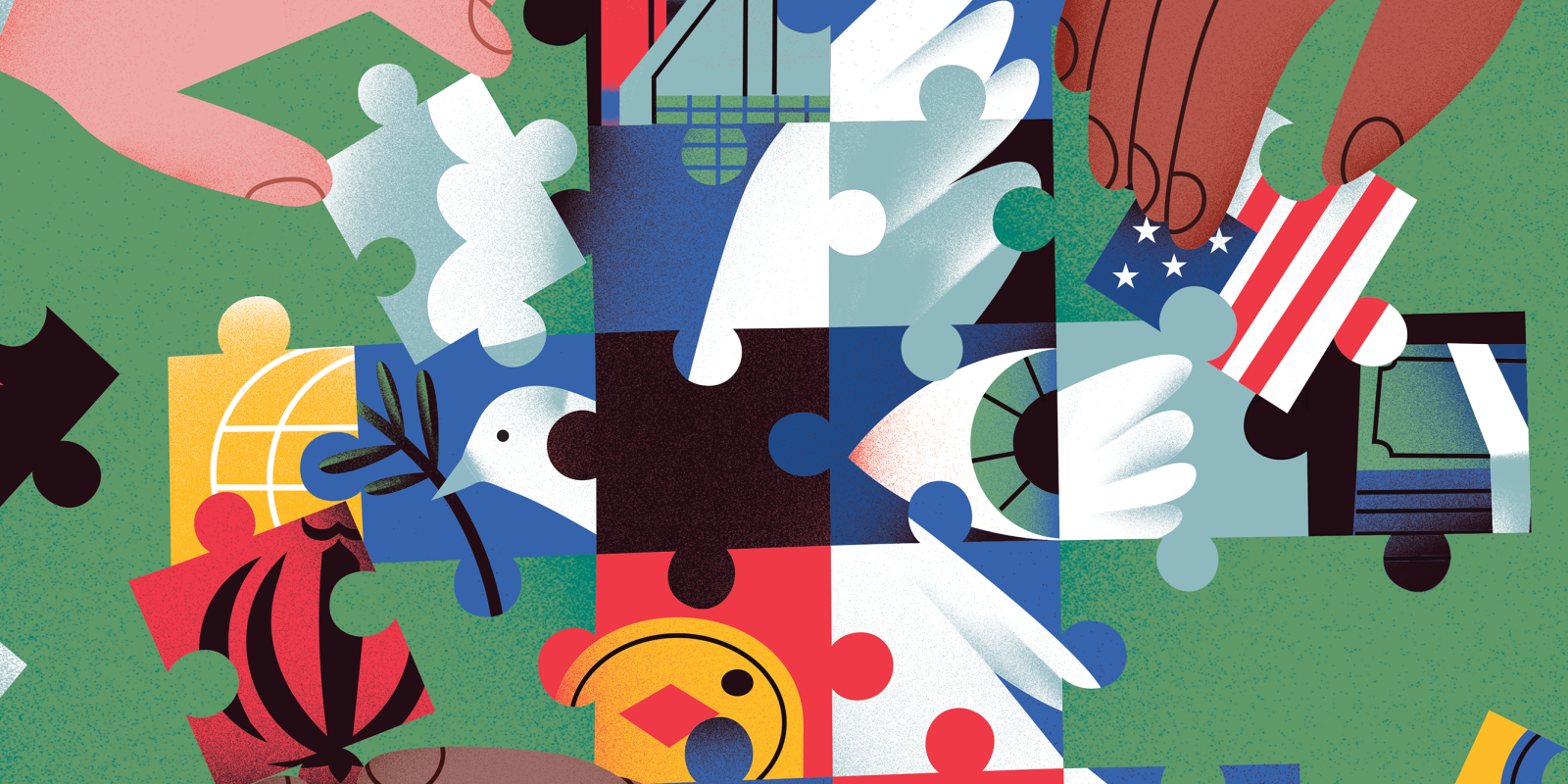
The announcement is a step forward. Nevertheless, much remains unclear. The pieces of the jigsaw puzzle that could end the US–Israel war with Iran remain scattered. Put together properly, the shape and size of each piece matters less than the picture they form, showing that major issues have been resolved, with no gaps. But pulling the pieces together to turn the deal announced over the weekend into one that lasts requires all participants to know what they are trying to achieve. Uncertainty about the reasons for the war in the first place, combined with a lack of clarity or consistency about its objectives, makes this more difficult.
On the crucial points of Iran’s nuclear programme and its ability to develop nuclear weaponry – issues repeatedly prioritized by US president Donald Trump and Israeli prime minister Benjamin Netanyahu – there are indications that these will be discussed as part of the framework agreement.
Nuclear negotiations
That last, important piece of the puzzle was central to Joint Comprehensive Plan of Action (JCPOA) negotiations that I chaired between 2009 and 2014 as foreign policy chief of the European Union, on behalf of the United Nations. The team of six nations – China, Russia, the United States, France and Britain, along with Germany – had one objective in their talks with Iran: to give confidence in the purely peaceful nature of Tehran’s nuclear programme. Other issues, from human rights to the role of Iran’s proxies, important as they were, could be dealt with later. (They weren’t.)
Our jigsaw puzzle had to show that Iran was not building a nuclear bomb. The JCPOA was finally agreed in 2015, and it worked – until President Trump in 2018, during his first administration, decided it was insufficient and effectively killed it. In this new jigsaw puzzle, putting the pieces together must begin from the answer to a fundamental question – which objectives for this war, that began on 28 February, are to be satisfied by a lasting deal?
The most obvious answer now is to open the Strait of Hormuz fully and get supplies moving. This conflict has had a global impact, requiring urgent action if the consequences are not to cause greater hardship, rising prices and shortages. It’s to be welcomed that the framework agreement focuses on reopening the strait. Yet its closure was a consequence of the war, not its cause. So, resolving it does not get to the heart of what the war has been about.
Proposals between the US and Iran have been scornfully rejected by one or the other as unrealistic or insignificant or both, leaving a nervous world looking on. It is vital for both sides to agree what puzzle pieces will form an agreement that develops into a lasting accord, and for Israel to accept the result. Otherwise, any deal will be at best fragile, or at worst impossible.
The ‘no surprises round’
A crucial aspect of the talks that led to the JCPOA was the ‘no surprises round’. This enabled progress from the interim Joint Plan of Action agreement in 2013, to the final JCPOA deal, allowing us to add that all-important adjective ‘comprehensive’ two years later.
The team laid out exactly what issues were to be discussed: from stockpiles of enriched uranium to Arak, the heavy water reactor, and from sanctions relief to repatriation of seized funds. Iran at the beginning did not have to agree even that they were prepared to talk about the issues. But they had to understand that without some recognition of the issues, there was no possibility of a final agreement.
As importantly, the list of issues was complete. There would be no surprises: neither side would suddenly raise a new issue. The Iranian team could calibrate their response – or offers – knowing exactly what areas we were going to need them to respond to. This helped with the laborious task of building trust – in stark contrast to today’s deep levels of suspicion on both sides. We succeeded through painstaking, detailed work around specifics that put the puzzle together. Getting a lasting peace from the current negotiations will require the same. In a good outcome, both sides get what they need – not everything they want.
One of the ‘surprises’ that may make negotiations difficult is the role of Israel. Arguably, Netanyahu’s objectives are different to Trump’s. He has long wanted to see the role of Iran downgraded to the point where it is incapable of looking outward and causing any kind of regional mayhem, especially that directed at Israel. In Trump he has found someone willing to back this ambition. As long as the war lasts, Netanyahu hopes to keep US support, allowing him to deal with Hezbollah in Lebanon and cause as much damage as possible in Iran.
However, the assassinations of significant numbers of potential Iranian leaders in the first instance have not helped. One, Ali Larijani, who served as secretary of Iran’s Supreme National Security Council, could have been a hardline but pragmatic interlocutor for the Americans. Instead, Iran is left with equally hardline but unknown and less experienced leaders.
The exception is the foreign minister, Abbas Araghchi, known to the international community as the deputy chief negotiator of the JCPOA. His apparent removal from any ‘kill’ list has allowed him to come forward and lead on negotiations, although the conduct of these discussions will be unlike anything he has experienced in the past.
It is important to be able to engage with interlocutors willing and able to take up the serious, detailed discussions necessary to get to a deal. Based on previous experience, Araghchi and some of the team around him know how to do this. How much flexibility they might have in their negotiating positions remains to be seen.
Whereas the JCPOA was conducted by the five permanent members of the UN Security Council and Germany, so far major discussions have been between the US and Iran, with Israel watching closely. Of course, this reflects the nature of the war; but the longer-term solutions, especially for traffic in the Strait of Hormuz, require a regional response at least. The talks need to be conducted in a way that generates confidence that the deal will hold. The failure of the JCPOA showed that fragility is not always in the agreement itself, but in the politics that surround it. That is just as true for Iran, Israel or the region as it is for the US.
The new ‘yachts’
While the UN and Europe languish on the sidelines, despite their critical roles in previous crises, new informal groupings come to the fore to solve problems that confront them. The engagement of Pakistan as mediator and host has been significant as part of a new quartet with Egypt, Turkey and Saudi Arabia – it was Islamabad that announced the framework agreement at the weekend. Excited media have pointed to Pakistan’s nuclear weapon capacity, Egypt’s control of the Suez Canal, Saudi’s energy reserves and Turkey’s growing political strength.
Whatever influence these countries have, they are using well-trodden methods such as bringing both sides together on ‘trusted’ territory to thrash out their problems. The durability of their efforts will depend on whether they can put a few jigsaw pieces together to show progress.
These new ‘yachts’ move faster than the old style ‘tankers’ of international diplomacy. However, their ability to keep moving in the same direction will be sorely tested if negotiations drag on. They will also have to decide on who the guardians of the outcome are. To whom will the responsibility to police, support, pressure or sanction fall? The US no longer wants to be the world’s policeman, and for many would be unacceptable. So, if the old structures are not supported, how will long-term, painstaking diplomatic efforts be managed?
While the neighbours deliberate, Trump’s meeting with President Xi Jinping in May focused on what China might do. Following that meeting, China’s foreign ministry issued a statement on social media emphasizing that ‘dialogue and negotiation is the right way forward, and the use of force is a dead end’.
Don’t ignore China
In all the discussions on the JCPOA, the role of China is often ignored. I found it to be important. China participated in every meeting over the years it took to get a deal, was prepared to lead on difficult areas and did not push hard on a future role. How might a long-lasting, robust deal come about? Although Trump has no time for the JCPOA outcomes, its process offers clues. Vital though the US and its brilliant team were to the 2015 deal, it was a group effort. The six nations stuck together through it all and the EU provided the glue.
Europe might play a role once again, either through the EU or with the E3 – France, Germany and the UK – or both. There are people who have extensive knowledge of talking to Iran, how to make proposals and how to challenge ideas. If nothing else, European diplomats could help set the backdrop to serious discussions. It is clear that the American and Iranian negotiators are bemused by each other, struggling to understand what is being offered or refused, nor capturing what they have agreed or talked about – witness the differing interpretations of whether Israel’s war in Lebanon was included in the April ceasefire.
The question of how much enrichment of its uranium, if any, Iran should be allowed will be tricky. Netanyahu has long held the view there should be no enrichment of any kind, while Iran will argue for some capability for energy and medical purposes, as they were given under the JCPOA.
Reports on the effects of the bombing in June 2025 suggest Iran is a long way off being able to put back together its nuclear sites and to move towards the 90 per cent enrichment required for weapon capability. From there it is still a journey to a fully armed missile, ready to launch – especially without being noticed.
My experience leads me to believe that the only way to approach the broader deal is to get confidence-building measures under way. The apparent willingness by the US and Iran, as reflected in the framework agreement, to reopen the Strait of Hormuz safely for ships and cease military hostilities are steps in the right direction. In other words, get a few pieces of the jigsaw in place, show how they fit together and assess what that means for the broader picture. In diplomatic language – drip, drip, drip.
What it means for the ‘tankers’
What does this fractured diplomatic process mean for the ‘tankers’, the major organizations of the world based on deep, long-term commitments? The UN has been struggling for years, accused of a bloated bureaucracy, buffeted by threats of withheld funds, dominated by an outdated structure. Its failures to resolve the conflicts in the Middle East, Ukraine or Sudan have left it on the sidelines.