Gulf states can contain the threat from Iran and Israel. But they’ll need help

The Iran war and its prelude have confirmed for GCC countries that they are in the crosshairs of their volatile neighbours. Yet with global support, Gulf allies can build a security architecture to protect their transforming economies, writes Rashid Al-Mohanadi.

The World Today

Published 15 June 2026

Updated 17 June 2026 — 4 minute READ

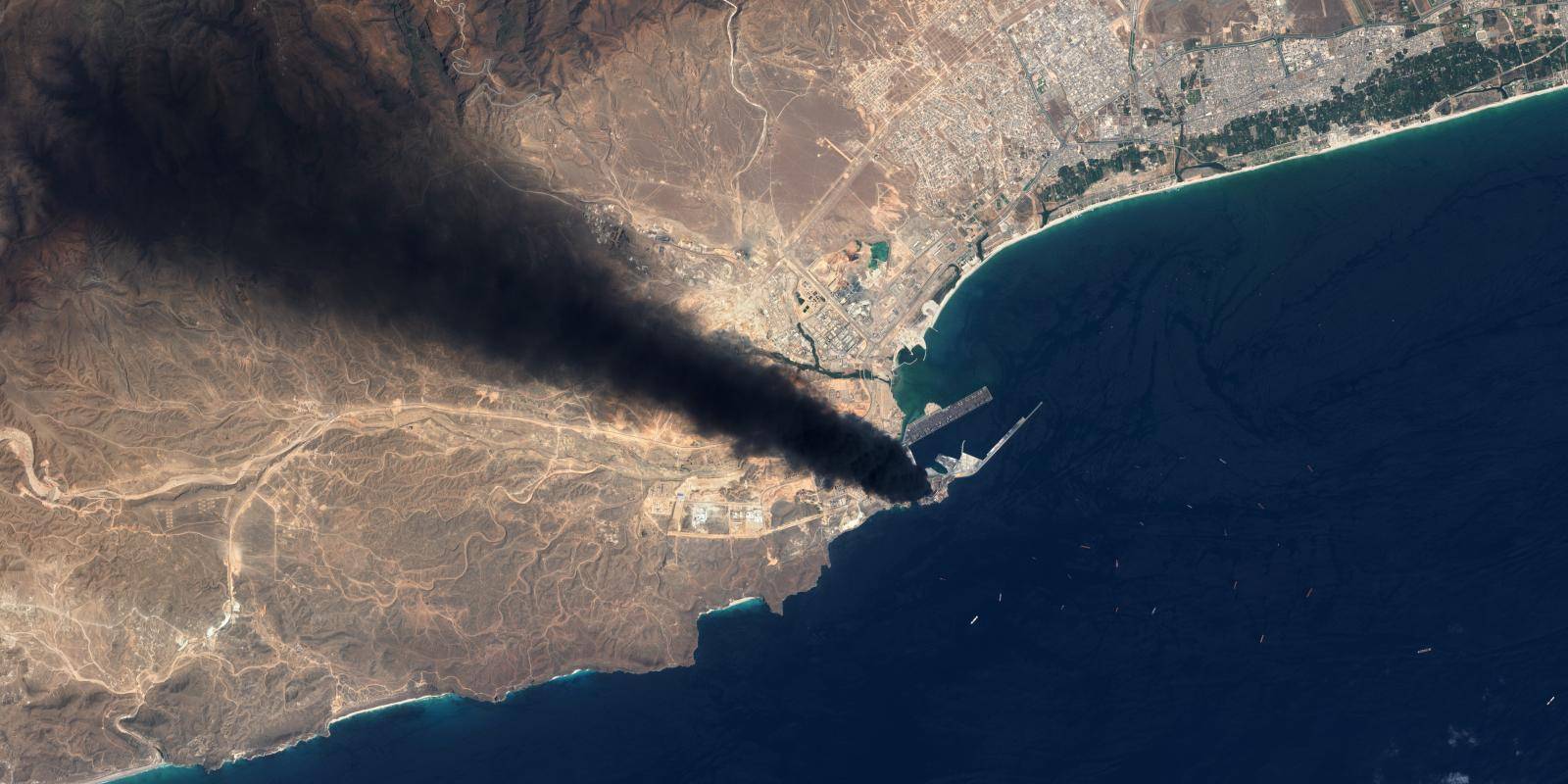
Image — A major fire erupts at the Port of Salalah oil storage tanks in Oman, after an Iranian drone strike on 11 March 2026. Photo: Gallo Images/Orbital Horizon/Copernicus Sentinel Data 2026.

Rashid Al-Mohanadi

Vice President, Center for International Policy Research

In 2019, swarms of drones and cruise missiles struck vital energy facilities in Saudi Arabia, temporarily halting a large part of the kingdom’s oil production and sending shockwaves through energy markets. Tehran denied direct involvement, but the geopolitical reality was undeniable.

Fast forward to June 2025: after a series of US military strikes on Iranian nuclear sites, Tehran launched a barrage of missiles at Qatar, most intercepted by Qatar’s integrated air and missile defence systems. Iran framed this as a measured, coordinated exchange. The Qatari government – whose sovereign territory was targeted – fundamentally disagreed.

That year brought another unprecedented escalation. In September, Israel conducted its first-ever direct military attack on a Gulf capital, striking a residential neighbourhood in Doha, Qatar, in an attempt to derail President Donald Trump’s emerging peace initiative for Gaza and killing a young Qatari officer. Then, in February 2026, after the collapse of negotiations and the eruption of a broader US–Israel military campaign against Iran, Tehran unleashed missile and drone attacks across all Gulf Cooperation Council (GCC) states and Jordan.

Iran and Israel each operate on the conviction that security can only be achieved through the subordination of its neighbours.

An instinct persists in western policy circles to view the Middle East in terms of an irreconcilable Iran–Israel rivalry. Such a reading obscures a profound and dangerous similarity between them. Beneath their mutual hostility, Iran and Israel share a foundational logic: however their public statements differ, each has concluded that its survival cannot be guaranteed through regional integration, diplomatic accommodation or collective security. 

Instead, each operates on the conviction that security can only be achieved through regional hegemony and the subordination of its neighbours. Such a zero-sum pursuit has generated systemic instability across the region. More critically, it has placed the Gulf states in the crosshairs of both Israeli and Iranian adventurism. The time has come for a fundamental review of how the Gulf and its global partners engage with these two disruptive powers.

Shared strategic endgames 

Iran and Israel share a strategic endgame, and though their operational methods differ, both inevitably sow chaos. Israel relies on unilateral, overwhelming military action, shielded by unconditional diplomatic and military backing from the US. This insulates Israel from international accountability, rendering UN Security Council resolutions toothless even amid violations of international humanitarian law.

Yet this architecture of impunity faced a severe test in September 2025. When Israel’s strike on Doha killed a young Qatari security officer and incinerated the pending Gaza peace plan, Washington was forced to respond. The administration took unprecedented punitive action against the government of Benjamin Netanyahu, compelling a formal apology to Qatar. Crucially, the crisis also produced a historic executive order guaranteeing Qatari security, a commitment akin to a NATO Article 5 clause.

Iran, by contrast, pursues hegemony through asymmetric instruments designed to maximize plausible deniability and externalize costs. Where Israel relies on direct state action, Iran has spent decades cultivating an expansive proxy network: Hezbollah in Lebanon, the Houthis in Yemen, the Popular Mobilization Forces in Iraq to name a few. It has concentrated its military investment on stand-off offensive capabilities, namely ballistic missiles and drone swarms, while deliberately under-investing in conventional defence and supporting spy cells within neighbouring states for espionage and sabotage.

Iran’s overarching strategy is extortion: raising the cost of escalation to intolerable levels. This was glaringly evident during the aggression of February to April 2026. Despite the GCC actively mediating and making clear that Gulf airspace, land and maritime areas would not be used for offensive operations against Iran, Tehran launched widespread strikes.

Iran claimed these targeted American military interests, yet the majority targeting Qatar struck civilian infrastructure and sovereign economic sectors. The Ras Laffan energy facilities were hit on 2 March, even before Israel struck fuel tanks in Tehran. Few munitions were aimed at the US presence at Al-Udeid Air Base. According to the Qatari government, roughly two-thirds of attacks targeted civilian sites.

Beyond inflicting damage on the Arab Gulf states, Iran aimed to manufacture a global economic crisis. By weaponizing Gulf energy infrastructure and the Strait of Hormuz, Tehran hoped to frighten international markets and coerce Gulf states into forcing Washington to halt its campaign. The strategy failed because Iran under-estimated Gulf resilience.

Iran’s most effective tactic was using asymmetric and conventional capabilities to dissuade commercial shipping from sailing through the Strait of Hormuz. Whatever the outcome of attempts to reopen the strait, preventing future attempts to deny the free navigation of this waterway must become an urgent priority of Gulf states with international partners.

Gulf states’ positive-sum paradigm

The regional instability caused by Israel and Iran poses a challenge to the Gulf states, because the GCC operates on a different strategic paradigm. Rather than acting as zero-sum security maximizers, GCC members are focused on prioritizing development, diversification, open trade routes, stable energy flows and regional predictability.

The doctrine underlying Gulf strategy is that stability is a multiplier. This drives Saudi Arabia’s investments under Vision 2030, Qatar’s mediation networks and UAE negotiation efforts in Russia and Ukraine. The Gulf believes regional problems can be managed through dialogue and that prosperity is best secured when shared. The UAE’s exit from OPEC in May doesn’t necessarily undermine this. What matters is that differences in economic priorities across the region don’t jeopardize core commitments to collective security.

The doctrine underlying Gulf strategy is that stability is a multiplier, not a scarce resource.

To foster such stability, the Gulf, for decades, tried to accommodate Israel and Iran. In the 1990s, Qatar opened an Israeli commercial office in Doha. In the 2000s, Saudi Arabia championed the comprehensive Arab Peace Initiative. More recently, the UAE and Bahrain signed the Abraham Accords, hoping to halt the Israeli annexation of the West Bank. With regard to Iran, Saudi Arabia restored diplomatic ties via Chinese mediation in 2023, while Qatar brokered ceasefires between Israel and Hamas in Gaza and Israel and Iran last June.

Yet leaders in both Israel and Iran view the Gulf states’ positive-sum logic not as a pragmatic virtue but as naive vulnerability. Every attempt at accommodation has been met with adventurism. Israel bypassed the Arab Peace Initiative, proceeded with de facto annexation of Gaza, and later bombed a mediating capital. Iran exploited the diplomatic platforms provided by Doha, only to launch hundreds of missiles at Qatari civilian infrastructure the moment a broader conflict erupted.

content continued

The lesson of the past decade is not that the Gulf’s diplomacy was flawed. Qatari mediation has alleviated suffering across Palestine, Iran and Israel, often preventing wider catastrophes. The lesson is that when rogue actors reject collective security, the strategy for managing them must evolve. Accommodation alone is insufficient, and often dangerous, against actors who use peace-seeking states as platforms for proxy warfare or diplomatic cover.

Accommodation is not enough

The Gulf states must therefore move from reactive accommodation to the building of a robust architecture. Militarily, this requires accelerating GCC defence integration, enhancing real-time intelligence sharing and ensuring interoperability. The repulsion of the recent strikes validated a doctrine of ‘defensive denial’, rendering adversary strikes politically and militarily futile. By denying hegemons the ability to achieve their ends through force, the Gulf states contained the fallout. Nevertheless, the Gulf’s unwillingness to use force to secure the Strait of Hormuz revealed a limitation; a joint force could neutralize Iranian capabilities in the strait, yet the Gulf states chose restraint to avoid escalation during the most intensive phases of the conflict.

The lesson is that when rogue actors reject collective security, the strategy for managing them must evolve.

Diplomatically, the GCC must institutionalize this containment while shifting to strictly conditional engagement. With regard to Iran, the GCC must establish red lines on proxy support and military programmes, with economic incentives tied to verifiable de-escalation, including investment that creates energy interdependence in the energy sector. As for Israel, the GCC should manage exposure by leveraging its relationships with Washington and European capitals. Because Israel depends on the US for its military edge and Europe for its economic vitality, the GCC must insist that these partners establish guardrails around Israeli actions, including commitments not to conduct unilateral military action without regional consultation, and not to support non-state armed actors.

The Gulf states did not choose the volatile environment they inhabit, nor did they invite the chaos sown by their neighbours. But survival requires acknowledging reality. Diplomatic accommodation must remain a tool but one extended only to parties willing to reciprocate. For those committed to regional dominance at the expense of stability, a unified, proactive and defensively unassailable Gulf architecture is the only viable path forward.

To read more from the summer issue of The World Today click here.