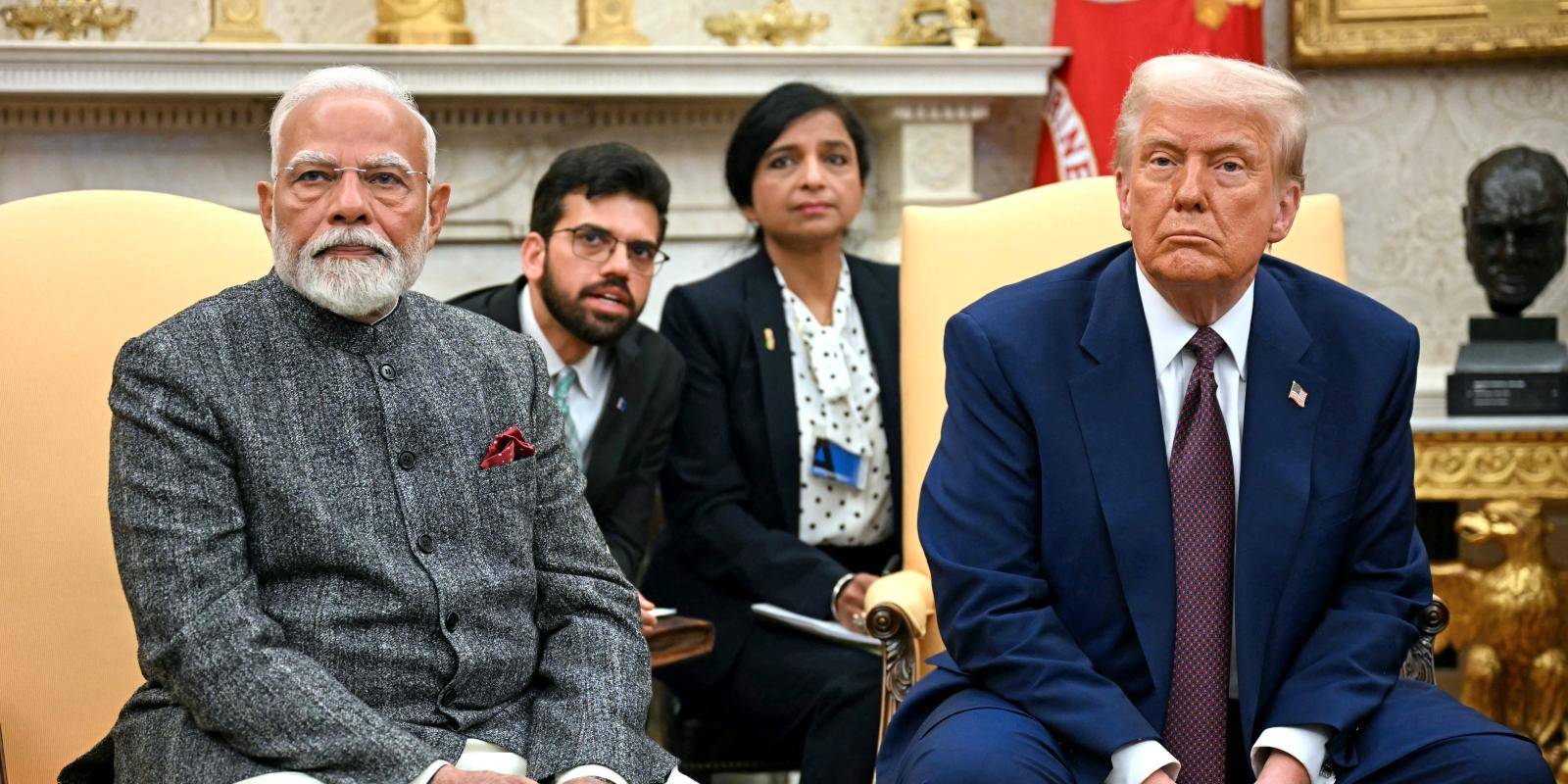

US-India relations are under strain. The Trump administration imposed a 25 per cent tariff on India on 7 August, followed by a further 25 per cent that is set to go into effect on 27 August.
The two sets of tariffs are ostensibly about different issues: the 7 August tariff was imposed after the countries were unable to secure a trade deal ahead of a 1 August deadline, while the more recent one is a secondary tariff related to US pressure on Russia to secure an end to the war in Ukraine.
However, together they reflect concerted pressure on New Delhi by the Trump administration that has taken some of the shine off what was a promising bilateral relationship.
Shine comes off India–US relations
When Trump began his second term in January, the expectation was that bilateral relations would remain positive. Indian Prime Minister Narendra Modi was the fourth world leader to visit Washington following Trump’s inauguration and both leaders were seen as populists and economic nationalists with similar worldviews.
New Delhi overlooked the Trump administration’s clamp down on illegal and legal migration into the US, with Indian nationals a leading source of both. Existing friction over trade was also eased by India’s offers to buy more American products to address the trade imbalance, with a target to more than double bilateral trade to $500 billion by 2030.
However, an expected interim trade agreement has not yet materialized. This is partly due to New Delhi’s entrenched protectionism, particularly in relation to its politically sensitive agricultural sector that employs over 40 per cent of the country’s workforce, coupled with cultural sensitivities over the import of GM crops and animal by-product animal feed.
Trump’s social media post claiming that India is a ‘dead’ economy that does ‘very little business’ with the US has added further bad blood. This has been compounded by the threat of 200 per cent tariffs on pharmaceutical imports, which will have a significant impact on India as a leading supplier of generic drugs to the US.
The latest source of friction comes amid Trump’s efforts to secure a ceasefire in Ukraine. India, as the second-largest buyer of Russian crude – which represents almost 40 per cent of the country’s total imports – has been caught in the crossfire. Washington had initially appeared willing to overlook New Delhi’s purchase of discounted Russian crude, given India’s needs as a major oil importer. The Trump administration’s initially conciliatory approach towards Moscow also led to expectations that Russia-India relations would become less of an issue for Washington.
This has now changed with Trump’s latest tariffs, which New Delhi described as ‘unfair, unjustified and unreasonable’. The fact that China and Turkey are also leading buyers of Russian crude has added to allegations that India is being unfairly singled out. India argues that its close relationship with Moscow is not an endorsement of Russia’s actions in Ukraine and that its dependence on Russian crude has helped to stabilise global energy prices.
Other issues have exacerbated tensions. New Delhi has rejected Trump’s repeated claims that he helped to broker a ceasefire agreement between India and Pakistan following their four-day conflict in May. While Islamabad echoed the US narrative, New Delhi instead argues hostilities ended without intervention from third parties (in line with India’s longstanding position to avoid internationalizing the conflict and the Kashmir issue). The US has also hosted Pakistan’s army chief Field Marshal Asim Munir twice since the conflict while Trump announced a trade deal with Islamabad.
Reaffirming strategic autonomy
New Delhi is now reaffirming its longstanding commitment to strategic autonomy in its foreign policy. This entails engaging all major countries and blocs, including those with which the US and West have historically difficult relations.
President Vladimir Putin is scheduled to visit India soon, in his first visit since the Russian invasion of Ukraine in February 2022. During a visit to Russia last week, India’s National Security Advisor Ajit Doval referred to New Delhi’s relations with Moscow as an ‘old strategic and privileged partnership’ that has a ‘very special role.’
Modi will also attend the Shanghai Cooperation Organisation (SCO) summit on 31 August. This will be Modi’s first visit to China since 2018, and the subsequent downturn in India-China relations triggered by border clashes in 2020.

Chatham House analyst Galip Dalay says today’s ‘Middle Powers’ are more focused on positioning themselves to advantage in a shifting Multi-Aligned world order than the values-driven Non-Aligned Movement of past decades.
Both these visits were planned before recent tensions but demonstrate New Delhi has a diverse and independent foreign policy. They will seek to demonstrate that Beijing, Moscow and New Delhi have aligned interests amid pressure on all three from the Trump administration. In reality, however, India is increasingly the odd one out.
New Delhi has presented itself as a non-western rather than anti-western power. It therefore does not want to be part of any overtly anti-US or anti-western initiative being promoted by Beijing or Moscow. Modi’s call with Ukrainian President Volodymyr Zelenskyy earlier this week reflects New Delhi’s efforts to be seen to be playing a constructive role while staying on good terms with the West.
