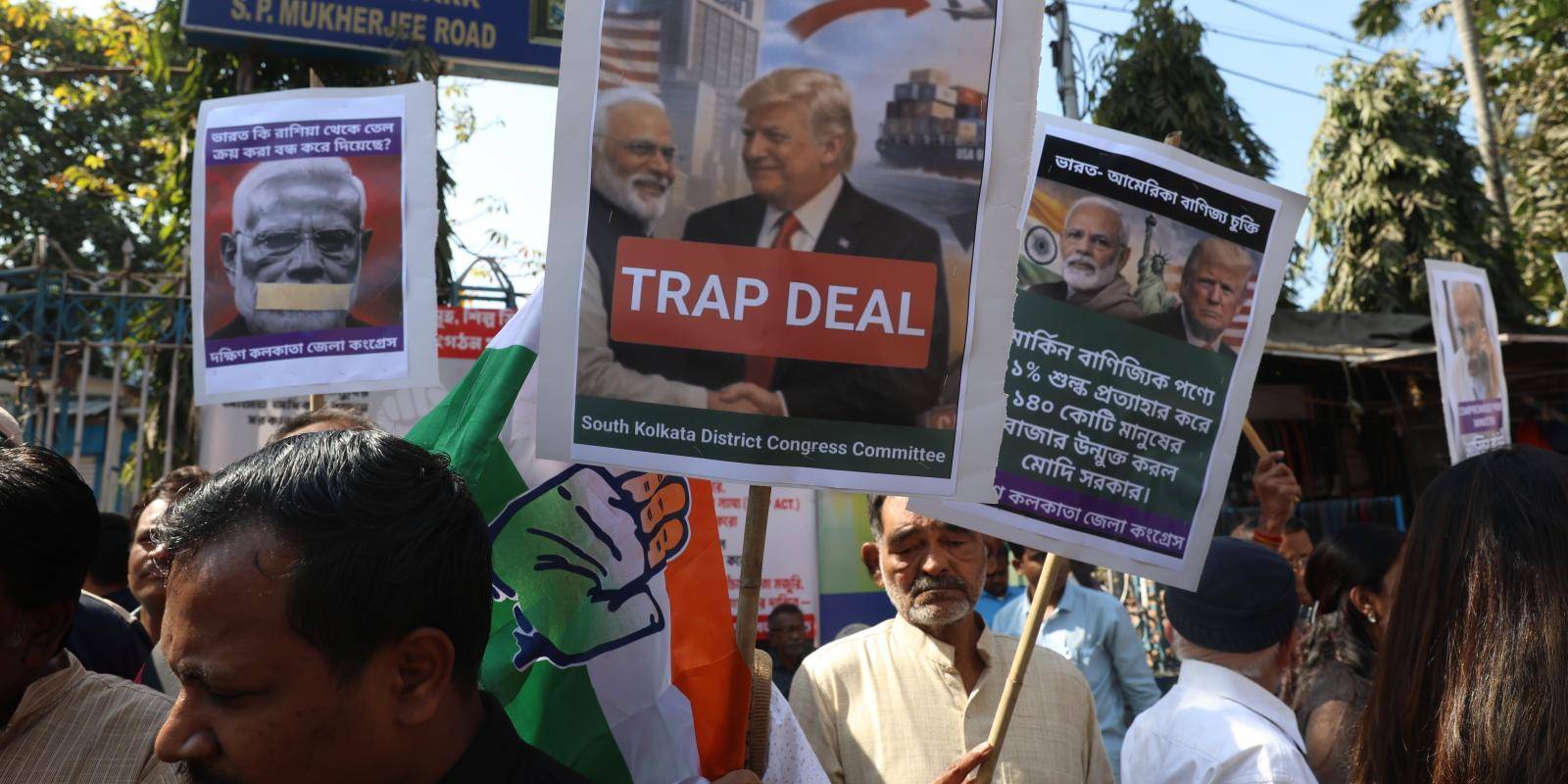

In a joint statement issued on 6 February the Trump administration announced it had reached an agreement to lower tariffs on India. The agreement has reduced the reciprocal tariff on India from 25 per cent to 18 per cent, and removed the additional 25 per cent tariff imposed for India’s purchase of Russian crude. In exchange, India will commit to buying $500 billion worth of US products over five years and stop buying Russian oil.
This significantly reduces the US tariff level on India from 50 per cent – which was among the highest in the world – to levels on par with other countries in South and Southeast Asia.
Both sides had noted they were close to concluding a deal for months. The recent appointment of Sergio Gor as US ambassador to India likely helped get this agreement over the line.
Ambiguities persist
The agreement paves the way for a partial reset in the relationship. It is only partial for several reasons.
First, the trade negotiations remain a work in progress. The joint statement will be followed by an interim agreement in March, which will culminate in a bilateral trade agreement. Interestingly, this reflects India’s longstanding position for a phased negotiation process.
There also remain several ambiguities associated with these commitments. India has significantly reduced its purchase of Russian crude – from a peak of 40 per cent of its total imports to less than 25 per cent in December. But so far there is no indication that the Indian government has directed Indian refiners to completely stop buying Russian oil. Private refiners like Reliance – which maintains the world’s largest refinery – have stopped. But state refiners have not. Russia has reaffirmed this point, noting that they have not yet received any communication from the Indian government indicating it will terminate its purchase of Russian crude.
How both sides will square this circle remains unclear. The narrowing price differential between Brent crude and discounted Russian crude will make it easier for Indian refiners to pivot away from the latter. However, New Delhi will remain reluctant to take any action that jeopardizes its longstanding relationship with Moscow.
The direction of travel in the India–Russia relationship is towards a managed decline. French President Emmanuel Macron’s visit to India this week may include the conclusion of India’s largest defence deal, reflecting efforts by New Delhi to reduce its dependence on Russian military hardware. But Moscow remains a key strategic partner for New Delhi, as noted by President Vladimir Putin’s visit to New Delhi in December.

On the same day as the India–US Joint Statement, the White House also issued an executive order in which it threatens to take ‘additional action’ against India if ‘India resumed directly or indirectly imports [of] Russian Federation oil’.
Related to this is the question of what substitutes for Russian oil. India is the world’s third largest crude importer, so any shift in its oil imports can have a knock-on effect on global energy prices – indeed, New Delhi has argued that its purchase of Russian crude helped to stabilize global crude prices.
President Donald Trump has noted that the US and potentially Venezuela could ramp up their exports to India to compensate for the loss of Russian oil. However, Venezuela’s crude production remains low after years of sanctions and under-investment. And Venezuelan crude is of a heavy sour quality, which only a limited number of Indian refineries can process.
India’s purchase of US crude and other products will help to address Trump’s perennial obsession with the trade imbalance. However, meeting the trade agreement’s $500 billion purchase requirement will be no easy task. At present, India imports just over $40 billion from the US.
The $500 billion is over a five-year time horizon and includes energy, defence and technology products. That may make it easier to achieve. And Indian policymakers argue that these commitments are nonbinding.
The most politically significant concessions New Delhi has made related to the country’s agricultural sector, which employs over 40 per cent of the workforce. This had been a key sticking point during the trade negotiations and remains a politically sensitive issue for both leaders.
The Indian government argues that the market access promised by the agreement with the US excludes staples like wheat and rice. That has not prevented renewed farmer protests and criticism from the opposition. The Modi government’s calculation has been that any political blowback is manageable compared to prolonged elevated tariffs, which would have more lasting damage on the wider Indian economy.
Hanging over all of this is the knowledge that there is no guarantee that Washington will not reimpose tariffs on India: the US recently threatened to raise tariff levels on South Korea over its failure to meet the terms of a trade deal the countries concluded last year.
Lasting damage
The reset in relations has been accompanied by positive statements. Trump referred to Modi as ‘one of my greatest friends and a powerful and respected leader of his country’. Modi reciprocated by calling Trump ‘my dear friend’ and saying that ‘India fully supports his efforts for peace’.
However, there is no doubt there has been lasting damage to the relationship. At the start of the second Trump term, India believed that Trump and Modi maintained similar worldviews and that India and the US would maintain a privileged partnership.

This has now faded. New Delhi is now likely to maintain a more pragmatic and cautious approach in its engagement with Washington. The hostility of Trump’s tariffs and statements by the president referring to India as a ‘dead economy’ will not be forgotten. Neither will Trump’s outreach to Islamabad in the aftermath of the brief India–Pakistan conflict last year, which has left a permanent scar on the bilateral relationship.
Indeed, in the months since the downturn in India–US relations, New Delhi has doubled down on its longstanding commitment to strategic autonomy in its foreign policy.
On the economic side, India has concluded a string of trade negotiations; three in 2025 alone (with Oman, New Zealand and the United Kingdom) followed by a deal with the European Union in January this year. It has also revived negotiations with countries including Canada, Israel, Qatar, and Peru. This is a significant achievement for a country that is historically seen as protectionist.
These developments demonstrate New Delhi’s efforts to diversify India’s export markets and ensure that it is not beholden to any one country – particularly the United States. They also reflect efforts to enhance India’s attractiveness as a foreign investment destination and make the country a global manufacturing hub.