
Just days after the US attack on Venezuela, US Secretary of State Marco Rubio put Washington’s definition of its sphere of influence beyond doubt. ‘This is the Western Hemisphere. This is where we live – and we’re not going to allow the Western Hemisphere to be a base of operation for adversaries, competitors, and rivals of the United States’.
China has a staunchly different view. Months before the US attack on Venezuela, Chinese foreign minister, Wang Yi, told a forum in Beijing that Latin America and the Caribbean are not anyone’s ‘backyard’.
In fact, China’s diplomatic and commercial relationship with Latin America has burgeoned over the past two decades. In 2024, Chinese trade with the region grew to a record $518bn and some economists have predicted it could exceed $700bn by 2035. China currently ranks as Latin America’s second largest trade partner after the US. Investment ties are growing fast.
Chinese financial institutions have also offered an estimated $303bn in financing across the region between 2000 and 2023, according to the AidData research institute. This is far more than US institutions have lent.
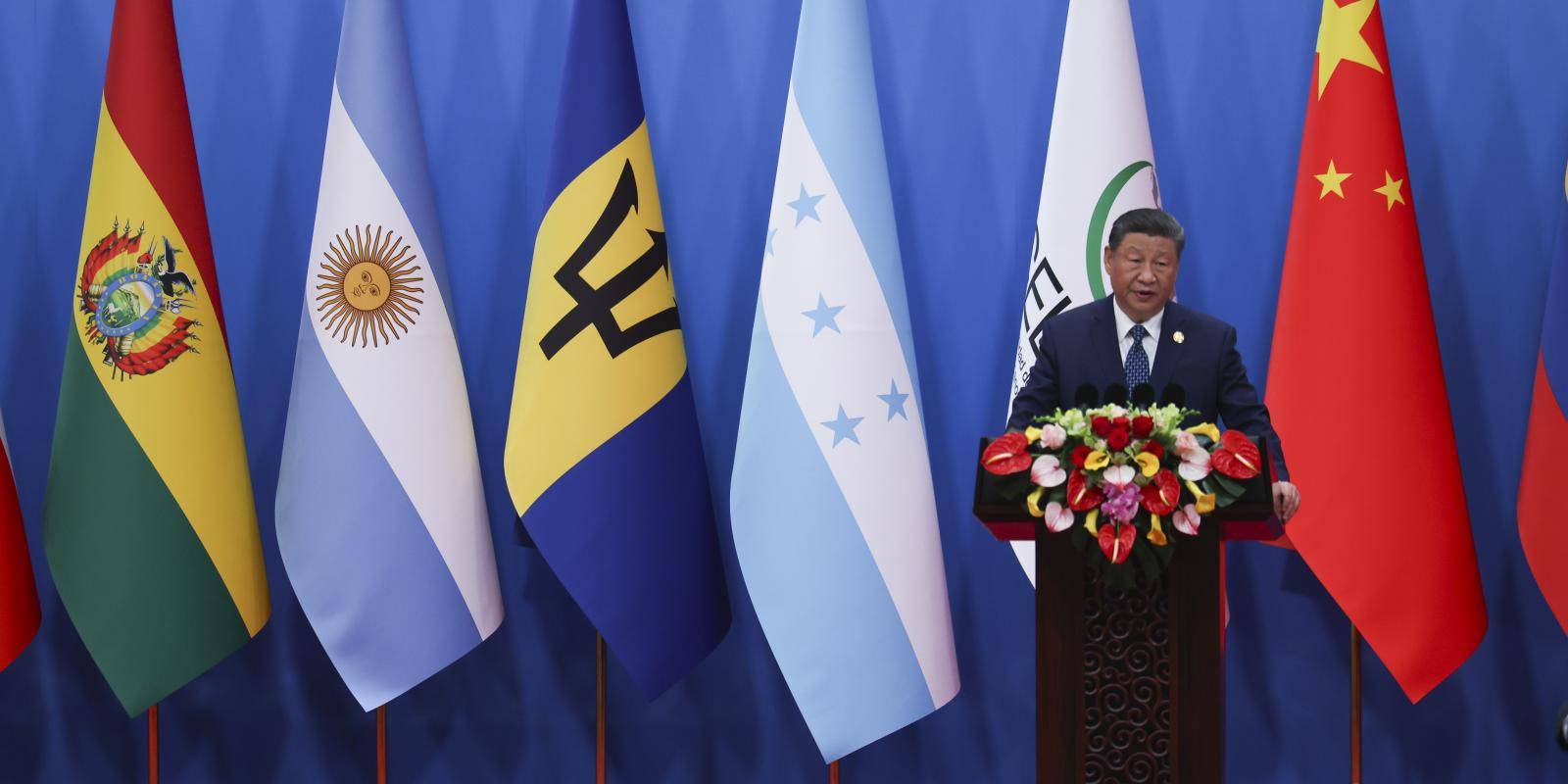
At a 2025 meeting of the China–CELAC forum, a Beijing-led body that brings together 33 countries in Latin America and the Caribbean, President Xi Jinping announced a new credit line in excess of $9bn to the region for cooperation projects. The loans are to be denominated in the Chinese renminbi – demonstrating Beijing’s efforts to divert its international lending programme away from the US dollar.
Two documents show highly conflicting ambitions

Two documents published last December – China’s third policy paper on Latin America and the Caribbean, and the new US national security strategy – reveal the starkness of the US–China rivalry over Latin America. It is not just a contest for economic advantage and resources, but also about deeply conflicting visions of how the world should be run.
The Chinese policy paper followed earlier iterations published in 2008 and 2016. It was officially defined as a ‘road map’ and a ‘guidebook’ for China’s ties with the region. While it does not mention the US directly, it makes common cause with countries in the region and repeatedly pledges to oppose ‘hegemonism’, ‘unilateral bullying’ and ‘power politics’ – coded phrases that Beijing often uses to denote US influence.
In the paper, China pledges to defend international fairness and justice and uphold the multilateral trade system. It also talks about safeguarding the stability of global supply chains and its ambition to ‘steer economic globalization toward the right direction’.
The US national security strategy uses similarly indirect language – such as ‘non-hemispheric competitors’ – to describe the influence of China (and other US rivals) in Latin America as malign. It claims that such competitors have made ‘major inroads’ into the Western Hemisphere and that allowing this to continue without ‘serious pushback’ would be a ‘great American strategic mistake’.
It adds that the US has successfully demonstrated that there are many hidden costs (including espionage and cybersecurity) embedded in so-called ‘low-cost foreign assistance’ and that US leverage in finance and technology should be used to incentivize countries to reject such outside assistance.
China’s prestige damaged as risk of proxy conflicts increases
The attack on Venezuela and the seizure by US forces of Russian flagged oil tankers show the limits inherent in Chinese promises of support. In 2023, China and Venezuela announced a strategic partnership but, in military terms at least, Beijing’s pledges have proven insubstantial so far.
This will have been closely watched throughout the region, boosting perceptions of US strategic power relative to that of China.
Zheng Yongnian, a Chinese government adviser and academic, said this month that a ’feudalization of the international order’ is underway with big powers seeking to expand their spheres of influence. While ’direct war among big powers’ is unlikely, risks centre around potential proxy conflicts.
Such conflicts could arise should Latin American countries leverage their relations with China to challenge US influence – or should the US’s increasing focus on its ‘backyard’ pose a challenge to China’s interests in the region.
China still has leverage

US plans to control Venezuela’s oil could be a problem for China. Venezuela has hitherto used oil to repay Chinese loans but how Washington now deals with Chinese claims on the oil remains to be seen. Earlier this week, two Chinese supertankers on their way to pick up Venezuelan oil turned back. If Washington’s policy is to cut off all supplies of oil from Venezuela to China (meaning that Chinese financial institutions are forced to write off billions in outstanding loans) then Beijing may decide to retaliate against US interests.
China has a considerable number of options here. It could once more restrict rare earth and critical mineral supplies to US companies, hampering manufacturing efforts. It could take action against US companies investing or doing business in China, or restrict commercial ties with selected US companies by putting them on Beijing’s unreliable entity list.
Will the US go after other Chinese assets in Latin America?
President Donald Trump has vowed to ‘take back’ the Panama Canal. But a proposed $23bn acquisition by a Blackrock-backed consortium of dozens of global ports – including two ports in the Panama Canal – from a Hong Kong port operator, is now in doubt, according to a Financial Times report.