

Tanzania’s general election on 29 October is a historic moment in one respect. President Samia Suluhu Hassan – who came to power after the sudden death of her predecessor John Magufuli in 2021 – will be on the ballot for the first time. Her widely anticipated victory would be only the third time a woman has been popularly elected as president of an African country.
But beyond this, the polls are more of a historical relic.
Not since before the advent of multi-party democracy in Tanzania has the ruling CCM party, in power since independence, faced so little competitive opposition.
Opposition leader Tundu Lissu has been imprisoned since April on treason charges, with his CHADEMA party banned from the election. Another prominent contender and ruling party defector, Luhaga Mpina, is barred from running.
Voter registration in 1990 – the final poll under the one-party system – stood at 7.3 million, while today the electoral commission reports over 37 million people are eligible to vote. Despite the size of the electorate increasing fivefold, Tanzanians are left with a similar lack of choice.
Democracy in decline
President Samia’s approach to governance has been varied – but has taken an increasingly repressive turn over the last two years.
When she first came to power in 2021, she oversaw the imprisonment of then-CHADEMA leader Freeman Mbowe. But by early 2023 there were partial signs of change such as the lifting of a ban on political rallies and beginning of dialogue with opposition. However, ensuing electoral reforms were only cosmetic – as evidenced by CCM sweeping over 98 per cent of seats in 2024’s local elections.
Tanzania civic election results 2009–24
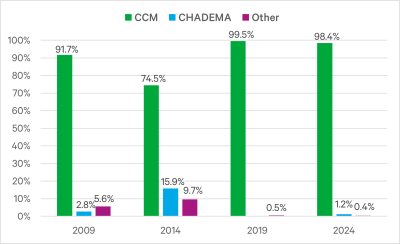
Source: President’s Office Regional Administration and Local Government. Percentages refer to share of total elected positions won.
Threats to civic space have not only impacted Tanzania’s political elite. Recent reports by UN experts and Human Rights Watch – strongly refuted by the Tanzanian government – highlight a pattern of abductions and attacks on activists, journalists and religious leaders. As aid budgets shrink and global priorities shift, economic pragmatism and perceived ‘political stability’ have taken precedence, leaving traditional development partners with little leverage or incentive to speak out.
Comparisons between Samia and her predecessor, or commentary attributing her actions to the influence of his former party loyalists, are not always accurate or analytically useful. Many have highlighted Samia’s early nomination as the CCM’s presidential candidate in January this year as an unprecedented break with internal party democracy. But this lack of internal competition is not new. Ahead of the 2020 election, Magufuli’s only potential rival was expelled from the party after indicating a possible challenge.
Nor is it clear that any coherent ‘Magufuli faction’ is to blame for governance issues. Many of the former president’s key allies were quickly sidelined – such as former CCM secretary general Bashiru Ally or the late speaker of parliament Job Ndugai – or have been shuffled in and out of cabinet. Others have become government critics, including former CCM official Humphrey Polepole who was reportedly violently abducted on 6 October after making a series of public statements.
Tanzania presidential election results 2000–20
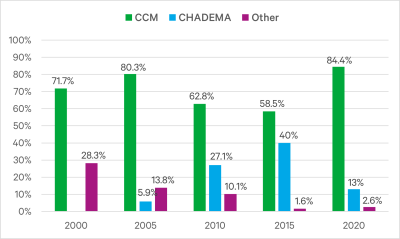
Source: Tanzania Independent National Electoral Commission. Percentages refer to share of eligible votes received.
After four years in power, President Samia must be judged on her actions and not those of her predecessor. A focus on past comparison risks obscuring the consequences for the future, as closing national political space raises the stakes for potential political challengers within the CCM.
This not only limits transparency and public choice but also increases policy uncertainty due to the repeated reshuffling of officials along factional lines.
Tanzania’s economic potential deserves better
President Samia’s campaign focuses heavily on her economic impact and achievements. Cushioned by its status as a leading gold exporter, Tanzania’s growth has been resilient despite global shocks; inflation has remained stable, and the country has so far avoided the high risk of external debt distress encountered by some of its neighbours.
Megaprojects inherited from the previous administration, such as a hydropower dam and standard gauge railway, have made progress while new projects are also in development. These include a $500 million investment in the Nyanzaga gold mine, a $1.2 billion uranium project with a Russian firm, and a $1.4 billion deal with China to refurbish the TAZARA railway connecting Tanzania and Zambia.

These deals highlight Tanzania’s clear strategic potential: it has abundant natural resources; is a gateway to major inland markets; and is unwilling to be pigeonholed amid growing geopolitical competition.
But a lack of consistency threatens wider transformation, particularly in the energy sector. Progress on a $40 billion investment to develop Tanzania’s offshore gas reserves has stalled repeatedly since a deal was signed in June 2022, while the government is facing a $1.2 billion arbitration claim over its decision to terminate a key gas-to-power project after 20 years – influenced by an error-strewn auditor general’s report from 2019.
Tanzania’s newly launched development blueprint Vision2050 sets out an ambition for the country to become an upper-middle-income economy by 2050, alongside a new foreign policy strategy. Both stress the importance of regional cooperation and reforms to improve the business environment.
