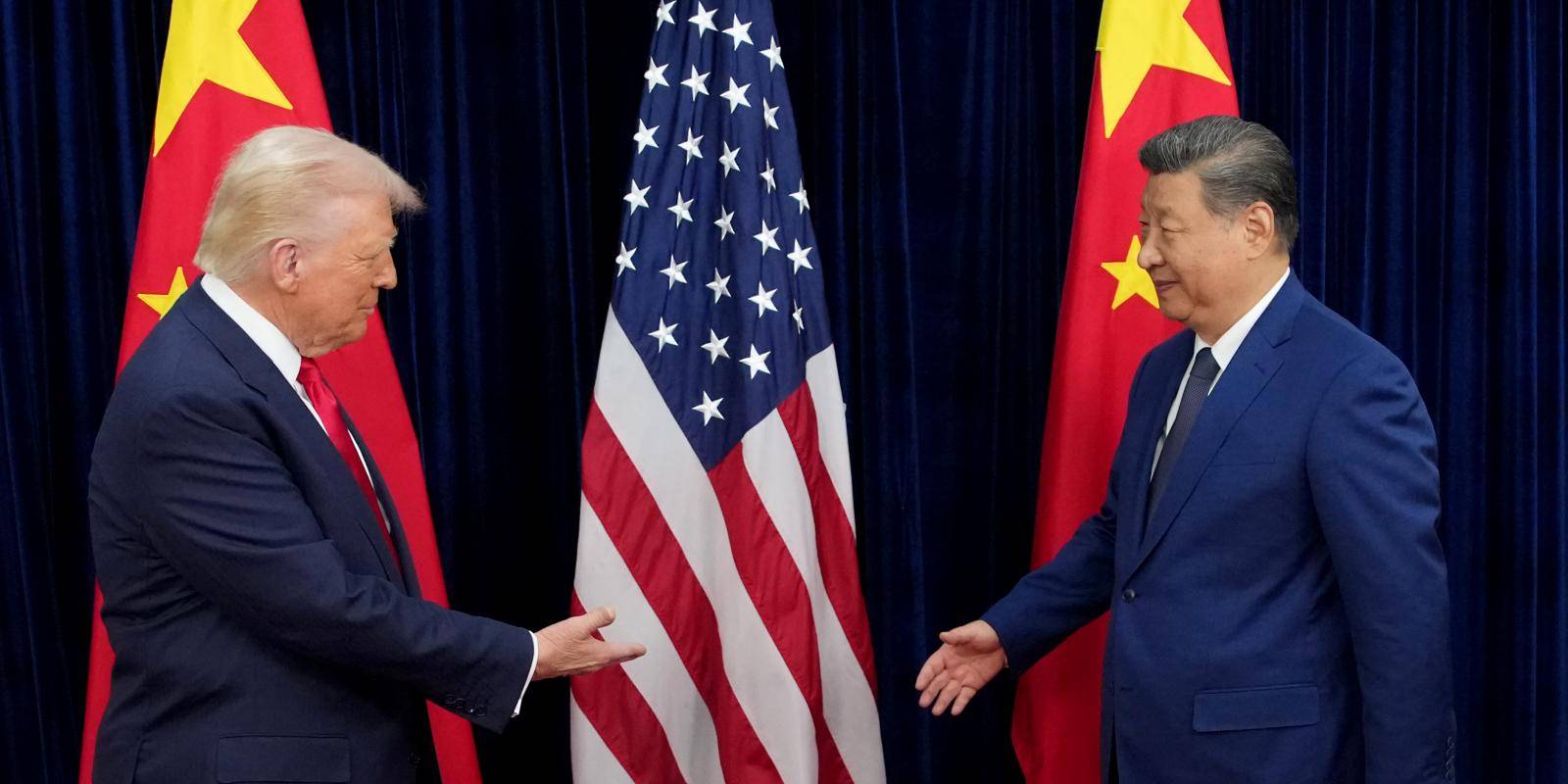


President Donald Trump and President Xi Jinping’s meeting this week comes at a moment of renewed economic confrontation and enduring mistrust.
Reports of a ‘positive framework’ covering tariff reprieves, China’s purchase of American soybeans, fentanyl cooperation, and rare earth export controls may build a fragile floor under the fraught relationship. But even a successful deal offers little scaffolding on which to shore up the structural foundations of this rivalry.
Beyond lofty stakes for the superpowers, the meeting holds significance for America’s partners, who are already recalibrating their strategies. For them the meeting reiterates the need to pursue independent strategies to manage long-term turbulence – whether the US and China ultimately reach an enduring bargain, muddle through, or heighten confrontation.
Since January, the US administration has pursued short-term measures towards Beijing, grabbing headlines but lacking a broader strategy. A February tariff blitz yielded a mutual climbdown and extended truce. Washington tightened semiconductor export controls, only to greenlight certain Nvidia sales. And Trump postponed a legally mandated ban of TikTok in favour of a commercial solution.
Senior US officials are also divided in their outlooks, with pro-tariff economic nationalists, market-oriented dealmakers and security hardliners vying for influence.
Vacillating between hawkish barbs and placatory rollbacks, the approach reveals a pattern of expediency that often catches foreign capitals by surprise, even as they struggle to manage their own relationships with the US.
A range of outcomes
A ‘grand bargain’ that addresses the greatest bilateral challenges – from Taiwan to the South China Sea to technology – is ostensibly appealing because it would limit uncertainty. But it seems unlikely, given limited political space and structural rivalry.
Negotiations could also collapse, escalating conflict and inflicting global economic damage. Both sides have honed coercive tools, with China learning from US innovations; its recent rare-earth export controls, which extend to ubiquitous inputs and processing technology, illustrate Beijing’s sweeping leverage.
The more likely outcome is continuity: a cycle of escalation and de-escalation. In this base case, any relative US advantage may wane over time.
Despite enduring American strengths – including in innovation and finance – China’s industrial capacity and relentless focus on cutting-edge sectors are formidable, especially considering funding cuts to American research. And US economic headwinds – from agricultural export losses to supply chain challenges and tariff uncertainty – may incentivize the pyrrhic embrace of short-term reprieves as strategic victories.
Global consequences
Policymakers in global capitals have long feared a forced choice between Beijing and Washington. Since January, US partners and allies have scrambled to adapt and hedge in the face of China’s assertiveness and the US’s unpredictability. Recent months have heightened anxiety that partners’ interests will be subordinated to American commercial outcomes – echoing a ‘Phase One’ agreement that prioritised commodity sales over structural irritants, and mirrored in current export control carveouts for US firms.
The Trump administration has largely pursued a bilateral approach to China, rather than collaborate with partners, with limited exceptions such as a recent critical mineral agreement with Australia.
Even under a more consultative Biden administration, allies chafed at the pressures of American economic security and industrial policy, like chip and green technology subsidies. Still, for partners, navigating difficult trade-offs on discrete issues is a different matter from acquiescing to an American partner lacking a cohesive strategy. Whether the longer-term US trajectory favours the Trump or Biden models – or a different approach entirely – the UK and Europe would be wise to pursue their own truly independent China policies.
This reorientation has already begun. Chatham House field research on three continents reveals a common thread: pragmatic adaptation to defend national interests and hedge against unpredictability.
Europe has belatedly sought to ‘Trump-proof’ through boosting defence investment, strengthening economic security mechanisms, and diversifying trade, including negotiations with certain Latin American countries. The UK is likewise diversifying trade – resuming talks with China and striking a deal with India. At the same time, it is advancing an economic security strategy and selective alignment with Washington on technology, even as it resists pressure on digital services taxation and content moderation.

Across Asia and the Americas, too, partners are hedging. Japan and South Korea continue to embrace security cooperation with the US, but maintain substantial trade with China. Mexico has leveraged USMCA access to mitigate trade fallout, but remains heavily exposed. And Brazil, facing punitive tariffs, looks to Beijing to offload commodity exports.
Even if Trump and Xi reach an agreement, partners may still face pressure from the US to sharpen their policies toward China, often at significant economic cost – making autonomy even more desirable.
To be sure, some states enjoy more latitude than others. Those that rely most on the US – whether for trade and investment or security guarantees – may feel more constrained. Pressures to align around advanced technology and artificial intelligence – where the US and China far outstrip others and barriers to competing are immense – can push countries like the UK into closer alignment. In some cases, managing dependency may be preferrable to missing out. And leaders must carefully navigate trade-offs rather than allow passivity to render them vulnerable.
Planning for resilience
To ensure independence in a global system in which rules are deteriorating and dominant powers act transactionally, partners must move beyond rhetorical ‘de-risking’ to practical resilience. This includes economic security measures and coordination – from industrial policy to supply chains to investment screening. The EU’s Anti-Coercion Instrument, establishing penalties for boycotts and trade restrictions, is a promising start. Also the UK’s emphasis on economic security. But they must be sustained, and aligned with partners including like-minded nations in the Indo-Pacific.
