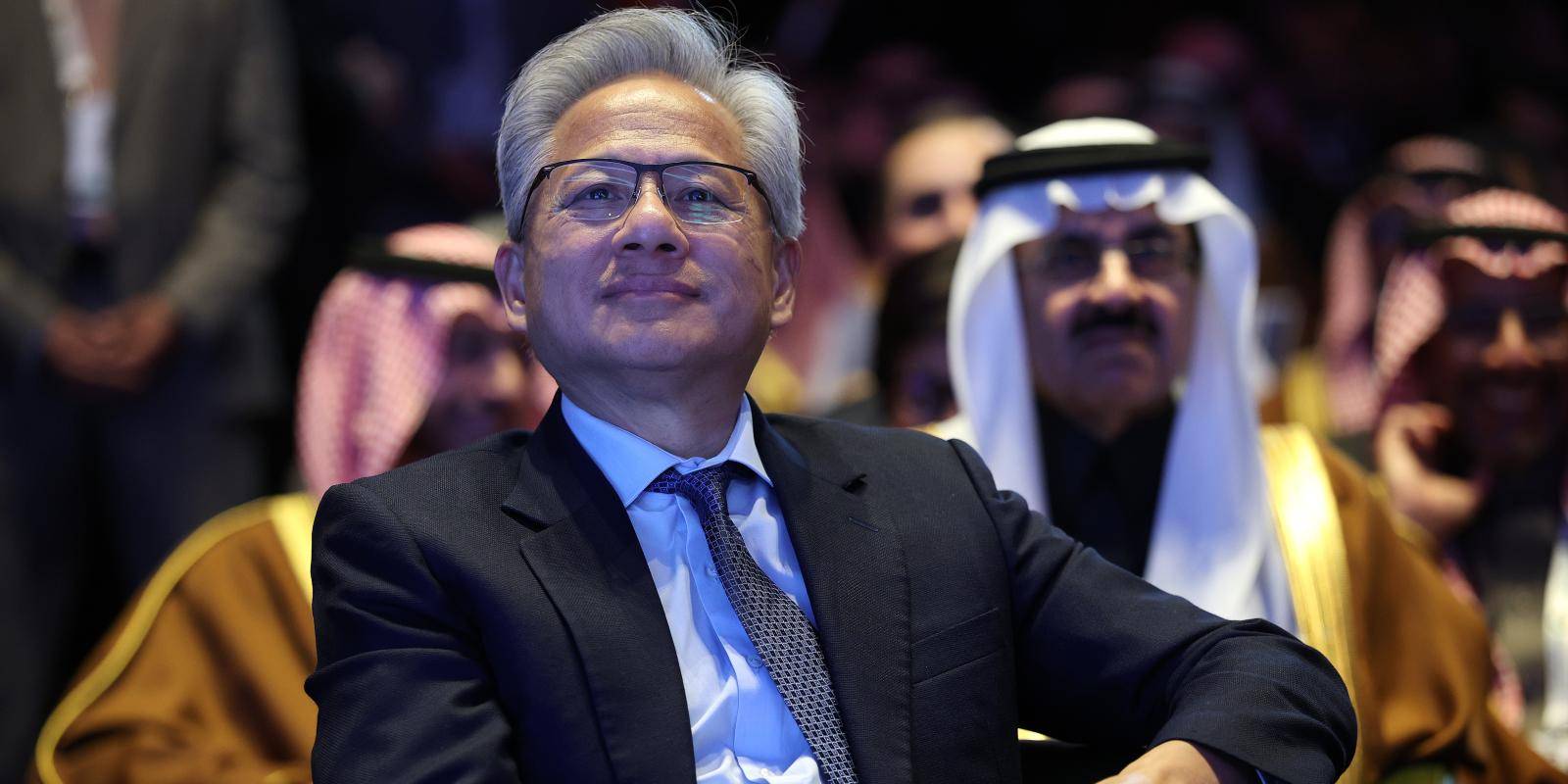

This week Jensen Huang, CEO of Nvidia, took issue with talk of an ‘AI bubble’, as Nvidia announced bumper earnings growth in the latest quarter on strong sales of AI chips. ‘There has been a lot of talk about an AI bubble. From our vantage point we see something very different,’ he told analysts on Wednesday.
Yet Huang’s previous remark on 6 November, that China will ‘win’ in AI , should be taken seriously in the West – in part for what it says about bubble fears.
Huang is not the only prominent US figure to have commented recently on China’s remarkable progress in artificial intelligence.
Brian Chesky, CEO of Airbnb and a friend of OpenAI founder Sam Altman, said that his company ‘relies heavily’ on Alibaba’s Qwen because the Chinese model is ‘very good’ and ‘also fast and cheap’. In contrast, he said of OpenAI’s ChatGPT: ‘I don’t think it was quite ready’ for Airbnb’s needs.
Remarkably, Martin Casado, a partner at US venture capital firm 16z, says that most of the AI entrepreneurs he sees in the US are using AI models made in China. ‘I’d say 80 per cent chance [they are] using a Chinese open-source model,’ he was quoted as saying.
Chamath Palihapitiya of Social Capital, a US investment firm, said he has chosen Kimi K2, an open-source AI model developed by the Chinese company Moonshot AI, to perform much of his company’s work. This is because Kimi K2 ‘was really way more performant and frankly just a ton cheaper than OpenAI and Anthropic’, he said.
The AI race between the US and China is still in its early stages. It is too early to call a definitive winner. But the assessments of key industry figures that low-cost, high performance Chinese AI models are gaining ground in the US should add to concerns over an AI bubble’ – one centred around high-cost US models.
China has huge cost advantages
It is clear that Chinese AI companies enjoy key structural advantages over US counterparts. The main one is cost. This includes both the cost of developing new AI models and updates, as well as the cost of operating Large Language Models (LLM) for customers.
In terms of development costs, China is quite simply in a different universe. By some estimates, Moonshot AI’s Kimi K2 cost just $4.6 million to train, a fraction of the billions that OpenAI is spending on research and development.

Similarly, the costs of running the leading Chinese LLMs – DeepSeek, Qwen-Plus and Kimi K2 Thinking – come in at a sharp discount to operating both GPT 5 from OpenAI and Claude Sonnet 4.5 from Anthropic. For reference, the Claude Sonnet 4.5 costs $15 per million output tokens, while the Kimi K2 Thinking costs $2.5 .
Another aspect of the leading Chinese LLMs’ appeal is that they are open-source. This allows users to deploy models on their own private infrastructure and ensure that sensitive data remains in-house.
Several US LLMs are closed source, including ChatGPT. However, Llama from Meta, Phi from Microsoft and Gemma from Google are open-source. Indeed, even OpenAi launched the open-source GPT-oss in August.
The US has access to much more powerful chips
The US AI companies, however, enjoy an advantage in their unrestricted access to the latest AI chips, the Blackwell series made by Nvidia. The US has banned these chips from being sold to China, with US president Donald Trump saying this month that only US customers should have access.
As things stand, the most advanced Nvidia chip that China can access under Washington’s export control regime is the H20, a high performing semiconductor which is nevertheless a full generation behind the latest Blackwell B200 and B100 chips. This gulf is thought to give users of the latest Blackwell chips up to 15 times more compute power over those using the H20.