

The battle for access to advanced US computing chips is well underway. Last week, the US House Foreign Affairs Committee advanced a range of export control bills, which came as the Chip Security Act makes its way through the layers of US legislative process. The act seeks to prevent US chips from being illegally shipped or diverted to foreign adversaries, especially China, by requiring companies to verify that semiconductors used in AI remain in authorized locations.
This policy aims to slow down the progress of Chinese AI and give the US more time to advance domestic AI capabilities. But for the US, its allies and partners, export controls alone will largely fail in this aim. This is not just because the enforcement of export controls has been leaky and undermined by smuggling. It’s because the policy itself is based on a hardware-centric approach to AI capabilities that the technology has since outgrown.
A technological chokepoint?
Export controls for AI are based on a core assumption: that chips are the technological ‘chokepoint’ for AI development. This logic suggests that whoever has the best performing chips (and other key hardware components) will advance faster towards the promise of AI supremacy; preventing adversaries from accessing them is therefore a viable tactic to retain the lead.
Historically, this rings true. In the Cold War, US restrictions on early semiconductors supported this assumption because computing power was almost entirely determined by physical hardware. But as AI advances and adapts, increasingly this logic no longer cleanly transfers. Failing to understand this could have broad sweeping implications for national security, strategic competitiveness and the AI race for both the US and its partners.
US partners and allies need a consistent and stable position from Washington to follow. Washington’s policy changes on chip exports have a ripple effect on its allies’ industrial and AI development planning. This is especially true for those deeply involved in the interdependent supply chain such as the Netherlands, Taiwan and Japan.
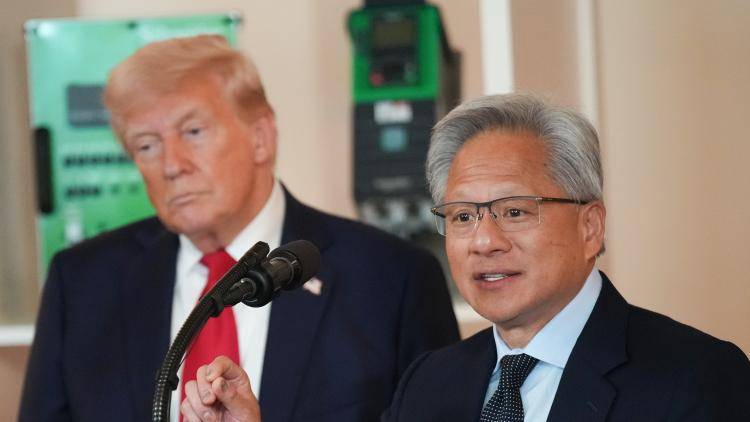
Unfortunately, Washington’s recent policy has been inconsistent and mercurial. US President Joe Biden’s ‘AI Diffusion Rule’ represented the fullest expression of a technological chokepoint argument: it sought to restrict access to US chips to preserve the US’s decisive first-mover advantage. But President Trump’s second term has seen an erratic approach. He scrapped the AI Diffusion Rule in May 2025 and has since broadly relaxed controls on certain advanced chips, including Nvidia’s H200 AI processors, while putting a 25 per cent tariff on them. Yet meanwhile Congress has pushed to tighten controls through the Chip Security Act.
This has led to the worst of both worlds. These divergent and inconsistent policy positions make short-term and mid-term decision-making deeply uncertain for supply chain partners. At the same time, both administrations share a common blind spot in seeing advanced chips as a geopolitical prize to be either restricted or used as a bargaining chip. Neither administration has fully grappled with AI trajectories beyond current capability.
More than just chips
US chips are indeed financially and technologically valuable, but seeing them as a permanent chokepoint for AI development is outdated for three main reasons.
First, the rapid increase in demand for AI means that export controls are difficult to enforce. Chip smuggling is reportedly widespread. Third countries, such as Malaysia and Singapore, have allegedly been utilized as grey markets for China. This lucrative trade appears to be growing, with many seemingly willing to break the rules for profit. In spyware and cyber proliferation, a similar story has played out – with intermediaries such as brokers and resellers reportedly fuelling the expansion of the sector despite regional export controls and trade bans.
Second, and more critical for long-term AI policy: gains in AI technology are increasingly no longer just based on raw computing power. Instead, frontier AI developers can improve AI models through making algorithms more efficient, improving the way models are designed and implementing inference optimization techniques that enhance model performance. These are all measures that can make AI faster, cheaper and more available on a variety of devices without using an excess of computational power.
AI laboratories based in adversarial countries are adapting around hardware constraints rather than being inhibited by them. For example, the Chinese AI research company, DeepSeek, has developed highly competitive open-weight, frontier models. Evidence does suggest that export controls limit computational resources for Chinese companies. But they did not stop DeepSeek from releasing its high-performing model for far cheaper than US competitors. These innovations were driven by optimizations in memory management and the use of synthetic data rather than access to the most advanced chips.
This isn’t a new story. Similarly, in 2023, Huawei’s Mate60 Pro caught the attention of US national security officials when export controls on 5G failed to prevent its development. These cases are not anomalies but rational market responses to a policy that misunderstands the development of the very technology it seeks to control.
