

Russian President Vladimir Putin’s visit to India on 4–5 December is his first since the full-scale Russian invasion of Ukraine in 2022. In some ways, the trip can be regarded as routine: both countries’ leaders meet regularly at annual summits (although the last, in July 2024 in Moscow, came after a gap of over two years). Putin will address the plenary session of the Russia-India Forum and attend the 23rd India–Russia annual summit.
However, in a broader geopolitical context, the visit comes at a time of strain on the bilateral relationship, with New Delhi under growing pressure from the West, and the US in particular, to downgrade relations with Moscow.
Crude calculations
Putin’s visit comes at a time when the Trump administration has been ramping up pressure on India to reduce its purchase of Russian crude oil.
India’s purchase of Russian crude rose from less than one per cent of total oil imports before the war in Ukraine to a peak of almost 40 per cent, making it the biggest buyer of Russian seaborne crude and the second-largest buyer of Russian crude after China.
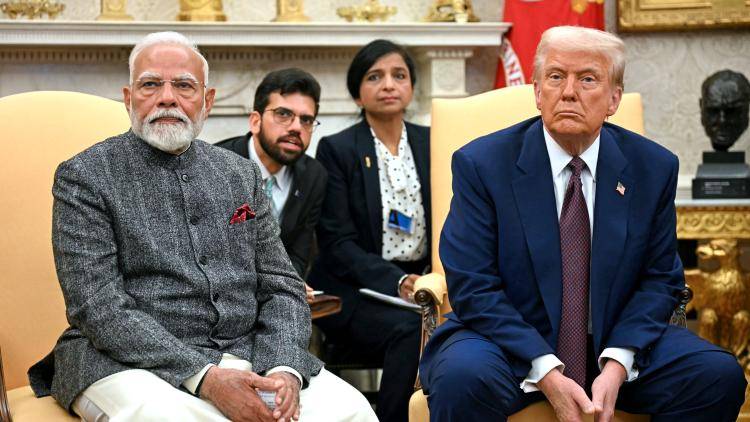
Half of the 50 per cent tariffs that the Trump administration imposed on India in August emanate from the country’s purchase of Russian oil (the other half comes because of their inability to conclude a bilateral trade agreement).
Tariffs were followed in October by the US’s secondary sanctions on Russia’s Lukoil and Rosneft companies, which account for over half of the country’s crude exports (although Indian companies can still buy from non-sanctioned entities).
Indian purchases of Russian crude went up in November, reaching the highest levels since July, as refineries stocked up ahead of the sanctions deadline on 21 November. But this is expected to drop, with Indian companies already responding to the sanctions: Adani, a large Indian trading group, has implemented a ban on the entry of sanctioned oil vessels at the 14 ports that it operates across the country. Reliance, which owns the world’s largest refinery in Jamnagar, Gujarat, has also reduced its purchase of Russian crude.
There has been a simultaneous increase in Indian crude purchases from elsewhere (including the United States) – reducing both India’s exposure to Washington’s sanctions and its trade imbalance with the US – a key grievance of the Trump administration. New Delhi has concluded an agreement for the purchase of US liquified petroleum gas. It is also stepping up imports from the Middle East.
Diversifying engagement
India-Russian trade has undergone significant growth – from just under $10 billion before the pandemic to almost $70 billion this year, with a target of $100 billion by 2030. However, this has been largely driven by India’s import of Russian oil. Putin’s visit can be seen as an effort to compensate for reduced oil purchases by diversifying the trade relationship.
Both sides will seek other areas for cooperation. Indeed, the 26th round of the India–Russia Working Group on Trade and Economic Cooperation recently convened to discuss expediting market access for several Indian products.
The countries are also expected to sign a labour mobility agreement during Putin’s visit, which will establish a framework for the legal migration of skilled Indian workers to support Russia in sectors experiencing labour shortages, such as IT services.
The civil nuclear space is also a key area of cooperation. Russia is participating in India’s largest nuclear power project, and discussions are underway to expand this collaboration to other areas such as the development of small modular reactors.
Another watchpoint during Putin’s visit will be the announcement of new defence deals. Over 50 per cent of India’s in-service military platforms remain of Russian origin. But there has been a steady decline in India’s import of Russian military hardware.
India has not placed any major defence orders from Russia since the start of the Ukraine war. As Moscow has prioritized its own defence needs, India faced delays in the delivery of several platforms (such as the S-400 air defence system) and spare parts. But the trend predates the war – as India has sought to diversify its imports and boost its domestic defence industry. 72 per cent of India’s total arms imports came from Russia in 2010–14, dropping to 36 per cent by 2020–24 (according to SIPRI). New Delhi is also increasingly concerned by Russia’s growing dependence on Chinese components .
However, reports suggest that India will use Putin’s visit to pursue a purchase of Russia’s 5th generation Su-57 fighter aircraft, along with advanced missile defence systems: were such a deal to progress it would signify a renewed confidence in Russia as a defence partner, although India’s long-term direction of travel towards diversifying arms imports and investing in domestic production would remain unchanged.
The brief conflict with Pakistan earlier this year offered India lessons on the utility of Russian military hardware. On the one hand, the S-400 performed well in repelling Pakistani attacks. On the other, the conflict demonstrated the growing importance of drone warfare, which may reduce the value of Russian jets.
Navigating strategic autonomy
India is navigating a difficult path in trying to maintain close relations with both Moscow and the West. New Delhi and Brussels want to conclude a free trade agreement this year. It could create an awkward optics, if Modi meets Putin the same month as India concludes a trade agreement with the European Union (and possibly even the US).