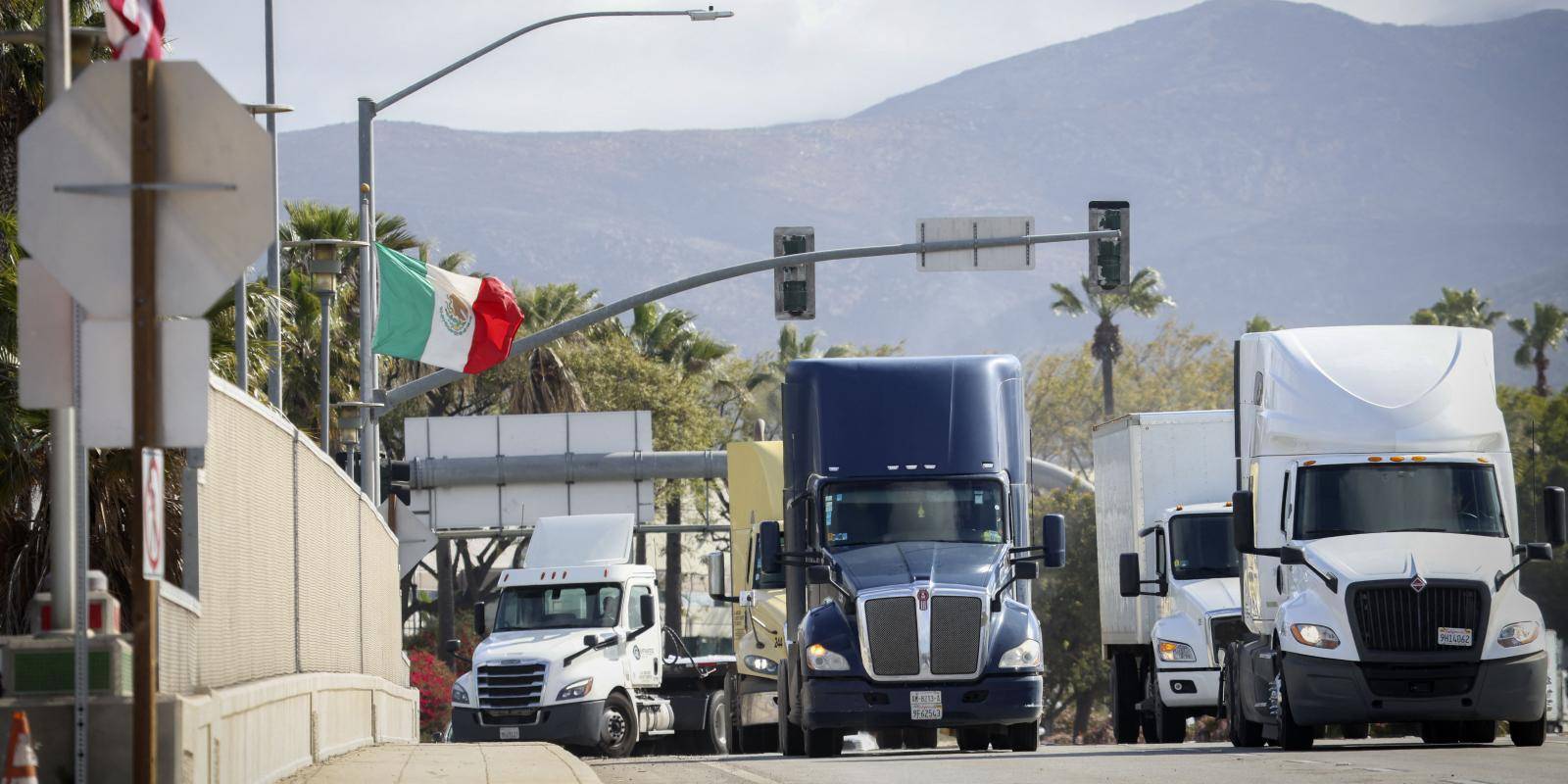

On 1 July, the US announced it would not renew the US–Mexico–Canada Agreement (USMCA) free trade deal in its current form. Mexico and Canada had each confirmed that they wished to extend the agreement for a further 16-year term, but the US declined. Its trade representative, Ambassador Jamieson Greer, said Washington would keep working with Mexico and Canada to address the agreement’s shortcomings and the trade imbalances with both. Crucially, the USMCA stays in effect while those matters are worked through.
The USMCA will now be reviewed annually until 2036. But the Trump administration’s volatile policies intertwining trade and security matters will add to the complexity of these negotiations – especially for Mexico.
US–Mexico trade: from NAFTA to USMCA to tariff uncertainty
The USMCA replaced the North American Free Trade Agreement (NAFTA), in place between 1994 and 2020. US president Donald Trump referred to NAFTA as the ‘worst trade deal ever’, and during his first term he set out to replace it with a new deal. After three years of negotiations, the USMCA came into effect in 2020.
But since Trump returned to the White House last year, things have changed. There is renewed focus on industrial policy and domestic manufacturing, exacerbated commercial tensions with China, and use of tariffs to bring about improvements in non-trade areas such as national security. In this context, trade and diplomatic relations between the US and Mexico have become increasingly rocky and volatile.

On ‘Liberation Day’ on 2 April 2025, Trump announced tariffs of 25 per cent on non-USMCA-compliant goods and 10 per cent on non-compliant energy against Mexico for its failure to stop flows of illegal migration and drugs across the border. Since then, Mexican officials have engaged in a series of negotiations, both through diplomatic and back channels, to achieve three main goals: preserve the free trade framework, cancel or reduce new tariffs and give as much certainty as possible to the future of the USMCA.
So far, Mexico has been relatively successful in achieving these aims: most of the conversations have revolved not around the cancellation of the agreement – as with NAFTA – but rather around a renegotiation. Although different from the ideal outcome stated in the treaty – a ‘simple’ revision – it is not as existentially damaging as an abolition.
Although US tariffs on Mexico are higher than before Donald Trump’s second term, they are far more competitive than those facing the rest of the world. Around 88 per cent of Mexican exports to the US enter duty-free under the USMCA. As a result, even though the headline rates on some sectors are steep – such as 25 per cent on steel and aluminium – the weighted-average effective tariff on Mexican exports is only about 3.4 per cent. By way of comparison, the average effective tariff on Chinese exports to the US now stands at about 22 per cent, while comparable economies such as India and Brazil face 8.4 per cent and 10.6 per cent respectively.
Mexico is also the main trading partner of the US and ranks between the first and third largest trading partner for 36 out of the 50 states, while the US accounts for roughly 80 per cent of Mexican exports. Meanwhile, migration flows have been significantly reduced from more than 2 million encounters reported by US authorities in 2022 to 237,538 in 2025, while US fentanyl deaths were halved during the same period, giving the US grounds to suspend new tariffs.
Mexico therefore retains a clear comparative advantage – preserving it should be the cornerstone of its strategy when negotiating the future of the USMCA.
Negotiating the future of the USMCA
Negotiations between the US and its two treaty partners have thus far been predominantly bilateral, although both Mexico and Canada are pushing for more trilateral talks.
For Mexico, given the extreme uncertainty that characterizes US actions towards Mexico, the government should make every effort to truly understand US priorities and rationale. Understanding the motivations behind Washington’s actions will help determine Mexico’s room for manoeuvre in the negotiations. President Claudia Sheinbaum has also stressed the need to ‘keep a cool head’ when navigating tensions with US. Mexican officials must understand Washington’s concerns in relation to trade deficits and how Mexico is positioned in that rhetoric – but they must also stress Mexico’s stance of cooperation without subordination. Having as much clarity as possible will help distinguish noise from reality in the years of negotiations ahead.
Event recording: The rewriting of North America: How are Canada and Mexico adapting to Trump?
The US refusing to renew the USMCA was a disappointing but expected outcome, given the new context in which no country is exempt from Trump’s tariffs – not even treaty partners. The fact that the treaty will remain in place during the renegotiation is hugely significant in its own right. What is up for negotiation is for how long, what kind of treaty, and how often it is reviewed.
The first point, the duration, was resolved in principle. The USMCA will remain in place for at least 10 more years, until 2036, unless the parties agree on something different in the coming years of negotiations. If the parties have not reached an agreement by 2036, the treaty will expire – although it seems unlikely this would be allowed to happen without something else in place given the importance of North American trade and economic integration.
What kind of treaty it is will depend on the outcome of the negotiations. However, it is important to remember that there will still be tariffs – and markets know this. Mexico is likely to continue bilateral negotiations in which Washington presses for measures to narrow its trade deficit, raise US content in regional supply chains and tighten the rules of origin to curb trans-shipment, among other demands. Mexico, in turn, will push to broaden the USMCA tariff exemptions. The aim of its negotiators will be to confine tariffs to as few sectors as possible, and to keep them as low as possible.