
Latin America’s regional diplomatic history is littered with failed multilateral organizations. Some have disappeared, such as the Union of South American Republics (UNASUR) and the Bolivarian Alliance for the Peoples of Our Americas (ALBA). Others, such as the Latin American Parliament or the Community of Latin America and Caribbean States (CELAC) continue to limp along, zombie projects of once high-minded goals.
This past weekend US President Donald Trump added one of his own.
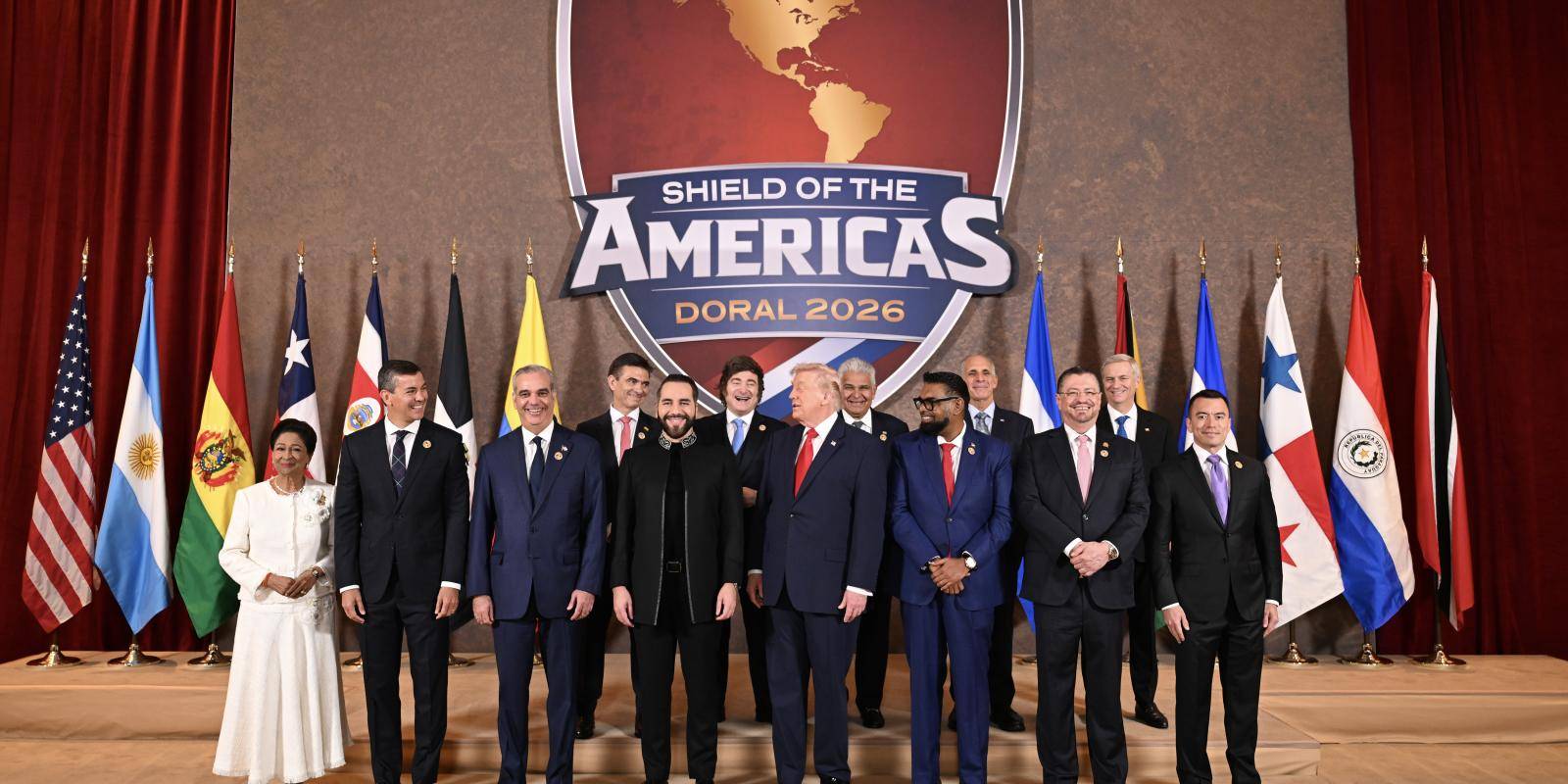
The ‘Shield of the Americas’ sounds much like a new instalment in the Marvel movie series. The first summit, convened on 7 March at the Trump resort in Doral, Florida, was intended to create an alliance to improve regional security and combat drug cartels. ‘The heart of our agreement,’ said President Trump, ‘is a commitment to using lethal military force to destroy the sinister cartels and terrorist networks.’
To that end the president brought together 13 heads of state, including the presidents of Argentina, Bolivia, Chile, Costa Rica, Dominican Republic, Ecuador, El Salvador, Honduras, Panama and Paraguay, as well as the prime ministers of Guyana, Trinidad and Tobago and Jamaica.
All are centre- to hard-right leaders, whom President Trump has either praised (Javier Milei of Argentina, Santiago Peña of Paraguay, Nayib Bukele of El Salvador) or endorsed when they were candidates (Tito Asfura of Honduras).
The others have vocally supported Trump’s policies in the Western Hemisphere. Notably, the sitting president of Chile – leftist Gabriel Boric – was passed over in favour of the president elect, Jose Antonio Kast, who ran promising ‘Trumpista’ hardline policies on crime and immigration. The defence/security secretaries of Bahamas, Belize, Guatemala, and Peru were also present.
Pointedly absent at the Doral-fest were the presidents of Brazil (Luiz Inacio Lula da Silva), Mexico (Clauda Sheinbaum) and Colombia (Gustavo Petro), all of them of the left. This is significant: those three countries represent more than half of the region’s GDP. And they host a large part of the region’s illicit markets including narcotics production and trade – the supposed targets of the summit.
And, even as the usual summit ‘grip-and-grin’ photo-ops took place, with Trump, US Secretary of State Marco Rubio, Secretary of War Pete Hesgeth and newly appointed head of the Shield of the Americas Kristi Noem, the shadow of previous failures loomed.
All Latin America’s defunct or zombie multilateral organizations were founded on laudable goals. But they had fatal flaws. And the Shield of the Americas shares many of them.
Now what?
In the end, the summit produced a half-page declaration, with signatories agreeing to four general points.
According to the official press release, those were: ‘expand multilateral and bilateral cooperation to enhance security’; cooperate in ‘whole of government’ efforts regarding ‘border security, countering narco-terrorism and trafficking, securing critical infrastructure, and other areas as mutually determined’; ‘advance peace through strength’; and ‘join a coalition to combat narco-terrorism and other shared threats to the Western Hemisphere’. Nothing more.
These are noble objectives addressing essential challenges for US foreign policy south of its border. And a new initiative could help deliver a long-overdue re-evaluation of failing past policies. Cocaine production and transnational crime of all sorts have increased over the last half decade.
In Colombia, cocaine production jumped 53 per cent in 2023 alone. Between 2023 and 2024, the US seized more than 45,000 pounds of fentanyl crossing its border, the vast majority produced in and shipped from Mexico, according to the Drug Enforcement Administration. And crime/ insecurity is the number one concern of Latin American citizens according to recent surveys and the International Monetary Fund.
But like many Trump initiatives – and previous failed Latin American multilateralism attempts – there is a telling lack of detail. The thin, four-point official announcement presents no long-term commitments for burden sharing. There are no promises to address the root causes of insecurity and crime – poverty, weak states and corruption. And, perhaps most importantly, no funding has been allocated to beef up security cooperation through regional institutions that can share intelligence, conduct joint manoeuvres and intercept drugs and related financial flows.
Neither are there regionally integrated plans for tracking cross border flows of illicit activities (including narcotics but also illegal gold, timber, and copper, money laundering and human trafficking). And no commitments have been made to independently investigate government involvement in corruption.
Partisanship
Most of all, it is misguided to believe that a summit of only like-minded leaders can establish a meaningful basis for long-term shared principles and cooperation on security and narcotics issues.
The openly partisan nature of this effort hobbles it at the outset. Without Brazil, Colombia and Mexico three of the most important Latin American countries are missing.
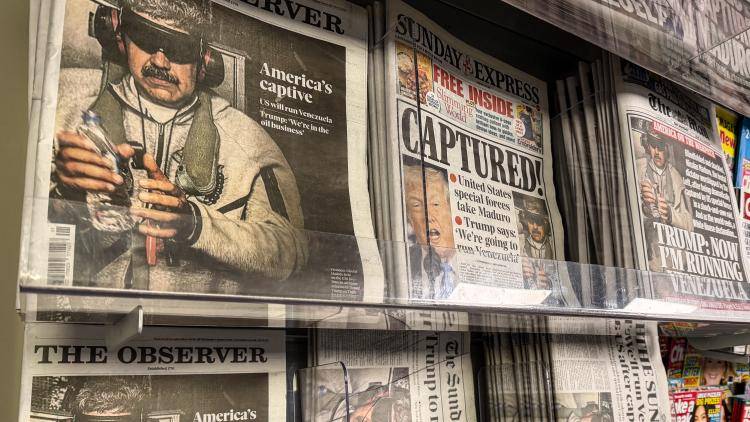
It is unclear whether they were invited or not. But the fact that their presidents were not in the Trump orbit likely contributed to their absence. Their concerns about the president’s so called ‘Donroe Doctrine’, and the spectacular US operation to abduct Venezuela’s former president Nicolas Maduro, may also have played a part. Brazil’s Lula, Mexico’s Sheinbaum and Colombia’s Petro have all spoken out against the operation.
Their absence is a fundamental flaw. Any meaningful hemispheric military alliance that could begin to hope to address the Shield’s lofty goals would need to include these countries.
As the data indicate, Colombia and Mexico are the major sources of narcotics entering the US. And Brazil is the home of one of the largest criminals groups in the region, the ‘Primeiro Comando da Capital (Brazil)’.
Trump may feel that the clear MAGA hue to the Shield of the Americas will make it easier for him to pursue his objectives – which many believe include countering Chinese influence in the region. But past Latin American attempts at regional alliances shows: partisan networking relationships never last.