
Vladimir Putin always chooses his words carefully. If Russia faced a direct attack on Kaliningrad (its enclave on the Baltic Sea), he warned on 1 October, the use of ‘all weapons in (our) country’s arsenal’ would inevitably be on the table.
The statement followed an earlier Russian note to NATO, threatening nuclear escalation if the alliance were to isolate Kaliningrad. NATO, thus far, has responded with restraint. Secretary General Mark Rutte said there was no imminent Russian threat and rebuffed Moscow’s nuclear rhetoric. But this skirmishing has pushed Kaliningrad – and NATO’s Baltic borders with Russia – back into the spotlight.
Kaliningrad is not just any territory for the Russians. At the Yalta and Potsdam conferences of 1945, Soviet leader Stalin asserted his claim to what was then known as Königsberg. It was, he said, necessary for Russia to have at least ‘one ice-free port’ at the expense of Germany. The US and UK consented, and Moscow gained a permanent military position on the Baltic Sea.
After the collapse of the Soviet Union and the withdrawal of the Baltic states to become independent democracies, Kaliningrad’s geographical isolation from Russia became more apparent, creating one of the most peculiar pieces of land on the continent. Today the enclave hosts Russia’s Baltic Fleet, missile systems and combat aircraft.
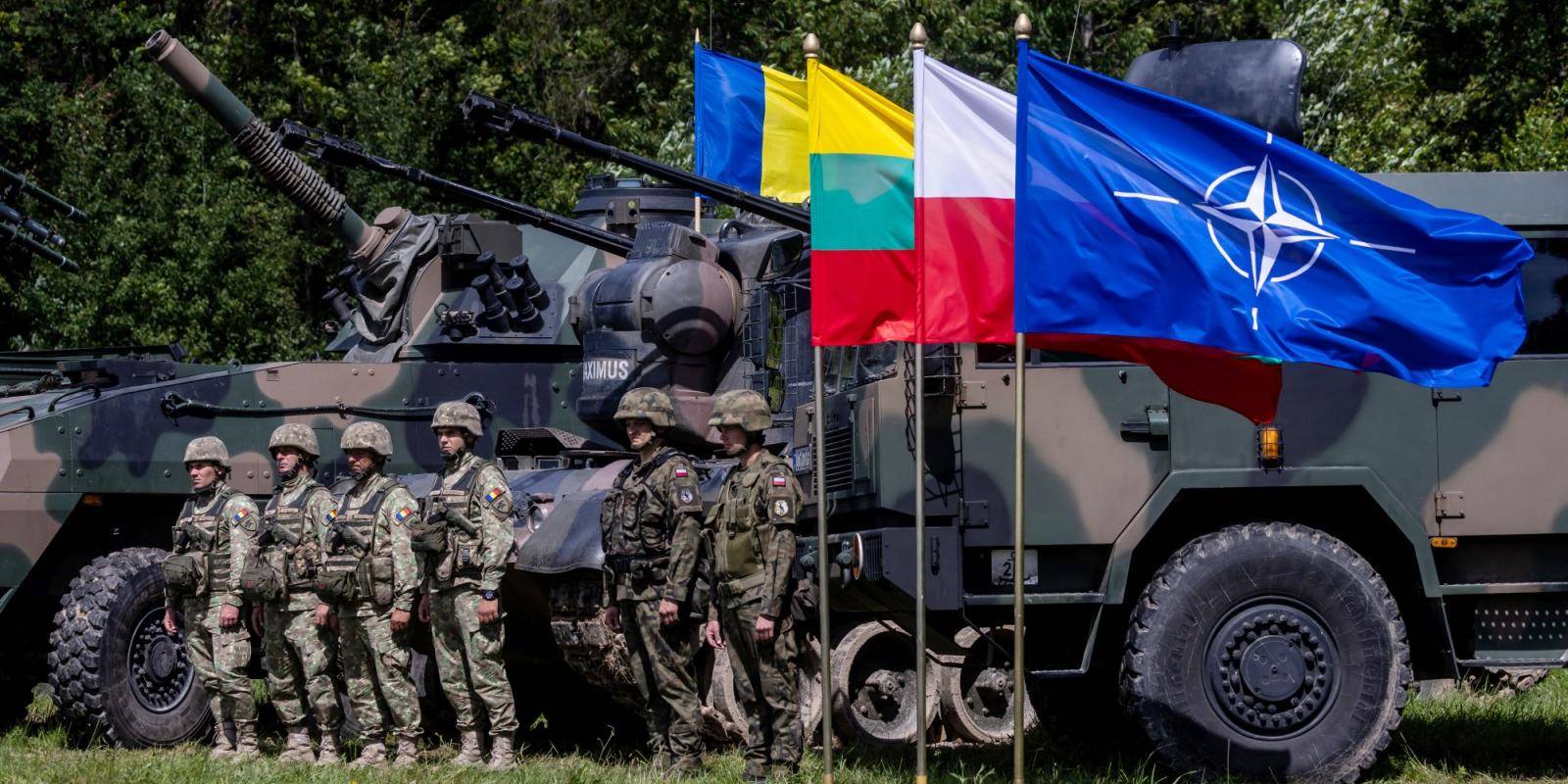
Since Russia’s full-scale invasion of Ukraine in 2022, the surrounding geopolitics has changed. Finland and Sweden are now part of NATO. Poland is rearming at unprecedented speed. And the military presence across the alliance’s north-eastern flank is much denser. Meanwhile, Lithuania may soon vote to lift a ban on hosting nuclear weapons on its territory – a move the Kremlin described on 6 October as ‘a step towards escalating tensions’.
Kaliningrad remains a key forward position for Russia. But its near-complete isolation, in the middle of a more coherent NATO Baltic presence, presents Moscow with a serious geostrategic and military challenge.
Denying Russia a quick victory
One glance at the map is enough to understand that Estonia, Latvia and Lithuania have but little strategic depth. The three states depend heavily on the Suwałki corridor – a 65km strip of land between Kaliningrad and Belarus that connects Poland and Lithuania – for overland reinforcement. Reclaiming territory from an attacker would be an unlikely option for Baltic countries.
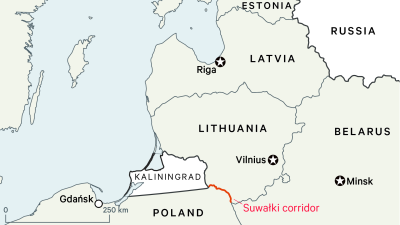
Made with Natural Earth data.
The only credible alternative is to make a Russian advance difficult from the beginning. ‘We have to start from the border and win from the first battles,’ Colonel Tarmo Kundla, commander of the Estonian First Brigade, recently declared.
That is the purpose of the Baltic Defence Line along the eastern border: bunkers, anti-tank obstacles and other defensive outposts. Estonia plans hundreds of squad-level bunkers. A permanently deployed German armoured brigade will become operational in Lithuania in 2027. And Finland now hosts a NATO Forward Land Force. Defence spending across the region has risen far beyond NATO’s old two-per-cent target to reach nearly 5.5 per cent in the case of Estonia.
The intention is clear. Russia must be deterred from any attempt to seize even a small amount of territory – a significant possibility if Russia were to test NATO resolve.
Preparedness before the first bullet is shot
But Baltic defence measures are about more than spending commitments and defending their Russian borders. Baltics countries know that to deter Russia it is just as vital to stress test their critical infrastructure and train their societies to keep functioning if and when a crisis emerges. Indeed, there is a lot the rest of the continent could learn from Baltic states’ whole-of-society model, which seeks to prepare their entire populations for an era of high-threat risk.
From Finland to Lithuania, this model consists of embedding all the layers of society in defence and preparedness strategies. This form of ‘comprehensive security’ is grounded in the belief that keeping the country functioning in a crisis is a shared responsibility of government, business, civil society and citizens. In this regard, the Baltics are the most strategically advanced in Europe.
Estonia, Latvia and Lithuania have accelerated preparations for grey zone conflict of the kind in which Russia excels, including attacks on infrastructure. All three have disconnected their electricity systems from Russian and Belarusian networks, progressively synchronizing them with the continental grid since February 2025. In the meantime, NATO has increased protection of Baltic undersea infrastructure, following damaged cables and various incidences of suspected sabotage.
Slowly learning
Europe’s larger military powers are awaking to the need to somehow follow the Baltic lead and prepare their societies for an enlarging spectrum of threats. Germany, which would serve as one of NATO’s main logistical hubs in any reinforcement of the Baltic region, saw much of its civil-defence architecture fall into disrepair after the fall of the Berlin Wall.
Its shelter capacity, for instance, now covers only around 480,000 people. Last spring Berlin approved a new €10-billion civil-defence programme, including plans to convert underground car parks, tunnels and stations into emergency shelters – evidence of renewed political engagement.
France has tested its armed forces at scale in the Orion 26 high-intensity exercise, which brought together 12,500 troops, 24 allied nations and civilian institutions in a scenario ranging from hybrid attacks to large-scale conventional war. The UK has developed a 2026 resilience plan that explicitly acknowledges growing Russian sub-threshold attacks. And the government is considering a reserve-style home-defence force to protect critical infrastructure.
These are important changes. But ‘E3’ countries are still struggling to jointly improve resilience in transport, healthcare, energy, and communications – even as the risk of an enemy trying to disrupt all of them at once grows.
NATO is moving to drive the task forward. Its newly released resilience baseline requirements ask governments to plan for large movements of populations alongside military deployments; to develop health systems that can function even in case of mass casualties; and to develop communications and transport networks that can continue supporting allied forces during high-intensity conflict. In the near future, these will become the pillars on which deterrence actually depends.
Baltic gaps
Still, resilience won’t be enough alone to vanquish an enemy attack on the region. Baltic air and missile defence remains rather thin considering the scale of Russia’s drone and missile arsenal. Reinforcements would still have to reach the region through corridors like the Suwałki gap. And Russia would seize any opportunity to disrupt such movements. Fundamentally, Estonia, Latvia and Lithuania remain reliant on their larger allies’ ability to swiftly provide additional forces and air power in the event of a significant attack.
This makes Stalin’s ‘ice-free port’ of Kaliningrad more than an isolated flashpoint on the Baltic shores. Putin’s nuclear rhetoric deserves to be taken seriously. Russia revised its nuclear doctrine in 2024, explicitly broadening the circumstances in which Moscow could consider nuclear use. These include threats to its territorial integrity and attempts to isolate parts of the Russian territory.
But the military geography surrounding the enclave has changed too. Once referred to as NATO’s most exposed flank, the Baltics have become much harder to intimidate, and harder still to overrun before NATO can respond.
Their experience also carries a wider lesson for Europe: strategic weight is not measured by size alone, even that of a nuclear arsenal. Agility, civil preparedness and political resolve have allowed small states, free and democratic since 1991, to alter the terms of deterrence at their border.
They have shown Europe that resilience begins long before deterrence fails and that it can change the enemy’s calculation. Their measures will make any attack look potentially far slower and costlier than Moscow would once have believed. Perhaps most significantly after the blatant failure of Russian objectives in Ukraine, Baltic resilience makes overall success of a military attack look far less certain for Vladimir Putin.