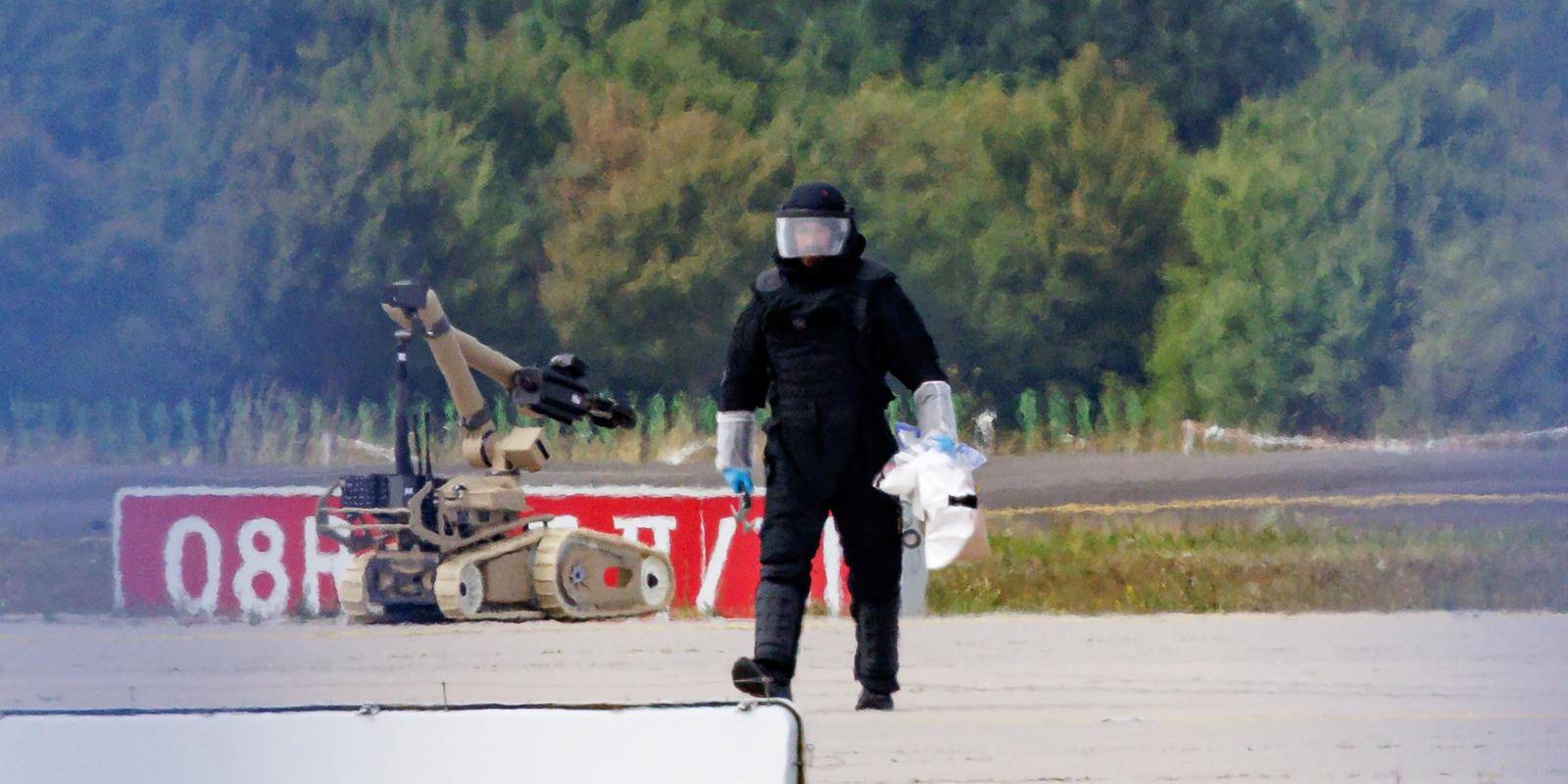

Spoiled food and fires in France, a botched drone attack at Leipzig Airport in Germany and flights grounded by bomb threats in the UK and across the continent are only some of the recent grey zone attacks to hit Europe.
As Europe’s adversaries – primarily Russia and Iran – increase the intensity and frequency of their grey zone attacks, national governments have been cautious and disjointed in their response. Governments need a stronger, collective response to avoid dangerous escalation.
Not quite war, not quite peace
The UK Ministry of Defence defines grey zone, or ‘sub-threshold,’ attacks as those which do not usually meet the legal definition of an act of war. Election interference, disinformation campaigns, cyberattacks, sabotage, harassment from drones, and manufactured security hoaxes all fall within this category.
Recently, Russia and Iran have presented the most significant state-based grey zone threats to Europe. Since the full-scale invasion of Ukraine in 2022, European states have fallen victim to an increasing number of grey zone attacks from Russia. Iran significantly intensified its grey zone efforts in Europe after the US and Israel launched strikes against it in late February 2026. China and North Korea, in addition to non-state actors like cybercrime syndicates, have also been previously accused of engaging in grey zone tactics across Europe.
The appeal of grey zone warfare lies in the ability of perpetrators to sow confusion and disunity among targeted populations and trigger failure in critical infrastructure systems, with the aim of gaining a strategic advantage without having to engage in full-blown armed conflict. Myriad grey zone attacks can strain governments’ resources, divide public opinion and distract attention. Internationally, they can also weaken cooperation towards shared objectives.
European governments see Russia’s grey zone attacks as aimed at hampering their support and assistance for Ukraine. Russia is also likely testing European NATO allies’ capacity to absorb grey zone aggression without triggering its Article 5 mutual defence provisions. Tehran likely aims to disincentivise Europe from aligning with US and Israeli foreign policy objectives in the Middle East and is less likely than Russia to intend these attacks to be the instigation of outright conflict.
Treading too lightly
To date, European national governments have struggled to effectively respond to grey zone activity in a way that deters future attacks.
The nature of grey zone tactics inherently complicates the ability of European governments to respond or retaliate. They usually fall short of explicit acts of war, are difficult to immediately attribute to perpetrators, and mimic natural disruptions.
European governments do not want grey zone attacks to lead to outright direct war with Russia or Iran, but this does not mean that they are not responding to these attacks.
For example, Estonia has already publicly initiated court proceedings against Russian saboteurs who allegedly attempted to commit arson against a UAV manufacturer on 14 November. France has named Iran’s Revolutionary Guards as responsible for the October 2026 supermarket refrigerator hacks.
Germany, too, was quick to identify Russia for conducting the failed Leipzig Airport bomb attack in August 2026, acknowledging in a statement that the attack was part of ‘hybrid operations by Russia and its war against Ukraine’. In the same statement, the government affirmed the likelihood of similar attacks in the future while insisting that Germany is ‘not at war.’ Similarly, the commander of the UK’s Cyber and Specialist Operations Command recently stated that the UK is not ‘at war, but we’re not at peace either.’
European countries have responded to attacks by seemingly accepting that they will be a constant target of grey zone warfare, but they have generally failed to translate these warnings into a wider public awareness of the escalatory potential of these attacks.
Attribution of recent attacks is helpful in establishing blame, but without wider public awareness of Russian, Iranian, and other sustained grey zone campaigns across the continent, there is a risk that the public misunderstands these attacks as one-off incidents.
Europe should acknowledge that it is effectively under coordinated attack and communicate this publicly. Without securing public support for strengthened resilience measures, especially around critical infrastructure, Europe will remain limited to responses that are clandestine, reactive, and disjointed.
Protecting infrastructure
The UK and other European governments must find ways to enhance security measures around critical infrastructure, given the increasing frequency with which it is being targeted. To respond more effectively, governments first need to take more preventive steps to protect their most obvious vulnerabilities to grey zone attacks.
Poland’s army, for example, was tasked in December 2025 to protect key energy infrastructure. Shortly after the freezer hacks in Europe, the UK’s proactive identification of a cybersecurity flaw enabled a cross-sector awareness campaign that prevented a similar hack occurring.

These kinds of measures signal a deeper readiness within national governments to deter grey zone attacks, though they are not without their costs: for example, dedicating military forces to protect infrastructure could impede frontline readiness.
It is also harder for Western European countries to secure the domestic political will required for proactive defence than countries in Eastern Europe that are closer to Russia. In Western Europe, governments are less likely to feel confident to take drastic measures that could be interpreted domestically as initiating unnecessary conflict or increasing defence spending amid rising concerns over the cost of living. In September 2026, for example, only 40 per cent of British residents surveyed by YouGov thought Russia posed a major threat to Europe beyond Ukraine.
Garnering political will
Western European governments therefore need to generate political will for improved defence against grey zone warfare. As a first step towards this, governments must invest in the creation and dissemination of awareness campaigns and resources mapping the comprehensive nature of attacks from Russia, Iran, and other malign actors.
This information needs to be disseminated by verifiable and credible outlets and departments, in anticipation of disinformation already being a demonstrated grey zone tactic. Awareness efforts also must go beyond individual attack attribution and explicitly connect various separate attacks, both domestically and transnationally. Clear messaging enables the public to understand the greater threat posed by grey zone attacks. Governments could also draw upon existing civil society efforts to map grey zone attacks, such as the Ukrainian think-tank Sahaidachnyi Security Center’s sub-threshold warfare tracker, to illustrate the threat to the public.

Increasing public awareness of what is at stake from further grey zone attacks might help persuade the public to support greater defensive measures, including an increase in defence spending to address grey zone vulnerabilities.
This would help governments to make the case for a two-pronged approach of supplying aid to Ukraine while investing in infrastructure security tailored to specific national and regional needs. Financially, this might also be less expensive overall than exclusively focusing on rearming national militaries for a future conflict.
Without a more forward-looking and unified approach to grey zone attacks, Europe runs the very real risk of offering Russia, Iran and other aggressors the upper hand in any future conflict escalation scenario. The risks of inaction far outweigh any costs of acting now.