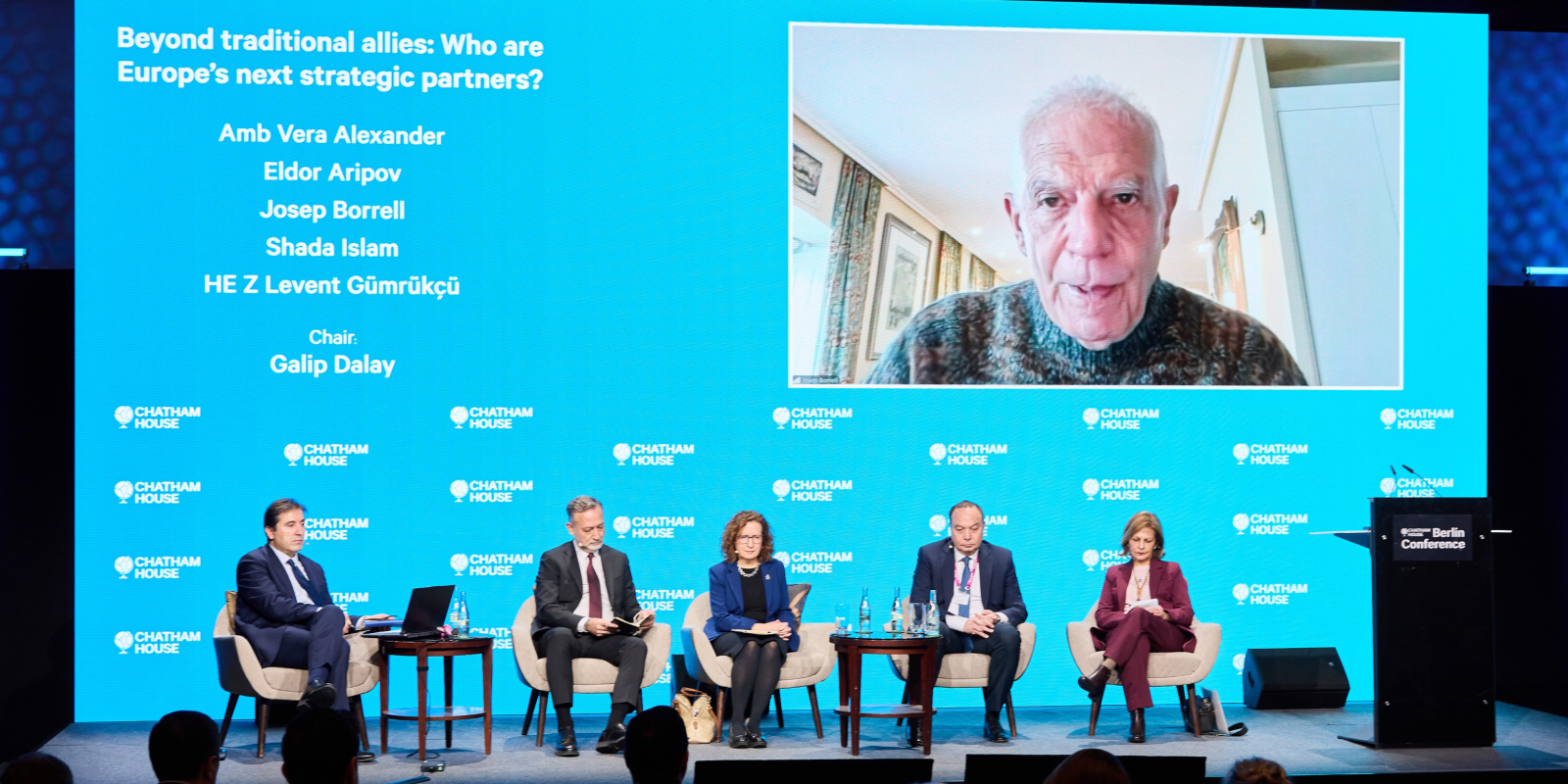

Europe must be credible and avoid ‘double standards’ as it seeks to build relations with Global South countries and other partners, said Josep Borrell, the former High Representative of the Union for Foreign Affairs and Security Policy of the European Commission, speaking on a panel at Chatham House’s Berlin Conference 2026.
He said the recent meeting of presidents Xi, Trump and Putin in Shenzhen was ‘much worse’ than ‘a new Yalta’, in reference to the 1945 summit where Roosevelt, Stalin and Churchill set out the post-war order.
‘In Yalta, they built institutions, and here, the three of them attack institutions,’ he said.
Borrell argued that in this context, while Europe had a lot to offer the rest of the world, including on trade, it needed to maintain its credibility if it wanted to serve as an anchor of a ‘network that makes spheres of influence impossible.’
He said:
‘We have to offer credibility, and there is an important thing for us: it’s not to show different standards. Not to show that in some cases we are in favour and others against. I’m talking about Gaza and the fact that many people around the world claim that we have been using double standards on that.’
‘We proclaim that we have values and we are acting according with our values, but these values have a variable geometry … We condemn strongly Russia aggression against Ukraine, but we say nothing about what’s going on on the Middle East.
‘This is the proof that many countries around the world consider that our values are relative. And this is certainly a political obstacle.’
Shada Islam, a journalist and author speaking on the panel, added that the perception of inconsistency also applied to Venezuela and the US-Israeli war on Iran.
She added that Europe’s ‘authoritarian impulse’ on migration policy and discussions about Islam also led to ‘disenchantment’ in the rest of the world.
‘The coarse and very damaging insults, innuendos etc. that are coming from many of our politicians … When the rest of the world hears that, there is also a certain degree of disenchantment, is the word I’d say, about Europe. People see those double standards more, I think, than they would if it was an external policy affair.’
Islam pointed out that some of the governments making the accusations of double standards were themselves ‘pretty authoritarian’ and ‘pretty much engaged in double standards too.’ She argued that Europe’s strategic assets were ‘people’ and ‘values.’
Outlining Europe’s partnership options, Borrell said: ‘I think partners should be chosen by shared interest in rules, not by geography or ideology.’
He pointed to three circles of partners: democracies with no current imperial ambitions such as Canada, Japan and the UK; ‘swing states’ such as India, Brazil, and the Gulf; and regional organizations such as ASEAN, the African Union and Mercosur.
Z. Levent Gümrükçü, Türkiye’s Deputy Minister of Foreign Affairs, argued that Ankara was already a key part of Europe’s security infrastructure, as a member of NATO, the OECD and the Council of Europe.
Gümrükçü said that the EU’s Industrial Accelerator Act and ‘Made in Europe’ initiative seemed to suggest Europe was preparing to ‘build walls’ around its industry.
He said: ‘From my point of view, this is wrong. I think the road ahead, the road forward should not be “made in EU”, but it should be “made with EU”.’
Borrell said that ‘Turkey has not received the attention that [it] deserves, and clearly [the] European Union has not been proactive in the relationship with Turkey.’