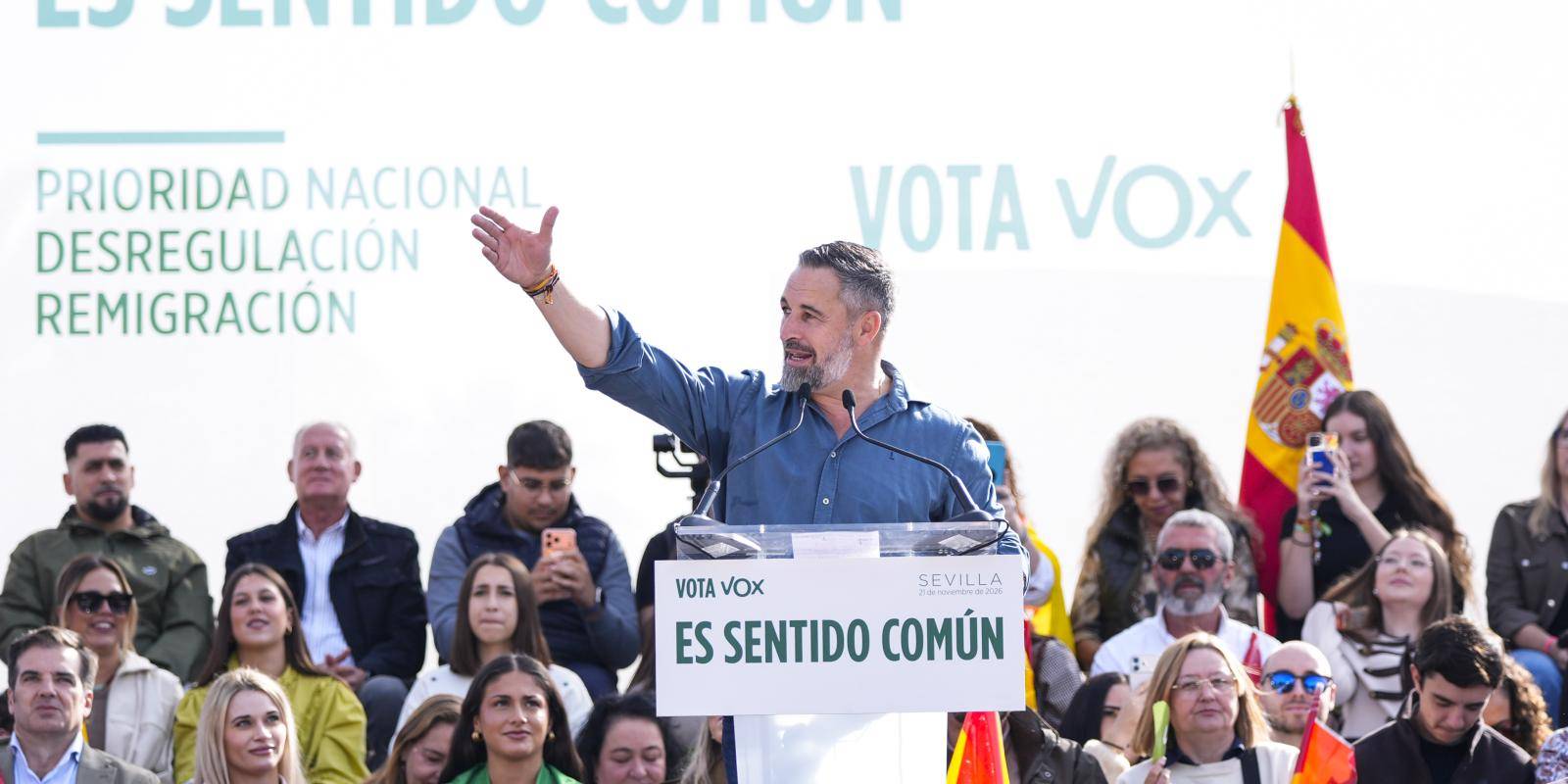

Spain votes on Sunday 29 November in a snap general election called by Prime Minister Pedro Sánchez. Most polls suggest the conservative opposition Partido Popular (PP), led by Alberto Feijóo, will be the largest party but fall short of a majority itself. They also suggest that together with the far-right Vox, led by Santiago Abascal, the right-wing bloc would have a combined majority in the 350-seat parliament.
As of 22 November, Convergent Opinion’s MRP poll put the two parties on a combined 186 seats, 10 above the 176 needed.
It is illegal in Spain to publish polls in the week leading up to the election, which is when data suggests that voters typically decide who to vote for, leaving poll watchers in the dark during the final straight. This may aid the left-wing bloc as voters consider how best to tactical vote against the right.
Sánchez has been clear that the only route to victory for the left is high mobilization – with the prime minister targeting a turnout of 75 per cent. Although the Socialists have gained ground in the campaign, the gap between blocs may be too large to overturn without such extraordinary high turnout.
A PP-Vox coalition government seems the most likely outcome. In this instance, Vox would not just lend its votes from outside government. On current polling it would win between 55 and 69 seats, close to a third of the right-wing bloc. This would be enough to claim ministries and shape policy.
However, it remains to be seen whether Vox choses to pursue its objectives from within government or to exert pressure on a minority Feijoo government. Until now, the PP and Vox have governed together only in regional and local government. A national coalition would give Vox a say in Spain’s foreign policy for the first time. It would also be the first time the far right has been in government in Spain since it became a democratic country.
Elsewhere in Europe, Finland, Sweden and the Netherlands have all brought the far right into government or into formal support arrangements. But Spain is the eurozone’s fourth-largest economy and, under Sánchez, has been the most outspoken progressive government among the EU’s large states.
If Vox is brought into government, Spain will become the test case for what happens when Europe’s centre right drops its barrier to the far right at the national level – referred to as the ‘firewall’ in Germany. It will have direct consequences for Spain’s foreign policy and wider European politics.
Divided over Europe
The deepest divide between the two potential coalition parties is over Europe itself. The PP belongs to the European People’s Party, the group that leads the EU institutions. In 2024, Vox left the European Conservatives and Reformists group and joined the Patriots for Europe, the far more Eurosceptic group that was founded by Viktor Orbán.
On trade, Vox calls the EU-Mercosur trade agreement a ‘betrayal’ of Spanish farmers and attacks the PP for supporting it. If a coalition is formed, Feijóo will need to decide if he will defend a deal in Brussels that his coalition partner back home has virulently rejected.
On Ukraine, Feijóo’s PP supports Kyiv in line with the mainstream European centre right position. However, when US President Trump clashed with Ukraine’s President Zelenskyy in the White House in 2025, Abascal took Trump’s side and attacked the European leaders backing Kyiv. Vox denies being pro-Russian, but Abascal has previously sought to blame Europe for financing the war in Ukraine and his party has repeatedly abstained on resolutions in the European Parliament.
Morocco, migration and Gibraltar
Vox’s manifesto makes ‘remigration’ a central promise, borrowing the term from Germany’s AfD. Yet Spain cannot easily control migration without Morocco’s cooperation. The PP’s Feijóo had pledged to make Morocco his first foreign visit as prime minister, but his tone has hardened since the Ceuta border crisis in the summer. In last week’s televised debate, he called the crisis an ‘invasion’, taking a far more hostile line towards Rabat than Sánchez. Vox, for its part, has vowed to militarize the border – something unlikely to please Rabat.

On Gibraltar, a PP-Vox government would inherit the UK-EU treaty, which has applied provisionally since 15 July. Vox calls it ‘illegal, illegitimate and unjust’ and has pledged to ‘recover Spanish sovereignty over the Rock of Gibraltar.’ Vox will likely press to reopen the issue, and Feijóo would have to choose between a dispute with London and Brussels and a dispute with his own coalition partner.
For British EU ‘rejoiners’, this will be a reminder that the bloc they hope to rejoin is changing. Any future UK application would need the agreement of every member state, including Spain. Other elections across Europe in the next 12 months may see other far-right parties come to power and support Vox’s position, potentially complicating any negotiations if the UK does decide to rejoin the EU.
Part of a wider contest
Foreign policy has been important in this election. Sánchez has told voters that the world is watching Spain and has made opposition to Trump central to his politics.
On 16 November, Sánchez welcomed President Lula to Madrid just weeks after he won the Brazilian election. Sánchez’s supporters have been buoyed by Lula’s victory, as well as by the Democrats winning big in the US midterms. This came after Orbán lost power in Hungary in April.
On the other side, Argentina’s President Javier Milei used a visit to Madrid in October to call Sánchez an ‘unpresentable dictator’ at a right-wing rally. Italian Prime Minister Giorgia Meloni sent a message of support to the same rally, as did Marine Le Pen and Orbán. Elon Musk has called Sánchez ‘a tyrant and a traitor’ over Spain’s plan to ban social media for under-16s.
Spain’s election will therefore be important in setting the tone for an upcoming crowded electoral year in Europe. In April 2027, France elects a president, with the far-right Rassemblement National’s Le Pen leading the polls. Finland, Estonia and Greece will also hold parliamentary elections, while Poland and Italy will vote by the end of the year.
International impact
Centre-right parties elsewhere in Europe also have to decide whether to work with the far right or not. In Germany, the far-right AfD won 44 per cent in Saxony-Anhalt in September, and the centre-right CDU’s firewall is under more strain than ever. In France, Les Républicains have ruled out a pact with the Rassemblement National for 2027, but the call from the mayor of Nice to work with Le Pen’s camp suggested some are unwilling to toe that line.

A divided left is a central factor in the potential victories of the far right. In Spain, the far-left Podemos and the left-wing Frente Amplio failed to agree a joint list in October. Podemos has been polling between 1 and 2 per cent – in Spain’s electoral system this means most of their vote will be wasted. In fact, Podemos has since spent much of the campaign attacking Sánchez and the Socialists, which could also depress left-wing turnout.
The pattern is not dissimilar elsewhere. In the UK, Labour lost ground to the Greens in May’s local elections. In Germany, the SPD has fallen to 15 per cent according to the latest poll from YouGov, equal to the Greens’ 15 per cent, with Die Linke (‘The Left’) on 10 per cent.
Given an increasingly fragmented electorate, centre-right parties may need the far right to govern, as Feijóo likely will now. If a PP-Vox government holds together and keeps Spain close to the European mainstream, it will be cited as proof that the firewall was never needed. But if it splits over Ukraine, Morocco or Brussels, it will strengthen the case for keeping the firewall. Sunday’s election is therefore important not just to Spain, but to Europe and the world.