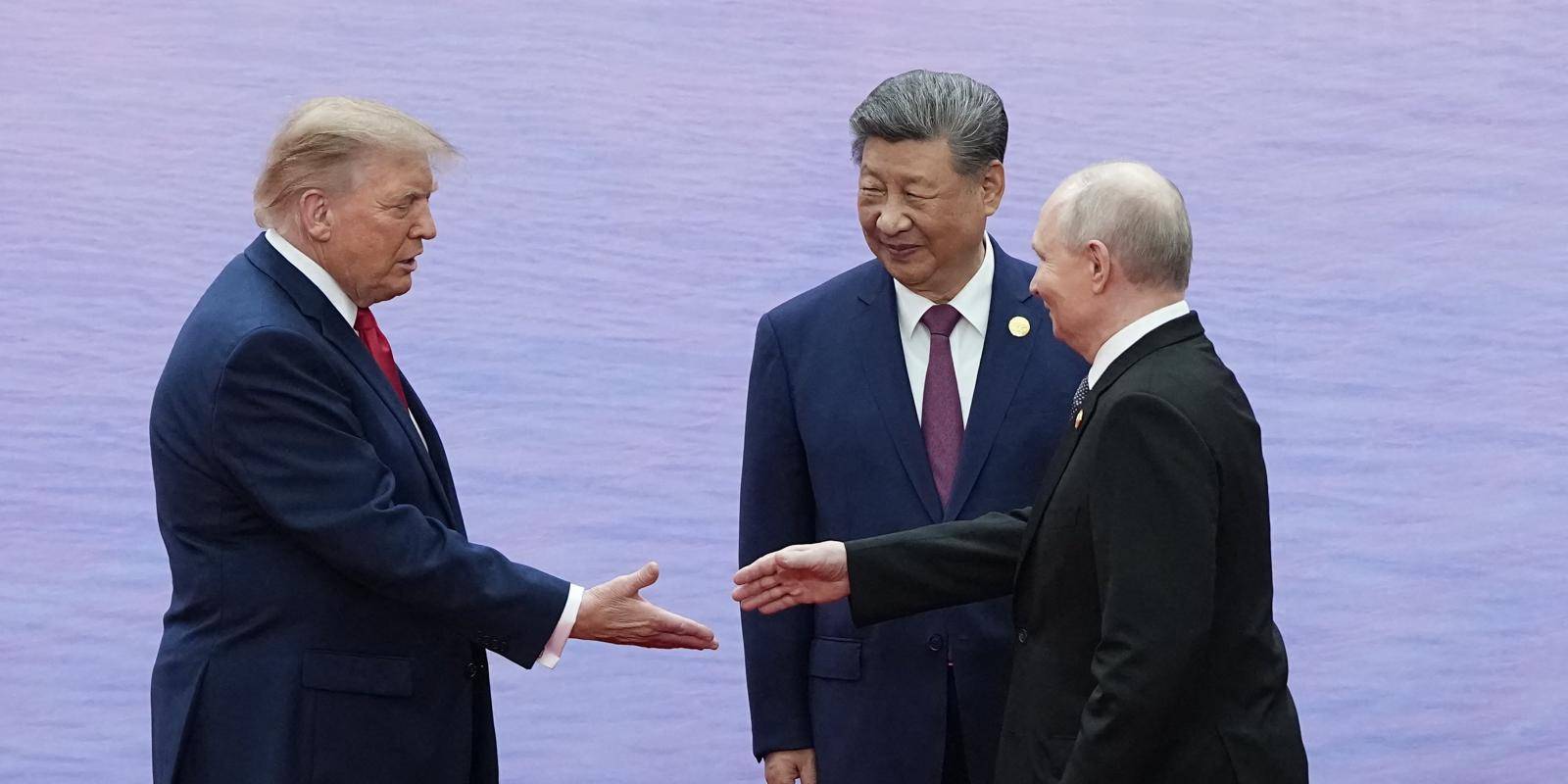

President Xi Jinping, President Donald Trump and President Vladimir Putin might be tempted to accept the comparisons being drawn between their coming talks in Shenzhen on Thursday and the Yalta summit of 1945. There, US President Franklin Delano Roosevelt, UK Prime Minister Winston Churchill and Soviet Premier Joseph Stalin set out the post-war peace, carving up the world between them – though the end of the British Empire was already inevitable.
But this week’s meeting is no Yalta. It is showmanship. Any deals to be done are small – and they are all in China’s favour, unless Trump decides to side with Russia over Ukraine.
For the rest of the world, particularly the UK and European Union, the display is a reminder of the urgent need to shore up regional alliances, the United Nations, and the rule of international law where possible.
The players
Trump has most to lose from going to this summit. The US would have been better off had he not gone. Perhaps he was attracted by the image of standing shoulder to shoulder with two authoritarian leaders he seems to admire – more than he does the leaders of the US’s democratic allies. Perhaps it was the possibility of taking part in a Yalta-like exercise in shaping the world.
If that was his judgement, it is wrong. For a start, unlike the Yalta photograph of 1945 (where the three leaders were seated, concealing the fact that the ailing Roosevelt needed a wheelchair) the US president will not be placed in the centre. That role will go to Xi, as host. But that positioning will also reflect the reality. Xi is the leader of the power with the least need of concessions from the others.
Besides matters of presentation, by attending this meeting Trump surrenders yet again what has been since 1945 the US’s strongest card: that it has been the ‘leader of the free world’, upholding the rights of democracies and acting as a beacon to all those who espouse those principles. Instead, Trump carries the banner of ‘Might Makes Right’ to the summit.
Unlike Trump, Putin has much to gain from this meeting. Russia is no superpower. Its economy is dwindling, with 40 per cent of production diverted to his war in Ukraine. With this summit in mind, Ukraine this week bombed Putin’s prized Kerch bridge to Crimea, built in 2014 after Russia’s invasion of the peninsula. The main span lies in rubble, blocking maritime traffic and the resupply of Russian troops fighting Ukraine.
But standing with Xi and Trump, Putin will look like one of the three main leaders of the world, not the instigator of a war which has cost Russia almost half a million military dead, according to reports – with no end in sight.
The stakes
President Trump is a supplicant at this meeting – to the point where it is dangerous for him to enter into negotiations. He wants to talk about curbing the growth or renewal of nuclear weapons arsenals, partly with a view to bringing down cost. But China has said from the beginning this is a non-starter, given that its nuclear arsenal is far behind those of the other two.
Trump may also want to push China on critical minerals: he has accused Beijing of not making good on the deal struck a year ago in South Korea. But as then, when he threatened tariffs only to swiftly back down when Xi threatened to withhold minerals supplies, he will find he has a weak hand.
He will be similarly on the back foot if Xi presses him to ensure the continued supply of top US chips from Nvidia, whether legally exported or through intermediaries. The defenestration of Jensen Huang as Nvidia CEO over a relationship with an alleged Chinese spy complicates the picture. But the fact remains, despite the weight of opinion in Congress and the opposition of Trump’s top team, Trump, Huang and commerce secretary Howard Lutnick have facilitated the chip trade with China. Should Trump try to change direction, it would not be surprising if Xi threatened to turn off minerals supply once again.
The wars in Ukraine and Iran are not likely to get useful attention from the trio. China has no incentive to get involved in Iran, a war of Trump’s making from which he is trying to extricate the US. And Beijing is quietly stirring the conflict in Ukraine, helping Russia by buying its oil and selling it engines and components used in aerial warfare. Having Europe preoccupied with the conflict suits China fine.
The danger for Ukraine is that Trump uses this summit to try to advance his notion of peace, including giving Russia territory it has not managed to seize by force. It is striking that Ukraine made a point of saying that its strike on Kerch bridge was conducted without Starlink, Elon Musk’s satellite communication system, which it accuses the US of turning off or switching to slower speeds to put pressure on Kyiv.
Ukraine will be able to hold out, but only with European help. There is bitterness among Ukrainian officials that despite the heavy rebuff to Trump in the US mid-term elections, a Democrat-dominated Congress – while talking tougher on Putin – is unlikely to send more funds Ukraine’s way.
Europe, not present at this summit, is in the crosshairs of all three leaders. Trump remains in open dispute with European leaders over their dependency on US defence and alleged cultural decline. China is unhappy about the tariffs the EU is now considering, targeting its exports. And Russia is of course probing European unity over Ukraine.
European leaders, including the UK, need to look hard at this trio and work out their response on security and trade. They have every incentive to work out a common front: a live war is taking place on their eastern flank, as their main security guarantor becomes increasingly unpredictable. And technological competition from China threatens to annihilate their manufacturing industries.
Other countries will look at the same photograph and similarly count their friends and new alliances. The smaller the country, the more it needs the rule of international law and respect for international institutions.
Xi, Trump and Putin may gather believing they dominate the world. But their meeting gives others every reason to look for ways to stand together.