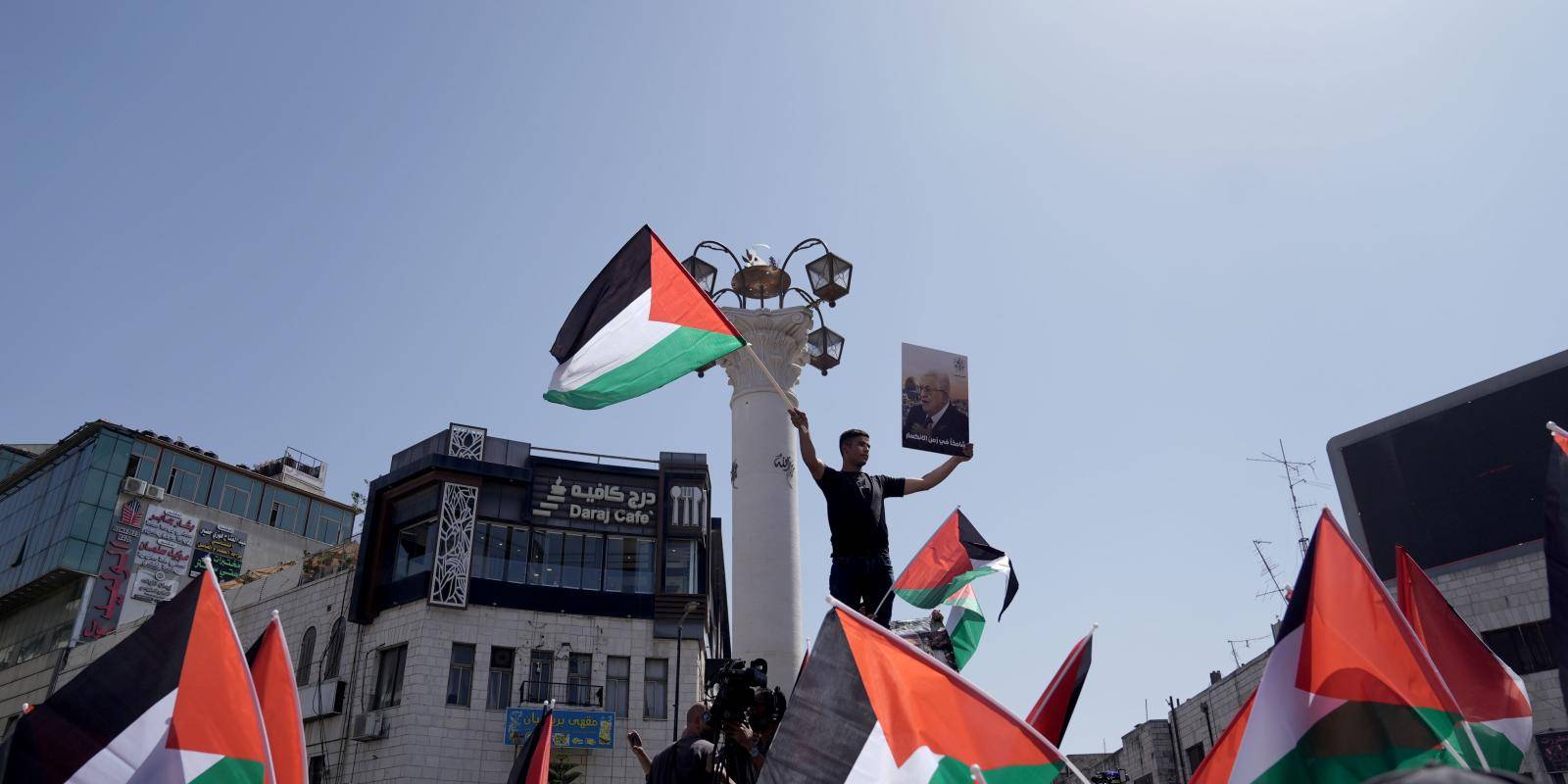
This chapter draws together the recommendations set out throughout the research paper, grouped by the actor responsible and sequenced to reflect the fact that the Palestinian leadership, Arab states or international actors cannot act on every front simultaneously. Immediate actions are those that can and should begin now; short-term actions are those that should take place before December 2027; medium-term actions depend on progress being made on the steps that precede them. For a useful summary please see the table in Appendix 1.
Palestinian leadership and institutions
- Convene a PLO-led structured national dialogue (immediate)
The PLO Executive Committee should convene a structured dialogue bringing together the PA, the major factions (including Fatah and Hamas) and representatives from across Gaza and the West Bank, including East Jerusalem, as well as civil society organizations, professional unions and youth and women constituencies. Representatives of refugee communities and the diaspora must be included. The pathway to statehood depends on a degree of national consensus. Earlier efforts, such as the Beijing Declaration of July 2024, have stalled because they were limited to factional considerations and produced declarations without sequencing or follow-up.
The broader dialogue should therefore work to a published agenda, timetable and secretariat, with Arab hosts or guarantors such as Egypt, Qatar and Saudi Arabia, and its outputs should feed directly into the national action plan recommended below.
- Embed the EU–PA reform matrix within a Palestinian-owned reform programme (immediate)
The PA cabinet, together with the PLO Executive Committee, should formally adopt, endorse and expand the existing EU–PA reform matrix as the basis for a single Palestinian-owned reform programme, with clear institutional responsibilities, benchmarks and timelines. It should cover fiscal transparency, civil service restructuring, judicial independence and security-sector accountability. Each area should have a named lead institution (for example, the Ministry of Finance, the General Personnel Council, the Higher Judicial Council and relevant security bodies), together with benchmarks and deadlines. A programme that originates inside Palestinian institutions is harder to dismiss as imposed or to interpret selectively. It also gives donors one reference point, which supports the common reform framework recommended for international actors.
The PA’s 2008–10 Reform and Development Plan and its 2009 state-building programme show that Palestinian-authored plans can secure donor alignment and measurable results. However, these were also largely technocratic and lacked political legitimacy. The new programme should therefore be anchored in the national dialogue and formally endorsed by both the cabinet and the PLO.
- Establish Palestinian-led reporting and monitoring (immediate)
The reform programme should be tracked by a Palestinian-run monitoring body, independent of donor control, that publishes regular progress reports against the agreed benchmarks in Arabic and English. It could draw on Palestinian civil society, professional associations and research institutions, and its findings should be submitted to the BoP and the UN so that reporting under UNSCR 2803 reflects Palestinian evidence. Without it, progress claims are likely to lose credibility with the Palestinian public and donors alike.
The reporting should include a credible polling exercise among Palestinians in Gaza. It should be fielded by experienced Palestinian research institutions, with the methodology published in advance and sampling that does not depend on the outdated civil registry. This would complement, and allow comparison with, the UN-commissioned exercise recommended for international actors.
- Preserve institutional links between Gaza and the West Bank (short term)
The PA, the PLO and the NCAG should formalize a standing coordination mechanism, building on the PA–BoP Joint Coordination Office, which has convened at least three times. The PA ministries concerned should keep Gaza’s civil and land registries, civil service payroll and legal reference systems within central PA systems. The NCAG should operate under Palestinian law, as provision 6 of the July 2026 roadmap requires. No Gaza-specific legal or administrative track should be created. The end point of the transition must be made explicit (see the red lines on the NCAG mandate below). There is no close precedent for a transitional administration nested within a national authority. The nearest lesson is the PA’s own history, in which an interim body became permanent.
- Revision of succession procedures to enable peaceful transition of power (immediate)
President Abbas holds four leadership posts – he is president of both the State of Palestine and the PA, as well as the head of the PLO and Fatah. The serving president’s advanced age and the uncertainty surrounding national elections at this critical juncture of the Palestinian national project, increase the urgency of establishing transparent, professional and credible succession mechanisms in all legitimate Palestinian political institutions.
Palestinian lawmakers and policymakers should undertake a comprehensive review of the existing legislative framework, including the Palestinian Basic Law of 2003, which serves as the constitutional framework for the PA and includes important provisions that have been suspended for more than two decades. Subsequent presidential decrees and constitutional amendments must also undergo a review with the objective of establishing a clear, credible and coherent legal and institutional framework for succession procedures consistent with democratic principles. For the best chance of success, the process must be grounded in inclusive consultations with political factions and civil society organizations and treated as a priority within a programme of genuine reform.
- Constitution-drafting consultations are an important tool for institutional reform (immediate)
The constitution-making process and related consultations are an opportunity to review the status of the Palestinian institutional structure and identify any gaps. The drafting committee should publish the revised document that followed the consultation process, listing the main concerns raised in the public review and how they were addressed. Additional consultations should be undertaken if needed.
A robust outreach plan should accompany the revision, with accessible feedback channels, online consultation for Gaza and the diaspora, and extended timelines where conditions require. Adoption of a constitutional draft by presidential decree should be avoided, given that unilateral decrees have already eroded public trust. South Africa’s 1994–96 constitution-making process, which was built around a dedicated public participation programme, shows how consultation can lend legitimacy to a founding document. Even if no constitution results from the current process, the consultation itself has value for institutional reform.
- Consider the drafting of a national charter that revamps the Palestinian national project and sets national priorities (immediate)
The constitution-making process and related consultations raised important debate on the trajectory of the Palestinian national project. This debate offers a basis for producing a national charter that sets national priorities. The proposed structured national dialogue above could give birth to such a founding document.
- Clarify the relationship between the PNC, PLC and NCAG (immediate)
The PLO Executive Committee and the PA presidency – with the support of legal, constitutional and electoral experts – should introduce a framework defining the relationship between their respective legislative bodies, the PNC and the PLC, clarifying how they relate to the NCAG before any electoral timetable is finalized.
Clarity is urgently required following the postponement of the PLC elections, the August 2026 decision to restore the PLC to 132 seats and the ongoing process to select PNC members. The relationship with the NCAG creates an additional layer of institutional uncertainty. The NCAG is unelected, its mandate runs to December 2027 (with the possibility of an extension), and its relationship to an elected legislature is undefined. The framework should set out the competences of both the PNC and the PLC, clarify which legislates in Gaza during the NCAG’s mandate, and be consistent with other institutional reforms. The process of producing the framework should also seek advance assurances from Arab states and international partners on whether an elected PLC would be recognized as part of a reformed PA. Without this, the status of the elected body, and therefore acceptance of the results, are likely to remain contested.
- Begin the legal, technical and consultative groundwork for national elections (immediate)
Elections cannot be held immediately. While the 10 October 2026 decree sets 11 September 2027 for elections, Israeli restrictions, divisions among Palestinian factions and the unresolved Hamas question remain obstacles. Preparation should nonetheless start now, led by the Central Elections Commission with full support from all institutions. A priority must be given to updating the voter registry, particularly in Gaza.
The Central Elections Commission should also publish its budget and timetable and finalize the legal framework for elections. International actors have a significant role in securing access for domestic and international observers as well as in the planning for elections in East Jerusalem. Israel’s refusal to confirm whether voting can take place in Jerusalem remains a major obstacle. Therefore, discussions must include the feasibility and scope of elections in East Jerusalem and their centrality to the entire elections process. Limited and or phased voting for East Jerusalem should be considered. Securing a clear international commitment to accept the results should be part of this groundwork.
- Build consensus on a limited set of national priorities (short term)
The outputs of the national dialogue should be consolidated into three to five headline priorities for governance reform and elections. The PLO Executive Committee, with the PA cabinet and the dialogue secretariat, should then translate UNSCR 2803 into a detailed national action plan, with objectives, timelines, roles and responsibilities.
Focusing on a short list prevents reform from dissipating across too many fronts. A coherent national position also gives Palestinians a stronger basis for shaping transitional arrangements and engaging the BoP, rather than reacting to them.
- Define clear red lines on any extension of the NCAG mandate (short term)
Through the national dialogue, Palestinian leaders should agree the conditions that must be met before any extension of the NCAG’s mandate beyond December 2027. Examples include a published handover timetable with milestones, continued application of Palestinian law, no separate legislative or revenue authority, and periodic review with sunset provisions. The PA was itself created as a five-year interim body and became permanent, so without an agreed exit the NCAG could follow the same path by default.
Agreeing these terms in advance could prevent a last-minute choice between accepting externally set conditions and rejecting the arrangement. These conditions should be communicated to the BoP, Arab states and UN Security Council members well before the mandate expires, ideally before the September 2027 elections.
- Introduce a youth quota and non-discriminatory electoral legislation
(short term)
The electoral law should be amended, after public consultation rather than by decree alone, to include a youth quota for candidate lists. The existing gender quota in Palestinian electoral law provides a drafting precedent. A conducive environment for political activity and protection of political freedoms should
be guaranteed.
Candidacy conditions should be objective, published and subject to judicial review. This includes reconsidering the January 2026 requirement that candidates commit in writing to the PLO programme to address concerns that were raised by CSOs following the amendment. Political structures should also be opened to young people without fear of prosecution, through explicit legal protections for candidates and activists and a public commitment by the security services.
- Sequence elections deliberately (medium term)
The 10 October 2026 decree currently schedules simultaneous presidential and parliamentary elections for 11 September 2027. Whether presidential and parliamentary elections are held simultaneously or in sequence should be decided through broad consultations guided by the national interest and by a realistic assessment of the logistical and technical requirements needed to ensure credible elections. Setting an electoral timeline must not be a substitute for ensuring that clear and consistent succession measures are in place. International pressure on Israel is needed to enable the electoral process to take place throughout all its stages.
Arab states
- Support and advocate for Palestinian-driven and Palestinian-led, inclusive reform that is guided by domestic priorities and the national agenda (immediate)
Technical fixes alone will not foster domestic legitimacy essential for sustainable reform. Acknowledgment and endorsement of completed reform processes is essential for progress.
Reforms that emerge from Palestinian priorities are more likely to command public confidence, secure political buy-in and produce lasting institutional change than measures perceived as externally imposed.
- Conditional disbursement of reconstruction funding (immediate)
Arab states should structure reconstruction financing in phased disbursements tied to governance, transparency and security benchmarks. This provides a mechanism for encouraging reform while aligning financial support with improvements in public administration and service delivery.
Saudi Arabia, the UAE and Qatar could release funding in tranches linked to progress in governance formation, financial transparency and security consolidation. Disbursements could be tied to audited payroll systems, functioning municipal services and the deployment of unified police units. For this to be meaningful, supporting countries must acknowledge and endorse progress as benchmarks are met.
- Joint approval of major reconstruction projects (immediate)
Arab states should require major reconstruction projects to receive joint approval from the NCAG, the BoP and donor representatives. Joint approval helps align governance and financing decisions while strengthening political and financial accountability. Coordination with the PA is necessary for preserving the link between reconstruction and the path to Palestinian statehood.
A shared approval process would reduce duplication, minimize delays and ensure that projects are consistent with wider reconstruction and governance priorities.
- Escrow mechanisms and controlled payments (short term)
Arab states should channel reconstruction financing through jointly governed escrow accounts and controlled payment systems. These arrangements strengthen transparency and reduce opportunities for diversion or political capture.
Payments could be made directly to contractors, suppliers and public employees rather than through intermediary political bodies. This would allow donors to maintain oversight while supporting implementation.
- Strengthening PA institutions (immediate)
Arab states should ensure that reconstruction financing strengthens Palestinian institutions rather than creates parallel governance structures. Preserving institutional unity is essential for maintaining links between Gaza and the West Bank and supporting future statehood.
Donor support should therefore be channelled through mechanisms linked to the PA’s central financial accounting systems and established public institutions wherever practicable.
- Technical support and capacity-building (short term)
Arab states should second technical advisers into NCAG-linked institutions to support implementation and strengthen administrative capacity. Building effective institutions will require practical expertise alongside financial support.
Project managers, security advisers, administrative coordinators and audit teams could work within key ministries and delivery units while preserving Palestinian ownership of decision-making.
- Salary financing and administrative compliance (medium term)
Where Arab states contribute to public sector salaries, payments should be linked to verified employment and compliance with agreed administrative standards. Salary support can strengthen institutional coherence when tied to accountability measures.
Verification mechanisms could include attendance records, payroll audits and compliance reviews designed to support effective governance and reduce patronage practices.
- Legal and administrative coordination (medium term)
Arab states should support legal and administrative coordination between Gaza and the West Bank. Preserving institutional links will be important for future reintegration and the development of coherent governance arrangements.
Jordan and Egypt are well placed to assist this process given the influence of their legal systems on the West Bank and Gaza, respectively.
- Regional social and economic connectivity (medium term)
Arab states should invest in regional social and economic connectivity between Palestinians and their neighbours. Stronger regional links can support recovery, reduce isolation and expand opportunities for economic development.
This could include partnerships involving businesses, universities, schools, cultural institutions and sporting organizations, alongside educational exchanges, professional networks and regional tourism initiatives.
International actors (US, EU and UK)
- Act to halt the accelerating annexation of Palestinian land (immediate)
The US, EU and UK should use sustained diplomatic pressure to halt the accelerating annexation of Palestinian land. This requires coordinated positions on settlement expansion, settler violence and measures that erode Palestinian territorial integrity, expressed consistently in public statements, bilateral engagement and multilateral forums.
Without credible limits on annexation, efforts to support Palestinian reform and reconstruction risk being undermined on the ground. Aligned diplomatic messaging, backed by clear consequences for actions that alter the status of Palestinian territory, would help protect the prospects for a viable, contiguous Palestinian state and the unified governance that reform efforts seek to restore.
- Preserve institutional integration and establish a pathway to Palestinian administration (immediate)
International actors should ensure that transitional governance arrangements in Gaza remain administratively linked to Palestinian institutions from the outset. Civil registries, public financial management systems, service delivery mechanisms and personnel records should remain connected across Gaza and the West Bank, while support for the NCAG should be tied to a defined pathway towards Palestinian administration.
This will require active coordination between the PA, the PLO and the NCAG. International actors can support this process by providing technical assistance, dedicated personnel and financial support to help integrate administrative systems and preserve institutional continuity. Working through existing Palestinian structures, retaining experienced civil servants and maintaining continuity of core public services such as health, education and utilities will reduce disruption, preserve institutional memory and limit the emergence of parallel governance systems.
- Ensure reform benchmarks are independently verified and publicly reported (short term)
Reform benchmarks should be agreed in advance, assessed by a neutral multilateral mechanism and reported publicly. A UN-backed mechanism would work best, for example, the Office of the UN Special Coordinator with a technical secretariat from the World Bank or an independent research body. Neither Israel nor any single donor should hold a veto over the benchmarks or the assessments. Palestinian institutions, including the Palestinian-led monitoring body recommended above, and civil society should have a formal channel to submit evidence. Transparent monitoring would strengthen accountability, improve donor confidence and reduce disputes regarding implementation and progress.
Other cases show that this model is workable. The PA is also familiar with parts of it, since World Bank and IMF assessments have long fed into the Ad Hoc Liaison Committee (AHLC), the main donor coordination forum for Palestinians. Three features recur in the other cases. The benchmarks are limited in number and fixed in advance, an independent body verifies them and the reports are published. The three examples are:
- The EU’s Cooperation and Verification Mechanism for Bulgaria and Romania (2007–2023). The European Commission assessed judicial reform and anti-corruption against benchmarks set at accession and published regular reports.
- Colombia’s 2016 peace agreement. The Kroc Institute at the University of Notre Dame provides independent technical verification of implementation, and its findings are published and publicly accessible.
- Northern Ireland’s Oversight Commissioner for Policing Reform (2000–2007). The Commissioner reported publicly on implementation of the Patten Commission’s police reform recommendations. This is a relevant precedent for the security-sector element of the Palestinian reform programme.
The Afghanistan Compact (2006) is a cautionary example. Its Joint Coordination and Monitoring Board tracked benchmarks across many sectors, but their number and ambition outpaced capacity. A short, prioritized list, like the three to five national priorities recommended above, would help avoid this.
- Protect Palestinian fiscal stability (immediate)
The US, EU and UK should use sustained diplomatic engagement to keep Palestinian public institutions and commercial banks financially viable. This includes opposing the arbitrary withholding of clearance revenues and protecting correspondent-banking relationships so that Palestinian institutions and businesses retain access to international financial systems.
- Condition reconstruction financing on clear PA–NCAG responsibilities (short term)
Before committing large-scale reconstruction financing, donors should require revenue, expenditure and administrative responsibilities to be clearly allocated between the PA and the NCAG and published in a transparent manner. Doing so would strengthen accountability and reduce the risk of competing institutional authorities.
- Support Palestinian civil society and local ownership (medium term)
International actors should invest in Palestinian civil society and ensure meaningful participation by municipalities, professional associations, businesses and community organizations in reconstruction planning, contracting and implementation, and in reform efforts. Broad participation strengthens legitimacy, supports democratic renewal and improves the prospects for sustainable recovery.
- Support a time-bound link between Hamas’s disarmament and political transition (short term)
Support for Palestinian political reform should encourage a sequenced process linking disarmament, political transition and future political participation. International and regional actors can help by providing guarantees and monitoring mechanisms that reduce uncertainty and encourage compliance with agreed arrangements.
- Strengthen Palestinian economic and social connectivity (medium term)
International actors should support initiatives that reconnect Gaza with the wider Palestinian economy and society. Priority should be given to educational partnerships, professional exchanges, private sector cooperation and programmes that strengthen links between communities in Gaza and the West Bank.
- Ensure temporary governance arrangements support long-term Palestinian governance (medium term)
The NCAG and associated transitional mechanisms should be subject to regular review and sunset provisions. Temporary arrangements should not evolve into permanent structures that weaken prospects for unified Palestinian governance.
Reconstruction assistance should also be delivered in ways that strengthen Palestinian institutional capacity and legitimacy. Where possible, programmes should work through Palestinian institutions rather than rely indefinitely on international delivery mechanisms, helping to prepare the ground for effective self-government and statehood.
Recognizing states
- Coordinate positions on settlements, governance arrangements and negotiation timelines (short term)
Fragmented, unilateral positions let Israel and other parties treat each state’s stance in isolation and dilute the effect of any single measure. Recognizing states should agree common positions on settlement expansion, annexation, the governance arrangements for Gaza and the timetable for negotiations, and state them consistently in public statements, bilateral engagement and multilateral forums. Recognition by more than 150 states carries real leverage only if it is exercised collectively.
Existing groupings offer a base for this: the EU, the Arab League and the Global Alliance for the Implementation of the Two-State Solution. One approach would be for recognizing states to align their positions with those of the US, EU and UK on annexation and the common reform framework, so that Palestinian leaders face one set of expectations. The UK’s sanctions on settlements, supported by France and Canada, show that coordinated measures are achievable.
- Upgrade diplomatic missions to full embassies and expand bilateral agreements (medium term)
States that recognize Palestine should upgrade their representative offices to full embassies and conclude bilateral agreements in areas such as trade, taxation and aviation. These steps do not resolve the underlying constraints on sovereignty, but they build the administrative and diplomatic infrastructure of statehood and treat Palestine as a functioning state actor. This process would also connect Palestinian institutions with counterparts and legal frameworks for routine government-to-government business, which recognition alone does not provide. Agreements should be sequenced by practicality. Taxation and trade agreements can take effect now, while aviation agreements may initially be preparatory, given current restrictions on Palestinian air access. States that have already extended recognition, including those that did so in 2025, could lead, with others following as their own processes allow. Where appropriate, bilateral agreements can also be paired with direct budgetary support, alongside humanitarian assistance, to sustain institutional continuity.
- Extend preferential trade access and facilitate banking and financial connectivity (medium term)
Recognizing states should grant preferential market access for Palestinian goods and services, accept Palestinian standards and certifications, simplify customs procedures and encourage private sector investment and commercial partnerships. Preferential access on paper is of limited value if Palestinian exporters cannot meet foreign standards or rely on routes controlled by Israel. Recognizing Palestinian certification and simplifying customs procedures should address that gap directly. Existing arrangements, for example, the EU–PLO Interim Association Agreement, show that such approaches are not new, but their benefits depend on practical implementation.
Banking connectivity is a priority area. Palestinian banks remain tied to Israeli banks and the shekel under the 1994 Paris Protocol. Although Israel’s two largest banks previously signalled their intention to end correspondent-banking services for Palestinian banks, those arrangements have been temporarily extended to the end of 2026. Recognizing states could support direct correspondent-banking arrangements with banks in Jordan, Egypt, the EU and the Gulf, working with the Palestine Monetary Authority. This would reduce the risk that Palestinian banks lose access to cross-border financial services.
- Support Palestinian participation in international institutions and back legal proceedings in international courts (medium term)
Recognizing states should support Palestinian participation in international organizations and treaty frameworks, coordinate their positions in multilateral forums including the UN General Assembly, and back Palestinian engagement with international legal mechanisms and courts. Recognition becomes meaningful when it translates into functional international status. The UN General Assembly’s May 2024 resolution, which expanded Palestine’s participation rights and recommended that the Security Council reconsider its application for full membership, gives states a concrete basis for further action. States can contribute by voting and speaking consistently in these forums, offering technical and legal support to Palestinian institutions, and cooperating with the findings of the International Court of Justice and the International Criminal Court within their own legal systems. This strengthens Palestine’s legal status and its capacity to act as a state in the international system.
- Support initiatives addressing Gaza–West Bank fragmentation through recognition-linked programming (medium term)
Recognizing states should treat fragmentation between Gaza and the West Bank as a central priority. Bilateral cooperation, development funding and technical assistance should be designed to reinforce institutional links rather than serve either territory in isolation. Without such measures, recognition risks proceeding while the territorial and institutional split that undermines statehood hardens. In practice, this means funding programmes that span both territories and work through Palestinian institutions. Examples are unified civil registries and civil service payroll, health referral systems, links between universities and schools, and professional exchanges.
To date, European budget support to the PA through the PEGASE mechanism has included salaries and pensions in the West Bank and Gaza, which shows that financing can sustain these links. States could also make new cooperation agreements conditional on arrangements that preserve Gaza–West Bank integration, in line with the connectivity measures recommended for Arab states and other international actors.