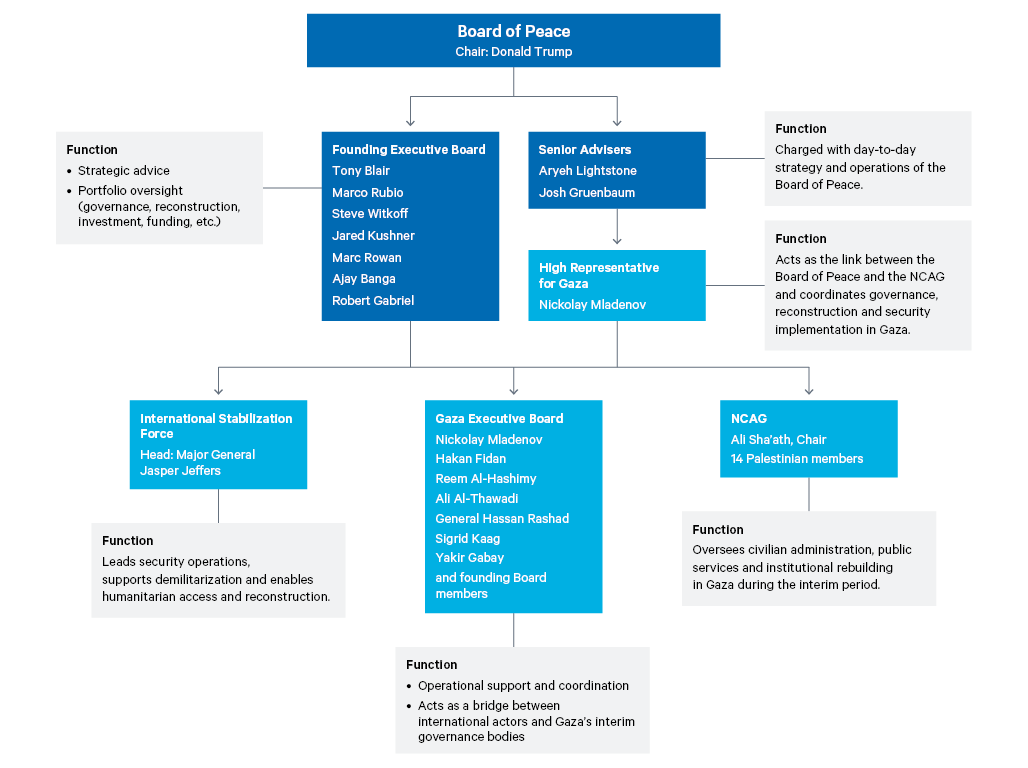
The BoP’s Founding Executive Board is responsible for implementing its mission and authorizing financial controls and oversight mechanisms. Senior advisers Aryeh Lightstone and Josh Gruenbaum lead the BoP’s day-to-day strategy and operations. For Gaza, High Representative Nickolay Mladenov links the BoP with the NCAG, supporting oversight of governance, reconstruction and development, and coordination across civilian and security pillars. A separate Gaza Executive Board, of which Mladenov is also a member, supports the high representative’s office and the NCAG in governance and service delivery.
At the ground level, the NCAG is intended to function as an interim local governing authority, comprising 15 Palestinian technocrats responsible for day-to-day governance, service delivery and institutional rebuilding. While the membership has reportedly been agreed with the support of key Palestinian actors, including Hamas, its deployment and ability to operate inside Gaza remains constrained. The BoP’s first implementation report to the UN Security Council names Ali Sha’ath as NCAG chair and states that the committee has assembled its legal, financial and administrative architecture and vetted candidates for a civilian police force, but that as of the end of November 2026 it had still not been able to enter areas of Gaza remaining under Hamas armed control, meaning no administrative handover had yet occurred.
The NCAG is expected to serve as a transitional administration until December 2027 (although this may be extended), at which point a reformed PA would reassume full administrative responsibility for Gaza and the West Bank. The NCAG’s mandate was initially focused on civilian administration and reconstruction, which left wider political and security questions unresolved. The Gaza Roadmap issued on 30 July 2026 handed the NCAG all civilian governance and security functions in Gaza including the administration and implementation of Hamas’s decommissioning process. The roadmap also stipulated that, ‘[the] NCAG shall operate in accordance with Palestinian laws, relevant international standards and the principles of good governance’. Nevertheless, while Hamas is expected to remain an influential political actor, the future of its security structures remains one of the most sensitive issues facing any transitional arrangement.
The transitional phase and its institutional structure will test whether Palestinian governing institutions can deliver effective and accountable administration while operating under international oversight.
At its core is the question of whether the NCAG will be allowed sufficient autonomy to fulfil its mandate. The transition will also test the BoP’s willingness to implement UNSCR 2803, including its readiness to support a Palestinian governing body in Gaza despite potential Israeli objections. More broadly, any progress will serve as a measure of the commitment of international actors to meaningful PA reform.
Within this context, UNSCR 2803 risks making Palestinian statehood conditional on political and administrative reform rather than treating a Palestinian state as an accepted political objective. This creates a tension with established legal principles. While international law does not guarantee a right to statehood, it does recognize the right to self-determination. Conditioning political progress on reform benchmarks therefore creates a gap between the legal principle of self-determination and its political implementation, which may complicate expectations surrounding both recognition and the future trajectory of Palestinian governance.
UNSCR 2803 has attracted significant criticism for the risks it poses to the long-term viability of a Palestinian state. A key concern is that the resolution may institutionalize the separation of the Gaza Strip from the West Bank, treating Gaza as a disarmed and depoliticized redevelopment zone rather than as a core component of future Palestinian sovereignty. This concern forms part of a broader critique of the policy logic underpinning the resolution, in particular its reliance on an ‘economics first’ approach to stabilization and reconstruction.
Economics first
An ‘economics first’ approach may offer short-term stability. However, in other contexts, it has failed to deliver durable political outcomes when separated from the broader struggle for national rights. An economic revitalization strategy that treats Gaza as a self-contained unit risks weakening its political and economic connection to the wider Palestinian cause.
If economic stability, service delivery and reconstruction move forward in Gaza without parallel political progress towards national unity, statehood and self-determination, then Gaza risks becoming a separately governed territory rather than part of a future Palestinian state.
An economic revitalization strategy that treats Gaza as a self-contained unit risks weakening its political and economic connection to the wider Palestinian cause.
There is a danger that normalizing Gaza’s separation from the West Bank will reduce incentives for political reconciliation and weaken international pressure for a comprehensive settlement addressing Palestinian representation, sovereignty and borders. Therefore, the drive for economic improvement may come to displace efforts by the international community to pursue a political resolution and advance Palestinian statehood.
One way in which this dynamic is likely to take shape is through the operational design of reconstruction itself. A phased economic approach, based on the division of Gaza into so called ‘green’ and ‘red’ zones, where access to reconstruction and services is conditional on compliance with security and administrative benchmarks, risks producing not only uneven recovery but a divided territory. Areas that meet these criteria gain access to reconstruction, employment and services, while others remain excluded, reinforcing inequality and deepening internal divisions.
These risks are not hypothetical. Leaked planning documents informing the BoP’s approach, including the Gaza Reconstruction and Economic Acceleration Transformation Trust plan (GREAT Trust) and Project Sunrise, envisage Palestinians exchanging their property rights for either permanent housing elsewhere in Gaza, which could take years to materialize, or resettlement abroad. Under these planning documents, land titles would be recorded on blockchain in a territory where land administration offices, boundary markers and records have themselves been destroyed. Although blockchain creates a permanent and difficult-to-alter record, it cannot determine whether the information entered is accurate. In a context of contested ownership and incomplete records, mistakes could become difficult to reverse. Reconstruction decisions of this kind will shape not only where services are delivered but who retains a legal claim to remain.
Under these conditions, there is a strong likelihood that such differentiation will become fixed over time, fragmenting Gaza into distinct zones of governance and opportunity. This would make it more difficult to reunify Gaza under a single Palestinian authority and, in turn, complicate efforts to integrate Gaza and the West Bank within a common framework of Palestinian governance. Division within Gaza would therefore pose a significant obstacle to Palestinian aspirations for statehood.
If this scenario materializes under the auspices of the BoP and a UN Security Council resolution, responsibility for sustaining that division would rest with the very organizations tasked with enabling Palestinian governance, which would end any credible pathway to a unified Palestinian state. In fact, Arab states represented on the BoP, the Founding Executive Board and the Gaza Executive Board would share responsibility for this outcome.
Palestinian agency under the proposed framework
The institutional framework built around the BoP and its interim committees limits the role of Palestinian actors, which is an issue that has drawn criticism. A former Palestinian minister interviewed by the authors remarked, ‘while Palestinians have no agency in the BoP/Gaza Executive Board, Israel – represented by a prime minister who rejects the idea of a Palestinian state – sits on the board, and one of the Gaza Executive Board members is an Israeli national. Regardless of how much the NCAG is trained or empowered, statehood is not on the cards under the current Israeli government.’
The administrative fragmentation described above is not incidental. Treating aid delivery, healthcare, civil records and reconstruction as separate technical functions, each without an accompanying national political framework, risks making the question of Palestinian political representation disappear by default rather than resolving it.
The concern that the NCAG could emerge as a political competitor when elections eventually take place, while a legitimate consideration for Palestinian leaders, should not be allowed to undermine its role during the transitional period. NCAG has itself sought to pre-empt this concern, stating in May 2026 that it is ‘a professional, non-partisan body that does not represent any political faction’ and that members’ prior political affiliations ‘do not affect its mandate as a temporary professional body’.
Although the NCAG’s ability to operate effectively, including in Gaza, remains constrained by political and security realities, Palestinian leaders should prioritize measures that preserve political, administrative and institutional links between the Gaza Strip and the West Bank. Failure to do so risks deepening existing divisions and creating separate centres of governance, posing a serious challenge to the territorial and political coherence on which any future Palestinian state would depend. This renewed focus on political reform has not been confined to the electoral track. It has also extended to broader questions about the institutional foundations of Palestinian governance, including the legal and constitutional framework that would underpin a future state.
The two-year transitional mandate set out in UNSCR 2803 marks an important moment for Palestinian leadership and society. It provides an opportunity to address internal fragmentation and for the PA to implement reforms needed to regain control over the political process, though the outcome will depend not only on Palestinian action but also on external pressures and the constraints imposed by continued Israeli policy and occupation.
The outcome of this period will depend in large part on the relationship between a reforming PA in the West Bank and the NCAG in Gaza. Although the PA has no formal governing role in Gaza, its ability to manage both formal and informal engagement with the BoP and the NCAG will be critical to maintaining institutional links between Gaza and the West Bank. This will require regular political dialogue, coordination of public administration and service provision, and efforts to harmonize governance arrangements in preparation for eventual reintegration. A Joint Coordination Office between the PA and the BoP already provides one such channel, having convened at least three times by mid-2026, though its practical impact on service delivery and reconstruction planning remains untested.
Without such measures, institutional and political separation is likely to become further entrenched, weakening territorial integrity and undermining any credible pathway to Palestinian statehood. If this transition period is not used to narrow the administrative and political divide between Gaza and the West Bank, permanent institutional separation will become an irreversible reality. International and regional stakeholders must prioritize the restoration of Palestinian political agency and ensure the reform agenda is tied to a viable, unified and sovereign state.
PA and NCAG: Complement rather than compete
The creation of a separate, quasi-independent interim governance body, in the form of the NCAG in Gaza, risks being perceived as a threat to the authority of the PA and the PLO. These concerns are only exacerbated by the PA leadership’s domestic legitimacy problem and struggles to govern and provide essential services and basic security to the Palestinian population. In this context, a better funded body responsible for governance and service delivery, backed by international and regional support, and operating outside the PLO programme and PA oversight, weakens the leadership in Ramallah and may develop into a credible rival in the event of national elections.
However, establishing a separate, transitional and dedicated structure to deliver basic services in post-war Gaza does not in itself pose a threat, provided the end point of the transition is clear, and sovereign links are maintained through other means. Indeed, if the NCAG delivers effective governance, reconstruction and service provision, it could help demonstrate the value of accountable Palestinian administration and contribute to rebuilding public trust in national institutions. For this reason, the challenge is not the existence of a transitional body in Gaza but ensuring that it remains connected to a broader Palestinian political framework and a clear pathway towards reunified governance. The following section sets out possible frameworks to preserve the link between the West Bank and Gaza, a central requirement for a viable Palestinian state.
Preserving the West Bank–Gaza Strip link
Maintaining connective governance between the West Bank and the Gaza Strip is essential if Palestinians are to preserve a viable pathway to statehood.
UNSCR 2803 mandates the BoP to coordinate reconstruction, governance and security reform in Gaza until a reformed PA is assessed as capable of resuming authority. As of October 2026, the BoP remains largely unfunded and constrained in its operations. The NCAG is not yet in Gaza and continues to operate from Egypt, with deployment tied to the disarmament of Hamas.
The first progress report and subsequent briefings by the UN deputy special coordinator for the Middle East peace process to the UN confirmed that implementation of UNSCR 2803 was significantly behind schedule. Hamas’s disarmament, the deployment of the International Stabilization Force, Israeli troop withdrawal and the handover of administrative authority to the NCAG all remained incomplete, with Israeli forces reportedly controlling more than 60 per cent of Gaza up from 52 per cent at the ceasefire, while the UN’s $4.06 billion humanitarian response plan for the OPT had received only $540 million.
However, on 30 July 2026, the BoP announced that Egypt, Qatar, Türkiye and the US had finalized a roadmap for Hamas’s disarmament and the transfer of governance to the NCAG, with a detailed implementation plan due within 14 days. Hamas agreed to the plan, while Israel rejected it. The NCAG nevertheless welcomed the announcement the following day, affirming that it had ‘completed extensive institutional and operational preparations to take over the administration of the Strip’ and describing its mandate as resting on ‘one authority, one law and one security apparatus’.
A European diplomat familiar with the work of the NCAG told the authors that ‘there are other challenges to Gaza’s governance than Hamas’s disarmament’.
A European diplomat familiar with the work of the NCAG told the authors that ‘there are other challenges to Gaza’s governance than Hamas’s disarmament’. They pointed to the absence of an agreed administrative and legal framework through which the NCAG could govern Gaza once deployed. While these concerns could be mitigated by provision 6 of the July roadmap’s stipulation that the NCAG shall operate in accordance with Palestinian laws, the NCAG’s governance is yet to be tested. Questions remain over whether existing civil service structures would be retained, how authority would be exercised at the local level, and how administrative continuity would be maintained over time.
Even within these constraints, the PA retains the capacity to support governance frameworks in Gaza without formally re-establishing a presence or undermining the role of the NCAG. Continued institutional links make this possible. The NCAG is largely composed of technocrats who previously worked within PA ministries and agencies, while Gaza’s civil and land registries remain integrated within central PA systems under the Ministry of Interior.
At the same time, a Gaza only economic model is unlikely to be viable. Even with support from the BoP, the territory cannot realistically function in isolation from wider Palestinian and regional economic networks. Although Hamas has governed Gaza since 2007, elements of the PA’s administrative, legal and regulatory frameworks have persisted, especially in civil service arrangements and legal reference systems. These continuities provide a basis for maintaining administrative coherence until the PA can resume a fuller political and operational role.
As mentioned earlier in this paper, the relationship between the NCAG and other Palestinian institutions, including the potentially resurrected PLC, must be clarified in order to avoid undermining the institutional linkage between the West Bank and the Gaza Strip. Instead of operating in parallel to the PA, the NCAG should operate in coordination with it.
On this basis, external engagement is less about constructing entirely new governance arrangements than about sustaining and reinforcing existing institutional linkages between Gaza and the West Bank. Regional actors can influence developments by providing incentives, stabilizing fiscal flows and providing political backing, rather than simply exercising direct administrative control. Their role should be to support an interim order that remains, however imperfectly, grounded in existing Palestinian institutions and administrative systems.
International engagement with the BoP and NCAG
The US, the EU and the UK share a broadly aligned approach, while relying on different policy tools and institutional frameworks. All three support transitional governance arrangements as interim mechanisms and maintain that long-term authority should return to the PA.
Each party ties financial and political support to institutional reform, fiscal transparency and the consolidation of governance under a unified Palestinian framework. They support technocratic administration during reconstruction as an interim measure and use financial assistance and oversight mechanisms to guide the transition. All three also aim to prevent interim arrangements from developing into parallel governance structures, insisting that they remain linked to a longer-term political settlement.
International actors retain a range of tools to influence Palestinian institutional reform, though their effectiveness varies by scale, technique and intent. While no single actor can drive reform on its own, coordinated deployment of financial conditionality, technical assistance and political signalling can influence the speed and direction of institutional change within the Palestinian system.