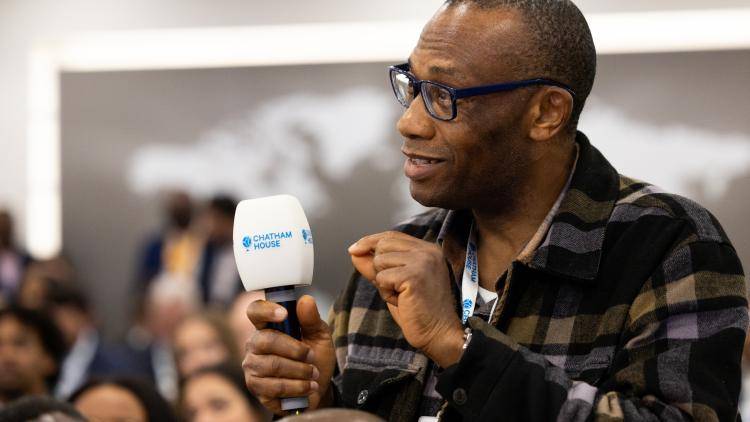
Mike Higgins
…line, you should see a Q&A box into which you can put your questions at any time, and if you want to post any related comments on social media, do please use the #CH_Events, and do tag us @ChathamHouse.
Right, well, even by the tumultuous standards of French politics over the last 18 months, the recent days and weeks have been eye-popping. The French Prime Minister, or ex-Prime Minister we should say, Sébastien Lecornu, resigned yesterday morning after just 27 days in office. Last night he agreed to the request of President Emmanuel Macron to have another go at forming a government that might have a chance of getting a budget through the National Assembly. Lecornu said he would let Macron know by tomorrow evening whether this is possible or not.
It’s notable that it’s been reported this morning that the leaders of the far-right National Rally Party have said that they “will not take part in talks with Lecornu,” all of which leaves Macron in ever deeper crisis and France on the brink of, well, what exactly? Its fourth Prime Minister since last summer, another round of parliamentary elections, or perhaps Macron’s own resignation. His longest serving Prime Minister, Edouard Philippe, has called for him to do just that and resign this morning. Whatever the next step, the implications are likely to be profound for France’s politics and for its economy, and they’re likely to be just as profound for the politics, economy and security, indeed, of the European Union. I’m sure all of your questions will get into that, in the meantime, Grégoire, over to you.
Grégoire Roos
Well, thank you very much, Mike, and I’m really happy to be here onstage. I’ve joined the institute a week ago, already on track for great conversations, and it’s great to have a hybrid format, which means that we’re privileged to be joined by over 80 of our members online, but there are also a few of you here, so it’s really great to connect.
It’s interesting you said that Lecornu was no longer Prime Minister, because constitutionally, actually, he still is, although he’s just in charge of ‘ordinary affairs,’ as they say it. But the fun part is that Ministers are expected to hire their Advisors, which they’ve been doing, which is one of the many jokes that we’re – that we have at the moment, is that public money is spent on – and that, of course, has provided the far-right with wonderful arguments against the so-called “elites cutoff from reality.” So, they’ve been hiring their staff because they need staff to, as the quotes say, “expedite the ordinary affairs.”
When I look at what is going on, has – what has been going on for the past 48 hours, as someone who’s been monitoring politics ever since I was born, and as far as French politics is concerned, perhaps even when I was in my mother’s womb, I think of what Churchill said about Russia, “A riddle wrapped in a mystery inside an enigma.” And I must say that it applies quite well to what’s going on in France, because when you look at it constitutionally, the President, so who’s the Head of State and Head of the executive power, is the most powerful person in one’s country amongst all G7 countries, and you would expect a minimum of institutional stability.
What we have seen for the past 48 hours is unprecedented since the end of the Second World War. And French politics has been through some twists, ups and downs, the most significant one, perhaps, was in May 1981, when François Mitterrand was elected President, the first Socialist President since the liberation in 1945, and who brought Communists. He had been elected on a platform, a common agenda, with the Socialists and the Communists, and back then, everyone on the right, or at least those who hadn’t voted for Mitterrand in the Communists said, “You will have Soviet tanks on the Champs-Élysées on the following day and then the stock market will collapse.” Nothing happened, and very quickly, Mitterrand, who was fitted for the clothes of President of the Fifth Republic, of Charles de Gaulle, very quickly got into the post and ran things relatively smoothly.
Then you had chapters of what we call ‘cohabitation’, whereby back then, the presidential term was only seven years and legislative – only – was seven years, now it’s only five years, but you would have parliamentary elections every five years. Which means that you could technically have a Parliament of a different majority, political colour, than yours, which happened for the first time in 1986. So, for two years, he had a cohabitation with Jacques Chirac, then Mitterrand got re-elected in 88, dissolved Parliament, had a majority for five years. Another parliamentary election in 1993, had a cohabitation with the right for two years, and then you had Jacques Chirac, who made the mistake of not dissolving Parliament, but did so two years later, and ended up with five years of Socialist Party rule, during which he couldn’t do anything but focus on what the Constitution provides him with the possibility of doing, mostly foreign and security and defence policy.
But what we have seen over the past year is just unprecedented, simply because we have a President that was elected twice, and this has never happened since – this hadn’t happened since Jacques Chirac, but back then, Chirac, just, like, Mitterrand, had a cohabitation. So, technically, they didn’t really have the executive power. Macron had, because his Prime Minister and his majority was his Prime Minister and his majority. So, first time in the history of the Fifth Republic that a President was elected twice without any cohabitation, and that perhaps, at some point, you need to have a crisis because you – when you have the cohabitation, you have a, kind of, space that you use to let your Prime Minister and the majority from the other party being worn over, if I may say so, and this was not the case. And so, there was a lot of exposure onto Macron and his Prime Ministers, with institutions that have become more presidential, and we’ve seen a shift from a lot of power in the hands of the Prime Minister to the hands of the President. Which means that if something goes wrong, back in those days, the voters would blame the Prime Minister and the President would leave unscathed. This has changed and so, all the blame goes to the President.
The idea of dissolving Parliament a year ago, just before the Olympics, was a risky move simply because we all know, even here, I mean, it’s fresh memory in the UK, you had European elections not so long ago, voters vote for European elections, they don’t vote for domestic policy. They’re just interested in possibly showing their anger towards the Prime Minister and the majority, but, you know, you take this as a peripherical matter. And the President just took it – perhaps there was a mix of over self-confidence, arrogance, hubris and I think hurt pride that led him to say, “Okay, you – I lost those elections because the National Rally, you know, ranked first sig – with a significant margin. Then I’m going to dissolve Parliament because it will give back some air.” While the fact is, the political environment in France landscape was so fragmented that you ended up with a hung Parliament.
But on top of that, you have a real, which is something that is perhaps a bit underestimated abroad, rejection of the personality and the prose – the person of President Macron. Which has led to every single party doing their best to make sure that he would be weaker day after day and simply not succeed. The last 36 hours have showed that – you’ve mentioned the National Rally was not interested in joining the discussions. I think they aren’t interested in keeping President Macron as the President. It’s clear that no-one would have imagined that his last – or two of his former Prime Ministers would say within 12 hours that he would need to go. One said so openly this morning, Edouard Philippe, who’s the lead contender in the next presidential election, centrist coming from the Republican Party. And the other was Attal, the much younger PM, who really didn’t like being imposed the de – the snap elections last year, then lost power, had to leave the Prime Minister’s office, and said yesterday, “I no longer understand any of the President’s decisions.”
So, that was a big blow within what is – what was still supposed to be until this very morning, his majority. And then you had the main ally party, the Republican, that used to be one of the – the equivalent, all things being equal, of the Tories here. So, a really significant party with Sarkozy as the last President. Sarkozy, it’s another Question Time, I guess, to talk about Sarkozy. I think it’s – it shows one thing, that we might see, if not the end of the Fifth Republic, at least a significant threat to the political stability of a country that had always been, you know, more or less challenged by local revolts. I mean, it takes back to up to the 16th century to see local rebellions against too high taxes. So, French, you know, the French have a ratio of tax to GDP of 44%, which is – sounds incredible. It’s the highest in all of the OECD countries.
At the same time, you have a debt that is skyrocketing, and which means that you simply cannot afford to increase taxes, although you have some parties who would apparently be very keen on doing so, which means that the leeway of any potential government is non-existent. And the only solution – now, you have two options, and we’ll know by tomorrow evening what the President decides to do, either he tasks Sébastien Lecornu with forming another Cabinet. That’s what he’s asked him to do, but then you would need to have a, kind of, technical, technician government, like, a Mario Monti, sort of, Government. France has never tried that but, you know, there’s a first time for everything in politics. And the second option is dissolving Parliament with no guarantee whatsoever that he would manage to rebuild a, sort of, if not majority, what I would call ‘minority majority’, whereby you have 30% of the vote, 35% of – the seat, sorry, and then you manage to have one ally. But who would the ally be today? I mean, good question.
The third option, which honestly, when I mentioned it a year ago, everyone was laughing, six months ago, everyone was laughing, and now it’s on everyone’s mind if you read the French press, it’s just Macron standing down. Most interestingly enough, there was – it’s quite breaking news, to be honest, there was a comment from a former IMF, rather senior Economist, who said, “If your President does not step down, markets will make sure he does.” I think the level of almost brutality of what is unfolding before our very eyes is unprecedented. It echoes what Berlusconi, in a way – again, all things being equal, France is not Italy, the context was different, had to go through in 2011 when markets, somehow encouraged by Angela Merkel and Nicolas Sarkozy, forced Silvio Berlusconi to step down. So, it’s not the same constitutional system, the French President really was anointed, like the Kings are, with the holy oil, the French President is anointed by the people, the only sovereign. So, you know, only you can step down, markets cannot force you, but that would be a first time.
So, I’ll end on one point. I think we are witnessing with a 20, 25, almost 30 years actually, hindsight, the limits of the five-year term, which has introduced and some constitutionalists in France have stressed that, a, kind of, instability. When you had a seven-year term for a President with parliamentary elections more or less in the middle, that would provide the Head of State with more flexibility and a greater distance from the events. Now every single President that has behaved de facto a bit like a British Prime Minister, ruling the show, is facing the wall. It’s not good for France. It is not good for Europe. Germany is not happy at all and the French have said, “Yeah, but we were very patient when your last coalition couldn’t deliver, so please be patient with us now.” It will be interesting to see where things go.
The French were very happy to see Merz come in, and the moment Merz comes in, the French lose any, sort of, impetus in – at the European level. And it’s, of course, not good for Europe, generally speaking, when we need to, you know, get our act together to bring back some – or build some geopolitical, if not resilience, at least relevance.
Mike Higgins
Thank you very much, Grégoire. I noted in your consideration of some of the options there, the potential resignation of Macron himself, or the continuation of Lecornu with some, sort of, technocratic, technical government, you didn’t address whether new parliamentary elections might be called. I mean, there have been calls from left and right for that to happen. Is there any suggestion that were new elections to be held, new parliamentary elections to be held, there’d be any break in the gridlock in the National Assembly?
Grégoire Roos
Oh, I mean, it is the question, as I briefly mentioned, it’s one of the two optio – I mean, technically you have three options. Again, either the President dissolves Parliament, either he calls for a referenda on some specific issues saying that Parliament is not able to pass bills, only the people can. I think this is unlikely, and third, he just steps down. His personality is such that he would refuse to do so unless, you know, people take to the streets and markets say, fine, but then your debt will not – you will not be able to pay it back, and now it’s – the first budget expenditure is debt in France.
I don’t see really how you cannot not end up with a hung Parliament again. The left bloc is still extremely strong. If you – if you just look at the projections of the next presidential election, if you add up Mélenchon, the hard left, with – and I’ve forgot his name, of course, the Head of the Socialist delegation in the European Parliament, Glucksmann, it’s almost 30%. It hasn’t changed. If you look at the – what the left bloc – the ‘New Popular Front’, as it’s called, represent in Parliament, it’s around that, 30 to 35. The National Rally could go up, that is for sure, especially now that Marine Le Pen cannot run.
So, technically, if Marine Le Pen – if they are snap elections, it might be the end of Marine Le Pen political life, because she cannot run in any election until she hears the decision of the appeal judgment in January that either overturns the first instance judgment or confirms it. In which case she will not be able to run in any elections for the next five years. But any case, if there’s an election now, she – she’s currently a Member of Parliament, she won’t be able to run, so it might be the end of Le Pen. So, just that, that simple fact, would actually change things.
The Republican Party, I – it’s unlikely they will significantly increase the number of seats. I think the Chairman of the party, and now it’s becoming very party political, but the Chairman of the party who had served as Minister of State, Minister of the Interior, whether he agrees or not, but is the reason of somehow, of that – of those developments because he was appointed – reappointed Minister, same position, same portfolio. And then apparently was not informed that his nemesis, Bruno Le Maire, who was the longtime Economy Minister for Emmanuel Macron, and have left the Republican Party in 2017 to support Macron, had been appointed Minister of the Armed Forces. And that was the argument, that apparently, he heard it on the radio, to say, “If that’s the case, then, no, I won’t join the Cabinet, and I’ll call a meeting of my board tomorrow.”
So, I don’t see that – and many French voters, including on the right, saying, “This is not serious. There’s something more important than your party, it’s your country,” at a time when, you know, markets just are behind the door. And just – so the only solution would be to perhaps have Edouard Philippe’s party getting more votes, but does that mean that we could have any party with more than 40% of the seats? I very much doubt it. That is why it is not unlikely to imagine the following scenario, that Emmanuel Macron would want to win time, call for snap elections, and depending on the results, saying, “Okay, I have no other choice, I’ll step down.” Or, “I manage to have to a, kind of, a 40% coalition and I can stay until May 20 – 2000 – to 2027,” which is in less than 18 months now.
Mike Higgins
Thank you very much, Grégoire. I’m going to turn to questions from in the room and also, online. In the room first, please put your hand up and the microphone will come round. We’ve got a question here and then we’ll take a question on the left.
Ignacio Pérez
Thank you. Ignacio Pérez from Mitsubishi Corporation. I wanted to ask about this scenario of, you know, even if you have new elections, you might again, end up with a hung Parliament. It – well, there’s a wider trend across Europe of fragmentation of political systems, right? Is this – maybe this is a bit of a twisted question, but is this crisis necessary for France to learn how to manage a, sort of, multi-party system? Because you said, right, you nee – you’re going to need a, sort of, coalition, whatever the outcome is, right? A similar thing happened in Spain five/six years ago, where, you know, you’re no longer going to have a single-party government ever, or it’s very difficult to see it going another way. Thank you.
Mike Higgins
Do you want to answer that?
Grégoire Roos
It’s an excellent question, absolutely excellent, and I’d love to break it on the streets of Paris and throughout France, because the answer is no, unfortunately. The main reason being that Italy, the UK, Belgium, Spain, that on paper, exception of the UK, are unmanageable, but they’ve always somehow managed to make it work because they have the culture. It’s like the children in the room and you won’t have cookies until you’ve agreed on a solution. The French can’t because it’s always been an unmanageable country where everything had al – has always been centralised. You had the King brought down because of an excessive centralisation, and by the way, high debt, and by the way, high taxes, end of the comparison.
Second, you had the interwar period, didn’t work well because it ended up with Marshal Pétain being given all the powers, by all of those parties, by the way. And then you had the inter-period between the end of the war and the Algeria crisis, where those parties could not really solve the crisis, so they called General de Gaulle, who designed bespoke constitution to suit his personality and the vision he had of a strong power. What I’ve heard – but if I take a step back and I say, can we change? Because after all, if humans can change, perhaps so can political systems shaped by humans. The thing is, with the current personalities we have, it is absolutely impossible.
When you hear that parties say, “I have not even heard what the Prime Minister has to offer me, it’s a no,” and some even said, “I will censor him in Parliament,” in Germany, you would not even hear that. And it’s not impossible that in Germany, the AfD gets elected in four years. Of course, won’t have 50% and might be forced to work with CDU. They don’t like one another, but they won’t have any other choice. Same goes with Spain and especially in the Netherlands and in Italy.
So, in the short run, the answer is no, and that is exactly why we are where we are, because there’s an absolute inability of trying to crack a deal. When, you know, you say, “I want a 60% tax on anyone earning more than,” I think, 100 and – “more than 100 million estate wealth,” and the others say, “No, I want nothing.” But you can’t want everything on the one hand and nothing on the other, you have to meet halfway. You don’t have that yet. When the IMF sits in the Prime Minister’s office, things might change. But it’s an excellent question, and, unfortunately, the answer is no. The question is then I could – as an answer, I would ask the question, what will it take for not just the French people, but especially Politicians in France to understand it’s about time to change? I think the answer will be painful.
Mike Higgins
Thank you very much. I think we have a question over here on the left. Thanks, Eliza.
Thomas Maddock
Thank you, Grégoire. My name is Thomas Maddock, and I’m a Researcher at Chatham House. My question is about the Franco-German engine, which you briefly mentioned. Specifically, Chancellor Mertz and Macron have sought to, kind of, re-kickstart the engine, and I just wanted to ask, how do you see this crisis, kind of, impacting on that relationship? Thank you.
Grégoire Roos
Goodness. Unfortunately, it will. As I said, for four years, there was a real leadership with a real vision. Whether one agreed or not with it, it’s another question, but of President Macron, and no answer from Berlin, for many different reasons that I won’t cover here. Now, it seems to be the other way around. You have real leadership from the German Chancellor, on Ukraine, on European defence, on European defence industry. On somehow – at last, we hear about how to implement part of the Draghi reports, but now it’s – the imbalance is extremely strong. That might also be why there might be, although it will be painful, but there might be a, kind of, a secret, if not inconscious [means unconscious], expectation from Berlin to see Macron step down to start anew with someone else.
Now I will ask a second question, and this is the greatest fear that somehow builds on the gentleman’s question. Okay, you will have a new President, but will that President have a majority? I’m not so sure, and for Berlin, it’s a significant problem. So, the second question is, you know, nature hates vacuum, so Berlin’s eyes will go towards someone else. Whom that someone else will be, it could be Rome, it will definitely be Poland, although for Poland at the moment it’s quite challenging, and what is certain is it would be London. Although the UK, of course, is no longer a member of the EU, it’s a reliable partner when it comes to defence, when it comes to trade. So, the Germans won’t wait forever, although France is, as far as co-operation is concerned for Germany, somehow replaceable. The Chancellor visited Macron in his summer residence last summer, nice pictures, but the truth is there’s no real – the ball is not coming back from Paris at the moment.
Mike Higgins
Thank you very much, and we have a question here, please. Thanks, Eliza.
Iona Allan
Hello, I’m Iona Allan, also with The World Today magazine. I just wanted to ask a bit more about what this means for the far-right. And I know you said, obviously, the banning of Marine Le Pen makes it complicated or impossible for the far-right to benefit from this, but I just wanted to ask, is there any way that they can, kind of, exploit this moment of dysfunction? And, if not, surely – I mean, like, in times of crisis, it is usually the extremes that are able to benefit, at least in the short-term, and if not, that is quite an unusual moment, I would say. Yeah, I want to hear your views on that, please.
Grégoire Roos
Oh, absolutely, but they’ve already started to instrumentalise the thing. What I’ve loved, if I may say so, is that they’ve said – they’ve used different chords. One was Marine Le Pen saying yesterday, speaking in a very presidential fashion, “Of course we don’t expect the President to step down because he’s the President,” but then she has her Lieutenant saying, “Of course he should resign.” So, they are actually pouring – putting more pressure on President Macron at the moment, and they know that should there be snap elections, they would most likely get more votes than they did last year. Because the security situation has deteriorated, because we can’t exclude the fact that after the Olympic Games, there was a, kind of, cheerfulness that led many French people to say, “Yeah, but, you know, it – the far-right is still the far-right.” That cheerfulness is long gone. So, it’s obvious – there were projections that many of the M – Socialist MPs today would lose their seats to National Rally candidates.
So, they’ve been instrumentalising it very well, but they also, on the other hand, have that uncertainty whether Marine Le Pen will – her appeal will confirm her first instance judgment next January or February or not. It is quite serious because she technically has a, kind of, stage in the National Assembly to keep a, kind of – the projector’s on her, if you will, the light, the limelight. The moment sh – there are snap elections, even if she runs in the safest constituency possible, she can’t run, so she would lose that. Would she take the risk? Not so sure, but she’s not alone anymore. There are many behind her who say, “Our time has come now.”
So, I think they have been using it rather well by not saying, you know, “You should just step down,” like her father would have done. They’ve played the – I would not say the democratic game, because they’re not anti-democratic, but the diplomatic tone, you know, they’ve sugar-coated it using different, kind of, voices. What is sure is that we will have a brutal and ruthless succession, whether the presidential election takes place before Christmas or whether it takes place as it’s scheduled, in May 2027.
Mike Higgins
Just to follow-up on that, we’ve got a question online from Mario Pietrunti, who asks, “Assuming the far-right wins the next elections,” I’m not quite sure which elections he’s referring to, but, “what should we expect from the National Rally by way of a policy platform?” And…
Grégoire Roos
Yeah.
Mike Higgins
…onto that, I might add, what might that mean for, sort of, France’s economy, as well as its politics?
Grégoire Roos
It’s a great question. I would imagine – I will answer briefly, if it’s a parliamentary election, they won’t have a majority. So, you know, they – and there won’t be any coalition just because – the answer to the gentlemen, we don’t have the culture in France. So, if the National Rally were to, you know, get 40% of the seats, no-one would want to work with them before the next presidential election, so I rule that scenario out. Presidential election, they would need two things, first, to be elected, but second, to have the majority. It’s not impossible that you can – you somehow have an electroshock of Bardella or Le Pen being elected, and then the voters saying, “Okay, that’s enough.” We go more central in parliamentary elections two months later, and you end up with a, kind of, a hung Parliament. Good luck with that.
But in any case, given what the Constitution provides the President with, even with a hung Parliament, they would have enough power to make significant decisions that would impact Europe on foreign security policy. The thing is that they have, I think it’s smart, in a way, kept a low profile when it came to European integration, their relationships with Brussels. So, what could be expected is definitely some of that anti-immigration agenda. You know, you cut any, kind of, social benefits for anyone that isn’t French. That would apply for any Brit, by the way, living in France. The second would be – but as we’ve seen in Italy, you know, easier said than done, and you might do that, you might save 100, €200 million a year, but compared with the 60 billion you need to bridge the deficit gap, it’s – you’re far away from there.
The second would be definitely reducing the deficit, and that will be another challenge, because they have absolutely no real serious fiscal agenda. Which means that you will still have the – and that’s actually the most serious point that we had with Mr Macron. You get elected on a very blurry agenda, people vote for you, but not for an agenda. And the moment you come out with saying, “Okay, this is where we’re going,” and people say, “I didn’t vote for that,” and you will end up with an economy that is blocked and a, kind of, a mix of equivalent of the yellow vest protest we had some years ago, where you will still have, kind of, social unrest.
The third point that is perhaps important for us here, because there are many different nationalities in the room, is the relations with Brussels. A very important point is that the National Rally has said that they wanted – that’s what we’ve heard in Poland, by the way. You might have heard that Poland had thus far been a net receiver of EU funds, and now they will be a net giver, which means that they will give more than they will receive. Which is the success of a economic transformation in Poland, but in France, where France gives more than they receive, the National Rally has said, “It’s not fair.”
So, it’s not, like, Margaret Thatcher’s “Give me my money back” moment, but in a way, it’s that. It’s, you know, why would we give more money to Brussels than we receive? It should be the other way around. So, France is still strong enough to push for that, kind of, negotiation with Brussels. Would that imply a significant systemic risk? I’m not so sure, because France is in such dire financial situation that its margin of manoeuvre to really curb whatever they want Brussels to do or not to do, it will be very limited.
Mike Higgins
Thank you very much, Grégoire. I’ve got a question here which was submitted before the event, actually, and it, sort of, relates, I think, largely to the scenario of Macron doing the best he can to remain in power ‘til 2027. He’s been key in pushing the idea of European strategic autonomy and collective security across Europe. His increasing struggles, though, and how they might play out over the next 18 months, what would that mean for that very notion of European strategic autonomy?
Grégoire Roos
To answer that, I think one needs to look at the bigger picture. The blows that are significant to the concept come from Paris, they also come from Czech Republic, they come from Poland. They come from all the countries that have been challenged either with the PM election or parliamentary elections or presidential elections, by candidates that are not so keen on strategic autonomy. And when you have what’s going on in France at the moment, plus an important, a seasoned, an experienced – and actually a nice chap, by the way, Babiš, to name him, in Czech Republic, saying, you know, “Sanctions on Russia is not so good,” there’s no su – there’s no space. There’s no oxygen for any concept like strategic autonomy.
So, I think, again, it’s not just because of what’s going on in Paris. It’s because of what’s going on in many different countries. But, also, I need to say that you don’t need to be in a country facing significant political crisis to severely hinder the concept, because what Spain is doing at times is a bit like that. The unwillingness to really push for more integration, the unwillingness to – although they said they wouldn’t buy US military equipment and rather, turn to European equipment, but, you know, this – it’s a conjunction of crises and behaviours from some countries in Europe saying, you know, “We don’t need that now. We just go for the cheapest options when it comes to issues with equipment.
Mike Higgins
Hmmm hmm.
Grégoire Roos
Let’s buy what we have now rather than investing in European solutions that will, you know, that will see the day in a decade from now.”
So, I think it’s serious because the biggest blow as far as Mr Macron is concerned is that – the Germans wouldn’t want to hear me say that, but he could be referred to as the father of the concept. Some might argue that it comes from others, but politically speaking, Macron is really the man who really pushed for the concept. If the father is so ill, I don’t see anyone else in Europe taking over. Could be Mario Draghi, actually, could be a good thing, but Mario Draghi has no political legitimacy insofar as he’s not elected.
Mike Higgins
Alan Houmann online, I hope that answers your question as to, “Who is leading the EU now?”
Grégoire Roos
Yeah, so…
Mike Higgins
But Byron Callan online as well asks, “What does all this mean for Ukraine and EU NATO aid if Macron is not able to call for it quite so vociferously over the coming months?”
Grégoire Roos
In a half joke, because I heard the question, “Who is leading Europe now?” If I look at the non-existent leadership from France, I would tell you that he who is leading Europe now is Donald Trump. Because if we look at all the most significant shifts and turns, whether it’s about spending or cutting further the reliance on Russian energy, it comes from Donald Trump. So, he might be the one here.
Implications for Ukraine too early to say. Simply because when it comes to financial transfers, my fantastic team in the room here, and I speak under their control, so I will know after that Question Time if I said something wrong or not, but most of the money is sent via Brussels. Some countries send military equipment, but I can’t say that the French have ranked first in the level of – in the amount and the volume of military equipment they’ve been sending. And what we do, like training, workforce, special forces, the President still retains the power to say yes or no and to sign the orders. So, in this regard, no impact.
The impact could be if there’s a National Rally candidate getting elected as President, irrespective of whether there’s a hung Parliament afterwards. I could go and explore different scenarios. With Marine Le Pen, it’s not impossible that she will somehow cautiously review France’s support to Ukraine. If it is Jordan Bardella, I would not be surprised to see a Melonization of the party. Meloni was quite, if not anti-Ukraine before she got to power, she was very critical of Italy’s support, and now Italy is a staunch supporter. Just like she was extremely against recognising Palestine and now she’s on the verge of doing so.
So, I would also look at the different, not so much the parties, but the personalities and the generations. Whether he likes it or not, Bardella is a European baby, you know, he’s a European, he’s an EU generation. So, the way you are critical towards the EU is, of course, different from someone like Marine Le Pen.
Mike Higgins
Well, to coin a phrase, “Macron was the future once,” which brings us onto our poll, which we like to conduct at Members’ Question Time events. We are going to ask this question online, and we’ll also ask it in the room. So, we’ll try and see if we can crunch the numbers. That question is, “Should Emmanuel Macron stand down as President?” “Yes, no,” or “not sure.” So, we’ll give everybody 20 or 30 seconds online to do that. You can consider your…
Grégoire Roos
I can’t vote; it’s a pity.
Mike Higgins
[Pause] Well, while people are voting online, let’s take the poll in the room. So, those who think Macron should stand down, if you wish to vote, and you wish to vote “yes,” he should stand down, please raise your hands now.
Grégoire Roos
I think they all come from the French Embassy.
Mike Higgins
And those who think he should not stand down. So, okay, [pause] well, I’ve got 14, but somebody else should be counting, and those who are not sure [pause]. Okay, thank you very much. Right, ah, so, the result online, “Should President Emmanuel Macron stand down?” “Yes,” 26%, “no,” 54%, and “not sure,” 20%.
Grégoire Roos
Interesting.
Mike Higgins
Yeah, which is quite different to the results here in the room.
Grégoire Roos
I think the “not sure” is perhaps a bit of the same, if I’m not mistaken.
Mike Higgins
Well, I mean…
Grégoire Roos
Yeah, between the room and – yeah, but it’s interesting.
Mike Higgins
Yeah, it is. No, well, the numbers I counted were “yes,” in the room, one, “no,” in the room, 14, and “not sure,” seven. Please don’t hold me to account on my counting. Have you a reaction to – let’s look at the online poll, to the results of that, so 54% say “no,” 26% say “yes,” and 20% unsure?
Grégoire Roos
I think there was a poll in France, as well, and many – it’s a bit of the same, really. I mean, there’s a difference between you think he should because you want, or he should because it’s better he does.
Mike Higgins
Hmmm hmm. I think…
Grégoire Roos
So, I’m – I think it’s – you know, committed Europeans here, people who are passionate about more resilience, more stability, so obviously no one wants to, but because at the moment the events are not serious enough for him to stand down. You know, the stock markets are not plummeted.
Mike Higgins
Hmmm hmm.
Grégoire Roos
Yields on longer term bonds are not – okay, they’ve gently skyrocketed, but so have they in Japan, by the way, with the upcoming Prime Minister saying, with a 250% debt to GDP ratio, “We’ll borrow more and spend more,” and everyone say, “Yes, do it.” So, France is not alone, but I think the lesson I draw now is that if President Macron watches this, he will be very happy to see that, you know, he has support.
But second, it means something more – even more interesting. It shows that amongst an audience that really understands the situation, I guess, perhaps even better as he doe – than he does, he still has time, and the events are not, again, serious enough for him to step down. But, to be honest, if tomorrow we hear that Sébastien Lecornu hasn’t managed to really – really has no support from the Socialists, I don’t exclude that the Republican Party and the Socialist Party might say, “Okay, for the time being, for the sake of the country, we’ll work together.” If it’s a failure and they can’t pass the budget, he won’t have any other choice. But for now, which is confirmed a bit, like, by the poll, he still has some time, which I think not just for France, but for Europe, is a good thing.
Mike Higgins
Just for reference, a poll taken yesterday revealed that 51% – this is in France, 51% of respondents believe Macron’s resignation would help ease the political situation in France, 26% said it would make things worse.
Well, on that, I’d just like to conclude and thank you all very much indeed, both in the room and online, for attending this Members’ Question Time. There will be more Members’ Question Times coming soon. Please log into the events part of the Chatham House website to find out when. All that remains for me is to thank Grégoire for his thoughts…
Grégoire Roos
Been my pleasure.
Mike Higgins
…and ideas today and see you all next time. Thank you very much.