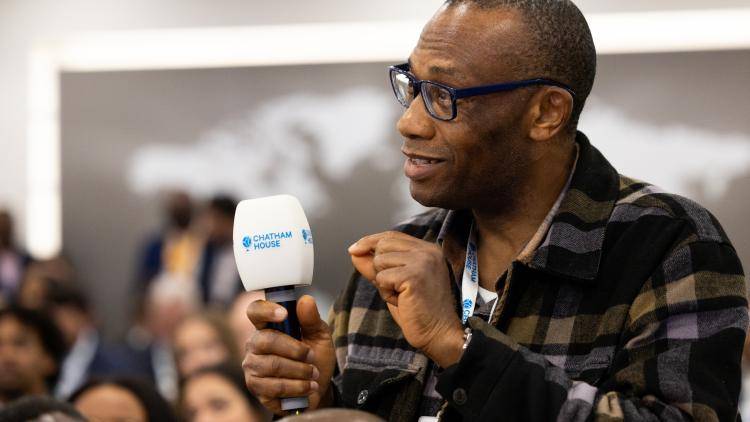
Dr Andrew Payne
Hello, everyone. Welcome to this next edition of Members’ Question Time. Thanks to everyone joining us in person, and thanks to everyone who I can see dialling in from further afield. My name is Andrew Payne, I’m a Research Director here at Chatham House, and I’m delighted to be joined by Dr Chris Sabatini, who is our Senior Research Fellow for Latin America. And I think for better or worse, Latin America is having a moment, in geopolitical terms, so we’re particularly grateful to you, Chris, for giving up your time and sharing some of your insights and answering some of the many questions that have come in from members.
Our topic today is “US policy towards Venezuela,” where we have seen a dramatic escalation of pressure in recent months. Most obviously, of course, have been the repeated strikes on civilian boats in the Caribbean Sea, but there’s also been a significant expansion of military presence by the United States in the region more generally, and of course, President Trump has also said that he has authorised the CIA to conduct covert operations in Venezuela itself. All of these actions have reignited a debate about Washington’s long-term interests and intentions in the region. Whether we are witnessing a particularly aggressive campaign premised on counter-narcotics, or whether this is the beginning of a much more expansive campaign of regime change, and of course, all of this is taking place in the context in which the Trump administration has not been afraid to intervene in the domestic politics of other states in the region, as well. So, plenty to discuss.
A couple of points of housekeeping before we begin. This event is on the record, and it is being recorded. If you are on social media, I warmly encourage you to post about the event using the #CH_Events, and tagging the handle, @ChathamHouse. In terms of the format, we’ll begin with a couple of questions that I’ll pose to Chris, drawing in some of the questions that we’ve received ahead of time, and then we’ll squeeze in as many questions, both from you guys in the room, as well as those online, in the 42 minutes that we have remaining of this session. So, we’re going to try and keep it as quickfire, lightning-round type feel as we possibly can.
When we do get to the Q&A, if you’re in the room, you just need to stick your hand up and I’ll call on you, and if you are online, at any point, you can drop a question at your leisure into the Q&A box, which you should see at the bottom of your Zoom feed. And then towards the end of the session, we will have an audience poll where you’ll get the opportunity to vote on a question relevant to today’s topic, and I’ll say a little bit more about that later on. So, for now, let me turn to you, Chris, with our overarching question for this session, which is as follows, “Is the US pushing regime change in Venezuela?” And if so, “why now?”
Dr Christopher Sabatini
The short answer is yes, and the reason ‘why now’ is a confluence of reasons. First, it’s important to recognise that in 2019, the Donald Trump 1 Administration, tried to push regime change by – in collaboration with the opposition then in Venezuela, by creating this fictional interim government. Claimed that since the 2018 election, presidential election, that re-elected Nicolás Maduro, the current President, had been stolen and it indeed, had been declared fraudulent by international observers, it was no longer – the President was no longer fit to serve. And so, the National Assembly, which was dominated at the time by the opposition, basically, cited a constitution that said that – the constitutional clause that said that “If the President” was “incapacitated, the President of the National Assembly” would “become the interim President until new elections could be held.”
It’s pretty flimsy ground, but the Trump administration went all in on it, convinced about almost 60 governments to recognise the fictional government of Juan Guaidó. Donald Trump invited Juan Guaidó to attend his 2019 State of the Union address, where he sat up in the balcony, and Donald Trump thanked him and welcomed him as the legitimate President of Venezuela. And then con – quickly convened a series of public protests, including an attempt to jam a convoy of humanitarian assistance across the Colombian-Venezuela border, all in the hopes of convincing the military to defect from Maduro and overthrow him, and recognise the government of Juan Guaidó.
Three years later, the government of Juan Guaidó had been dissolved, and Juan Guaidó now lives in South Florida and is in a pickleball tournament, last I heard, seriously. It didn’t work. So, what I’ve heard is Donald Trump felt deeply embarrassed by having lost and bet on Juan Guaidó. Fast forward to the 2024 elections, Donald Trump very famously claimed, erroneously, that Venezuelan gangs had taken over a city in Colorado, Aurora, and that this gang, Tren de Aragua, was working with the government of Nicolás Maduro, and Nicolás Maduro was emptying his prisons and sending criminal undocumented immigrants to the United States to create havoc in the United States.
So, what you have is this confluence of two streams in Donald Trump’s – first is a failed policy of regime change, the second is a domestic agenda, driven in part by Stephen Miller, who basically, had attempted to stoke US citizens’ fears of undocumented immigrants and singled out Nicolás Maduro and the – his alleged contacts at Tren de Aragua as being the culprit. But then you have a third to this, and that is the appointment of Secretary Marco Rubio to be Secretary of State. Marco Rubio is an immigrant of Cuban Americans par – Cuban Americans, who for a long time has seen the entire region through the prism of battling communism and ending the Castro regime in Cuba and has – with the arrival of Hugo Chávez, elected in 1998, sworn in in 1999, believes that Venezuela is responsible for saving the Cuban Government.
So, why now? Basically, what you have is a moment in which the US Government designated the government of Juan Guaidó – of Juan Guaidó – of Nicolás Maduro as being a narco-terrorist regime, a very broad designation, a new designation. It’s clearly trying to cite what was done under George W Bush and Barack Obama by claiming terrorism and thereby, giving it license to take out so-called ‘terrorists’. Now, there’s international law issue here, which I won’t go into, but I can, whether that’s legal. But then also what he’s trying to do is politically signal. So, he sent first six boats to the Caribbean, including a nuclear submarine, also. Now, I think it’s due to arrive, the USS Gerald Ford, which will be arriving shortly from – which was in the Adriatic. You’ll have about ten boats there. A number of them, I think four at least, have guided missile systems, a number of them are amphibious aircraft, air – yeah, amphibious boat craft, as well as about ten F-35s parked in the – Puerto Rico.
And all of this was intended to do the same thing that they failed to do with Juan Guaidó, scare the military into turning on Maduro and his inner clique and opening it up for a democratic transition. We can talk about whether that will work but think about this as regime change on the cheap. Donald Trump in 2016 campaigned against forever wars. He very under – much understood US citizens’ reaction, opposition, to the Iraq and Afghanistan war. And so, that was – so now what he’s trying to do is achieve what he didn’t do and what Stephen Miller wants him to do and what Marco Rubio wants him to do, just by frightening the bejesus out of the military around Maduro.
Now, will it work? We don’t know, but clearly there’s an escalation step here, taking out the 16 boats, 60 people, not actually convicted, or even without any evidence of being narco-traffickers, and now launching this covert plan or announcing – and it isn’t – you know, I’m not a spy, but I’m not sure it’s a covert plan if you’re talking about it in public, but that’s a different issue. All this is, is a PSYOPs, it’s signalling. It’s saying, “You guys could be next.” And Donald Trump is now talking about sending missiles or drones and taking land strikes in Venezuela. Again, the point is, you could be next.
And indeed, I’ve been talking to a number of my friends, the military off the coast now is, basically, patching itself into radio systems and broadcasting to Soldiers and mid-level Officers, saying, “Defect now, save your skin, we’re not going to hold you responsible. Get rid of the guy and his inner circle and all will be good.” The question is, will it work? And how far is Donald Trump willing to push it to make it work?
Dr Andrew Payne
Indeed, that is a very good question, which may be coming back to you imminently. So, you mentioned the analogy to the ‘forever wars’ and the last time out attempt at regime change, if you like, that the US has attempted in Iraq and Afghanistan, of course, didn’t particularly go very well. That is an analogy that many Commentators are drawing at the moment, and famously, in the lead up to that conflict, a lesser known Brigadier General, or whatever he might have been at that point, called David Petraeus, posed a question to a Reporter saying, “Tell me how this ends.” And a lot of the questions that we’ve had come in so far, basically, ask a variant of that question. So, one, for example, “How will Latin American countries and neighbours react if the US launches military strikes on Venezuela directly?”
So, perhaps you could pick up that, but more generally reflect on some of the, kind of, scenarios that you see playing out. What are the most likely outcomes here, and what are the main risks associated with them?
Dr Christopher Sabatini
Good. I’m going to break out my crystal ball here and try to make some predictions. Please don’t hold me to them if I’m wrong. Even within 24 hours from now, please don’t email me and remind me. But first of all, you know, I’m reminded often of the famous comment by the Russian Playwright, Anton Chekhov, that “If you show a gun on the wall in the first act, you better use it in the second act, otherwise, why have it there?”
Dr Andrew Payne
Hmmm.
Dr Christopher Sabatini
Donald Trump is going to have to use his guns, okay. The question is, how much and how deeply into Venezuela? What I think the first thing that we’ll see shortly are some drone or missile strikes inside Venezuela. Now, as you’ve been reading in the media, I don’t need to repeat the numbers, the truth is Venezuela is not a major source of narcotics entering the United States. It’s not even a source of any of the fentanyl that enters the United States. So, consequently, what he’ll probably have to limit those strikes to are airstrips, ports, maybe some missile defence systems.
Then the question is, does he want to go to the next step, to even further rattle the military, make them, again, turn on their President and some of their Commanders? Does he strike military barracks? Does he strike other military sites that could bring the loss of military lives, Servicemen? We don’t know. And then – again, so, at that point, maybe the military will flip. Arguably, it could flip at some point. There was an excellent op-ed by my friend Javier Corrales in The New York Times yesterday, I highly recommend it. I’ll actually quote it for a second here. “The members of this privileged class,” talking about the people around Maduro who have benefited from illicit activities and corruption, “will be unwilling to co-operate with efforts that involve the destruction of the system on which they thrive.”
Basically, and this is going to go to the sanctions question, too, what Maduro has done, thanks to sanctions, thanks to corruption, thanks to a very state-centric concentration of pow – executive power, is, basically, so deeply corrupt and hollow out the state of Venezuela that it’s unclear whether, even if there is a military putsch that takes him out, it will actually create – lay the foundations for a democratic transition. It may just be a symbolic change of power. I can talk about what that would mean. So, that’s one thing, some – maybe some change of power will happen.
Let’s imagine in the first case that it is indeed something that does remove Maduro. I think most likely in that case, if it does, is that, basically, some of the other circles try to clean their names, save their skins and say, “Okay, new government, interim government, we’ll try to hold elections next.” What is unlikely is that they will invite the democratic opposition and throw open the doors of the Miraflores Palace, the presidential palace, to María Corina Machado and Edmundo González, who likely won the elections last year, 2024, about 70 to 30%, according to international election observers and their own [inaudible– 14:31].
What is more likely is that this, sort of, more ad hoc transitional arrangement tries to maintain itself in power by giving a fig leaf of legitimacy to a transition government. The question there is, will that be enough? It may be enough for Donald Trump, it may be enough for Stephen Miller, especially if they engage in some sort of pro forma co-operation on narcotics, and if they engage in some, sort of, very open, public effort to demonstrate that they’re willing to accept repatriated, undocumented immigrants from Venezuela. They are, by the way, already, but it’s being done very quietly.
So, if you can imagine if someone went down and cut the ribbon on a new, unfortunate planeload of Venezuelan undocumented immigrants, it would basically satisfy Donald Trump. And in that case, Donald Trump, whether it works or it doesn’t, he can simply say, mission accomplished. Because Donald Trump has never used the ‘regime change’ phrase. Marco Rubio has, others around him and close, in fact, the Cuban-American constituency in Congress often likes to use it, but Donald Trump hasn’t. So, there could come a point, whether there’s a change of regime or whether it’s simply a very superficial change of regime, that, basically, Donald Trump says, “Mission accomplished, put – let me put on my flight suit,” just like George W Bush, “get on an aircraft carrier,” that’s now, luckily, fortunately, just parked off the coast of Venezuela, “and let me have a giant ‘mission accomplished’ banner, we’re done, business as usual.”
Because the other third option is that they launch in some missiles and drones, and it creates chaos. Because they are right about this, this is a deeply corrupt government. It has outsourced and created a whole series of decentralised, basically, mini-criminal states. In the gold mining sector, in the smuggling sector, in the human trafficking sector, they do exist. Money laundering, as well. So, it’s quite – it won’t be Libya, it won’t be Iraq, but it is quite likely, too, that these little mini political economic illicit states engage in some, sort of, protection racket among their own and become difficult to consolidate.
The last, and I would say least likely, is that there is some dramatic change that does bring the democratic opposition into power, and that won’t be easy either. A moderate Venezuelan opposition leader told me, he’s like, “Who would, of the opposition, would want to inherit this state?” Indeed, the security sector is completely bought out by criminal networks and illicit commerce. Who would you turn to for your bodyguards, for your military, for your police? What would you have to do? Now, the opposition says it has a 100-hour plan and a 100-day plan for reforming, but the scope of what will have to be done is tremendous. It’s not to say that it wouldn’t work, not to say that it’s unrealistic, but it does mean that there is a real risk of chaos erupting. And I think Donald Trump doesn’t really want that.
Just one quick thing, and it goes to the scenarios. You know, the MAGA movement is – we’re already seeing the base react against Venezuela, but according to a YouGov poll, only 18% of American voters support US military action, 46% oppose and 36 are undecided. Compare that to a survey that was done one month before the US invasion of Iraq, in which 66% of Americans supported the US invasion of Iraq. So, the support is already soft there, and while polls don’t, unfortunately, dictate foreign policy, Trump is very susceptible to that. Especially when you hear Laura Loomer and you hear Tucker Carlson and Stephen Bannon rail against what he’s doing in Venezuela. And so, he’s going to be stuck between his base and Marco Rubio, and I think the question is, ultimately, if there is going to be some, how spineless is Marco Rubio?
Dr Andrew Payne
I think the political question is particularly interesting here, right? ‘Cause if you just think about some of the common criticisms of Trump’s America First brand of foreign policy, one of the most prominent critiques is its ‘creeping isolationism’, but this seems to square quite awkwardly with that, kind of, framing, right? Which teases up a couple of questions that have come through about the wider regional policy of the US and whether this is a Venezuela issue, or if we do get the mission accomplished moment, does it stop in Venezuela? So, I wonder if – I’ll try and group a couple of questions here, but it very much is focused on whether we are seeing something from the US administration which is Venezuela specific, or if this is part of a broader Western hemisphere policy that we’re seeing being rolled out by the US.
So, one question that we’ve had come in is as follows, “With the further – with further regional military action notably building up and reinforcing bases across the region and the deployment of major naval assets to the Caribbean Sea, is this the reassertion of American power in the Americas more broadly? Why is Trump looking to push strong power and dominance in the region now?”
Dr Christopher Sabatini
So, the quest – the answer is, yes, this is. They’re rebuilding airports in Hai – in Puerto Rico, most likely probably for Haitian reasons, not necessarily – but also to engage in, sort of, drug interdiction. Yes, the – as a member of the Trump administration, and you had mentioned this in a previous discussion, Marco Rubio said this as well, tweeted recently…
Dr Andrew Payne
Hmmm hmm.
Dr Christopher Sabatini
…“You can’t be a world power if you don’t control your own neighbourhood,” which I think is actually something Vladimir Putin would probably agree with. And so, this is part of a larger policy of, basically, creating a more solid bloc of countries aligned with this particular White House, okay. And people are saying, “Is this the new Monroe Doctrine?” It is, but with a very partisan twist. We see in the case of Argentina, Donald Trump, in a policy that actually made sense, but had a boldly partisan twist to it, basically, bailed out or gave a $20 billion offer of a credit line to Javier Milei if his party won the elections, the midterm elections. That was clearly partisan.
The – we see his slapping of 50% tariffs on Brazilian exports to the US, because the independent Supreme Court dared to try a Trump ally, Jair Bolsonaro, for insurrection. And now we see this – a very ugly and public – I’m trying to think of a synonym here, argument, between Gustavo Petro of Colombia and – where he accuses – Trump has accused him without evidence of being a major drug trafficker, but he’s also of the left. and this is also – it’s not – that isn’t just an attack on Gustavo Petro, although with reason. Gustavo Petro has, in fact, he’s – he himself is very intemperate, his call for the ouster of Donald Trump. I think it’s the first time, it’s maybe the first time in history will reverse, is where actually a Latin American leader called for a coup in the United States, actually, now that I think about it. Okay, we’re in historic moments here, Andy.
But, by the same token, what is also – ‘cause there are elections next year in Colombia, it’s also an attempt to sway the Colombian election, and the Colombian electorate tends to be very conservative, probably in a much more Trump-favoured direction. You’ve got candidates in the upcoming elections in Chile who are – the Conservatives will probably win, very Trump-centred. You have Noboa in Ecuador already secured his seat, and then, quite possibly, I’ll – this I will go on, you can mock me if I’m wrong, the – that López Aliaga of Peru is a very Trumpist candidate in Peru that’s competing for the presidency next year. You’re looking at a region that could become very deeply Trump-aligned, and that is what he wants. It isn’t just US national interests; it’s Trump and Steve Bannon’s partisan interests.
Dr Andrew Payne
Hmmm.
Dr Christopher Sabatini
And then they would leverage that in many ways, but against, sort of, the – what John Bolton referred to as a ‘triangle of tyranny’, rather colourfully and alliteratively, against Venezuela, Cuba, and Nicaragua. So, yes, I think we are seeing this. What this means in terms of projecting power outside, I think is still unclear.
Dr Andrew Payne
So, one final brief question, if I may, and I’ll throw it open, but it’s about ‘sanctions,’ which you mentioned there. Because one reading of what we’re witnessing today is the downstream effects of the failures of past policies, and sanctions have been in the toolkit of many administrations in the past. So, one member asks, “Have US sanctions been effective in pressuring Maduro, or have they mainly deepened Venezuela’s problems?”
Dr Christopher Sabatini
The short answer to that is, no, they haven’t been effective. The – we only – I mean, sorry, this is – there’s a joke about a pretentious Academic who is introduced, he says, “Enough about me, let’s talk about my book.” So, let me talk about my work here. We did research here on sanctions. We looked at sanctions from 1950 to 2023, and we coded the ones that were dedicated to regime change, human rights and democracy. There are 800 of those, so it’s included US, mostly unilateral sanctions, but US, European, likewise.
Of those, the self-defined successes of the 800 was around 400. That looks about half, that’s good, right? The failures, self-defined failures, was about 100, but there are another 300 that are ongoing, including the Cuba embargo imposed in 1962, clearly not a success case. Why is that? Now, this is the second phase of the research I hope to conduct, is that the reason is, is because ‘maximum pressure sanctions’, self-call – self-defined by Donald Trump, leads to the consolidation of political and economic power around the government, which is exactly what you don’t want to do. We saw this with Putin and the, basically, reallocation of, say, the old McDonald’s franchises to one of his buddies. Pizza Hut’s now controlled by his buddies. Not that those are major economic assets in Russia, but they’re important.
Is it – and this is what has allowed Maduro to consolidate criminal control over the economy. So, no, it hasn’t worked, and it also creates isolation and a certain, sort of, us against them scenario. And again, I, you know, I was in a debate in Oslo a few months ago with Venezuelan opposition, I said, “Please cite for me one example, one example, where maximum pressure,” don’t – they often cite South Africa, but that was unilat – multilateral, it wasn’t – “when maximum pressure sanctions have presoke – provoked regime change.” Zero.
Dr Andrew Payne
Great, thank you very much. So, I think let’s open the floor. I think we have – do we have mics? Yes, we do have mics. So, we’ll go here first of all. If you can please introduce yourself, and as we are compressed for time, please make your questions brief and to the point.
Euan Grant
Yeah, thank you all very much. Euan Grant, UK Defence Forum. I’m an ex-UK Customs Service Intelligence Analyst from the days when we were still the equivalent of the DEA, which has, of course, changed now to the National Crime Agency. My question is, what is the European view, and I very much include the UK, particularly given the recent guilty plea in New York by Carvajal? Because I think this is a greatly underestimated scenario and source of information in reg – relation to the wider picture. Thank you.
Dr Christopher Sabatini
Shall I answer on that?
Dr Andrew Payne
Sure.
Dr Christopher Sabatini
Yeah, so Carvajal was, for those of you who don’t know, was engaged in all sorts of nefarious activities, mostly money laundering and nar – and moving narcotics around. He is probably, by all accounts, coughing up some pretty rich information, and so, what the US is doing with this now, parallel to the policy of military buildup, is they’re using that to close down all these different loopholes. Whether it’s the use of cybercurrency, whether it’s banking accounts, whether it’s cash transfers between, again, a, sort of, a rogue’s gallery of allies, Russia, North Korea and the like. So, they’ve really been using this to try to identify.
And this is the policy that does make sense. You may not have – again, you may not have needed to mobilise 10,000 US Army personnel and an aircraft carrier and helicopters and special ops forces. This is a policy that does make sense, is to identify the sources of revenue, illicit revenue of this government, and try to close it down. It’s a longer-term strategy. You don’t get all the, sort of, if you will, you know, nice military show of force, but that is happening, and that’s the other, if you will, arm of this, and then I think it – this will continue. Even if the military forces pack up and go home, I think you will see this continue and that’s what, in many ways, is what has allowed this regime to survive.
Now, the Europeans’ view of this, I won’t name names, obviously, it’s Chatham House, the – but in talking to a number of Diplomats, their basic sense is, “Where are we in this?” You know, “We have a stake in this.” In fact, most of the drugs, most of the cocaine that leaves Venezuela is actually heading to Europe.
Dr Andrew Payne
Hmmm.
Dr Christopher Sabatini
And there’s a sense that we – you know, there’s a frustration that they’re left sitting on their hands, watching this play out, having no stake in it, and hoping maybe that it works, but also, fully cognisant of the risks and feeling that there’s no Plan B. So, it’s frustrating and I can – having been – talked to a few European Diplomats, I can tell you that’s very much where they feel, and they just don’t feel the space where they can even weigh in. This is being driven entirely by, basically, by Stephen Miller, Donald Trump and Marco Rubio, and the Ve – and elements of the Venezuelan opposition.
Dr Andrew Payne
So, let me pick up on the issue of drug trafficking, right, ‘cause we’ve talked a lot about regime change, but at least the pretence is that this is about drug trafficking and there is an issue there. One of the questions we had ahead of time asked about this, you know, “Is the drug trafficking claim used by the Trump administration actually valid?” We’ve had a related question come in from Nathan Danquah, who asked, “Why is he picking on Venezuela only when most of the hard drugs reportedly come from elsewhere?”
Dr Christopher Sabatini
Well, it’s easy to pick on Venezuela. First of all, it is an illegitimate government. As I mentioned, there were elections last year that demonstrated that the government has no legitimacy. Venezuelans – now, Venezuelans, by the way, voted 70% against the Nicolás Maduro, but only according to surveys which are not public, about – only about 30% of Venez – 34% of Venezuelans inside Venezuela actually want to see military action. But about 70% of Latin Americans do want to see the removal of Maduro, not necessarily military action, because he’s, you know, sent almost nine million Venezuelans flooding across the border. Three million of them are in Colombia, they’re scattered throughout. There’s a whole series of, fortunately not excessively nationalistic, nativistic responses to it, but we’re seeing that, as well.
So, why pick on Venezuela? A) it’s illegitimate government. B) it’s got, a huge constituency behind it, both in the Venezuelan American lobby and the Cuban American lobby and others who have always railed against it and with reason. Don’t get me wrong, I’m not justifying or even trying to legitimise the Maduro Government, but there’s a huge – there’s not much of a, sort of, anti-Mexican constituency in the US. The third reason is that he has good relations with the others. Yes, most – almost all of the fentanyl comes from across the border from Mexico, but you can’t start bombing a country with whom we have a free trade agreement, a co-operative agreement on migration and all sorts of trade flows that go back and forth. So, it’s easier to pick on Venezuela. It is, sort of, the, you know, the scrawny boy, if you will, in the – that no-one wants to pick for their basketball team, and it’s not well-liked. Even though Lula and Petro will, you know, defend their national sovereignty, they’re not about to defend Nicolás Maduro, so that’s primarily why.
Now, is the drug threat real? No. According to UNODC and the US Drug Enforcement Agency, only about between five to 8% of the cocaine that leaves Venezuela makes it to US shores. None of the fentanyl that comes from the US – comes to the US comes from Venezuela, and Venezuela does not produce cocaine. It is actually a transshipment point from cocaine – for cocaine produced primarily from Colombia. Now, there are a lot of illicit Colombian groups, paramilitaries, and former – I don’t want to refer to them as guerrilla groups, ‘cause right now they’re just criminal groups, like the ELN, that are engaging in this on the border. But this is not – you don’t have the large cocaine laboratories as you do in Colombia. So, no, it is a – it’s a fiction invented by the Trump administration to justify the policy.
Dr Andrew Payne
Hmmm hmm.
Dr Christopher Sabatini
And as I said before, in part, potentially to even give an excuse for when, if it doesn’t work, to say, “We took out those 16 boats, thank God, that will be” – he says, “with every boat,” he “saves 25,000 American lives.” I don’t understand the math, first of all, because only 80,000 Americans died from drug overdoses last year, so the math just don’t quite work out. But most of those Americans who died from drug overdoses was from fentanyl, not cocaine, but he can claim with some – that he tamped down those drug flows.
Dr Andrew Payne
Okay, we’ll go here.
Dr Jennifer Lind
Thank you so much. This has been really interesting. I guess I’m still struggling to underst…
Dr Andrew Payne
Please introduce yourself if you can.
Dr Jennifer Lind
Oh, sorry, Jennifer Lind. I’m an Associate Fellow in the US and the Americas Programme. I guess I’m still struggling to understand why all of this attention and energy and firepower would be directed at Venezuela. And you’ll forgive me for being a geopolitical expert and so, maybe I’m seeing China where China is not supposed to be seen, but I’m wondering if you could comment on that angle. Obviously, Colombia, you’re saying, is really the much bigger perpetrator of drug problems in the US, but the US has good relations with Colombia, for example…
Dr Christopher Sabatini
Yeah.
Dr Jennifer Lind
…and Venezuela is very much in, kind of, the other camp. So, I’m wondering if you could comment on that.
Dr Christopher Sabatini
So, a lot there, Jenny, thanks. The – so, first, about anywhere between eight to 14% of US naval assets are now positioned off the coast of the Caribbean. That’s huge, and you mentioned the geopolitical aspect, I mean, you know, I would argue there are other hotspots in the world where they should be concentrated, not off a country that where it has about 80%, 60% poverty and is not involved in drug production.
You know, on the China front, even, you know, in the case of Venezuela and China, China’s, kind of, backing away. You know, the – Venezuela owes China a lot of money that it eventually wants back, and China was more than willing to safely toss a line to Venezuela to buy its oil under shadow fleets, when it was under sanctions, but it really doesn’t want to go to the mat for Venezuela. There’s really no geopolitical reason, except again, in the eyes of some people who believe that this is about you can’t be a world power unless you dominate your own neighbourhood and dominate is the key. We saw that, obviously, with the effort – the claims of retaking the Panama Canal, which thankfully, are no longer being talked about. And in this case, it is about we can’t be a world power without that – by having some openly antagonistic governments that are mocking the US, refusing to co-operate on a number of issues, including repatriation of undocumented immigrants.
So, it’s really about that, but this is really also about domestic politics, it’s not about geopolitics. It’s about Donald Trump’s, you know, campaign in 2024, it’s also about the Cuban American lobby who has long obsessed – and there is a –I’m going to get into a little bit of inside Washington gossip here. There’s a large number of people that have made their way into the administration who have been arguing for a long time, I won’t name names, that Venezuela has become a hotspot of Hezbollah, Hamas and Russia, and Iran, often without much evidence. In fact, often without any evidence, and this is a true story. One of them, I won’t name him, who’s now in the Defense Department, advises in the Defense Department of the Western Hemisphere, he – a presentation where he had a – had put up a graph of Iran’s influence in Latin America. And he – on the horizontal axis he had the years, and on the vertical axis he had low/high, and then he just had a line that went 45 degrees. That was it, that was it. You can’t argue with that, you can’t, ‘cause there’s no evidence actually at all.
There is this very fevered idea among certain MAGA folks and Trump supporters that this is a real threat to the US national interest, not just because of what – the flow of undocumented immigrants, but also because of the threats from extra hemispheric powers and hence, they hang this on the Monroe Doctrine, yeah.
Dr Andrew Payne
So, you mentioned, sort of, the domestic politics angle and that’s featured in a few of the, kind of, questions that have come through so far. And you did briefly allude to the Cuban American population, which is of course another, kind of, prominent voting bloc that has gone for Trump in recent elections, associated with Marco Rubio, as well. One of the questions that’s come in is about Cuba, it’s from Byron Callan, “Where would all of this leave Cuba, and how could Cuba respond to US actions in Venezuela?”
Dr Christopher Sabatini
So, just to give you a taste of how – the temperature among some of the Cuban American Congress people. Representative Giménez, who’s actually a former Democrat, he’s a Republican now, a Congressman from South Florida, has been posting pictures of – that picture of Muammar Gaddafi being dragged out of a car and literally ripped to pieces by a crowd. He’s been posting that saying, “Maduro, you’re next,” and also posting stories about Suleiman, the Intelligence Chief from Iran being bombed and saying, “You’re next.” You know, this has really reached a very – you know, whatever your – these are truly criminal people, don’t get me wrong, but a very inhumane way of talking about human beings.
So, on Cuba, many Cuban Americans feel that it was Chávez who saved Cuba. They felt – they’ve been saying this for a long time, that “Cuba was on its last leg,” and that by – Chávez, shortly after he was inaugurated, started giving away either free or low-priced oil to Cuba, 100 barrels – 100,000 barrels of it a day. So, the thought is – and Cuba does still receive funds from, and some oil, not as much, from Venezuela. The thought is that if you dry up that source of revenue, Cuba will fall eventually, too, and indeed, Cuba is in the midst of a humanitarian crisis and a hurricane that recently hit, it’s tragic. So, the thought is, this is – if you cut that off, this is, like, sort of, a reverse domino theory. You’ll go from Venezuela to Cuba and then Nicaragua. I’m not sure that’s true.
Cuba has a lot of, according to reports, intelligence operatives in Venezuela that have been embedded and basically, consolidated the Maduro government’s control over the military. And I should say, you know, if you are a military defector in Venezuela, you get treated like a defector in North Korea. Your family gets imprisoned, you get imprisoned, you have to flee, or in one case, a Military Officer who dared to question Maduro’s authority fled to Chile and was sent – was actually killed and cut up, completely dismembered and buried in – under a sidewalk. So, you know, the incentives to defect are pretty low if you’re a Cuban – if you’re a Military Officer. And part of that is the way the mil – the Cuban intelligence has embedded itself in the Venezuelan Government.
So, I’m not sure Cuba would fall, I think there’d be a lot more suffering, if Venezuela fell, in Cuba, but that’s often what they’re thinking of, is this is part of their plan all along.
Dr Andrew Payne
Okay, we have time for one question, or I might sneak in two if we can do it as a very quick-fire round. I saw your hand earlier. Is there anyone else that wants to jump in very briefly? If not, we’ll go with this as the last question.
Stan Wojewodzki
Thank you very much. Hello, yes, Stan Wojewodzki, Managing Director of Perseus Advisory, formerly Advisor to several governments in that region, now just very interested in the issues that are unfolding before our very eyes. To rebound on your comment, Chris, about Cuba’s role in Venezuela, it is known by experts that SEBIN and other military apparatus in Venezuela have had embedded in them a number of Cuban Advisors, and so, their inter – or co-dependency of the two regimes to work together, to survive together, seems pretty obvious.
We tend to forget, and Obama got bad rep for legitimising through the normalisation process the Cuban regime and re-engaging with Cuba without asking anything in return. And I think history is not kind on President Obama and on Cuba, since it seems to me that Cuba was instrumental in brokering a peace deal with the FARCs, and we tend to forget the role that Cuba played in that resolution of a 60-year conflict in our hemisphere. And so, I think Santos and Obama could not have done that with the FARCs had it not been for Raúl Castro…
Dr Christopher Sabatini
Yeah.
Stan Wojewodzki
…and his direct involvement. The Cuban American factions, whether in Congress or in the Florida politics or in DC Beltway, seem to be hell-bent on bringing about the end of the Maduro regime as a way to bring down the Cuba regime. Is there a logic to reverse that approach and say, how can the Cuban, knowing and understanding the influence that they wage on leftist governments in the region, play an actual role in a peaceful transition before it gets to a kinetic regime change that will have both reverberating effect on their economy and on their further isolation, but also on the security of the hemisphere and the US border? Thank you.
Dr Christopher Sabatini
It’s a good question, Stan. So, I’m going to – having been involved in a lot of the discussions around Obama’s Cuba change in 2014, and talking to the Cubans in the process, ‘cause I was go – coming and going from Cuba, several things happened. Is I do think the Obama administration, which had a very positive and courageous policy change in opening up Cuba, and having been there several times before the opening and then after, there was a sense of real economic and political dynamism that didn’t occur because of the flow of tourism and the cuentapropistas, the informal sector, and so on, that was beginning to flourish.
The problem is the Obama administration was never all that active. It didn’t have enough time, also, but it wasn’t – and I think they thought that Hillary Clinton was going to be elected, so they’d have time. In fact, I know they did, they thought they didn’t have time. But they never leveraged that opening to get Cuba involved on Venezuela. Knowing full well that of the two countries, Cuba or Venezuela – Venezuela is a far more national security, I would say risk, but also more in ch – having – fostering some peaceful change of Venezuela, was more in the national security interest of the United States than worrying about Cuba, quite frankly. But there are the politics around Cuba.
Once Trump came in, that was completely shut down and then it was flipped. Then the problem was still Venezuela, but Cuba was not a pathway to do that. And under the current administration, the ide – I mean, even during the Santos peace negotiations that were held, as you mentioned, between the FARC, the Colombian guerrilla group, and the government in Colombia, in – they’re held in Cuba, that was anathema to the Cuban Americans. They were convinced they were giving away everything to the FARC. It was going to be a complete cluster mess. How could you trust the Cubans? And indeed, it did end a 50/60 year civil war, imperfectly, but it did, and – but the idea that they would ever go back to ask the Cubans to do this is an impossible thought.
I will say this, in my discussions with Cubans, when the opening happened, I was like, “Hey, you guys could play a role on Venezuela.” And the Cubans did say in this, and I think they were being, for once – these were Cuban government officials, quite likely intelligence officials, they were, like, “Look, we never abandon our allies,” and I think that’s true, actually. Whereas the FARC, they could be seen as playing a constructive role in the construction of a more integrated nation state and addressing issues of poverty, in the case of Venezuela, they would be seen as being traitors to a government that had saved them. And so, I’m not sure Cuba would have played that role, but I don’t think we tested that proposition fully enough.
Dr Andrew Payne
Great. So, we are rapidly approaching time, so it is time for our audience poll.
Dr Christopher Sabatini
Okay.
Dr Andrew Payne
I’m going to do a slightly manual poll in the room, but if you are online, you should shortly see this pop up as a quiz question that you can answer. You can see this question. So, for those of you in the room, the question is, “During the remainder of the Trump administration’s term in office, do you think the US will achieve regime change in Venezuela?” Your options are “yes, no,” and “not sure,” right? So, do you think the US will achieve regime change in Venezuela? While the online audience is voting, let’s do a show of hands in the room. Please raise your hand if you think that the US will indeed achieve regime change in Venezuela during Trump’s term of office. One, two, three, four. Okay, who votes “no”? Lots more. One, two, three, four, five, six, seven, eight, nine. And “not sure”? Everyone else, one, two, three, four, five, six, seven…
Dr Christopher Sabatini
We could vote like the Venezuelan Government wants us to, twice.
Dr Andrew Payne
Okay, so we’re slightly indecisive, but leaning “no.” Let’s see what the online audience have. Can I see such a thing? Do I have to vote myself?
Dr Christopher Sabatini
You would [inaudible – 44:45] escape the entire…
Dr Andrew Payne
Here we go, okay, results are in. Pretty reflective of what’s in the room, actually. 27% said “yes,” 50% said “no” and 23% said “not sure.” Do you agree, Chris?
Dr Christopher Sabatini
I would agree with – I would – polling is always difficult, ‘cause you break things into false dichotomies or false multiple choices that – I would say, “What type of regime change?”
Dr Andrew Payne
Yeah.
Dr Christopher Sabatini
And if we were to phrase that – and I – actually, I’m going to ask, I’m going to – if I may go off script here a second, how many of you think that if it does provoke regime change, the Trump administration does, that it will be a democratic regime change?
Dr Andrew Payne
Hmmm.
Dr Christopher Sabatini
One, okay. Was that you too?
Member
No, sorry.
Dr Christopher Sabatini
Oh, alright, ‘cause I think, you know, I – that would be – the – I think there will – there is a possibility that it will happen. At some point, the – you know, Maduro isn’t going to live forever and this regime will have a shelf life. The question is does that lead – if provoked in the way that Donald Trump wants it to happen, will that lead to democracy? On that one, I’m, kind of, sceptical, but it could happen. I mean, that’s…
Dr Andrew Payne
Yeah.
Dr Christopher Sabatini
I guess I’m taking a, kind of, a pretty weaselly way out, but…
Dr Andrew Payne
Well, we shall see. We shall have to do another one of these events…
Dr Christopher Sabatini
Oh, yeah.
Dr Andrew Payne
…to check in and test your predictions and hold you to account, but for now, thank you very much, Chris…
Dr Christopher Sabatini
Thanks.
Dr Andrew Payne
…for sharing your insights. Thank you, everyone, for joining, both in the room and online. Have a great afternoon, and we’ll see you next time [applause].
Dr Christopher Sabatini
Thanks.