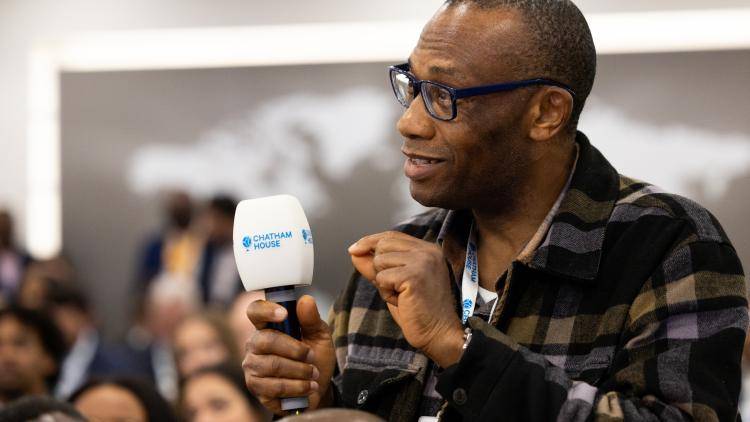
Nicolas Lawley
Hello, everyone, my name is Nic Lawley. I am the Special Advisor to the Director – of Bronwen Maddox here at Chatham House, and welcome to this Members’ Question Time. This event is on the record and being recorded. We encourage you all to join in on social media, so please do tag us. And last year, we actually hosted another Member’s Question Time on Hungary, and there was a Mr Péter Magyar in the audience, I believe he was online, but if he is online today, please feel free to say hello, Mr President. That would be great to have you join us, but you may be too busy, I suspect.
Thank you very much to Grégoire, who is our Director of Europe and Russia and Eurasia Programmes, who is here to unpack what was quite a momentous day on Sunday. And I think that’s where I, kind of, want to start today, Grégoire. I’ve seen commentary largely fall into two camps. One, this is an enormous change, everything changes, everything is going to be radically different now, or, two, he’s not that different politically, we should all calm down, domestic pressures won’t make him the saviour that perhaps Brussels think he might be and may have hoped for. What’s your take? Where do you sit on this?
Grégoire Roos
Well, I think, as usual, truth lies in the middle, and both of those groups has the right take on it. It is nothing less than a revolution by Hungarian standard. It is, after all, politically a young country, like all the Central European countries that became independent nations at the fall of the Wall and of the fall of the Soviet Union, so it’s basically a country that politically is less than 40 years old, that’s young, and in those actually 36 years, Viktor Orbán was the Prime Minister for 20, 16 years until last Sunday, and four years between 1998 and 2002. And that means one thing, that he has brought down an entire system, put an end to an entire era of domestic politics, and that in itself is a revolution.
The second aspect is that he is what I called an interesting case of insider-outsider. Insider because he comes from the Fidesz galaxy, ten years ago he still was an Advisor in the office of Viktor Orbán’s Prime Minister office, and before then worked as a Senior Official in the Ministry of Foreign Affairs. He only left Fidesz two years ago, less than that, actually, and became elected after he took over the small centre-right TISZA Party at the European Parliament, joined the European People’s Party, that Viktor Orbán used to be a member of.
So, having someone who knows the Orbán Galaxy so well but manages to stand out as someone radically different because he is pro-EU, against any form of intervention or interference in domestic affairs, and in that case, he sent a clear signal to both Washington and Moscow, having someone who managed that way to build confidence and a bond of trust with voters from both the cities and rural areas is quite a performance, not just for Hungary, but for any liberal democracy today. So, in this regard, yes, it’s a revolution, and we can expect significant change in some areas, starting, of course, with the relation of Budapest with Brussels.
At the same time, I’ve just said that he is an insider indeed. So, there are things that might not change at all. Like Hungary being staunchly attached, and we can understand why, given, you know, the fact that still 40 years ago they were not an independent nation, with their sovereignty. So, there have been discussions about whether Hungary should join the eurozone and ideas of that kind, but for now, I don’t expect any significant change.
I don’t see any radical change when it comes to immigration, migration, and there will still be a balanced approach to Ukraine, Bot that relations with Kyiv won’t mend, I think they will, and for the past two days, the message is that the Prime Minister to be – he’s not yet a President, but Prime Minister to be, will take is to definitely rebuild the relation with President Zelenskyy. There will be, I think, more warmth in the relation. It will not be very difficult given the fact that relations with Viktor Orbán were particularly cold. And he will no longer play as a, kind of, spoiler or bottleneck in Brussels to accelerate European financial transfers to Kyiv and military support to Ukraine.
At the same time, he has said that he would not abandon energy relations with Russia, and he has not had a radically hostile, I’d say, discourse towards Moscow. So, it will be a balancing act, and he will have no other choice, by the way, because he has indeed managed to build a supermajority. 70% of the seats in Parliament is something that even Viktor Orbán never managed to do in terms of the popular vote, because the electoral system in Hungary is a bit complex. So, there is such a thing, like in the United States, as a popular vote. He got more, of course, votes, a greater share than Orbán, but Orbán did slightly better in 2002, but not significantly better. So, this is indeed a remarkable performance.
So, I’d say, again, to answer your question, it is a revolution, you can expect change. He will likely change the constitution, saying, “I vow not to have Viktor Orbán back in power again.” There will be a much losing grip on the judiciary, if grip at all, and the media, so, some think tanks, some foundations, some NGOs, might eye a return to Hungary. We’ll – let’s be cautious, but that’s not impossible in the short run. At the same time, some deeply embedded traits or reflexes in Hungary are here to stay, or at least not to be cast away overnight.
Nicolas Lawley
Hmmm. Let’s just touch on the actual election, just very briefly. As you said, it’s a very complicated system, and over the weekend when I was preparing to host this event, I was trying to get my head around the system and I’m very glad…
Grégoire Roos
Good luck, it’s – yeah.
Nicolas Lawley
Well, I was very glad that we got what was a very clear result very early on in the evening, ‘cause I was a bit concerned that we might still not have that at this point. But one thing that really fascinated me about this election was it, kind of, started looking at what you’d expect, cost of living, domestic things, but it very quickly seemed to become an election on foreign policy. “Russians out” was chanted, Zelenskyy’s face on every poster. What do you make of all of that?
Grégoire Roos
Well, it’s good for us. I mean, the more geopolitics, the more business, so I think we should welcome that. No, but joke aside, it’s very difficult these days with all the mayhem in the world everywhere, that we look not to see any local election – even local, well, that one was not local, national, but not to turn at some point into a, kind of, geopolitical discussion or – if not clash. So, I think this was not so Hungarian as such. It’s – it becomes a trend, hopefully not a norm, but a trend. This being said, you’re right, that geopolitics became the crystallising, sort of, obsession of Viktor Orbán in that campaign. I wouldn’t say it was the main priority or concern of Péter Magyar, and I think this is what has made him stand out in this campaign.
I find it remarkable that Viktor Orbán, someone who lost the election in 2002 because he felt that he was not aligned with voters’ expectations, worked very hard to understand how to win over voters, worked very hard for eight years, got back to power in 2010 and adopted that, and brilliantly so, let’s face it, populist approach. Giving voters – not just the voters what they wanted, but anticipating what they might expect, and he has – he had done that for 16 years quite well. And it seems that he completely lost his populist touch. So, the, kind of, Orbán magic’s disappeared, to the extent that he ran a campaign in a context against a backdrop of skyrocketing energy prices in spite of governmental caps, high inflation and significantly higher.
I mean, expectation now is 2.2, whereas next year of – last year, if I’m not mistaken, it was around 1.4, so it’s significantly higher. Around €20 billion of EU funds frozen, this is not petty cash, and all of that taken out of the other facts does not matter so much independently, but if you take them all as a system, it starts to become a liability, politically speaking. At the same time – and not to mention the very large queues to get an appointment with a Doctor. What used to take one month now takes at least six or seven months. So, this is something that is a problem for ordinary citizens, or citizens from the cities, as well. So, in this regard, urbaners and citizens from rural areas were on the same boat. Viktor Orbán did not address any of those concerns.
Nicolas Lawley
Hmmm.
Grégoire Roos
He just focused on Zelenskyy, obsessive – I must say, obsessed with Zelenskyy. You couldn’t see any picture of Magyar without a picture of Zelensky. Magyar being portrayed as a, kind of, puppet of Zelensky. And of course, you had the Germans, because he was also apparently in a, kind of, obsession relation with the Germans, be – accusing the European Union to be at the – “in the hands of the German mafia,” with the trio of mafia bosses, the President of the Commission, Ursula von der Leyen, the German Chancellor, Friedrich Merz, and the President of the European People’s Party, of which TISZA is – the party of Magyar is a member, Manfred Weber, that was the only obsession. And not to mention the – can I use the word ridiculous, even his voters found so, video, fake video, AI video he used and spread during the campaign showing Hungarians going to fight in Ukraine and dying in horrible conditions, saying, “This is what is going to happen if Magyar gets elected.” No-one bought that, it was so ridiculous and excessive.
And at the same time, Magyar was mostly focusing on how to make sure that Hungary would diversify its energy supplies, reduce imports, which is something that at a time of rising inflation is a problem for households, and improve the health systems and infrastructure. So, energy, purchasing power, I would say material socioeconomic wellbeing, while at the same time Orbán was trapped in this, kind of, obsessive anti-Zelenskyy and Ukraine. You know, at some point, voters can – and not to mention corruption, obviously, but at some points, voters can say, “Look, there is corruption, I can turn a blind eye on that, provided I have – my piece of the cake is growing.”
And that was the success for Orbán’s equation for many years, but now you ended up with a piece of the cake that was not growing and corruption that was becoming more blatant. At that point, voters do not turn a blind eye anymore. So, yes, it was geopolitical, but I think too much for Orbán.
Nicolas Lawley
So, I think my – the immediate, sort of, comeback question, which Trisha online has also, kind of, flagged here, is should we not read too much into reading into how much of the Hungarian popular vote supports closeness with the EU and –versus distancing with Russia? Should we not read too much into that? What’s your take on that?
Grégoire Roos
Yeah, it’s yes and no. I think at this stage yes, because it would still reflect to the extent, we could read that, and we could if we really look at the exact map and looking at who used to vote for Orbán and hardcore base of Orbán, who now turn to Magyar, of course. But with a 70% supermajority and a clear agenda to reform the Constitution, to bring back some rationality in economic policy, I think we need to leave a chance to Magyar to change the mindset of voters. He will not do that overnight, but I think it is possible. I mean, Hungarians were not born Orbán-obsessed. Some voted for a very liberal Orbán in the late 1990s, and some of them, who were the same, voted for the illiberal one in 2000 – not so much 10, but 14, 18, 22. So, there’s such a thing as voters you win over and then voters whose mindsets you get to change by delivering on the economy and on social welfare.
So, I think Trisha is right. We should read that now to get a sense of the level of constraints that Magyar will face, but it’s 70%. I mean, my – personally monitoring the campaign in the election, my main question, if not concern, was, okay, will this be a significant landslide or a neck and neck, sort of, victory that would have provided Viktor Orbán with the opportunity of challenging the result of the election? 70% was such that, you know, within two hours, even less than that, Viktor Orbán conceded defeat and congratulated Magyar, which I think was very dignified for Hungary.
Nicolas Lawley
Did that surprise you?
Grégoire Roos
If I’m honest, no, because it was interesting to hear him – I mean, I dread – I was prepared for a, kind of, Trump scenario whereby he would tell his bases, “Look, they stole the election,” and as early as noon on Sunday, you – Fidesz have already filed for more than 600 reported cases of fraud. So, hmmm, doesn’t start well.
Nicolas Lawley
No.
Grégoire Roos
So, I was somehow wondering whether we would be going in that direction, but there was a very interesting signal sent by Viktor Orbán himself in February, after – just after the Munich Security Conference. US Secretary of State Marco Rubio visited his two pals, one in Budapest and another one in Slovakia, Robert Fico. And during the press conference with Rubio, Orbán was asked a question about how he felt about the upcoming election, and Orbán said, “Look, some” – I quote, “sometimes I win, sometimes I lose.”
Nicolas Lawley
Hmmm.
Grégoire Roos
This is not something Donald Trump would say. So, I said, okay, he’s too experienced not to sense that it’s not looking good for him, and it was a way of preparing mentally, not just himself, but also his electorate, or at least that’s how I interpreted it.
Nicolas Lawley
Okay, let’s do a little – something a little bit fun. Let’s do a whistle-stop tour around the world.
Grégoire Roos
Sure, love it.
Nicolas Lawley
I just want one or two-word reactions of how they must be feeling, and…
Grégoire Roos
Very uneven, yeah.
Nicolas Lawley
And then we’re going to come back and dive a bit further into them. So, just one or two words, how’s Brussels feeling?
Grégoire Roos
For now, very happy. I mean, result, good, happy, but there’s a caveat, they will not unfreeze the funds until they see concrete measures by Magyar. So, it’s a congratulations, we’re overwhelmed, but now, please deliver.
Nicolas Lawley
Moscow?
Grégoire Roos
Moscow, not the best outcome, but for now, Magyar has confirmed that he will not stop relations, energy relations. They might be sad not to have their intel, sort of, source in Brussels, in NATO, for sure, but they will survive. Magyar is not the, kind of, “decadent liberal anti-Moscow,” and he knows he needs to crack a balance. So, at this stage, they will survive with that result.
Nicolas Lawley
Kyiv?
Grégoire Roos
Kyiv would be obviously happy, is happy, because they know – and Magyar has already spoken about it. He said clearly, plainly, in his press conference yesterday, that he thought that it was Kyiv’s role and prerogative to decide what to do with their sovereign territory. And it was a clear indication that Magyar would side with the European Union and all the member states in favour of supporting Kyiv. So, I think they’re very happy. Of course, like the EU, they will expect to see concrete proof of love. You know, there’s nothing – the French Philosopher said, “There’s no love, there are just proof of – there’s just evidence of love.” I think it’s true, and Zelenskyy must be feeling the same, but very happy at the moment.
Nicolas Lawley
London?
Grégoire Roos
London, I think it’s good news. I mean, London is not – no longer a member of the EU, as some of you might have heard, and they’re eyeing now rapprochement with the EU. There are discussions about whether the single market’s rules should apply in the UK, so anything that reduces friction in the single market and political fragmentation across the union is good news for London. So, London is reasonably happy. You know, it’s nothing massive for them, but it’s good news.
Nicolas Lawley
Would they welcome this, I believe Magyar said that he would welcome the UK back into the EU if that’s – is that something that Starmer is comfortable hearing from others or does it not…?
Grégoire Roos
Well, you know, we heard from President Stubb here that if you have seven years ahead of you, you can – it took seven years to get out, seven years to think about coming back and seven years to come back. So, yes, I’m sure. No, obviously, I mean, he will have an ally, and let’s not forget that the strongest – the staunchest supporter of Ukraine in Europe from day one has been the UK.
Nicolas Lawley
Hmmm.
Grégoire Roos
So, having someone who will not stand in the way against making the most of all those resources that, after all, you know, you have British taxpayers behind. So, it’s a way to say everything that we’re sending Kyiv is indeed going to Kyiv and it’s not being slowed down, and we don’t reduce the political impact or opportunity of the support we’ve been providing Kyiv. So, yeah, London is looking at it quite positively.
Nicolas Lawley
And, finally, Washington, D.C.?
Grégoire Roos
Biggest loser, obviously. Not a very good winning moment for Washington at the moment. That’s the least one could say. Two things: first is the National Stra – Security Strategy that I’m sure everyone has read twice or three times, especially in the light of the latest developments in the Middle East. Because you read again whether, you know, they are just implementing the strategy or just rewriting it. And it was clear in the National Security Strategy that they saw the so-called ‘patriot’ and so-called ‘sovereigntist movements’ as their best allies in Europe to weaken the European Union and strengthen what they call a ‘sovereign Europe.’
Well, it’s completely failed, and not just because of the results, but also because the United States and the Trump administration personally got very much involved in the campaign. And last week you had a visit of Vice President JD Vance, who held a long press conference with Viktor Orbán, after Rubio in February, and a rally of – in front of 5,000 Hungarians, a rally during which, on stage, JD Vance called Donald Trump on his phone, and…
Nicolas Lawley
He didn’t pick up.
Grégoire Roos
He did pick up.
Nicolas Lawley
Oh, did he?
Grégoire Roos
He did pick up.
Nicolas Lawley
Yeah, sorry.
Grégoire Roos
He did pick up. So, Donald – I don’t know, I guess it was a real call and not pre-recorded, I guess it was a real call, he did pick up. And it’s just the fact that you had the President and the Vice President, I mean, one physically, the other one remotely on stage, with a big communication around it, with Donald Trump saying, you know, “He’s the smartest guy you could possibly imagine,” might have been the kiss of death.
Nicolas Lawley
Hmmm.
Grégoire Roos
And there have been lots of memes online about JD Vance, you know, he meets Pope Francis, Pope Francis dies the following day. He goes to Hungary, three days later, Orbán loses the election. He goes to Pakistan, and the next day the negotiations collapse. Might not be good to be associated with JD Vance at the moment.
Nicolas Lawley
I don’t think Chatham House is suggesting by any means that JD Vance was responsible for the death of the Pope. Let me just dig in one – I want to just bring something back to Brussels before we expand on this point. Does the EU now reconsider this movement towards getting rid of unanimity on – is that now something that’s on the cards and they’re now rethinking, or do they think, no, now’s the time to actually get that solidified in…?
Grégoire Roos
Yeah, that’s a – I think that’s a great question, and I want to look at it in the light of your first dichotomy, whether it’s a revolution or business as usual. I don’t think the outcome of the election will fundamentally change the way the EU is looking at a qualified majority. Because Viktor Orbán, Robert Fico, possibly others, if France falls in the hands of the National Rally next year, if at some point Vox ends up running Spain, if the AfD is somehow, even indirectly, in power in Germany, they are imp – we talk about important countries who might block things, not to mention Bart De Wever with sanctions against – when using Russian frozen assets.
So, it’s not just Hungary. Hungary was the example of what can happen if in some priority areas one single country, demographically, could be small, I mean, coun – Hungary’s less than 50 million inhabitants, is – decides to block things. So, I think the – it will remain a priority, and even the Germans are very strong about it. The Foreign Minister said, “We want qualified majority.”
Nicolas Lawley
We’ve had a whole series of questions, essentially, it’s, kind of, taking the same issue at hand, and I think Antoine here, who we know dearly here at Chatham House, puts it quite well. “Do you think there are grounds to interpret the result of these elections as offering some optimism for voters across Europe amid the rise of far-right populism?” And Philip U Price made a similar point of, “Too much populism can lead to too much expectation.”
Grégoire Roos
Yes, absolutely. I think Antoine and Philip are right. I think it’s really interesting to see that what I’ve been hearing and reading since Sunday is, “Oh, it’s a signal sent to populists.” Yes, it’s a lesson sent to populists that if you focus on geopolitics and excessive narrative and confrontational rhetoric and you abandon what matters to voters, you know, the economy, it’s the economy, stupid, health, you will lose voters.
Nicolas Lawley
Hmmm hmm.
Grégoire Roos
But it is also signals sent to the centre-right, or the centre-left, but for that matter, the centre-right that we all say is being eaten by the far-right. Well, I think Péter Magyar showed that you can be socially conservative, not just economically, but socially conservative, in favour of state intervention in the economy, you know, he’s not a free marketeer, without being anti-EU and without being obsessed with, kind of, complotist, sort of, narratives. And he won by a landslide.
So, it just shows that, look, if you don’t focus on narratives that fragment society, you know, he kept saying, “I’m not campaigning and speaking to one part of the electorate, but to the whole” – I think that’s an im – very important lesson. He said, “I’m speaking to every single Hungarian, not about whether you have been supporting Orbán or not. We are all Hungarian, and we just think that this is going too far and it’s going – there’s simply too much of it.” So, you speak to not one part of the electorate, but the whole electorate, and you focus on what matters the most to voters.
He talked about migration, indeed, but he also talked about the economy, he talked about energy, he talked about infrastructure, he talked about unemployment, which is something that many – and with concrete measures of how I’m going to do it. Not just like what we hear in some countries, “Let’s do this,” and when they are asked about how they will do it, they just changed topic. It’s a signal that with the right method, you can win, and you don’t need to be anti-EU.
Nicolas Lawley
Yeah. JD Vance aside, is there a bit of a, sort of, moment of reflection for, say, the AfD in Germany to reflect on not wanting to be too close to MAGA, given the, sort of, what we’ve seen in Canada, Australia, Denmark, now Hungary?
Grégoire Roos
Yeah, absolutely. No, no, absolutely, there’s no doubt about it. We already saw after the, how should I call it? Greenland chapter, now, it seems it’s not entirely closed because Donald Trump is mentioning it again, might be too hot in the Arabian Gulf at the moment, but we saw already in February that you had Mr Farage, Monsieur Bardella, Mrs Meloni, saying, “Okay, this is” – that too close an association might become somewhat of a liability. What it’s becoming now is serious, you had – no-one has commented about it. It’s – you – I was listening to the radio this morning, Giorgia Meloni issued a statement yesterday condemning in the fiercest terms the accusation of Donald Trump against the Pope. This is something massive, because we’re talking about a group, MAGA, you know, the MAGA galaxy, of Christian conservatives. Okay, one is more talking to the Evangelicals, another one more classic European Catholic, but it’s a serious issue of – feud of opposition, on something that used to be the cement of that movement.
Then you had, after the operation, if I might call it that way, the Russian would call it, the ‘special operation’ in Venezuela, you had a tweet from Jordan Bardella, the president of the National Rally in France, and Nigel Farage, issuing statements on X way more cautious, let’s say, than what President Macron released, for instance. So, there was the feeling already that, okay, this is becoming at a – this is becoming a political cost. It’s interesting that Marine Le Pen used to get money to fund her own campaign, because she would not get loans from French banks – from Russian banks. Then it became a bit of a liability, so she got money from Hungarian banks. Now it’s becoming a liability, and now Donald Trump is becoming a liability.
So, it will happ – I mean, the moment you say – and that’s the – in the National Security Strategy, and it’s something we said on that stage months ago, that your main ambition is to empower sovereigntist movement, you cannot be surprised if you unleash sovereignty.
Nicolas Lawley
Hmmm.
Grégoire Roos
Sovereignty is not in one direction, it’s global, it’s absolute, it’s universal. Sovereignty means you’re independent from any kind of influence. So, yes, I think we might see a strategy of influence of MAGA, and I don’t think MAGA plans to be influent in Europe. It’s mostly Donald Trump and his close circles in Washington. I mean, if you talk to MAGA voters, they don’t really care about what’s going on in Europe. They’re mostly interested in the US. So, that’s the point, it’s ve – they’re very isolationist, not just in terms of wars, but in terms of geo – of politics and electoral – and an electoral sense.
So, I say, yeah, definitely, I think we’ll get to see movements, including in Germany, who understood that they will need to be not so harsh on Moscow because it still appeals to part of the electorate, but less from Moscow, and definitely less infatuated with MAGA and Trump.
Nicolas Lawley
Okay, let’s go to questions from the audience, and whilst everyone here in the room has a think of what they’ve – what they’re going to ask, I’m going to start us off with a question online that we’ve had. We have hundreds of you online, thank you so much for tuning in, and it’s Professor Mark Cornwall, who, first of all, and I have to say I agree with him, takes issue with calling Hungary a ‘young country’.
Grégoire Roos
I was wondering when the comment would arrive.
Nicolas Lawley
Yeah, well…
Grégoire Roos
I meant from a contemporary point of view. Poland is not a young country, but politically – Spain is not a young country, but politically, Spain’s current constitution, and if I take Spain, is 51 years old, so that…
Nicolas Lawley
As a Spaniard, I’ll – I will allow that, but here he asks, “What are the prospects for restoring the rule of law in Hungary, especially the separation of the executive and the judiciary…
Grégoire Roos
Yeah.
Nicolas Lawley
…after the Orbán years? It may be very difficult.”
Grégoire Roos
It will be difficult, but he said it clearly in the campaign. there’s – there was no hidden agenda. He said, “We need to make sure that change comes in a, kind of, a package. We won’t improve the economy if we don’t clean up our institutions, get rid of corruption and make sure that there’s transparency and accountability.” So, I think this was strategic from his part. He has a supermajority in Parliament, and that gives him not necessarily a free hand, but it will con – significantly limit the ability of Orbán and – or at least Fidesz in Parliament to block anything.
He said already – I mean, it’s really interesting that most of the times when a candidate is elected President or Prime Minister, he doesn’t say so much after the election. And he said so much in the press conference yesterday, and even more yesterday evening and this morning, that it’s clear he intends to do things fast. And he already said, “Viktor Orbán cannot and will not come back. We have to change the Constitution, just like Orbán changed the Constitution, and limit the number of terms someone can be a Prime Minister consecutively or not to two terms.” Orbán having been Prime Minister for five terms, he will likely not come back if that new Constitution is voted.
So, yes, it will be challenging, but it will be challenging for anyone in Europe to do this, but there’s – the methodology is there, the political capital is there. He has a strong mandate, and if he manages to keep the voters behind him and he doesn’t antagonise them by looking to a pro-EU or anti-Russia, that’s again why I said he’s been playing a balancing act, he might be successful. I mean, there are many reasons to be pessimistic in this world. If one is a realist, one has to acknowledge that Magyar has played it rather well thus far, and there’s no reason why now he would fail, but everything is possible.
Nicolas Lawley
Everything is possible, that’s great. Let’s go to the audience. Please raise your hand and when you’re called, please introduce yourself and your affiliation, please. Straight up in the – right at the front, sir. Just wait for the microphone to arrive.
Richard Sanders
My name is Richard Sanders, and I’m a member of Chatham House. What I’m interested in is, you know, I remember four years ago we had the guy who stood up against Orbán here, and there was a lot of talk about several parties, several opposition parties to Fidesz, congregating around one candidate in order to win, and I presume that’s what’s happened this year, too. I mean, that – the – I mean, to what extent will Magyar find it easy to accommodate the possible demands of the smaller parties or the smaller segments of the population?
Grégoire Roos
It’s a great question. I wish I could give you a sh – not – I would not say a sharp, but a definite answer. I would say that there’s a big difference, though, between the Mayor of Budapest and Magyar, is that Magyar ran on his own party platform. It was not a coalition of small parties that, taken separately, were minority parties, that’s the main difference. Second, which is massive, that’s why I believe the first question that Nicolas raised was so important, Magyar, as I said, is an outsider who’s an insider. That matters a lot because it reassures a lot of Orbán’s voters.
In the end, what made him win was the transfer of votes from Orbán to TISZA. So, the ability of having – and that was a strategic decision, not to run against Orbán, but saying, “This is the Hungary we want, okay, Orbán is not going in that direction. Do you want to go in that direction with me?” Of course, they said, “Yes, we don’t want to have, like, €20 billion of EU funds frozen, having the US telling us what to do and whom to vote for, and having constant, chronic problems with energy prices and rising inflation.” So, he focused on that. I think in the previous elections, and that’s why I – really – your question is on point, they focused on Orbán as a personality, saying, “Our main agenda is to get rid of Orbán because he’s a bad person.” It did not appeal to some of his voters.
So, in this regard, I’m not saying there won’t be challenges ahead, but he’s won on a clear agenda, and it might be more difficult for voters to say, “Hmmm, I thought I had voted for something different.” Voters did support an agenda, not just a platform of opposition to Orbán. Not that he didn’t mention Orbán or corruption or – not at all, I think he was clear on that, but I felt there was more substance, I have to say it, than I could assess four years ago.
Nicolas Lawley
Right at the back.
Martin
I’m Martin, I’m from Chatham House. I take all your points about all the constitutional amendments that they’re going to try and put through in Hungary, but if you go back to 2021/2022, I think in the States there was this idea that Trump was gone. Given everything that’s happening now, and Magyar’s coming in and they want to make these changes, what do you think Orbán’s going to do now?
Grégoire Roos
Yeah, it’s an excellent question. When some said, “I never thought – it would not happen,” but that’s another question, “that President – Donald Trump would not come back,” the Constitution did not go against that. Donald Trump could go back – come back, constitutionally speaking. Now, it’s unlikely, but again, as I’ve said, everything is possible that Donald Trump will succeed in changing the Constitution, so he will not be able to come back. Which means that if Péter Magyar indeed succeeds, and then that will be a top priority for him, to make sure that he neutralises Orbán as soon as he possibly can, because if Orbán cannot come back constitutionally, it reduces his political relevance, obviously. And the system has been so much about a person. I mean, the personalisation of power is such that if you neutralise that person, of course, there will be a successor, but it will take more time.
So, I understand your point, but if the Constitution is indeed changed and it’s clear that Orbán cannot come back, his likelihood of blocking change and of mobilising the opposition will be very limited.
Nicolas Lawley
There’s a question here online from Chris Weston, which flags that I forgot Beijing on my list. “How’s China reacting?”
Grégoire Roos
Yeah, I mean, it’s a good question. It’s true, we haven’t talked so much about China and the campaign. I think – I mean, one could say the more fragmented the EU, the happier they are, because the easier it is to manipulate the EU. That could be a way of reading it. Another one could be that the more united the EU is, the more it can stand up to Trump. So, I think Beijing is looking at its own interests. There have been investments of China in Hungary. Magyar has said nothing against it. So, Magyar has also said he wants to diversify as much as possible imports to reduce dependency on one single country. So, at this stage, I believe they are in a, kind of, wait-and-see mood.
Nicolas Lawley
I was going to join something else that Chris has said to what Martin has said. We’ve, kind of, looked at what happens next for Orbán, but what about Orbán’s loyal oligarchs who’ve made a lot, what happens to them next?
Grégoire Roos
That’s an excellent question. There have already been discussions in Brussels, and I know in Budapest, as well, to put some on trial. Will Orbán himself be put on trial for possibly – I’m not saying there is, but if some reports are true, potential treason, if NATO-sensitive intelligence was shared with Russians? Does Magyar want that? I don’t know. It’s difficult to say, but it’s true that one of Orbán’s closest friend, who was a very humble man in 2010, and after the election of Orbán, rose up to become the richest man in Hungary – the same man, I think, who is behind the bank that has been lending money to Marine Le Pen for that matter, so it’s the same, kind of, galaxy.
Yes, it’s not impossible that they will run out of business very soon, and you can expect some cleanup, meaning that some might be put on trial because corruption is something they will take on. I think the idea behind is to say – one thing is to mention bringing up corruption in the campaign. Another thing is to take that bag and empty it and show the Hungarian population this is what had been crippling and controlling our country for a minority – for 16 years, while ordinary people were having to queue for longer to get to a hospital or pay higher energy prices.
So, politically, if it is well carried over – carried out, it might be a win for Magyar, but we’ll see again. It’s a very specific political culture, and I’m not sure that it’s in the interest of Magyar either to open too many battlefronts. At some point, he will lead an opposition, and I don’t think he wants not to have an opposition. So, you need to be sure whom you keep and whom you don’t, and – but as far as Orbán’s circle is concerned, yes, there will be consequences. It’s too early to say whom, but there are some people who might be looking at buying country houses outside the country at the moment.
Nicolas Lawley
This lady in blue just here.
Sarah
Hi, I’m Sarah, also a member of Chatham House. So, over the past few weeks in the media, Magyar has been described quite often as a ‘dark horse’ in the UK, but also in Central Europe, with regards to his policy. So, there’s a bit of an idea that you don’t really actually know what’s behind, you know, his appearances in public and so on. That’s quite different compared to what you’ve just describe, so I’m quite curious to see why you think that notion exists, or that idea exists, and how much substance there actually is to that.
Grégoire Roos
It’s a great question, because your question underlines the fact that he’s a very young Politician with almost no governmental experience, or at least short-lived when he was in the higher spheres, and he was not the most visible member of the European Parliament. Amongst Hungarians, he was, but I mean, there were more vocal MEPs, so he did not use the Parliament as a, kind of, platform to get his voice heard as much. And it might also be because he is not aligned with the, sort of, ideal candidate many governments in Europe would have liked to see, and I think that’s what made him win. He’s a conservative. Many people would have liked him to be a pure liberal, he is not. He’s young, and he is a pro-EU, and just this is scrambling the line, saying, “I don’t understand, I thought that if you were pro-EU, you were a liberal.” Well, not necessarily. You can be conservative and pro-EU and against corruption.
But we got used to I think such a, kind of, pattern that if you’re not – if you’re in two boxes at the same time, it blurs the lines and it makes you look like a dark horse. I’m not saying that I can predict everything he’s going to do, but he’s already confirmed that he wants to improve relations. He wants to be – by the way, we didn’t bring it, but very important, he wants to be a good NATO member. So, as far as Washington’s concerned, if I were to nuance and moderate my comment on how much of a failure I think it is to Washington, Magyar said that he intends Hungary to deliver on the 5% NATO pledge by 2035, by whi – by when I think Donald Trump will no longer be in power if everything goes according to the constitutional plan in the US, but it means that, you know, he intends to play the game.
And that’s why I think – I – if you really look into what he said during the campaign, it’s quite clear what he has in mind, but again, he – is he pro-migration and say, “Hey, what Angela Merkel did in 2015, we should do the same in Hungary”? No, this won’t happen. And when you get such support from such a large part of the Orbán electorate, you can’t antagonise them, so you need to segment or chapter – sequence your change, and it will be a chapter one after the other, I guess.
Nicolas Lawley
Have time for one more question, the gentleman right here. If you could keep it short, ‘cause we need to get Grégoire off to a lunch with someone special.
Jeremy Penance
Very short question. Jeremy Penance, member of Chatham House. By the way, I think if – to win an election you need – do need a good slogan, and I think “Now or Never” was a very good slogan. The question is, just continuing your geographical tour, Bratislava, might they be feeling a bit isolated now, and might that have an effect on their next election?
Grégoire Roos
Oh yes, absolutely. I think Robert Fico will find himself very lonely in Brussels corridor because he will find no friend to obstruct decisions of the EU to support Ukraine. He already lost appeal in the polls, and will that affect the elections? It’s not impossible, yes. Even in Slovenia, we saw that Janša, who was the populist not at the level of Orbán, but in Slovenia, got a relatively good outcome, but not at the level of what he used to have. So, it’s an interesting change of momentum for populists in that part of Europe, but again, there are many Europe’s when it comes to populism. So, populism is anything but dead in Europe, at least in that part of Europe, it’s a quieter moment, but I don’t rule them out of the landscape.
Nicolas Lawley
Right, we have our poll that we do at the end of our Members’ Question Time. Online, you will be able to vote very shortly, in person, I’m just going to ask you to put your hands up to vote one way or another. So, “Is Orbán’s defeat the start of a decline for Europe’s populist right?” In the room, yes, raise your hand.
Grégoire Roos
Are we neutral on stage?
Nicolas Lawley
We’re neutral on stage. Okay, and no in the room? So, I think a slight win for yes. Any nos or maybes or abstentions you want to clarify? No, I think it was a quick win, and it’s pretty close online. It’s – well, actually, no, it’s going one way now. It’s 41% yes – 43%, to 27% no, but there’s quite…
Grégoire Roos
And the rest is undetermined, which is a lot.
Nicolas Lawley
Quite a few not sures in – online as opposed to here.
Grégoire Roos
Yeah, as we know, populist thrives on the not sure, so…
Nicolas Lawley
Thank you very much, everyone, for coming. We really appreciate our members coming to this and also, thank you to Grégoire.
Grégoire Roos
Thank you, Nicolas, thank you [applause].