Isabella Wilkinson
Fantastic. Well, good afternoon, good evening, everyone. Let me extend a warm Chatham House welcome. As many of you may know, we’ve been spending the past – well, over a century now, convening conversations a little like these, perhaps not much like these, on issues of international affairs, and as we celebrate and commemorate Pride Month, let me extend our gratitude to all of you for being part of not only continuing this tradition, but also advancing it and moving it forward.
Now, today, we’re going to be talking about ‘disinformation’, and specifically disinformation targeting the LGBTIQ+ community. In 2025, it’s taken as a given that digital spaces and information environments are infrastructure, the infrastructure needed for modern functioning democracies. And it’s nothing new, nothing controversial, to say that these spaces, this infrastructure, is under threat. It’s rife with disinformation, it’s polluted with hate speech, it’s used in foreign influence and interference and disruptive operations.
Now, there’s also nothing new in the fact that minority groups, and particularly the LGBTIQ+ community, have been targeted, not only within the space offline, but also online, as digital spaces have evolved. But 2025 feels different, right? It seems that the state of disinformation, online threats, online harms, targeting minority groups, and specifically the LGBTIQ+ community, have reached a, sort of, fever pitch, and this is a complex, I think, position to be in, right?
So, let’s untangle this a bit before we dive into the discussion today. Let’s look at this from three angles. You know, this is a story about democracies in crisis and Big Tech, incredibly powerful companies, who are the mediators and arbiters of this essential infrastructure, many of whom are taking steps backwards on protecting minorities. It’s also a story about regulators moving too fast and doing too much, but then also not doing enough and not doing enough in time. It’s a story about political leaders divided on whether disinformation targeting minorities is a priority issue or not one to contend with whatsoever.
Let’s turn to the second angle, this is about geopolitics and global disordering. This is about democracies’ open information spaces becoming the targets of, as I mentioned before, influence and malign interference operations. It’s about the politicisation of minority rights in elections, and the use of these hot button issues in foreign influence operations. And the final angle, the final part of this story, is the tech itself. The fact that we live in a world where a minor decision on algorithmic design can influence how we engage, how we contest online, and these spaces are, of course, evolving. So, the story that emerges here is a simple one, and one actually argued in our recent issue of The World Today, which I recommend you to check out, “Where LGBTIQ+ rights are under attack and sliding back, so too is democracy.”
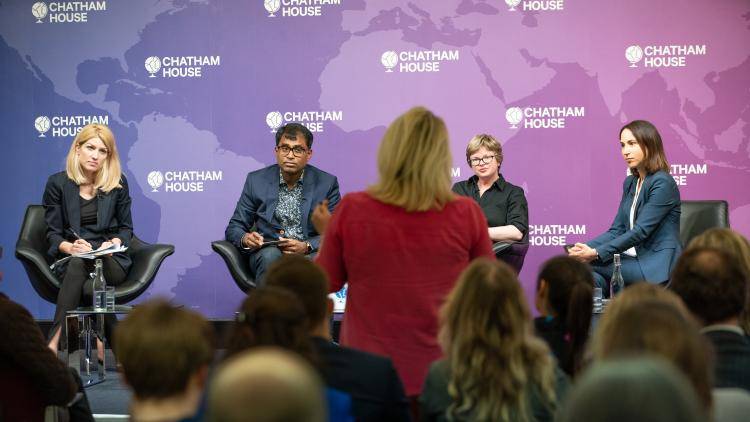
So, as I mentioned, we’re here to, obviously, celebrate Pride, but also to commemorate it, to have an action-oriented conversation about the steps and the coalitions needed to drive dialogue, to drive action, and to ensure that in a generation’s time, we’re not having this conversation again. Now, we are incredibly well equipped to achieve these objectives, maybe, work towards them in the next hour or so. Joining me on the stage, I’ll start with Peter Tatchell. Now, if I were to list his achievements over the course of his over 60 years campaigning for civil liberties, democracy, LGBTIQ+ rights, we would be here probably until about 2:00am. So, I’ll leave it at this, he co-proposed the UN Global Human Rights Index and led the first successful Reclaim Pride march, which was an ambition to move Pride back to the grassroots.
To his left is Lucy Middleton. Lucy is Thomson Reuters Foundation, LGBTIQ+ Journalist. She was formerly the Deputy Editor at Openly, which was the Reuters Foundation’s dedicated platform to LGBTIQ+ issues. And finally, Francesca Gentile, Francesca is an Open-Source Researcher and an expert in gender and identity-based targeting extremism online, with offline dimensions as well. And myself, I’m Isabella Wilkinson, I work at Chatham House, evidently, and I’m part of our Digital Society Programme.
So, before we turn to our speakers to help us, again, map out the state of disinformation targeting the community, let me do a little bit of housekeeping. This session is on the record, it’s being recorded, we have a big online audience as well, so thank you so much for joining us. We encourage you to tweet, so go on LinkedIn, go on X, you can use the hashtag #CH_Events. We will be doing a brief conversation on stage and then turning to a Q&A. So, when you’re asked – well, if you would like to ask a question, rather, stay where you are, raise your hand, and my colleague will lower a microphone above your head, and please introduce yourself. We really want this to be an inclusive dialogue. We have a great group here today, many experts, many practitioners I recognise, many I don’t. So, we really want you to be part of a very lively Q&A afterwards.
Now, let me turn to our fantastic speakers. Perhaps, Lucy, I could start with you. I mean, from memory, you’ve worked in over 25 countries, commissioning pieces on the state of LGBTIQ+ rights, experiences, freedoms. From your perspective, as an Independent Journalist having this global reach, can you talk to us about the state of disinformation and online harms targeting the community?
Lucy Middleton
Yeah, of course, thank you. So, disinformation against the LGBT community is something that we see getting worse at the moment. Just to, kind of, put it into perspective a little bit, there was a report that was released today from the European Parliamentary Forum that said “Around £1.18 billion had been invested in anti-gender initiatives across Europe,” just, for example. And that, in balance with how, kind of, US aid and other foreign aid supporting LGBT groups at the moment, that is going down, while that is – while funding for anti-LGBT inform – misinformation and disinformation is rising, that – it’s something we’ve been tracking at the moment, because it’s just growing more and more stark online.
And particularly I think in the last 12 months or 18 months with the – so many elections last year, I think there were 70 plus elections – we’ve noticed how LGBT lives and issues are being targeted as a means to, kind of, create more polarisation and benefit those who want to have political power, particularly on a right-wing status. Yeah, I think – so, I mean, just some examples I could give you from the top of my mind. We know that for one example, so in Turkey in – at the moment, LGBT people are being blamed for low fertility rates. And the Ministry of Family Affairs and Social Services is – got an action plan for the next four years that is all about raising those fertility rates, and a whole section of that is to do with targeting LGBT lives and targeting LGBT propaganda. And that includes funding for documentaries and leaflets and magazines.
And it’s just – it’s really demonstrating how LGBT people are becoming a scapegoat, and that disinformation about LGBT lives and what they represent to political parties that want to use them for their own gain, is – has got that state sponsorship that’s making it far more wide reaching. And we – it’s something we’re seeing time and time again at the moment, which is, it’s all interlinked in a way that it hasn’t been previously, I think. We know that for a – just even looking in the US at the moment, and in the UK, last year, LGBT issues were used by both – were used in both elections with misinformation, disinformation, to, kind of, get that – secure those votes and things by scaremongering, and things like that, through online spaces, as well. For ex – with Trump’s targeted adverts and things about Kamala Harris and things like that.
Yeah, it’s a real ongoing topic, and often it’s – I think it’s, kind of, feeding into each other. So, we know, also, for example, that disinformation campaigns are leading to legislation, which we’ve seen a lot in, like, Western Africa, a lot of French-speaking Africa, that there is a lot of fear about Western acceptance of LGBT lives. Which has then been monopolised and turned into more scapegoating and is creating a rise of anti-LGBT legislation in places like Liberia and Senegal. So, yeah, I think it’s, oh, it’s definitely something that’s getting worse, and it’s definitely something that is interlinked globally. Yeah, I think that’s…
Isabella Wilkinson
Hmmm.
Lucy Middleton
Yeah.
Isabella Wilkinson
Thank you so much for pointing out the interconnections.
Lucy Middleton
Hmmm hmm.
Isabella Wilkinson
I think it underlines the importance of looking at the evidence, looking at the data, and then following those threads back in the disinformation space, call it maybe “following the money” and the trail back to what might be a homegrown narrative, or might be evidence of an actual influence operation. Francesca, as someone joining us from, kind of, the research and investigations community, could I perhaps turn to you for your assessment on some of the key trends, not only in narratives, but also in targeting and impacts?
Francesca Gentile
Of course. So, at CIR, we’ve been researching how identity basis information, which includes gendered, sexual, racial, ethnic and religious disinformation, is being spread by state and non-state actors, both foreign and domestic, online. And when it comes to disinformation targeting the LGBTQI+ community, we’ve seen actors using similar tactics and techniques to spread disinformation, but then also adapting narratives to advance their own specific agenda. But the end goal that we’ve seen is that all perpetrators spreading this type of disinformation have the same goal, which is to undermine, shame, silence and single out members of the LGBTQI+ community.
In terms of the narratives that we’ve noticed globally, and to add to the ones that, Lucy, that you’ve mentioned, which we’ve also seen, we’ve noticed that in the context of the Russia-Ukraine conflict, Russian state and non-state actors have spread LGBTQI+ disinformation. Not only to amplify homophobic content, but also to undermine Ukraine’s efforts in the conflict. So, for example, a lot of the claims that have been made, false claims, are that the Ukrainian Army is made up of homosexuals who are fighting for their homosexuality.
If we move to the US and the UK, we’ve noticed far-right extremist accounts and conspiracy theorists spreading false and harmful narratives claiming that members of the LGBTQI+ community are paedophiles, that they are grooming children and that they are pushing forward a so-called ‘satanic agenda’. In the 2024 elections in Moldova, LGBTQI+ disinformation was spread with the aim of undermining pro-EU candidates. State and non-state actors shared false claims, mentioning that if Maia Sandu won the election, she would have imposed and promoted non-traditional values all over Moldova, especially in state institutions and in schools.
And then we also saw it in the US presidential election last year, where we noticed an increase in transphobic and homophobic disinformation online. And it targeted not only the members of the LGBTQI+ community, but also female and male candidates, as Lucy was mentioning, regardless of their actual identity. And in these narrative, transgender identity was portrayed as ‘negative’ and ‘shameful’, trans individuals were framed as ‘threats’ and as ‘predators’ in society, or they were falsely accused of having a mental illness, and then words, like, ‘trans’ and ‘gay’ were routinely used as slurs and as insults.
When we look at the tactics, we’ve identified a set of them that are routinely used, and these are image manipulation and context collapse. So, you might all remember the example of a couple of years back when Russian state and non-state actors shared a manipulated image of a pink tank. The original image was from a Pride parade back in 2007 in Manchester, but these Russian accounts had used that image and then spread it with the claim that feminists in Europe had raised money to send a tank to Ukraine, but had painted it pink and chopped off the barrel. And that’s a perfect example to show exactly what Russia is doing, spreading homophobic content, but then also trying to undermine Ukraine’s efforts.
We’ve noticed actors fomenting tensions in society, and that’s a tactic used by both state and non-state actors, to influence a country’s decision-making processes, so by spreading certain narratives that an – can increase those tensions in society. We’ve noticed actors spreading conspiracy theories, abuse and hate speech online. We’ve noticed them us versus them distinctions, which is also a tactic known as ‘outgrouping’, whereby an individual or a group is deemed as ‘the other’, and usually that other is seen as the enemy. And the ingroup blames the enemy, or the outgroup, for all of its perceived ills and grievances. And then, lastly, we’ve also seen, actors use whataboutism, or denial and distraction, which is a tactic used by actors to dismiss any information and/or narrative that is not in line with their own.
One thing that we found consistently in our reports, and it’s something that I’d really like to emphasise, is that what happens online does not stay online, but it does have offline repercussions. So, disinformation targeting the LGBTQI+ community can be very dangerous, as it can encourage and normalise physical violence against members of the community, especially if they are being framed as ‘predators and/or as a ‘threat to society’.
Isabella Wilkinson
Thank you so much. There is so much food for thought there, but let me tease out your final point on the escalation of harms from the online environment to the offline. And I think this is the perfect chance to pivot to Peter, perhaps for a bird’s eye view of the state of LGBTIQ+ rights and freedoms, understanding, and I think, you know, elucidating the fact that their online experiences, the diversity of online experiences, again, not homogenising the community, but recognising that different parts of the community move through online spaces in different ways, recognising that these are inextricably linked to the offline. Over to you.
Peter Tatchell
So, I think it’s true that a combination of insider lobbying and non-violent direct action by groups like OutRage! in the 1990s helped raise public awareness about discrimination suffered by LGBT+ people. It motivated public support for change, and that emboldened Members of Parliament to vote for change. So, we saw a parallel rise in activism leading to social change. But we should always remember that until 1999, Britain had, by volume, the largest number of anti-LGB+ laws of any country in the world, some of them dating back centuries. Yet from the Year 2000 onwards, until 2013, just the space of 13 years, all those laws were appealed. That is the fastest, most successful law reform campaign affecting a disadvantaged minority in Britain and possibly anywhere in the world.
So, we have made huge, huge progress, and coinciding with that legislative progress has been a parallel shift in public opinion. So, back in the late 1980s, according to the British Attitude Survey, 75% of the public believed that homosexuality was mostly or always wrong. A decade ago, it had gone down to about 20%, so a huge fall. But what we’re seeing now is a reversal of those attitudes among a minority. It isn’t a universal, but it is a worrying trend that increasingly, there are organised far-right, religious groups in particular, that are promoting a backlash. And, you know, backlash is part and parcel of the process of social progress, it happens every time a marginalised group seeks to get their place at the table, but it is very, very worrying.
And I think that, you know, we still have some ongoing issues that are unresolved. The Conservative Government in 2018 promised a ban on conversion therapy. That is, the attempt to change a person’s sexuality or gender identity. We still don’t have that all these years later. The Labour Government promised it, but has not yet delivered it. We have the new trans culture wars, which echo the culture wars against lesbian, gay and bisexual people in the 1970s and 1980s. And the demonization of trans people, the misrepresentation of trans people, is particularly acute, extremely acute, and, you know, it is very difficult to battle against because the online world seems to be biased.
You know, nearly all human rights and LGBT+ groups report that since Musk took over X, the algorithms have reduced their number of views and reduced their engagement, and overwhelmingly, the engagement is from homophobic and far-right groups and religious extremists. Now, that is something which I can’t prove it’s deliberate, but it is a notable trend across a whole range of LGBT+ and human rights groups. So, in that space, it’s very difficult, or increasingly difficult, to get an alternative point of view or a response and a reaction, a correction of the misrepresentation.
I just want to echo what has been said earlier, there’s been surveys which show that just about every LGBT+ person who’s online has experienced hate, in terms of threats, abuse, you know, calling them ‘paedos’ and ‘groomers’, suggesting they’re ‘threats to society’, and should be ‘exterminated’, really extreme stuff, and right now, the prime victims of this online hate are trans people. Nearly all my trans friends have had threats to kill them, rape them and castrate them, nearly all, and Police action has been derisory. The Police have acted sometimes, but for the most part not, and this has forced a lot of LGBT+ people to go offline.
You know, the scale of hate is so extreme, I know friends who’ve had near mental breakdowns because of it, and you know, they used to try and respond, and that would just get more abuse, and the abusers would alert more of their friends and there would be further pile-on. So, it means that people are being forced out of the public square, you know, online square. And that is really bad for democracy, if people cannot engage and are so intimidated and so threatened that they have to withdraw, that’s not what democracy is supposed to be about. It’s supposed to be about engagement, involvement, participation, and being able to have a dialogue.
Isabella Wilkinson
Thank you so much, and I think especially for that last point on what experts often call “digital spirals of silence,” when, because of disproportionate targeting due to your identity, perhaps due to your overlapping identities, as well, noting the importance of an intersectional perspective here, it’s easier and safer to withdraw. Now, thank you all so much for this first part of the discussion, where, you know, using your unique vantage points, I think we’ve sketched out one piece of this global puzzle, denoting the state of disinformation, but also general harm targeting the LGBTIQ+ communities offline, but of course, online, as we’ve established, incredibly connected.
Where I want to move us now is to perhaps the next generation. We’ve established I think, in the first part of this panel, that this is about more than disinformation. It’s about resilience, it’s about democratic institutions and values, it’s about the nature of participatory democracy. So, let’s take a moment before we open up the floor to Q&A, to think creatively about the coalitions, the partnerships, the incentives, the progress, that we owe future generations to make now. Lucy, perhaps I can turn to you first now. I mean, you’ve been working within LGBTIQ+ journalism and media for many years. You, within that time, have me – absolutely being exposed, or involved in perhaps, effort to improve what’s often called ‘information resilience’. What works and where are innovations needed?
Lucy Middleton
So, I think it’s still very much an ongoing process. I will say that by no means do we think that we found what works, but it’s incredibly difficult at the moment because there is so many sources of mis and disinformation. So, my organisation at Thomson Reuters Foundation, for us, a huge element of everything we do is this – impartiality is an incredibly important part of our work. And I mean, I’ve definitely – when I talk to people about this sometimes, there’s a lot of debate about whether a Journalist can ever truly be impartial. But I think if you can write journalism that will cover an issue in its full context, that will always help with supporting the truth and supporting the reader in making up their own mind about anything, this is just a level of groundwork before getting onto specific LGBT issues.
I have noticed – I used to work at national newspapers and I got into doing LGBT journalism from a vantage point of seeing a lot of mis and disinformation. That’s what got me into writing LGBT topics, because all the national newspapers in the UK feed off each other in terms of what’s the story of the day, and quite often, as Peter said, particularly with trans people, if there was a story about trans issues, it would be served without context.
Isabella Wilkinson
Hmmm hmm.
Lucy Middleton
And that’s how I, sort of, came into this, was that we would take what was – everyone was talking about and we would investigate it ve – further and write our own articles.
And I think – so, yes, there needs to be a shift, I think, in journalism, away from – at the moment there’s a lot of pressure on Journalists who get their money through advertising and who are – and I’m talking, I guess, specifically about tabloids, but I think all Journalists who work in online media, or print media for that matter, are struggling with this. To serve up something that is very exciting or clickbaity, or eye-catching, rather than factual. And I know that, being on the other side of it now, that our work is incredibly well researched, it goes through multiple layers of sub editing, but it doesn’t quite have the reach all the time that an article on one of the UK’s biggest tabloids might have. So, there is an element of, kind of, I don’t quite know how we would implement it, but tightening those journalistic practices.
Isabella Wilkinson
Hmmm hmm.
Lucy Middleton
But the other thing I just want to mention is, so part of our journalism that has been really successful is that we have a TikTok channel, and our TikTok, anything we make on TikTok is – still comes under our Reuters Trust Principles. So, they’re always scripted, they’re always fact checked, they’re everything, but we are finding that the viewership on those and the impact that we have from those is so much bigger than online. There was a Reuters digital report that came out recently that showed that people who use social media to get their news, I think it’s increased to 65% to TikTok, versus, I think it was, like, in its 50s a couple of years ago. And in countries like India and Kenya and the Philippines, more than half – the majority of people say that they watch video news rather than reading anything. And that is something that I think all media platforms have to cater for.
That is where the majority of the mis and disinformation is, is the social media. I think, again, it was in the US, and it’s in Fra – and in France, both of them had really high numbers of people listening to Podcasters, like Joe Rogan, for example, specifically for their news, rather than media outlets. So, there is an element of you have to try and meet people where they’re getting their information. You can’t expect them to come and find you in the platforms that are now outdated…
Isabella Wilkinson
Hmmm hmm.
Lucy Middleton
…to them. And I think, the last point I suppose I just want to make to that is the, kind of – the spread of misinformation that can go through social media is so rapid. If you sit back and think, this is taking off, I can see this taking off on TikTok now, but I’m going to write an article and, like, that’s going to be my counter-element, you’re not going to actually actively be able to stop that impact in its tracks.
Yeah, and I – and the impacts of social media misinformation is felt in real life, again, as Peter described earlier. We know that, for example, campaigns of anti-LGBT information have been going on and on, and for example, the Ivory Coast is having elections this year, and is having a huge mi – disinformation campaign on social media that is making LGBT organisations and support networks, specifically HIV support networks, cut back on their visibility, because they don’t want to feed into that, which then is harming real life LGBT people. That sort of campaign has a real-life response, and you’re not going to be able to fight it or aid it or break through it with a different platform. You’ll unfortunately have to meet it where it is, yes.
Isabella Wilkinson
A powerful statement there, I think meeting people on the platforms, hmmm hmm. This brings us to, I think, the elephant in the room on platform accountability, but perhaps before I turn to Francesca on this, Lucy, a really simple question on responses, does debunking work?
Lucy Middleton
I would like to say, yes, seeing as it’s a big part of what I do, and I’m like, “Yes, I’ve done it.” I think it does and it doesn’t. So, it all depends about visibility. I think it really does, when somebody is seeing your article, seeing your TikTok video, encountering it, great, but it’s just the reach, it’s just trying to – you can’t possibly reach everybody that’s seen a million view video on something online. You can try your best. I mean, I have the same conversations even with family members who are reading stuff on the news and it’s very frustrating, ‘cause I’m, like, “But didn’t you see this?”
Even with the Supreme Court ruling recently, I mean, I think that it was very frustrating, as somebody in the field of LGBT journalism who was painstakingly speaking to Lawyers and putting together a, kind of, “What does this mean?” article that all the national newspapers – or I say all of them, a majority of the national newspapers had taken that ruling of the Equality Act, which basically said that trans women weren’t regarded as women under the Equality Act. That trans women were no longer women, which wasn’t actually accurate at all, but it, kind of, put that on blast.
And I did have emails from LGBT organisations who’d read my article and had said, “We’ve seen you say this, but we also see the media saying this. Like, what – I don’t understand.” And I could feedback and be, like, “This is the – like, this is what I’ve working out is correct, and this is how it’s been spun into this way and we don’t know yet actually, what they’re saying is true. But, yeah, it’s – I think it’s just about reach. I don’t have the same reach as a front page of a newspaper that’s…
Isabella Wilkinson
Hmmm hmm.
Lucy Middleton
…everywhere, unfortunately.
Isabella Wilkinson
A really important point.
Lucy Middleton
So…
Isabella Wilkinson
Francesca, as I – as we explored before, in the first part of this event, your role in this space is very much on the research and investigation side, but there is a string connecting what you find in your reports on tactics, techniques, procedures, as you walked us through earlier, to platforms maybe changing their policies, or policymakers may be changing their opinion, or perhaps we really, really hope there is. But as we’ve established over the course of this event, that string, perhaps it’s non-existent. You know, are, I guess in your perspective, platforms and policymakers listening when you point out the immense targeting, the harms generated in influence operations which are targeting folks based on their identity?
Francesca Gentile
Before I get to that, I’d like to say that I think research and investigations generally are really important.
Isabella Wilkinson
Hmmm hmm.
Francesca Gentile
Not only to provide that evidence of, you know, the scope, the tactics, techniques, the narratives, but also the impact that disinformation has on vulnerable communities, but they also shed light on the gaps and the issues that you might see whilst carrying out your research. So, when I was working on the gendered hate speech report that we published at Afghan Witness, which is one of CIR’s witness projects, we noticed that a lot of the hate speech and disinformation was being spread in minority languages or regional dialects, such as Dari, Farsi and Pashto, and what we noticed was that it wasn’t being detected or taken down. So, one of the recommendations that we put forward, and this wouldn’t have been possible if we hadn’t researched it, was for social media platforms to ideally improve and amplify their language capabilities, and deepen their understanding of local context. So, then, in that way, they can better detect and respond to these online harms.
On your second, sort of, bit about whether or not they are responding, and they’re actively…
Isabella Wilkinson
Perceptive, yeah.
Francesca Gentile
…I will say that we at CIR have had some success with certain social media companies, where with – whereas with others a little bit less. So, a couple of years back, we published a report on gendered hate speech in Myanmar, and our team at Myanmar Witness worked with the BBC to share our findings directly with the platforms where we’d noticed gendered hate speech being spread. And a few months after the report had been shared with these platforms, we saw that Telegram and Meta had removed most of the abusive posts and channels that had been identified. So, yes, there is some responsiveness, but I feel like there is a lot more that social media platforms can be doing.
Isabella Wilkinson
Hmmm hmm.
Francesca Gentile
Not only by enforcing their terms of service, but also by revisiting and updating their hate speech and disinformation policies to make sure that they reflect the evolving landscape and environment that we’re living in. And only then will we have, and will we be able to create, a better and safer online environment.
Isabella Wilkinson
Thank you so much, Peter, let me turn the conversation over to you now, and perhaps not over to you as much as the grassroots. We kicked off the discussion today with an appeal to the next generation, and I think Lucy and Francesca have really expertly pointed out specific interventions, strings, right, between interventions and potential positive change? Looking to the next generation, at the grassroots level, what are the coalitions and the partnerships and the incentives and the money needed to ensure that we’re not having this conversation in a generation’s time, to ensure that the current state of backsliding, it’s mitigated, it’s slowed down, maybe even reversed? A big question, but I trust you to handle it.
Peter Tatchell
I don’t think there is any easy answer…
Isabella Wilkinson
Hmmm hmm.
Peter Tatchell
…sadly. I wish I had the magic wand, but I don’t. Obviously, one thing would be for better moderation by the tech giants. They’ve got billions and billions, they can afford to employ more people to do moderation. That’s quite easy, quite simple. And I think that, you know, if you – the way I look at online media is, basically, it is a digital form of the public square. So, it’s like a public place or a forum like this where people come and discuss ideas. In this kind of scenario, we wouldn’t tolerate threats to kill or incitement to rape or castrate someone, so why should it be tolerated online?
And then you have to ask yourself, well, if public squares are not under the control of tech giants, not privately owned, why should social media be? It’s a – the major form of social communication today, why should that be in private hands and for profit? Surely, it should be – there should be some form of public access or accountability or even ownership. So, maybe we need to think about breaking up the Big Tech giants, that’s one.
Another one is, I suppose a more complex and potentially dangerous one, is I think there is a case, a case, not saying it should happen, but a case, that tech giants should require everyone who uses them to register with verified ID. They would still be able to post under an anonymous pseudonym, that would be fine, but the tech giants would have their official ID so that if they incited threats and violence, then they could be more easily tracked down and the Police could investigate. ‘Cause that’s the one of the biggest problems the Police say is, you know, “We don’t – this is an anonymous account, we’ve got no way of finding it.”
The downside to that, of course, is that this information would have to be held in very secure databases that no-one, apart from the tech giants, would have access to, and there’d have to be a complex verification process to get access. Because there are, for example, people right now in Iran who are putting out message on social media anonymously about the executions and the killings that are taking place in Iran right this very day, and their identity needs to be protected. Likewise, particularly for LGBT+ people, if they’re not out and open, if they’re living in a very homophobic, biphobic or transphobic country, if their parents could potentially harm them, it would be totally wrong for them to be easily identified. But this registration idea, I haven’t got the perfect blueprint by a long shot, but I think it’s something that needs to be considered by minds more braver and intelligent than mine.
Isabella Wilkinson
Perhaps before turning this conversation over to the audience, I wonder whether maybe Lucy or Francesca had any quick off the cuff responses to this registration idea. Because it is certainly something that’s circulated in the disinformation and resilient community for a while. I’m sure many in the audience might have some things to say about it as well, but I thought I would pause to see if either of you had any reactions.
Lucy Middleton
Yeah, I mean, I – it’s something I’ve heard of before and I think it’s – I don’t know, I always think it’s very difficult in terms of the – I definitely agree that the social media space needs to have more accountability.
Isabella Wilkinson
Hmmm hmm.
Lucy Middleton
And it certainly needs a way that people can not only account – like, an actionable accountability, not just a, kind of, threat of it, but a realistic way that it’s going to be, like, worked upon. Yeah, I mean, I think that it is definitely something that should be implemented. I just don’t know if realistically, it would be, I guess is my only thought with that. But I think in terms, as well, like, for the protection of LGBT people, particularly online, the number one thing that we need before – it is that moderation. It is that recognising that certain language or terms, and as you said, things that would be said in real life that would be harmful become harmful in the online sphere, as well.
So, there needs to be that, sort of, due process, where somebody that says something is going to be reprimanded. Otherwise, there’s almost no use of them being able to be held accountable, if the process isn’t there, if that makes sense?
Isabella Wilkinson
Hmmm hmm, no, thank you so much for that. Let me now open up the conversation to the room. What I think we’ll do, in the interest of time, is take one or two questions from everyone here. I’ll choose one or two questions from online, pitch it to the panel, and then we’ll see if we have any more time for some final reflections. So, if you could just raise your hands now if you’re interested. Fantastic. The person in the black dress, and the person in the sweater vest.
Rheea Saggar
Hi, is this working? Okay, thanks. Hi, thanks for this today. I’m Rheea, I work with Chatham House’s Communication and Publishing Department. I’m also the Co-Chair of Chatham House’s Pride Network. I’ve got a question and I’m going to try to be precise about this. So, the LGBTIQ+ community is not one monolithic community, right? In the sense that it’s a bunch of communities who experiences are coloured by their race, by their nationality, among other things. For instance, the online experience of a brown lesbian woman is going to be realistically quite different from that of a white trans man. So, inevitably, so we have to think about the communities’ online experiences intersectionally. My question is, what does that mean on a tangible level in terms of the policies that the platforms should have? How do they think intersectionally? Thanks.
Isabella Wilkinson
Brilliant question. Would you like to go ahead, person in the sweater vest?
Member
Oh, sorry.
Isabella Wilkinson
Sorry. Not to call you out as your…
Member
No, sorry.
Isabella Wilkinson
Making notes.
Member
Interesting question, yeah. My question is more a UK historical based one, in a sense of that – especially maybe towards Peter, going back into the 90s, sort of, always advocating for especially the Met Police in London to take LGBT hate crime into their statistics. Is there – a very short question, is there a, sort of – in activism, are we always too late? Does something like a 1999 Soho bombing or serial killers, where non-LGBT cases are 50% more likely to get solved by the Met Police, or were solved by the Met Police, does something bad happen that this tipping point, this momentum of change, from the policing side happens? Thank you.
Isabella Wilkinson
Thank you so much. Really, really fascinating. What I’ll do is take one question online, and then go to the panel and then bring it back to the room. Joseph Black asks, “Are there any countries that stand out as having taken meaningful steps to combat” disinformation – or “misinformation” rather with an ‘m’, “targeting the LGBTIQ+ communities, and what might we learn from their approaches?” So, we have an interesting question on intersectionality, one on readiness and crisis response, and then a final one on any best practices we can learn from. Perhaps I could start with Francesca, and feel free to pick and choose. There’s lots of food for thought there and I don’t anticipate that we’ll solve everything in the next 15 minutes.
Francesca Gentile
Really great questions. I’ll start off with the one on intersectionality, and it’s actually one of the things that we pointed out in our report, that you can’t have specific categories. When we talked about ‘gender disinformation’, it’s not just gendered, it’s not just sexual, it’s not just racial. There is an overlap, and I think normalising that understanding that there can be a crossover between different identities and it’s not black and white is the first step to actually then creating specific policies for social media platforms, but also for governments to actually understand it. So, I feel like the first step is normalising that it’s not black and white, but there is a crossover and there is – there are different identities. There’s different – there’s disinformation that is spread in different ways. So, I feel like that’s probably the first step. I don’t know if Lucy and Peter would like to add anything to that.
Lucy Middleton
No, I completely agree with you. I think, as well, that, kind of – I mean, I’m just building on what you’ve said, I suppose, but it’s – we notice a lot in advocacy, as well as, kind of, separate to digital harms, I guess, that the best way of understanding those crossovers and that intersectionality is data. So, the more specific data research can be to different groups within the LGBT community, the more beneficial it is. Which is a bit of a struggle at the moment, because I think that a lot of organisations who are struggling with funding, it’s a real issue that’s happening to – I’d say, like, 90% of LGBT organisations globally have lost some sort of funding this year, and data collection is a massive thing that is being hit.
So, I – that doesn’t quite play into the same thing, but I do think that the more you can try and learn about specific experiences, the more you can cater to them, because they are, as you said, completely different.
Isabella Wilkinson
Peter, would you like to come in on the intersectionality point or on the…?
Peter Tatchell
The tipping point?
Isabella Wilkinson
Yes, I thought you might.
Peter Tatchell
You’re definitely right that certain events do provoke a huge outpouring online of outrage and demand for action, which often does produce action. So, I’m thinking of the killing of Matthew Shepard in the United States. Through social media and other means, that killing and the subsequent anniversaries and commemorations did lead to a lot of US Force – Police Forces taking proactive action to address homophobic, biphobic and transphobic hate crime. Often not enough, but it was that killing that triggered at least some action.
The same with the Stephen Port serial killings here in London. The anger that the Police had never properly investigated the first two killings and ignored so obvious leads, the social media outcry against that was one of the factors that led to a review, and indeed, to the inquiry, and where the Police were thoroughly condemned. Though the punishment for the Officers was very poor. Another example is in Uganda with the passing of the Anti-Homosexuality Act in 2023, that led to a huge outpouring of outrage all over the world, you know, imposing the death penalty on LGBTs in certain circumstances, but also in Uganda. But in Uganda, it was both ways, there’s the outrage of LGBT and allies, but also, the pushback by those who supported the new draconian legislation.
So, your point is absolutely right, tipping point events can be articulated and amplified through social media.
Isabella Wilkinson
Thank you so much. Let’s bring it back out to the room here. Could I go to the person with the white t-shirt and the person with the light blue top?
Gabriella Wilkinson
Thank you very much. Hello, my name is Gabriella Wilkinson, I work at the Foreign Office. Quick question for Francesca. With the targeting that you’ve seen on minority language groups, do you see a particular actor, foreign actor, targeting these groups? And where do you see, kind of, the AI role in taking down disinformation posts specifically targeting LGBTQIA+ community? Thanks.
Isabella Wilkinson
Thank you.
Aroni Sarkar
I’m Aroni, I’m also with Chatham House, and my question is about the increasing attachment of national identity with advocacy for LGBTQI+ people online through homonationalism. So, for example, we see within Western democracies the use or instrumentalization of queer communities, such as, armies displaying Pride flags in conflict zones to justify their democratic stance, and advocating for democratic rights within, you know, countries where they believe there are oppressive regimes. Whereas, we also have in conservative Asian countries, for example, Singapore, where I’m from, where advocacy groups need to use nationalist strategies to advocate for themselves by saying that, “We fit in with the country and the national identity.”
So, what are the implications of this – and to all the panellists, especially in times of conflict where national identity is being more and more attached to either being pro or against something, and especially when it comes to creating safe spaces for queer communities?
Isabella Wilkinson
Hmmm hmm.
Aroni Sarkar
Thank you.
Isabella Wilkinson
Thank you so much, and maybe on a personal note, I have to say, the quality of questions at Chatham House panels are so good that I learn as much during the Q&A. Thank you so much for that. So much food for thought there, on the use of AI for takedowns, on specificities of the foreign actors targeting – doing identity based targeting, rather, and finally, on using national identity in advocacy and the difficulties this raises. I realise that’s a mass simplification of your fantastic question, so I hope you’ll bear with me. Francesca, perhaps I could turn to you first, followed by Peter and then Lucy.
Francesca Gentile
So, when we were looking at the gendered hate speech that was being spread against politically engaged Afghan women, we noticed that it was mostly domestic actors. So, it was pro-Taliban accounts and low ranking Taliban officials, so it was domestic. And the same was in Myanmar, where I think it was pro-junta Telegram accounts spreading it. So, we haven’t seen any – at least in the reports that I’ve looked at, we haven’t seen any foreign interference, it was mostly domestic being spread, which says something about the gender disinformation being spread, as well.
On AI and taking down disinformation, that is a brilliant question, and it’s something that we’ve been talking about a lot, because I feel like AI has so much potential that it can definitely help in that sense. I feel like it’s about training the machine properly with a lot of specific keywords that then it can detect. But then it’s also a case of updating it regularly, because there’s a lot of slang, there’s a lot of terms that might be different in different countries. So, you have to, at least in my opinion, have to have that updated quite frequently to make sure that the, you know, the AI can learn and be better able to detect disinformation being spread.
The big question is then, can it detect humour, and can it detect disinformation being spread in memes? So, when certain memes are being shared, and I’ve been looking at far-right extremist content, will it be able – and, you know, and memes being spread there that are humoristic in tone, will it be able to detect the hate speech and the disinformation that’s being spread there? And that’s a question I actually don’t have an answer to, but I feel like that constant, like, making sure that it is constantly updated and it keeps learning is a way forward.
Isabella Wilkinson
Hmmm, thank you. Peter.
Peter Tatchell
I think it’s true, and I hope we all agree on that, LGBT+ rights do not trump all other human rights, they’re one of a spectrum, and that we cannot just ignore other abuses in the name of LGBT+ freedom. I think there are some good examples of this, particularly in Uganda. In Uganda, with the passage of the Anti-Homosexuality Act, and before that, there was a coalition of groups that worked together to challenge all human rights. So, the LGBT+ community and organisations were part of this alliance and coalition, which included women’s groups, tribal minority groups, trade unions, opposition activists, cultural campaigners and others, and their strategy is that they stand together. So, when the LGBT+ community is under attack, all the other groups pile in to support, and conversely, if women or a tribal minority’s under attack, the LGBT groups join the others in defending those tribal minorities.
So, that’s a really good example of how working together around a common shared human rights agenda can really make a difference. And that is one of the reasons why by not just the LGBT+ groups, but others, have survived. And of course, in Uganda, you know, LGBT+ issues are important, but they’re by far not the only issue. You know, there’s poverty and hunger, malnutrition, lack of adequate sanitation, clean water, and of course, the government, which is a quasi-dictatorship, which has successfully rigged successive elections and tried to jail and even kill opposition leaders. So, LGBTs in Uganda, those in the movement, understand this and for the most part, they are supporting bids to resist the Museveni – President Museveni’s regime, not just on the grounds of anti-LGBT+ policies, but because it is a quasi-dictatorship.
The other point to make is that you’re right, LGBT ri – + rights is used in different ways and different scenarios. So, a lot of African LGBTI+ activists argue that LGBTI is part of an African tradition, and they look at historical evidence of same sex relations pre-existing prior to colonialism. To argue that it’s not a Western import, it is actually part of traditional orthodox African culture. Another level, of course, in a different way, Hungary and Russia are using national identity to suppress LGBT+ communities, to argue they are ‘alien’, they are ‘foreign imports’, they are a “malign Western influence that is not consistent with” their own “national identity and culture.”
So, it does go both ways, but I definitely think that those LGBT+ groups who try to promote LGBT+ rights in a way that is, sort of, consistent or allied to their cultural traditions, tend to have the most success.
Isabella Wilkinson
Thank you. Lucy, a final word.
Lucy Middleton
Yeah, I – well, I was actually going to say something very similar to you, and, like, we do a lot of reporting on – from Southern Africa, and a lot of the response to LGBT people in places like Uganda or Kenya or Nigeria where it can be hostile, is that being LGBT is un-African. And we work with activists who are, as Peter said, actively trying to demonstrate that, number one, this is not the case you can be LGBT and African, but also that it isn’t African founded. And that’s something that is – it’s an – so a lot of regions that are – previously were part of colonies find that the, kind of – their anti-homosexuality laws, or things like strucking out – striking out the recognising of trans identities is colonial, rather than indigenous to the population.
So, there is a – there is – I definitely agree that activists and advocacy groups that can talk about the historical roots of LGBT identities, because they have always existed and they do date back as far back as populations do, it’s a huge source of benefit for them. But yes, I can also see how a lot of – I mean, it’s the same – and not to just repeat everything you said, but it’s the same in a lot of Eastern European countries at the moment that have anti-censorship laws for LGBT so-called ‘propaganda’. It’s almost always described as a ‘Western import’, a, kind of – an American thing that’s coming over to Eastern Europe, and that’s equally harmful. So, it does work both ways, yeah.
Isabella Wilkinson
Thank you, and thank you to all three of our speakers for, I think, three different things. The first is for really weaving a global narrative and sharing specific examples globally from your work, from your experience. This has been absolutely fascinating. Second is for making an effort to ensure this conversation was proactively intersectional, and it’s been a real pleasure to listen to your insights from this intersectional perspective, as well. And finally, thank you so much for making this a conversation, as well, about the geopolitics of disinformation, of targeting, so really, connecting it on those three crucial levels.
Now, on behalf of Chatham House and our EDI Working Group, thank you all for being part of this conversation. I invite you all to join us upstairs for a drinks reception, where we can continue the conversation in a slightly more informal setting, and if you could all please join me in sincerely thanking our brilliant speakers.