Olivia O’Sullivan
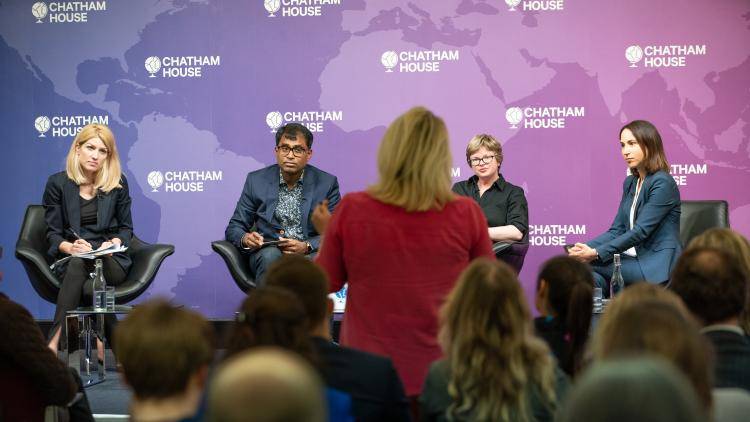
Right, good evening, everyone, and a very warm welcome to this Chatham House discussion asking the question, “Can the UK Afford to Fight a War?” We really appreciate you giving us your time on this freezing cold day. My name is Olivia O’Sullivan; I direct the UK in the World Research Programme here at Chatham House.
I’m absolutely delighted to have an excellent panel to unpack this question with us. General Sir Richard Barrons, who is Senior Consulting Fellow at the International Security Programme here at Chatham House, former Commander, Joint Forces Command, and of course, one of the Authors of the UK’s most recent Strategic Defence Review. Professor Jamie Gaskarth, who’s an Associate Fellow with our Programme, the UK in the World, here at Chatham House, and is also Professor of Foreign Policy and International Relations at the Open University.
Max Warner, Senior Research Economist at the Institute for Fiscal Studies. We’re very pleased to have someone from the Institute for Fiscal Studies join us during IFS Christmas, which is budget week. We’re delighted to have his time. And last but certainly not least, we’ve got Deborah Haynes, Security and Defence Editor from Sky News, who’s very kindly joining us from Kyiv, which we really do appreciate very much. And all of those people are here to discuss, aptly, post-budget, this question of not just whether the UK can afford a war, but what type of war might the UK be engaged in fighting, what could it do now to avoid fighting that war, and what type of spending and capabilities would it need in the eventuality that that happened?
I’m just going to offer a brief word about how this event will run, and then I’ll introduce that discussion a bit more fully, and we’ll go straight to our panellists for their opening thoughts. So, I’ll put an opening question to our panellists, then we’ll have some discussion among the panel, but then we will open up for questions. So, please do be thinking about the questions you would like to ask. When it comes to that section of the event, please do ask a question rather than make a comment, if you would, and if you’re comfortable, do just say your name and organisation so people in the room know where you’re coming from on this question. Just a reminder that this is an on the record event, it’s being livestreamed, and just to thank you again for joining us today, much appreciated.
This is a critical time to consider this question. The UK has set a target to spend 3.5% of GDP on defence by 2035. Current spending trajectories suggest that by that date, there’ll be multiple other calls on the public purse, not just some of the commitments made in the budget this week, but much deeper drivers of public spending in the UK, particularly health and pensions. And indeed, as the IFS has pointed out, the last time defence spending was as high as 3.5% of GDP, it was the late 80s, and we spent about 4% of GDP on health, not the nine to 10% that we are on current trajectories expected to spend on health by about 2035, if we continue with the public – with public spending levels as they are.
The Defence Select Committee here in the UK published a report last week about the UK’s contribution to European security, in which they questioned whether the MoD is able to protect the UK and the overseas territories from crisis or conflict with the armed forces in the state that they currently are, and raised concerns that means the UK is not fulfil – not fully fulfilling its obligations under NATO. So, with concerns, particularly concerns about Russia regrouping and threatening Europe, the speed at which we can spend, how well we can spend, what we should spend on, are all critical questions to discuss. And I think, more generally, whether we are on a realistic and honest trajectory, and what we might do to change that in our public conversation about defence spending and about conflict are all themes that I’m really pleased to be able to discuss with everyone on the panel today.
General Sir Richard, I’m going to start with you. As an Author of the most recent Strategic Defence Review, what kind of war, in that document and in general, do you envision the UK potentially fighting, and are we spending enough and fast enough to be ready for it?
General Sir Richard Barrons KCB, CBE
So, as far as I’m concerned, the review was really clear about the sort of world that we live in, a return to an era of state confrontation, potentially conflict, and that we had exited a world where we didn’t worry about those things and we were able to engage in the, sort of, discretionary interventions which defined Iraq and Afghanistan, which were of a type, and they were of their time. And the SDR recognises that in an era of state confrontation and conflict, although it’s a really bad thing because it implies deterrence has failed, and this should always be about deterrence, if you end up fighting against a state like Russia, it doesn’t have to be Russia, but like Russia, it will be a very immersive experience.
And the two things that really mattered in the review were, first of all, that sort of war poses genuinely potential existential levels of risk to the way this country goes about its business, its security, its prosperity and obviously, its values. So, that’s really different from just managing the relatively marginal risks of terrorism, which we did, although they really matter. And the second thing, which for the UK is really difficult, is this sort of war will absolutely affect the homeland. So, the homeland is on the pitch and in a way that it wasn’t when we were intervening in places like Afghanistan, and the homeland is going to be threatened with all the levers that are available in the way you make war in the 21st century.
So, that includes the things that really aren’t military, but matter, cyber, social media manipulation, sabotage of things like critical national infrastructure, and many other dimensions. And we recognise the UK is attacked that way every single day already, so we can’t claim it’s a novelty. But, in addition, we’d have to contemplate being attacked with the sort of military capability that Deborah Haynes is sitting vulnerable to this evening in the shape of ballistic and cruise missiles and drones. Because as the review made very clear, we are talking about war in the 21st century, which will reflect the digital age as much as everything else. And the key to deterrence is to be able to have the military capability that can credibly fight, as well as the will, based on essentially transformation for war in the 21st century. That’s the opportunity. So, very confident about how many people in government, outside government, in the office, understand the dilemma now.
Olivia O’Sullivan
Hmmm.
General Sir Richard Barrons KCB, CBE
But at the heart of the outcome of the review was, I think, a clear articulation of what needed to be done, so this is where we need to be, it’s quite a high bar, this is for state confrontation. But based on the money that the UK is choosing to apply to defence, amongst all the other things that we have to think about, it has decided to take at least ten years to get to a point where we are ready to meet the, sort of, benchmark that we’ve established. Despite the fact that our allies in NATO are saying this, “You need to be readier in three to five years,” which would just, of course, require more money sooner to go faster. But we have made the choice in big handfuls to go at half the speed of the risk, and that’s the vulnerability we’re running today.
Olivia O’Sullivan
I want to come onto the other panellists, but I do want to just follow-up with you there, because as you say, we’ve made the choice to do that. You – the government appointed you to write the Strategic Defence Review. You and your fellow writers of it gave that message very starkly. Why aren’t they listening to you? What do you think are the barriers?
General Sir Richard Barrons KCB, CBE
Well, so, first of all, they don’t have to listen to – so we were an external review team, we weren’t independent, we were writing the government’s review, and they have to make really difficult choices. So, when we say, “We think events will cause you to go faster,” we meant you’re going to have to find more money sooner. And I would argue on the passage of the last six months, how much more evidence do you need? So, you might have to go a bit faster.
But the government has to look at a whole range of other things it does with – and we have an expert here tonight who will tell us, a bit more than £1 trillion in the public sector, and the fact is, it’s not just the government and this government’s backbenchers, but most of our fellow citizens much more concerned about NHS and potholes and things than they are about defence. And they’ll spend more money on defence, but not if we’re taking it from elsewhere. And so, we, on the basis of the instincts of UK civil society today, reflected in the government that we’ve elected, we are not making the choice to do for our defence and security what our own analysis says we should do because we worry about other things more.
Olivia O’Sullivan
Let me – and I’d love to get into the question of public opinion and society’s view with the panel but let me just put one more question to you, Sir Richard. Which is, you drew this distinction in your remarks, you talked about the cost of deterrence, and I wanted you to just explain a bit more about what we – what you feel we should be spending on deterrence, what that costs, versus what it would cost to fight the kind of war you’re describing, the, kind of, peer-to-peer state war.
General Sir Richard Barrons KCB, CBE
So, for me, the cost of deterrence is about making sure that your potential opponents very clearly understand that should they try and take you on in a warlike way, what they get back is more than they can manage. In the jargon, you establish escalation dominance, in our case, as part of NATO. So, the price of deterrence in the time we live in should be set by how do you deter your actual enemies? And we all talk about Russia, I think, mostly, and therefore, that conversation is driven by what your allies do and expect and what your enemy – where your enemy is setting the benchmark. And yet, our habit for 30 odd years is to set the amount of money we spend on defence as part of a very difficult discussion across public spending, and we would understand that.
Olivia O’Sullivan
Hmmm.
General Sir Richard Barrons KCB, CBE
So, we have a conversation about, “Well, if you spend 3.5% of GDP on defence, then, well, what does that mean for other bits of public spending?” The conversation that I wish we could have more often is, well, if you undergun deterrence and it fails because you’ve ended up in a place where you’re easily exploitable, and you give your enemy a free shot, essentially, well, what’s the price of deterrence failing? Well, if you look at Ukraine and you look at our own history, if you end up fighting, it ticks up to 50% of your GDP and all the damage to your economy and your built environment that you see in Ukraine, and we saw here in the Second World War, and the scars of the death and destruction on civilian and military alike, which will span at least three and probably four generations.
So, if that’s the cost of going to war, the price of deterrence seems to me a bargain, but it’s set by the need to avoid fighting, not set by the need not to take money out of, say, welfare or health or potholes, or whatever it is. So – but that’s our national habit.
Olivia O’Sullivan
Richard, thank you, and Max, Richard finished his answer there by talking about exactly the choices that you think about a lot at the Institute for Fiscal Studies, between defence, health, welfare, potholes, other calls on the government’s resources. And you wrote a report about the government’s defence spending trajectory recently. I wondered if you could just tell us a bit more about the big picture fiscal challenges, and particularly about what – the current targets the government has set, what sort of problems or concerns do you have about how the government would actually reach them based on current – the current spending picture?
Max Warner
Absolutely. So, I’ll start with getting – thinking a little bit about getting to 3½ %, you know, that’s the number that the government has chosen. As you said in the opening remarks, you know, we have spent much more than that in the past as a share of GDP on defence. I completely agree, it is ultimately a societal choice, you know, through the government on how much we spend on defence. The government has set out not a path to get there; it’s set out the next couple of years. But I guess the challenge is from getting where we are now, say, roughly 2.3%, getting up to 3.5% is still quite a large increase. And unlike last time when we spent that level, we do spend a lot more, at least the government spends a lot more on those other things, and that, I think, is the challenge.
So, just to illustrate, what would you have to do to get to 3½%? Maybe why is it maybe happening slower than some people would like? Well, you’ve got three options fundamentally as a government if you want to spend more money on something. The first option is to borrow more to pay for it. Now, that’s the option that some of our allies have taken. You know, Germany, Poland, the EU are funding quite a lot through borrowing. That is much more difficult, and I would say mostly undesirable for the UK, because we are in a worse fiscal position than many of those countries. We have a much higher stock of national debt, and we already actually pay a lot more debt interest on that debt than some of those countries. So, borrowing is pretty difficult. There’s a case for some of it, and indeed, some of the increase we’re already doing in defence spending is funded by borrowing, but you probably couldn’t go all the way by borrowing alone.
So, that leaves you with the difficult choices of tax or spending cuts. So, thinking about tax, if you wanted to get up to 3.5% of GDP just by increasing tax, you can think that’s in the order of three to 4p on all rates of income tax. Now we know there’s been a lot of discussion about will the government raise, you know, 1p of income tax at the budget? A lot of maybe political heat for that. We’re thinking three to 4p on income tax, all rates, or maybe, say, four – three to 4p on VAT instead. So, that’s really quite a chunky tax rise.
The alternative is that you can spend less on something else, but then you have to pick what do we want to spend less on? You can set things out, again, to give you a sense of scale, the increase would be roughly equivalent to cutting the entire budgets of the Home Office and Ministry of Justice. So, that’s everything we currently spend on immigration, policing, courts and prisons is the size of the increase we need in defence. That’s why it’s pretty difficult to cut spending. You really would have to pick which part of a state are we happy to lop off. So, basically, getting there is going to just inevitably either resize and – or reshape the state, and that is a really big problem, or a big challenge, certainly.
Olivia O’Sullivan
Thank you for setting it out so clearly. I mean, just one quick follow-up to you, because you mentioned our peers there. I wondered if you could just say a bit more about countries that on the face of it, seem to be in quite a similar position. You know, they also have ageing populations, they also have, kind of, messy democratic processes by which they have to litigate spending, but they’ve made some different choices in terms of funding via borrowing or thinking differently about their fiscal framework. So, I wanted you to tell us more about that.
Max Warner
Right, and I think Germany and Poland are two interesting examples here. So, starting first with percent – thinking of spending as percent of the GDP, I think we overthink like that, but starting like that, Poland has already done, basically, more than going up to 3½%. Poland a couple of years ago was roughly spending as a share of GDP what we spend on defence. It’s gone way past 3½% already in a couple of years. Germany has traditionally spent a bit less than us as a share of GDP, and it plans to go – get to 3½% in the next couple of years.
Now, as I mentioned, I don’t think percent of GDP – that’s useful in some angles, but of course, what actually matters is the amount you’re spending. That’s what translates into capability, and the UK has long been the second largest defence spender in NATO, after the US, that’s, you know, ten times further, but again, allies are moving quite quickly. Germany overtook us last year, Germany is now already the second largest defence spender in NATO, they knocked us down to third, and you can clearly see other countries moving up again.
So, not – I don’t want to say that all of NATO – like, you know, other countries, France is having incredible difficulties trying – you know, it’s, basically, taken down five Prime Ministers, or however many, trying to pass finance bills that will increase defence spending even somewhat, but, you know, some countries are moving much further and much faster than the UK.
Olivia O’Sullivan
Thank you. Jamie, let me come to you, because Max rightly said there that we often – we overemphasise percent GDP targets sometimes, and we – a lot of this conversation gets centred on the arithmetic, the figures, the amount being spent, but the crucial question is, when you spend that money, does it translate into capabilities that actually make you more secure? And you’ve done a lot of work on British strategic culture, problems with translating strategic intent into things actually happening on the ground. So, tell us a bit more about what needs to happen practically to implement current plans to improve the UK’s ability to fight a war? How do you translate that spending into real capabilities?
Professor Jamie Gaskarth
Thanks. Yeah, I mean, there’s an old joke that Brazilians would probably groan at, that Brazil is the country of the future and it always will be, and UK defence is a bit like that. There’s something that the General mentioned there is that since 2010 at least, we’ve always been predicting that in ten years’ time, we’ll have this fabulous, well-configured force, with the best equipment and a fantastic concept and doctrine to go with it, but it never quite arrives. It’s, like, the ten year is a, kind of, convenient time period, ‘cause everybody involved in it is probably retired by the time you get to that point. At which point it’s somebody else’s problem, and then they will predict that in ten years’ time they’ll have a future force. But we’re in very serious times, and I don’t think that kind of pattern can continue.
One of the aspects that we found in our research that I was doing with colleagues at King’s, Maeve Ryan and Will Reynolds, looking at Strategic Defence Reviews, is implementation is a, kind of, really forgotten aspect of these reviews. That they spend a lot of time writing that document and making it right, and then very soon afterwards, within six months, the implementation phases really seem to fall away. I think there’s been some serious work on this one to, kind of, rectify that a little bit, but implementation is key and that’s the, kind of, the missing ingredient that I think is the reason why we’re not getting what we should. It’s not being rolled out in a timely fashion and we’re not getting the right kind of forces in place.
There’s four aspects, very quickly, to talk about. One of them is prioritisation, and I think one of the risks of chucking a lot of money at defence is that all those people who’ve been consenting and evading and trying to, kind of, carry on doing what they were doing and not changing their patterns of behaviour, if they get more money, then they might try and reconstitute doing stuff that actually should be discarded. You need to ruthlessly prioritise if budgets are tight and you’ve got a very serious ec – geopolitical environment and an economic environment. So, you’ve got to prioritise is one of the first, kind of, key aspects of this. You know, don’t let people slip under the radar in reconstituting things that aren’t relevant to your key, kind of, missions.
Second aspect to this is resourcing it properly. So, very often there’s been this pattern of under-resourcing at the beginning and then finding out that later on, you’re running out of money and that’s a real problem. So, you’ve got to resource it properly at the beginning. You’ve got to reverse that, kind of, Treasury brain, and I think you need to think very seriously about, are these proposed cost savings that you’re going to make in order to make an annual budget figure, are these actually going to be long-term savings or is this just fiddling the figures for the short-term and creating future budget deficits? So, you need to be much more long-term, much more serious about how you, kind of, plan out your budget and resourcing and make genuine intelligent decisions about what is going to save you money in the long run, which might be spending more money now in order to not spend it later.
The other two things are – you know, I’d say, it’s not rocket science. Quite a lot of defence is rocket science, but one of the aspects of this is responsibility, you know, that actually, giving individuals responsibility for programmes and for the missions that you set them, empowering them to do it, you know, and then having proper benchmarking so that you identify when things are going wrong or when they’re going right, doing that kind of thing, that’s common across so many different projects across government. That you need to have, you know, named individuals with clear lines of responsibility and empowering them to actually adapt and make decisions, so that they can achieve what it is you want them to do, and that’s absolutely crucial. And it’s – if you look at the lines of responsibility and the, kind of, the way it’s set out across defence, it was – it’s as if it was deliberately designed so that no individuals can be held responsible and that you can never actually identify where programmes went wrong, because it’s just a mess.
And the last aspect of this, the, kind of, fourth aspect, is about accountability, and, again, that’s just very common across big projects. You know, the Department of Transport wrote a report in 2019 saying that “The first priority for a major project is that accountability must be unambiguous.” You must know who it is who’s responsible for something that you can then hold them accountable for. As I say, when you look at major equipment programmes across the Ministry of Defence, there’s all these different partners, all of them deflecting responsibility, all of them saying that somebody else is responsible for this delay or whatever. So, it’s a real problem.
I mean, part of that was that, you know, we’re hoping that this Defence Investment Plan might address some of this, and we’ll think about this, but if you think about the senior responsible owners, but I’m sure we’ll start talking about Ajax in a little bit, you know, from 2014 to 2019, the SRO’s allocated 25% of his time on that project. So, he’s only spending a quarter of his time. He’s got two other major projects, one of them which is Boxer, that he’s supposed to be responsible for. Then he goes up to tw – to 30% of his time on this massive equipment programme that’s costing a bill – you know, over a billion. You know, and finally, in 2021, after seven years of that contract running, you know, they then get allocated full-time to deal with it.
You know, that kind of thing can’t happen again in the future. You need to make sure that the SROs are concentrating on a project, giving it their full attention, and actually being allocated the resource and the time to do it. If you put those together, then, hopefully, then you might get better outcomes.
Olivia O’Sullivan
I mean, do you think that – so this government has appointed a National Armaments Director. As you say, it’s following the Strategic Defence Review with this Defence Investment Plan, that is intended to set out a bit more clearly where spending will go. Are you hopeful at all that that will address some of the problems that you’ve identified in your work? And I wondered if you could just say a bit more, you use this phrase “consent and evade,” and a lot of the problems that you’ve identified are about just, sort of, being honest about what is and isn’t working and what we’re committing to. Do you think it’s a, kind of, cultural problem that we have more generally in that we’re – in the UK in that we’re not honest enough about what’s needed in regards to defence, or do you think some of these fixes can address that problem?
Professor Jamie Gaskarth
Yeah, I mean, there is an endemic, kind of, dishonesty in UK defence, and we found that across our research. Everybody, kind of, admitted to it privately and some people would admit to it publicly, that they are not – you know, in the internal benchmarking, people would mark stuff as green routinely, knowing that it probably wasn’t, it was just ticked off, and there would never be any follow-up from that, so therefore, that wasn’t a problem. When it comes to the National Armaments Director, I think that’s a really good development. I’m still unclear about how that fits in with the Chief of Defence Staff. You know, who’s ultimately responsible on these things? How is that National Armaments Director then going to delegate responsibility to specific programmes? How’s it going to work with the rest of the Quad? You know, I think some of that’s still a little bit ambiguous.
And I think a key aspect, actually, of accountability that is not being dealt with at the moment, and something that the General spoke about in the SDR, was you need a national conversation about these things, and part of that is to be much more transparent. You know, we haven’t had a National Equipment Plan since 2022. We don’t know what the defence planning assumptions are. These things actually used to be public and they’re not anymore, so we’re becoming less transparent. The Defence Investment Plan hopefully will reveal some of this, but that’s not coming anytime soon, well, not for the next – it was due in autumn, but it’s not here yet.
So, we need to be much more transparent about what do you want the armed forces to do? And explain that to the public so they can see whether we’re gearing up towards actually being able to achieve that.
Olivia O’Sullivan
Yeah. You ended there by talking about the need for a national conversation, which I think is a great cue to bring in Deborah. Deborah, thank you again for joining us. A real theme of the panellists’ responses so far has been the need to be honest about what is required, both in terms of spending, but also in terms of, kind of, other things that we need to address and prepare for in terms of the threats that we face. I wondered if you might just talk a bit about where you think the public are on this and what you think might be needed to, sort of, shift public opinion or shift public understanding around the necessity for more defence spending around other measures that might be required.
Deborah Haynes
Thank you, and thank you for having me, and I hope you can hear me okay. And I apologise if there’s any light that goes out, but there’s been power – lots of power cuts over here. Again, as Richard was saying, you know, the cost of war is deep. On the awareness question about societal awareness, public awareness, I just think that anyone – well, anyone under the age of 60, basically, was an adult, or has only ever lived in the post-Cold War era. And we’ve all enjoyed the benefits of the peace dividend when government chose, and again, it’s about choice, to shift spending away from defence into peacetime priorities, so, you know, potholes, welfare, pensions, growing the economy.
And from that time, from the early 90s, all the way through into this century, Politicians and the public have just lost the language of defence, and especially national defence, national defence, national resilience. Since the September the 11th attacks back in 2001, there was a huge strategic shift in UK military posture and public understanding of what force is used for, when the UK and the US obviously went to war in Afghanistan against Al-Qaeda, and then obviously the Taliban. And then in Iraq, as well, where it was all about counterterrorism, counterinsurgency, which requires a different kind of force, and also fosters in the public back home a sense that war is something that happens in a far-off place with an increasingly small, professional army, a professional military. And there is that – there was that grow – well, that growing gap has been allowed to form between the public and defence and the Politicians and defence, because the Politicians are the people that the public choose, because we’re a democracy.
And then when the threat really did return and this “holiday for history,” as it’s called, clearly ended, and people, many people, now say it never really started, but from at least 2014, with Russia’s invasion of Crimea, when all the experts were crying out for a significant shift back to a wartime fitting for the UK and the whole of the NATO alliance, and it just didn’t happen. And in terms of the, sort of, the narrative that the public hears, which is what’s so important when you come to today, when, like all the panellists have been saying, the situation is so grave, if the public doesn’t understand the risk as a country that we’re holding when it comes to our ability to defend ourselves from the kinds of attacks that happen in Ukraine every day, then it’s hardly surprising that they’re not putting pressure on the Politicians to make those difficult choices when it comes to allocating the budget.
And so, what you have seen – and it’s true, inside defence, there’s a dishonesty about capabilities, and then from the Politicians, too, there’s a dishonesty about what the military can do. The language we always hear is, especially at the moment, and ever since, frankly, the 2015 Defence Review – like, 2010 was when under David Cameron and George Osborne there was that significant cut, on top of the previous decades of cuts, to the armed forces, but then from 2015, the language was always about “growing defence.” Whereas anyone who knew anything about defence knew that it – there was no growing. It was regrowing from a deep trough based on efficiencies that never materialised. So, there was a dishonesty about what the messaging was to the public.
So, for the public, they’re listening to what they’re being told, “Oh, you know, we’re regrowing defence, you know, we are – this – you know, we’ve got the biggest,” at the time, “defence budget in Europe. Obviously, we’re a nuclear power,” which is a very serious capability and a serious position, “we’re a permanent member of the UN Security Council.” So, there’s this impression of power, and yet the reality is that it’s been hollowed out. And unless there’s a more honest discussion about this, then it’s very hard for Politicians, when they understand the seriousness of the gap, to be able to make those painful choices to switch – to spend – you know, to switch spending away from the areas where they’re familiar with, health and welfare and schools, into an area that they’re not familiar with, defence.
And then the one other final point to make, which is so important, as well, is that defence has done a – you know, it has done itself no favours with its inability to, at times, spend the vast amounts of money that it does have well. It’s, you know, it’s meaningless to talk about the UK’s – the size of the UK’s defence budget, it’s – when it – when you don’t look at what it’s actually buying. So, input is one figure, but it’s the output that’s the figure that matters. And when you look at programmes, you know, we just heard about Ajax, £5.5 billion, nearly – you know, it’s a much bigger number than the original contract, years late, and it’s just been stopped yet again because of concerns about Soldiers being harmed, being harmed inside a vehicle before it’s gone anywhere near a frontline.
And again, that’s – there’s obviously multiple problem – multiple issues to do with what went wrong, or what is going wrong there, but another factor is to do with the industrial base and how we have let – allowed our industrial capacity and our knowledge and our engineering capabilities also to be hollowed out since the end of the Cold War. So, there’s a huge amount of work to do, and yet this national conversation, which the Prime Minister wanted to launch on defence and security, as in that MP’s report that you mentioned, isn’t happening. And worse than that, the Defence Chiefs are being gagged, they’re not free to speak as much as they perhaps might like, and that’s devastating.
Olivia O’Sullivan
Deborah, thank you. You laid out a really stark picture there, so I do want to just ask you one follow-up, is, given what you’ve said and what everyone said about the pretty poor picture of the way in which defence funds have been spent in the past, you know, as a Journalist covering this, what would you like to see in terms of greater scrutiny, greater transparency, greater accountability from the defence establishment in this country, in order to, sort of, ensure that this now rise in defence spending, we don’t have the same, sort of, problems again?
Deborah Haynes
That’s a really good question, and honestly, it makes you want to, kind of, weep, because it’s not – it’s nothing – there’s nothing new, and, you know, the UK is not alone, right? And actually, it’d be interesting to see – we talk – you know, everyone is ho – hailing Germany as this great beacon of example of hope where the government is getting serious about defence, but it’s getting serious about defence from a very, very low base. I mean, you look at our hollowed out armed forces, I mean, look at Germany’s, you know, it’s a – in a much more precarious state in terms of its actual fighting capability. So, it’s got a long – a much longer way to go in terms of rebuilding that.
But it will be interesting, again, that question of input versus output, whether Germ – you know, the defence industries of Europe have the capacity to be able to ramp up efficiently, to be able to deliver the capability that’s needed. In the UK, the problem of wasteful defence spending, which can, in basic terms, be boiled down to a failure to be honest about the cost of a programme in the first place by the Services, because they’re all wanting to get their programme approved, and so they will maybe be a bit optimistic about how much that’s going to cost, sort of, get it under the radar. Then it gets on the programme schedule, and then the money’s not there, so the programme gets slowed down. So, the contractors are, like, “Well, it’s going to cost you more,” but then it ends up costing more and so, therefore, the military has to reduce the number of what they’re buying. And then they make changes and modifications, and the modifications then also cost more.
And so you end up with spending more for less, and it’s way more complicated, and it takes ages, and that system has been a problem forever. And, you know, there was – I remember reading a book that was written at the beginning of the – this – of this century about this, and, you know, the Gray Report. Bernard Gray, 2009, laid it all out, then he came in as the Chief of Defence Materiel at the time, so the Head of DNS, to try to sort it out. And he did try, and it’s a really difficult system because you’re, you know, trying to, sort of, change a very conservative, timid bureaucracy that’s got a peacetime mentality, not a wartime let’s go get it, mentality, and now here we are.
You talked about the National Armaments Director. I mean, how ridiculous that it’s taken this long, 18 months into the government when it was the Defence Secretary’s priority to get a vital job filled, given this urgency that we hear from the government to rearm, and yet, he only got appointed a few weeks ago and he’s not somebody steeped in the defence industry. And maybe that’s a bonus, he obviously knows about satellite communications, but whether he’s empowered to make a difference, and whether the government empowers defence, and defence has the capabilities and the talents to be able to procure with more risk, with far more efficiency and far more speed, and far more flexibility, then I just don’t see how it’s going to change.
And there must be accountability, so, as a Journalist, there needs to be accountability, especially on Ajax, for example, because nothing will change if individuals who mess up don’t get held to account.
Olivia O’Sullivan
Deborah, thank you. I want to open up to questions shortly, ‘cause I’m sure people have a lot, but just before we do, I wondered if I could come back to you, Sir Richard, for a question, because we’ve focused a lot in the panel on the, sort of, internal nuts and bolts of spending. Is it fair to say that a lot of our current assumptions, the assumptions in the Defence Review, assumptions about that spending, are based to some degree on having America as a security partner?
We – you know, if we zoom out from this conversation, we may have some even bigger questions to answer, right, because they are becoming, to say the least, unpredictable in terms of their commitment to NATO, in terms of the role they might play in a future conflict. Do you think that should be shifting our assumptions about what we are spending any future defence funds on and what kind of capabilities we and our European allies should be investing in?
General Sir Richard Barrons KCB, CBE
So, I think the SDR was really clear that the US is going to reduce its subsidy to European security, which in today’s prices is worth about $400 billion a year. So, this is an immense contribution from the US taxpayer. It made sense in 1949, when Europe was in a bad state. It doesn’t make any sense now, with 500 relatively prosperous Europeans. And America has been saying for more than 20 years, “You need to hold up your end of the log a bit better,” so the SDR knew that. What is really the issue is really, I think, two things. One is, is this American reduction a cliff edge, which is frankly what it felt like in February, or is it a managed withdrawal? And at the minute, we’re in that space, because the European flank matters to the US as well, and we should remind the US that they get 31 allies out of NATO, so it’s not entirely a one-way street, but we know that.
The second thing is the US does things for NATO that only the US can do, in terms of some space-based capability, big logistics, big command and control, air power, some aspects of air power, and if all of that goes, then you’d have to work out, I think, focused on deterring Russia, what you really have to replace. And that means that this hill to climb I describe is even – is going to be higher, shared amongst a number of nations. And set against that is, because we’re talking about war in the 21st century, some of that you will manage differently, and I would argue eventually more cheaply, because you will evolve the digital kill web enacted through a crude-uncrude autonomous mix. So, we’ll find ways – well, if we were unlocked, we would find ways of establishing deterrence over Russia in a different way. So, it’s not about simply light flow, but it is a, I think, a major factor.
And to pick up the point the Professor and Deborah have mentioned, during the post-Cold War, we were doing deterrence by punishment. Essentially, don’t do anything beastly to us, Russia, because we got nuclear weapons, and that essentially meant countries like Estonia and others having to accept that they might be invaded, and about six months later, NATO might organise itself and come back. And the Ukrainian experience hasn’t been good in that regard and so we’re now, in any case, back to deterrence by denial. So, don’t do this because we will really prevent you, and then we’ll hurt you, and that’s a much bigger bill.
But if you were doing only deterrence by punishment for 30 odd years, you – it was easy to fall into shop window deterrence. Here is a very nice expensive ship, but what you don’t see is it’s got two missiles on it, and it’s not that well trained and the radar doesn’t work brilliantly because we didn’t buy the spares. When you go back to deterrence based on the credible ability to fight, you can’t do that. But it also has a major financial implication, because if you’re doing shop window deterrence by punishment, what the UK was able to do was essentially describe how it did four things, a nuclear deterrent and a first division Army, Navy and Air Force, and they were all getting smaller and yeah, but do this one, essentially with the money for three, because it was the shop window.
And what the SDR said is, “You can’t do this any longer. You have not only got to transform, and that will have ups and downs, but you’re going to have to do four things well.” And we often forget 20% of the budget goes on the strategic deterrent, and other countries don’t have that…
Olivia O’Sullivan
Yeah.
General Sir Richard Barrons KCB, CBE
…burden or benefit. So, just as we’ve got to the bottom of the Cold War trajectory, the bar has got higher and the US is easing out, and you have to do things properly, as well as transform. So, this is a very difficult conundrum, but I am resolutely of the view that this is doable, and it requires leadership and competence and a certain ruthlessness and it will require more money, and what we need to see is all of those things being exhibited at pace now.
Olivia O’Sullivan
Thank you, and thanks to our panel. I must give people an opportunity to ask questions. There’s a few coming in online but let me come to folks in the room first. I’ll take a few at once, so let’s go to the gentleman here.
Dr Tim Oliver
Thanks. Tim Oliver from Loughborough University. Germany has announced it’s bringing back conscription, of limited form, France has done the same today, and the Conservatives talked about it at the last election. In 2035, will we have brought back conscription?
Olivia O’Sullivan
Thank you, and the lady at the front here, just here. Who’s going? There we go. Thank you.
Elizabeth Bullock
Hi, Elizabeth Bullock here. I recently spent three years in the Donbas, on the southern front, and my background before that was in technology, so I’ve quite a particular appreciation for the power of Russian disinformation. General, you mentioned hybrid warfare, but since coming back to the UK, my greater fear actually than our lack of a conventional deterrent has been that we may have a population that is not even primed or defended from that kind of assault that Russia is waging on us. And I’d be really interested to hear the panel’s thoughts on how as a country can we actually protect our population from this, as opposed to not just having, hopefully, clearer messaging from our government about the threat that we face?
Olivia O’Sullivan
Yeah, thank you. Let’s take one more, and then we’ll give the panel a chance to respond. Let’s go to the gentleman here.
Member
Thank you. I’m a KCL student, war studies, third year. My question is, we’ve talked a lot about the financial side of war today, which is right, but can the UK morally afford to go to war when the UK have – when the government have just reopened legacy investigations in Northern Ireland and would not be able to – not able to look after our veterans properly or military personnel at the moment? And at the end of the day, the people who are making the mistakes about not investing in deterrence and all the other problems that we have mentioned today aren’t going to be the ones who are storming trenches or getting blown up by a drone, but it’s young men and women who will be expected to do that. How can we expect them to do that if we’re not prepared – preparing now?
Olivia O’Sullivan
Thank you. So, three good questions there. By 2035, will conscription be coming back? A question about defence against disinformation, and a question about how we, sort of, take care of veterans and the offer that we make to people to…
Member
Just to answer the question…
Olivia O’Sullivan
…work in the armed forces.
Member
…around it, yeah.
Olivia O’Sullivan
How can we ask people to be part of the military? Let me give the panel a choice, although actually, Sir Richard, I might start with you on the conscription question.
General Sir Richard Barrons KCB, CBE
Yeah. So, I think what both France and Germany – have arrived at the same conclusion, which is in the world they live in, they must understand how they’re able to mobilise, to make their armed forces bigger. And you make your armed forces bigger either ‘cause you’ve got a major problem, so you need more, and/or because you have to endure. And if you’re talking about a long war, a war that lasts, you know, months or years, you know you will exhaust the stock of people that you start with and the stock of material that you have on the shelf when you start with.
And in the UK experience, we have a small regular army, and then we have people who have been in the regular army, but who have now left, and they have a – in law, a reserve liability. So, the first thing is you call those people back. Now, that would be easier if they had any idea where they were, but they’re looking for them now. Then you have the volunteer reserve, what we still call the Territorial Army, and they are part-time military, so you mobilise them and they have no choice, they come. And then what traditionally happens is you call for volunteers, and in the – both the world wars, it’s about 600,000 people put their hand up that they were volunteers, so you like them. And then you will find it’s not enough, and that’s when you have to know how you could conscript if you needed to.
So, I think the middle ground for me is, and this is what I think France and Germany are doing, is that they are laying the foundations, so they know where people are and they assert the obligation. They’re not going to conscript everybody. It would be expensive and they wouldn’t have any work for them, and I think as part of this world we live in, the UK will go down that path of having a conscription platform. But to do that in the UK will require a process of education, socialisation and resourcing, which is absolutely not there now. But what we’re not saying is you go from where you are today to conscription. You go through those steps that I talked about.
Olivia O’Sullivan
I wonder if you might comment on the gentleman’s question, as well, given – on the, kind of, moral conflicts.
General Sir Richard Barrons KCB, CBE
Yes, I mean, as some of you know, I’m one of the rebellious four-stars that have signed a letter to the government saying that this draft bill is unacceptable, and we have two concerns. One is in the particular context of Northern Ireland, and all military people accept that you volunteer to serve The Crown and to go into a difficult position and to apply lethal force. And that requires in the heat of the moment, on the basis of imperfect information, very difficult choices and sometimes it doesn’t go well, and we expect to be held to account for that once. But what we’re ended up is a world where because of the – particularly around the troubles in Northern Ireland, that the legacy of this thing – and people are just – of course they’re upset. They’re upset for their whole lives, but what we’re seeing are veterans, who in good faith, did difficult things and took judgments, have been held to account once and found no case to answer or insufficient evidence. And there may or may not have been bad behaviour.
But that was the case, but that wasn’t the answer some people wanted, and so they find new laws and new processes, and we’re in this appalling place where 50 years after an event, 80-year-olds are being invited to go round it all again for the eighth time, in some cases, and we’re saying, “That’s not on.” And the reason we’re saying it not on is because we think it’s wrong, but also, if you look at today’s armed forces, particularly the Special Forces, when they do the thing we need them to do, they don’t want to sense, well, are they going to come after me eight times for the rest of my life?
And the point is, if we’re going to go to war, we’ll be summoning many other citizens to the Colours, and they need to feel the same thing, that if they’ve been put in the situation, whether they volunteered for it or not, and they have to take difficult judgments in the heat of the moment, if they behave badly, hold them to account. We’re absolutely not arguing for the reverse of that. But if they did what they need to do in good faith, ask them the question once and then everybody move on. Otherwise, people won’t stay and they won’t volunteer. Why would you?
Olivia O’Sullivan
I mean, in your view, is that affecting – I wonder if you might comment on recruitment now, whether…
General Sir Richard Barrons KCB, CBE
So, it’s – it is affecting the retention of highly skilled people who understand the dimensions of this because they have been in those situations. And it’s not just a matter for the Soldier on the ground, the person who, in a flash, frightened, in the dark, has pulled the trigger and someone has died, and in some cases, they should have and, in some cases, it was the wrong target. It’s also for people like me in the chain of command, we sent them there to do these things in good faith, and we all need to know, whether we’re – you know, on the front line or, you know, like me, a Château General miles away, hopefully, that, you know, you can act in an appropriate way. So, it’s affecting retention.
It is affecting recruiting in a small way, but most people will – when they join the Army, Navy and Air Force, it’s not going to be that – that’s not going to be in the forefront of the mind. They’re coming because they’re committed to the Colours, but it really is an issue, and it needs to be dealt with.
Olivia O’Sullivan
Let me give the rest of the panel a chance to comment on those questions. So, on defence against disinformation, let us make sure we get to your question, on – and on conscription and on retention and legacy investigations, as well.
Professor Jamie Gaskarth
Just two quick points on conscription, hi Tim. I don’t think we’ll have conscription, but I think a much wider range of people might be involved in defence. I mean, the average age of a combat Soldier in Ukraine is about 43 or something, isn’t it? And yet you wouldn’t be able to join up, you could be in the reserve, but you couldn’t join the regular army at that age. You might have to think about expanding the number of people who can join and think about the different roles that are available to people across the age group.
The point about – I think it’s a really well take – a really good point you make there, I don’t think government at all is geared up for the kind of environment that it’s saying we are in. If we are genuinely in a major strategic competition with Russia and significant, kind of, threat that we’re facing, I don’t think most government departments think like that. I don’t – you know, if you were, you would be much stronger about thinking about countering disinformation, but also perhaps exploiting disinformation in their neighbourhood to disrupt their societies, rather than just receive it and then have to deal with it ourselves and try and make ourselves resilient.
There’s two parts to that. In the Cold War, we had the Information Research Department as part of the Foreign Office, and we had a department there that was deliberately trying to counter the influence of the Soviet Union through information campaigns. So, I think we should be resurrecting that as well, and we should be thinking very seriously about being much more assertive. But then also in terms of domestic resilience, I think we need to, sort of, we need to engage in much more bipartisanship. I know it’s easy for me to say that and, you know, the government, you know, I can understand why it made a point about reforms, recent court case, and that it needs to put its own house in order.
But actually, all the major parties and from the nations, it would be nice if Number 10 brought them all in and asked them about how we can try and think in a unified way about countering Russian influence, about thinking about rolling out advice to Special Advisors and anyone working within the parliamentary framework. You know, how can they make sure they’re not being subject to influence attempts being tapped up by foreign agents and that, kind of, thing? And actually, how we can have a national conversation that brings us together. I think that’s really important. They need to put that aside and think, yes, you’ve obviously had this problem with this – the bribery case, but then Labour’s had its own problem with Chinese influence agents and Conservatives have, as well. So, I think all parties are tainted by this in some way, so they need to bring it together.
Olivia O’Sullivan
And Deborah, let me give you a chance to come in on any of those questions.
Deborah Haynes
Thank you. Yeah, so on the conscription question, yes, I definitely think by 2035 there will be some form of maybe not conscription, but some kind of National Service, and – as long as the money’s there, as Richard says. And actually, before the Rishi Sunak, sort of, pledge as part of his election campaign, which he didn’t actually, I’m told, bring the Ministry of Defence along with, so they were as surprised as everyone else when he announced that he’d be bringing back some form of National Service, inside the MoD, there were serious conversations going on about, sort of, looking at what Norway does, for example. Where they have a form of National Service which is – it’s really elite, it’s real – it’s highly selective, and it’s really sought after by young people wanting to get on that. Because you go, you do your year or however long of experience, and then off the back of that, you’re seen as elite and you get into, you know, good universities and employment. So, it is actually seen as, kind of like, a win-win, so society wins and the individual wins and the military wins, so win-win-win.
So, I think something along those lines would make a lot of sense, and I remember being in Latvia a year or two ago where they were reintroducing conscription and the Lieutenant General in charge of the process, kind of, quoted Churchill back at me saying that “Conscription is a fundamental pillar in a democracy,” because not only does it teach youth, you know, how to march and shoot straight and, you know, light a fire and survive in – at night outside, but it also teaches young people the value of being part of a nation and being, you know, more than just yourself, which is something that, you know, is really lost in today’s society here in the UK.
And on the disinformation question, and I totally agree, it’s a really dangerous environment here, it’s really interesting how the government – and government is slow, but they are – you know, the National Cyber Security Centre has definitely, you know, really, sort of, stepped up its messaging in terms of raising awareness about cybersecurity. So, there seems to be a lot more in the boardroom awareness about the need to counter that threat than, say, ten years ago. It’s, like, it’s absolutely night and day. But when it comes to tackling disinformation, it’s just there isn’t yet this – you know, the huge education that is needed and happens in the Baltic states. Like, everyone is fluent and –in recognising, you know, disinformation and the sources of news and what you read online in a way that, unfortunately, people – you know, young people in the UK, although a lot of them are very savvy, they don’t have the same kind of structure for that.
And, yes, you know, we allow our Soldiers to fire weapons, and yet, military Chiefs seem to be nervous about letting Soldiers write on social media and use information, weaponize information. Which is really, you know, tying our hands behind our back, given that, you know, the information space is a battle space, and the UK needs to be in that space and have the confidence to be effective in operating in it, and it’s not at the moment.
Olivia O’Sullivan
Thank you. We’re a bit tight on time. Max, was there anything you wanted to add to those?
Max Warner
No, happy with that.
Olivia O’Sullivan
Let me just – well, let’s take a couple more in the room, and I’ll mix in some online ones, as well. So, down the front here, so gentleman here with the glasses. Yeah. If everyone can make it a really succinct question, we’ll get them all in.
Praveer Saldin
Yeah. Praveer Saldin, Chatham House member. Assume we go into a war, sort of, a Vietnam-sized scale war, you were talking about stockpiles and the current level of stockpiles we have. At what point do we start ramping up beyond 3½% of GDP or to really high numbers to sustain a war?
Olivia O’Sullivan
Thank you, and gentleman at the front, here.
Member
Very short question, just taking into consideration the topic of the conference, can UK afford to go to war?
Olivia O’Sullivan
Thank you. We also have a couple of questions online, which forgive me, folks online, I’m going to mesh together, about the need to not just spend more, but have a more coherent European defence industry. I think – forgive me if I didn’t get to you, but for time, I’m going to stop there and give the panel just a chance to pick which one of those you would like to respond to in the next three minutes, and final thoughts, and we’ll wrap up. Jamie, why don’t we start with you?
Professor Jamie Gaskarth
Well, the balance is always the issue with Europe, because logically, you would prioritise. The UK would focus on maritime, cyber and space and allow Germany and Poland to take the, kind of, weight of the land, kind of, issue. But the trouble is that people then want a land contribution to demonstrate your resolve, and can you rely on allies to fill in the bits that you haven’t done? So, our defence posture is reliant on allies, but we still keep a level of latency because we actually can’t entirely trust whether we can rely on everybody completely, and that creates a tension, I think.
Olivia O’Sullivan
Yeah, and Max, any comments on those questions?
Max Warner
Sure. I mean, briefly, I think as we discussed, can the UK fight a war? Well, the experts here know more in terms – but in terms of the money, I mean, again, if we choose to, the UK GDP is very high. We allocate just quite a small amount of it to defence. As we’ve seen in conflicts right now in other countries and in past, if we need to, we can ramp up a lot more GDP towards defence. That’s a societal choice, but that is possible. You just have to in some way pay or borrow for that.
I think in terms of industry, I think there’s a really important point here about – a lot of the discussion – actually, government likes to talk a lot about industry and defence industry and how that’s going to lead us to growth and that’s going to make this all, kind of, add up, and there clearly are opportunities for the UK to export more. There’s clearly – if European industries can expand rapidly, that’s going to be helpful, because one of the challenges here when we think about capabilities is it’s not just the UK trying to spend more. All of NATO is trying to spend a lot more, and one of the reasons why increased money is not going to lead to increased capability is if just prices go up because there’s not an increase in capacity, everyone’s just chasing after the same industrial capacity. So, actually ensuring that industrial capacity can expand is going to be really important if we actually want to translate any of this into actual, yeah, capabilities.
Olivia O’Sullivan
Thank you, perfect. We’re tight on time, so I’m going to go final word to Richard, and then…
General Sir Richard Barrons KCB, CBE
Stockpile…
Olivia O’Sullivan
…final word from Deborah.
General Sir Richard Barrons KCB, CBE
…my favourite subject. So, when you’re doing shop window deterrence, you don’t like – no-one likes a photograph of them against a pile of ammunition. So, you say, “We’ll have 30 days’ ammunition,” and then every year you’re, “Well, that’s expensive,” and you’ll have seven in the end, and then you give it to Ukraine. If you’re doing credible deterrence, you’re going to have 90 days stock, a much bigger bill, but you’ll get there eventually, but that’s really not the issue for war of the 21st century, where the review says, “Armed forces must constantly evolve at the speed of innovation.”
So, you’ve got to know two things. First of all, how do you attach to innovation, which is all coming from the private sector, AI, robotics? And secondly, you must know that when you’ve got to the end of your 90-day stocks, the factories are turning out what you have. Now, they won’t turn out expensive ships and cruise missiles, that’s a two-year build. They’re going to turn out in the way that Ukraine has what we’ll call a drone, but low-end technology. That’s where this equation goes now.
Olivia O’Sullivan
Deborah, I’m going to give you a chance to…
Deborah Haynes
The…
Olivia O’Sullivan
…come in with a final word.
Deborah Haynes
I’ll be very quick. Just the question about a Vietnam-style war and GDP. I mean, as soon as war starts, GDP jumps, and I’m not 100% sure, and Richard, correct me if I’m wrong, but in Ukraine, isn’t it something like 50% of GDP being spent on defence at the moment…
General Sir Richard Barrons KCB, CBE
Yes.
Deborah Haynes
…fighting a war? I mean, that’s what we’re talking about in terms of scale. And just really quickly on the defence industry question, there’s a real worry that, you know, that politics come into it, and obviously there’s a massive European defence fund, but then there’s, sort of, talk about British companies being, you know, not included in certain bids and there’s jostling around. There’s not – you know, companies are – they’re not national assets. They’re quite often, like, listed on stock exchanges and their priority might be their shareholder and their stock price, not the national interest. And so, that also –there needs to be some, kind of, mechanism, if we want to get really serious about expanding capacity at the speed of relevance, to be able to force companies to work, or get companies to take on more risk, government to do more to help that and together, to be able to do that quickly.
‘Cause at the moment, you know, we’re – you know, there was talk about these ammunition factories in the UK. There’s only going – the first one’s going to be built at some – or start to be built at some point next year, where the threat is right now, and it’ll be probably back at the back end of the year, one factory out of, you know, up to six or however many they’re building. It’s just not fast enough.
Olivia O’Sullivan
Deborah, thank you. Thank you to everyone on our panel. Thank you to everyone for joining us. We’re two minutes over, so I won’t take much time to wrap up, other than to say I hope that was a useful attempt to answer the question in the title of this discussion, and also attempt to identify some things that could change to address the problems that we spoke about. Thanks again for your time and thanks to the panel.