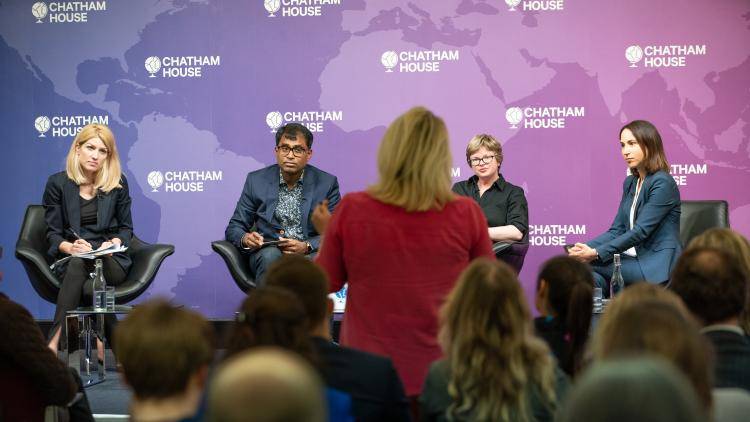
Andrew England
Good afternoon and welcome to Chatham House. My name’s Andrew England. I’m the Middle East Editor of the Financial Times and I’m going to chair this timely panel on Iran. Obviously, it comes after yesterday’s extraordinary day in the Middle East, with Trump visiting Israel and Sharm El-Sheikh, the release of hostages and Trump promising peace in the region. And obviously, you can’t have peace in the region without dealing with the Iran question. So, I’m delighted to have Dr Sanam Vakil, the Middle East Director of Chatham House and a leading expert on Iran, Vali Nasr, from John Hopkins and an expert on Iran, and Dr Marion Messmer, a Senior Research Fellow at Chatham House.
Trump said yesterday that a deal with Iran would be ‘great’. He even said Iran “wanted it’. But there’s a lot of people in Iran and outside the region who think the war’s not over. We’ve had two years of tumult in the region. We’ve seen the first direct strikes between Israel and Iran. We’ve seen the shadow war burst into the open. We saw the 12-day war in June, during which Israel and the US bombed Iran’s main nuclear sites. So, Vali, let me start with you. Is the war over?
Professor Vali Nasr
In a way, no, the war is not over, largely because you had a ten-year ceasefire that President Trump imposed on both Iran and Israel, but neither did Israel actually achieve its war aims. And I think Iran, obviously, not having been fully subdued, does not see itself as defeated and is – would like to, sort of, restore a balance of power or a balance of deterrence with Israel. And the United States, despite what President Trump claimed, cannot say that Iran’s nuclear programme can be satisfactorily now set aside. So, all of those issues that led to the war are still there, that – and unless they are negotiated at the table between US and Iran, then you have to think that at some point, the chance of conflict would go up again.
Andrew England
Sanam, we know the US Envoy, Steve Witkoff, and Abbas Araghchi, the Iranian Foreign Minister, are still having discussions. They’re still communicating, they both said that. We know that Trump said they were close to a deal before Israel attacked in June. What’s preventing them getting to a deal and why aren’t they talking now? What – if Trump is saying, “Let’s do a deal,” we’ve seen Iran say they would like to do a deal on their terms, what are the stumbling blocks?
Dr Sanam Vakil
It’s a good question to ask, particularly also, since yesterday, President Trump again dangled the prospects of a deal, intimating, really, that part of this new Middle East requires an Iran deal. I think what’s missing is a couple of things. I think both sides understand that a deal is necessary, but the terms and conditions of those deals need to be arrived at, and Iran still insists that negotiations with the Trump administration should be indirect. And currently there are no real clear interlocutors, not facilitators or convenors, which is the role that the Omanis played, and other countries have played in the past. What they really need is a mediator and it’s worthwhile remembering that just a few weeks ago, the E3, Germany, France and the UK, snapback sanctions on Iran, really, sort of, using that to pressure the Islamic Republic to get back into negotiations with Washington. But having taken snapback for it, they too are no longer the real mediators.
So, we’re in search of, let’s say, new mediators and then secondly, it’s about bridging the divide on issues, where Iran is still looking for a face-saving solution, if you will, trying to preserve its right to indigenous enrichment, even if it’s at a small level, for research purposes. And the United States, which is divided between the neocons and the restrainers within the Trump administration, is trying to show that they’ve gotten a better deal, that they’ve imposed zero enrichment on Iran. And then there are other terms and conditions that they are looking to address.
But I think it’s a matter of time. This is a President that is unconventional, certainly, and is looking to solve problems in unconventional ways. The devil, of course, like in the events of yesterday, will be in the details. So, we know that the contours of the deal are out there. What we don’t know are what those details are going to be and who’s going to bring these people together.
Andrew England
Okay. Marion, when you listen to Trump, you know, he said that after the US dromped – dropped bunker buster bombs on Natanz and Fordow, “We obliterated the nuclear programme.” It’s almost like he’s saying we’ve dealt with it, it’s over.
Dr Marion Messmer
Hmmm.
Andrew England
But we still don’t know the whereabouts of the 408kg of highly enriched uranium. A lot of experts will tell you, including Diplomats, that, you know, the programme has been severely damaged, but not destroyed. How likely is it that Iran could resume its nuclear programme, its nuclear activity, particularly enrichment? And when you’re in Iran, you hear a lot of people worried that, you know, Israel will strike again and that maybe if the attention’s off Gaza and there’s a halt to the war in Gaza, Israel will turn its attention back to Iran. How big a risk is that if the question of the nuclear programme is unresolved?
Dr Marion Messmer
If the question of the nuclear programme is unresolved, then I think that’s a risk that’s going to remain, in huge part because it’s more of a political decision, rather than anything else whether Iran wants to restart its nuclear programme. The US strikes undoubtedly have done significant damage, but we also know that they haven’t completely destroyed all nuclear facilities in Iran. There was a question – prior to the strikes, there was a question about Iran building a new enrichment site that the US wouldn’t have targeted in those strikes. And of course, there’s a lot of knowledge building and knowledge management, knowledge capability, that Iran also still possesses.
Israel, of course, targeted Nuclear Scientists as part of their attacks, but a nuclear programme is bigger than just some Lead Scientists. There will be a broad knowledge structure in universities, there will be a knowledge community, and while that community might have lost some leaders, a lot of that infrastructure is still there. And Iran is in a really strong position with regards to its nuclear programme, in the sense that it has built up a lot of domestic capabilities over a long period of time. So, you know, even if centrifuges were damaged, Iran undoubtedly has the capabilities to rebuild them. And…
Professor Vali Nasr
Yeah.
Dr Marion Messmer
…you, of course, already mentioned the highly enriched uranium stockpile. Well, we’re not sure where that is being kept at the moment.
So, those are all components that, essentially, could be used to restart a nuclear programme. And we also know that Iran, at the very least, wants to retain a peaceful nuclear programme that it can use for research purposes and for nuclear energy. And so, I think in many ways, the nuclear programme is the key question to resolve, to see whether we can get to a more stable situation in the region, or not.
Andrew England
Sanam, I’m going to come back to you. There’s one person in Iran who ultimately matters, and that’s the Ayatollah Ali Khamenei. He’s been in power for decades. He’s concerned about succession. He’s 86-years-old. He’s probably faced, arguably, his biggest crisis as Supreme Leader. What is he thinking? Is he thinking about preservation, succession, or is he thinking about resistance and defiance? What is the calculation? What is his calculation?
Dr Sanam Vakil
Obviously, it’s very hard to put yourself in the mindset of someone who has been in power for as long as Ali Khamenei, since 1989. He is the region’s longest serving autocrat today, and he has survived many crises. It’s striking – I mean, when the day does come, we will, sort of, go through all of the crises, and – but certainly the 12-day war might take the cake and I’m curious to hear Vali’s view on this. I think he’s thinking of all of the above. This is about preservation of his legacy, and we very much see in today’s terms how leaders are so concerned with their legacies while still in office or in positions of power.
But secondly, it is very much about what has driven the Islamic Republic for well over 40 years, is the security and stability of the Islamic Republic, above all, and that’s tied, of course, to his legacy. And, you know, what the 12-day war really showed, I think, internally, but externally, for anyone who had any doubts or questions, is that the Islamic Republic is an institutional system. It’s not personalistic and thereby, despite the shocks, the intelligence failures and Israel’s deep penetration of Iran, the system pulled itself together and the chains of command were quickly recapitalised, and there wasn’t a collapse of the Islamic Republic.
That doesn’t mean that there is no divisions within the political establishment. There certainly are. It’s a factionalised system with deep divides and have – that have been there for, also, for decades. That doesn’t mean that there are not deep social and economic, and political cleavages across the country, deep frustrations with the system. But I think that the fact that the system survived the huge shock of the 12-day war and recovered, you know, gives a leader like Ali Khamenei pause for what comes next. It’s about preserving the system.
In 1989, when he came to power, the system did undergo transformation. There was constitutional reform. They empowered certain institutions, they created new institutions, and I think that the Islamic Republic, or the key individuals across the system, are looking to show unity and looking into their future and trying to create a more stable, functioning, institutionalised process. They announced while he was, you know, in a bunker somewhere, that there were names in an envelope. And we know that this is a system that relies on processes and institutions.
So, I certainly expect there will be more details of that process or how it will unfold, and what’s been very interesting to me, as an outcome of the 12-day war, is that we are back seeing people in Iran talk about the future and talk about how things might develop. And we’re seeing contending ideas of governance reform in Iran. And so, the op – the more open space, I think also gives the elites and someone like Khamenei an opportunity to manoeuvre more openly, as well.
Andrew England
Yeah. It’s interesting, ‘cause I was in Iran in July…
Dr Sanam Vakil
Hmmm hmm.
Andrew England
…and the two themes that I came away with, was one is the sense of anxiety…
Dr Sanam Vakil
Hmmm hmm.
Andrew England
…and one that the war is going to change things, but nobody quite knew how it would change. And we’ve seen some social change. The hijab law has been far more relaxed, there are more music concerts, etc., happening. There’s – it looks like the regime is trying to tap into the sense of patriotism that came out during the war. But what kind of genuine change can we expect, Vali? I mean, you and I spoke during the war, and you said that this war would ‘bring change’. But beyond, I don’t want to say the cosmetic, but beyond the social changes, what kind of fundamental jane – change could it bring or not to the way the system is ruled under this theocratic regime that’s been in power, you know, since 79?
Professor Vali Nasr
Well, I mean, if the expectation is for a sudden drastic 180° change, perhaps we will be disappointed. It’s not going to – it’s not necessarily around the corner and I think that, as you said, the sense of ‘patriotism’, the siege mentality, etc., also dampens the enthusiasm for that kind of political change. But often change comes exactly like this. It’s if you wear a mask long enough, it becomes your face, and so, the co – obviously, the issue of hijabis in Iran was not a concession that was given from above. It was an – it was a fight that the Iranian women won. In other words, their entire uprising, etc., ended up putting aside the issue of hijab altogether and nobody observes it if they don’t want to.
In Iran, you can go into the airport, into government offices, into all official settings, there are women with hijab. Women are also even showing their bellies in Tehran. It’s not an issue. Nobody’s persecuted and the Iranian President said, “Nobody will be fined or jailed for not observing the hijab.” But it also suggests that there’s certain degree of pragmatism that is at play. That the top priority of this regime is actually its national security and national survival. It’s not ideology or theocracy at this point in time.
Now, why I think it’s significant to, sort of, take this change seriously is because, you know, building on what Sanam was saying, is that Iran sees itself in a long war with the United States. In fact, it’s been in war with the United States in its own mind for over 40 years. This is only the last battle. Now, what has happened in this 12-day war is that in their mind, in the minds of the leadership, every assumption they had about the West and the United States was actually validated, that you can’t trust the US, that the US is not after the nuclear programme, is after the regime. That it will – wants to not only topple the Islamic Republic; it may want to topple the Iranian state. You know, all of these things, basically, was validated.
But where they, I think is significant, is that they lost their most important line of defence, which is Hezbollah and the Assad regime, and were put in a position to have to defend Iran from within their own border and not very satisfactorily, one might say, and their largest leverage, which was the nuclear programme, was significantly downgraded. And you have to think that this has secondary/tertiary impact on the way that the regime operates. In other words, you cannot just continue the way that you did before.
So, I think short of a complete implosion or collapse, I think already, we are well into a major transformation in the character and nature of the Islamic Republic. I would say, sort of, we’re in that phase between Mao and Deng Xiaoping. It’s not going to be fast, it’s not going to be overnight, but I think what you observed in Iran are quite significant. I just cannot conceive of the Islamic Republic going back to enforcing the kinds of social restrictions that it did even five/six years ago. And then, you know, you would say then the next change will come on top of this change and on top of this change, so now, the battle lines for women is not hijab, is actually patrimonial legal rules about inheritance, divorce, etc. For the larger populations, it’s about elections, it’s about constitutional changes, bureaucratic changes.
And so, I think Iran is in the throes of massive change. So, on the one side, you have this picture of a country that has war, it’s fighting for its survival, economically in war with Israel, and on the other hand, already the massive change has started. Now, for the West, I think what’s very key is that all the focus is on this nuclear issue and also, on an image of maybe the Islamic Republic, which is a little bit outdated. Without, sort of, saying what sort of policies that you follow now, can actually impact this other much more important development. And in the minds of President Trump, these things are disconnected, necessarily. I don’t think there’s a gameplan. Or in the minds of the Europeans, it’s all about how do we put snapback sanctions so that they will do X, Y and Z with IEA, without thinking that there’s something much bigger already has started in Iran? And what might be the ways in which you might influence that in the right direction?
Andrew England
Right. Just something you mentioned, Vali. Marion, the Axis of Resistance, it’s been seen as a key part of Iran’s security strategy since the war with Iraq, asymmetrical warfare, rather than conventional warfare. Just how weakened has that Axis been and how might that impact on Iran’s thinking?
Dr Marion Messmer
Hmmm hmm, I think that’s a really good question, and we’ve seen in some ways how Iran’s traditional relationships have been significantly weakened. I mean, the Assad regime is no longer. Bashar al-Assad is essentially in exile in Moscow. Hamas has been significantly weakened; Hezbollah has been significantly weakened. So, all of these traditional relationships that Iran has relied on in order to project force, in order to be able to influence what’s happening elsewhere in the region, doesn’t necessarily exist in the same way that it did even a few years ago.
But at the same time, what I also think is quite interesting is that the constellation of, perhaps for lack of a better umbrella term, nuclear likeminded states, has also changed quite significantly, right? So, part of the reason why the Joint Comprehensive Plan of Action was as successful as it was, was because you had Russia, China, the US, the UK, France and Germany all, essentially, push in the same direction on this. And Russia used its significant diplomatic relations with Iran for positive effect. It, essentially, was willing to make sure that Iranian Negotiators were willing come back at – to the table, even when things were difficult. And that, sort of – I don’t think it’s an alliance, because we could never really call it that, but that, kind of, configuration of states, that at one point were able to move in the same direction on this very specific issue is also looking much more fragmented now.
I mean, Sanam described how the E3 essentially tried to pressure Iran to get back to the table with the US, but even between the US and the E3, there are significant cleavages. Not just when it comes to Middle East policy, but also on lots of other issues, and the relationship between Russia and Iran has changed completely over the last few years. And so, I think, you know, something that undoubtedly will be on the Iranian Government’s mind is, essentially, how to use that balance of relationships and whether it can actually be used, you know, in a positive way.
I could well imagine, for example, that Russia and China, given that they weren’t in favour of snapback sanctions, might also be helping Iran evade some of those sanctions as best as they can. And given the much closer relationship when it comes to the exchange of military technology and so on between Russia, China and Iran, that could actually also have a significant impact on what the Iranian Government is able to do.
Andrew England
Sanam, the Revolutionary Guards, central institution, economic power, military power, political power, many of their top leaders were killed in the Israel war, 12-day war. Humiliation for the Guards in terms of the level of Israeli intelligence penetration, and yet, when you speak to people, people – when I was in Iran, people were telling me that “Actually, you’ll see a new generation come to the fore, which could actually be more hawkish, more militaristic, less pragmatic without the experience of serving in the Iran-Iraq War, which might push Iran in another direction.” And people have always expected the IRGC to have a role in succession.
So, how, as a body, have – or as an institution, have they emerged from the 12 – sorry, not – somebody disagreed, from the 12-day war, and what role are they likely to have with this new cadre of Commanders in the future trajectory of the Republic, particularly with succession in mind?
Dr Sanam Vakil
I think that’s a really good question and not one that I have a certain answer to. I mean, we’re watching the changes that might emerge from Iran from the war, and I think those changes will come very slowly over time. These are certainly untested people, you know, second or third in command, in and across the institutions. What’s interesting is that these are, of course, individuals who have been part of these systems, right? So, they’re not unknowns or complete outsiders. It’s just that they haven’t been as visible to us. So, I would say, on the one hand, they’re – the culture of the institutions is certainly imbued in the individuals. The decision-making remains still very consensus based and as an outcome of the war, the Islamic Republic recreated a council, a Defense Council, that sits under the Supreme National Security Council, where foreign policy decisions are debated. And in that Defense Council, I think again, there will be debates on how things will go forward.
What’s interesting to me, and I don’t have an answer for, but I’ll be looking out for, is, you know, if we – I don’t imagine that the Islamic Republic today, with its security and stability being, you know, foremost on the agenda, is going to change anything too much. Rather, I, sort of, anticipate and expect that the Islamic Republic right now is, of course, maybe seeing itself as a – in between another confrontation, not sure if there will be one, looking to prevent one, if possible, but rebuild their defence capabilities. Certainly, narratives about Iran and its role in the region have been punctured. There is a sense, of course, that Iran has been weakened or that maybe we’re in a post-Iran Middle East, and so, Iran will be looking to, I think, reproject power, but hasn’t necessarily figured out how to do so.
I would imagine that Iran is also going to be rebuilding, refortifying the so-called Axis of Resistance, which has retreated, not been eliminated, as Marion said. Hamas is still very much there, so is Hezbollah, and perhaps the Axis of Resistance will reconstitute in a different way. This is an evolving entity. The ballistic missile programme from the Iranian perspective, and it’s important to understand how countries and individuals see themselves, while, you know, maybe had a 30% penetration rate into Israel, was a 30% penetration into Israel, with the – all of the help of the United States and NATO and central command. So, perhaps further investment in their ballistic missile programme, which is, interestingly, the biggest issue for the Europeans, that are very frustrated by the growing Russian-Iranian relationship, etc.
So, I would imagine that they find ways to reinvest, double down and rebuild over time and maybe there is some innovation over time. I mean, we’ve watched how wars are fought in very different ways and I think they’re preparing for that next layer and generation of war with untested people that have something to prove, really.
Andrew England
Just very succinctly, this is perhaps a question I should’ve asked at the beginning, ‘cause…
Dr Sanam Vakil
Right.
Andrew England
…there is a perception that sometimes you hear that the regime is about to collapse…
Dr Sanam Vakil
Ah, yes.
Andrew England
…that it is incredibly weak. I mean, let’s just, very succinctly, clarify that. How weak has it emerged after – or how has it emerged after the 12-day war? I mean, is it on the brink of collapse?
Dr Sanam Vakil
Well, I mean, I think every year for as long as I’ve been working on Iran and maybe also you, Vali, like, we’ve been talking about the ‘fragility’ and the ‘collapse’ and the moment of ‘revolution’ for the Islamic Republic. And I think – and I don’t want to put words in Vali’s mouth, but we are watching the change of the Islamic Republic, not necessarily the collapse of the Islamic Republic. I don’t see Iran balkanising tomorrow, but certainly, it is in transformation, and the 12-day war was, like, an accelerant on a transformation that we were already witnessing. The IRGC, like every institution, is looking to preserve itself, its influence and its capabilities within an evolving system.
So, how it’s going to change, we can’t predict. We can offer you scenarios, but they’re certainly going to be influential and perhaps even more so on the political sphere, but they remain deeply loyal and connected to the Supreme Leader. They came up together, they grew up together, they’re – you know, they have a symbiotic relationship. I don’t, you know, foresee a coup or any kind of military takeover by the IRGC. It will be an evolution of them in the system.
Andrew England
Ali, on the – Vali, on this, if we don’t get a deal with the US and Iran and Trump maintains maximum pressure…
Professor Vali Nasr
Hmmm.
Andrew England
…then the Iranians will say, “We got a resistance economy,” which is what they’ve said since Trump withdrew from the deal in 2018 and first imposed hundreds and hundreds of sanctions on them. But how long can that be sustained? I mean, this year we’ve seen water shortages, electricity shortages. You know, in Tehran, they’ve declared national holidays because the shortages of water and electricity and government workers go home at midday. The economy is under constant pressure. There’s 34% inflation. So, can it sustain itself and how, if there is no deal and the sanctions continue to strangle the economy?
Professor Vali Nasr
I think it’s a good question. I mean, building on what Sanam said, you know, the 12-day war suggested that actually, the Islamic Republic cannot be forced to collapse easily. I mean, that was really Israel’s game plan, an intelligence coup that allows you to decapitate the system, as they did with Hezbollah, and then the whole thing will fall apart. And it didn’t and I think the Iranians are now prepared, and they say it, that when the war comes, Israel may kill large number of civilian leaders this time. And there’s been a mandate that every, sort of, civilian official has to already appoint up to four people below as – if that happens. So, in a way, there is resilience there and I think the reaction of the Iranian public, which was a rally to the flag, not necessarily to the regime, but rally to the flag and defence of the country and patriotism, etc., suggests that war does not necessarily force the collapse, if you were to say.
So, the war is actually much more so over the economy, right? So, in other words, if you have a significant degradation of Iran’s fundamental infrastructure, which has already begun, water, electricity, industrial capacity, roads, etc., that that might create a very different circumstance. Although, I have to say, having worked on a lot of developing countries over the years, in Africa, in Asia, you always expected that, you know, it just cannot go one more year like this and yet, they did. Yet those countries are still there under similar regimes, although no two countries are alike.
But I would say that, you know, the – it – the longer this sanctions goes on, the more it gives also, a impetus to a voice inside Iran that this is being too cost-free for the United States and Europe. That they could impose the sanctions or give a green light for Israel to hit, but there’s no blowback for them. And, you know, once Iran played this game, right, a year after the maximum pressure was imposed, Iran attacked oil facilities and tankers in the Gulf. It began escalating, pressure on the US. It went to 84% enriched uranium. At one point it, sort of, nu – normalised the fact that it will enrich up to 60% and so, you know, there is a period in which you’re just not going to have just a steady decline. And the likelihood of Iran actually trying to change the calculus on President Trump test that. See, is he this comfortable with just imposing sanctions and then forgetting and going somewhere else, or is he really willing to put skin in the game and deal with a much higher tension?
When you talk about the new generation in IRGC, you know, this new generation up and coming, these are veterans of the Syria war, as opposed to veterans of the Iran-Iraq war. And so, they’re much more likely, and they’re already making this argument in Iran, that Iran needs to impose cost and it cannot be the only country in this war that is actually absorbing the cost and it’s just far too easy for Trump right now. And he’s making assumptions that, basically, calculates that Iran will not respond. So, there is a – this is not going to be a steady, I think, smooth picture of just singular decline over two/three years. That it actually increases the risk of military confrontation in the region, which then would write its own rules going forward.
Andrew England
Yeah. Marion, one thing that Iranian Officials would tell you is that the resistance economy can survive because of its relationships with Arab states, Gulf states in particular, which have made a great deal with, I would say progress, over the last couple of years. You had the Saudi-Iran deal brokered by China in 2023. The UAE’s – consciously trying to develop economic links with the UAE as a way of dealing with the hostility, and that serves Iran. And it also, in a way, it should impact on the mindset of Iran when it is looking to respond to US or Israeli hostility. Will they go after UAE base – military bases in the UAE? Obviously, they did in Doha after the 12-day war. But how has that relationship evolved and how has that impacted on Arab – the way Arab states and Gulf states, in particular, are looking in Iran and that layer of regional tension? And what does that mean for Iran?
Dr Marion Messmer
Hmmm, something – just one quick word, actually, on what Vali just said, because I think, you know, if we look at North Korea as an example of a state that’s been under significant sanctions for decades, and the population is not doing very well at all, actually, but the regime is able to carry on, and North Korea is able to be a significant regional spoiler. And so, you know, I think if we’re worrying about the state of the Iranian economy and the impact of sanctions, that’s one, I think, sort of, perhaps more scary example that I would point to.
But to answer your question about regional relationships, something that I found really interesting is that you could see a lot of other regional states hesitate a bit at the outset of tensions between Iran and Israel. I think in part, also, because many of these states have been in a process of normalising their relationship with Israel, and I think some of them didn’t necessarily want to jeopardise that process. So, I think looking to the future, it will probably help to have other states in the region that primarily want a stable region and that want to find a good solution for this. And I think, you know, if we, sort of, tie that back to the nuclear question again, I think some of the solutions that have been floated around, whether, for example, some sort of enrichment consortium might be a pathway to provide more stability, they’re technically very challenging to resolve. But what I like about it is that it’s a creative step towards a problem that’s been very stuck for a long time.
So, while I’m not sure that a consortium would necessarily be the right way forward, because there are a lot of technical challenges – I mean, there are a lot of political challenges, but there are also a lot of technical challenges around how you could verify such a consortium, how you would [inaudible – 42:20] for materials and so on, and how you could make sure that that’s not diverted in any way or, essentially, ends up in several nu – military nuclear programmes, rather than just one potential one. The good thing is that it makes the problem the responsibility of additional stakeholders, which I think could really help get to a more stable solution.
Andrew England
Okay. Last question for you, Sanam, before we open up to questions. All these issues we’ve talked about, the, sort of, state of flux, the transition, the economic pressures, the external pressures, on top of that you’ve got people like Netanyahu, you’ve got the exiled Iranian opposition who would like to see a public uprise, they would like to see from within. What are the risks of that in reality? We haven’t seen that, we didn’t see it during the war, but there are all these pressures. How likely or unlikely is it that you could see movement from within?
Dr Sanam Vakil
I – well, I fully expect, not because I know when, but I fully expect that there will be more protests in Iran, for no other reason than there are protests all the time in Iran. There is someone on Twitter who does protest tracking.
Andrew England
But there’s protests and there’s uprisings.
Dr Sanam Vakil
Yes, okay, so protests are common and then we have had a series of uprisings in the country now, going back to 1999. So, I fully imagine that one of these protests, on any myriad of issues, can certainly become national protests again. Again, you know, hard to understand the spark or the issue, but I fully expect that there could be that sort of outcome, but is it going to be co-ordinated and organised and potentially revolutionary? I, you know, I have been on the record to say I see that outcome as very unlikely, for a few reasons. The system in Iran is institutionalised and thereby, every time it adapts its institutionalised response, there is a playbook of repression that is coercive and adaptive and very effective and of course, impacting people internally in a very brutal way.
Secondly, of course, the system has upscaled their surveillance and monitoring of the society, building, you know, ties with China and Russia to do so, among other countries, and I think that’s very sophisticated. Thirdly, of course, it is adaptive in that it has been successful in, sort of, trying to break linkages among the classical, sort of, revolutionary groups or protest building groups in society, be them students or activists or women, etc. And, you know, thirdly, and I think this is – there is no real unified opposition movement inside Iran. There are a number of fractured political opposition leaders inside the country that are united as Iranian nationalists, divided on the way forward.
So, you know, that is something that this system very much exploits and will continue to do so if, you know, Iranians of all different stripes can’t get in a room and discuss, you know, what sort of political reform, governance reform, they would like to envisage, and the same, you know, exists externally. There’s a more organised monarchist group and then there are fractured movements across the political spectrum. So, you know, without organisation, co-ordination and the like, again, this system, you know, is very good at sustaining itself.
Andrew England
So, really, you’re suggesting quite a lot of resilience, really?
Dr Sanam Vakil
Yes, it – I mean, I would say 46 years proves resilience.
Andrew England
Hmmm.
Dr Sanam Vakil
I mean, I think we have to acknowledge that the system has been much more resilient that – than we, or people maybe even inside the country, have wanted it to be. And that we’re – here is, you know, maybe a reassessment of Iran. I think there are very different al – different Irans, inside the country and then the ones that we have in our imagination for those of us outside the country. And for Western policymakers, unless they understand what Iranians want and what is actually happening inside Iran, and instead if they latch themselves onto the monarchist view of Iran, they risk making, you know, real, sort of, strategic mistakes in how they engage with the Islamic Republic.
Professor Vali Nasr
Can you just – I have…
Andrew England
Yeah…
Professor Vali Nasr
…just a…
Andrew England
…very quickly, Vali.
Professor Vali Nasr
I agree with every…
Andrew England
We have to go to questions, so…
Professor Vali Nasr
No, no, I agree with everything Sanam said, but I also want to say that the poorer a population becomes, the less likely it is that it can carry out uprisings. In other words, the Western sanctions are singularly responsible for actually retarding uprising inside Iran. Every democracy movement we’ve seen around the world has been assooci – every world-led revolution we’ve seen around the world has been associated with the growth of middle class and its prosperity. And therefore, you know, a population that can barely make ends meet is much less likely to be able to organise, to be able to risk to organise, and that – and therefore, there is an outside contribution to, actually, that resilience.
Andrew England
Okay, great, thank you very much. I should’ve said at the beginning, this is on the record…
Dr Sanam Vakil
Hmmm hmm.
Andrew England
…and it’s also online, so apologies, but it is on the record. We’ll take questions now from the floor and from the online viewers. If we have a microphone, there’s a gentleman at the front here [pause]. Please state your name.
Member
Thank you very much. [Inaudible – 48:03] Aziz, [inaudible – 48:05] University and Salahaddin University, back home, Kurdistan. My question about the external levels of Iran. Iran has been a powerful – one of the powerful state in the Middle East before 7 October. Post 7 October, has been weakened because of the Hezbollah [inaudible – 48:26], Bashar al-Assad collapse. Hamas has somehow been weakened is backed in Iran, and Houthi, as well. But the only Iranian backed group has not been hitted – attacked by others, for example, Israel and United State, is PMF, Hashd al-Shaabi, in Iraq. And Iraq strategically and economically is important for Iran. If Iran will be weakened, it should be, you know…
Andrew England
Question.
Member
Yeah. Should be, you know, that’s the reason – should be some way to stopping this economic for Iran and this intervene to Iraq by PMF.
Andrew England
Okay, well, the question is?
Member
Question is why PMF Hash’d al-Shaabi has not been attacked by others, to be weakened like Hezbollah, like, you know…?
Andrew England
Hmmm, sure, yeah, Marion, do you want to take that? It’s interesting. I mean, they were hit by the US, obviously, in February after three American Soldiers were killed, but why do you think they, sort of, kept their head down?
Dr Marion Messmer
Great question. I mean, I obviously can’t say it for sure, so this is just speculation on my end, but I would assume that other groupings in the region were more important and that, you know, in the grand scheme of things, there are other relationships that Iran has that are probably more significant. I mean, I would say especially if we’re talking about economic relationships and sanction evasion, I would focus much more on the relationships that Iran has rebuilt with Russia, with China, you know, with other countries, like Azerbaijan, for example. I think those kind of relationships are more significant in that regard than those with that group.
Andrew England
We have a gentleman here.
Dr John Warren
Thank you very much for the invite. John Warren, a retired Physician. There’s a lot of discussion, understandably, about Iran, past wars and future wars, but not so much about peace, and half the population is female, and the women’s revolution did get a Nobel Peace Prize two years ago. What does that tell us about the possibilities for diplomacy, which isn’t one of the subheadings here? There’s just “War, Nuclear standoff and Shaken Alliances,” but not diplomacy, which you might expect for Chatham House.
Andrew England
Oh, I think we did discuss it. Sanam?
Dr Sanam Vakil
Sure, happy to take the diplomat – diplomacy. I mean, certainly, diplomacy has been shaken, because it’s, you know, worthwhile remembering that on June 12th, when was it, June 12th?
Professor Vali Nasr
23rd.
Dr Sanam Vakil
23rd, sorry, my dates are all mixed up. Iran was on the brink of going into its fifth round of negotiations with the US in Oman. So, the Iranians certainly, I think, were caught off-guard, expected, perhaps, that a strike might be imminent, but didn’t expect it going into negotiations, and so, thereby, obviously, diplomacy has been railroaded for the time being. I think the aim, though, for many in Iran, perhaps even the Iranian President, Pezeshkian, and his cabinet, is to get back to that negotiating table, but on better, fairer terms. You know, President Trump, or there are, you know, people in the Trump administration that would like to see, you know, complete surrender and I think capitulation of Iran’s position.
And the Islamic Republic is quite steadfast as a system in not fully surrendering and in fact, looking for terms that would be face-saving. And I think the aim, though, for this Pezeshkian administration, certainly would be to obtain a deal that would guarantee them access to frozen funds abroad and eventual sanctions relief and that is what would be discussed between Tehran and Washington, directly or indirectly. Whether it’s on WhatsApp with Witkoff, who has been amenable to an easier deal, or at a negotiating table with the right interlocutors.
I think in addition to Tehran and Washington, it’s worthwhile also thinking about the landscape of the Middle East since the 12-day war, as well. I mean, yesterday, you know, was positive but also, you know, theatrical, if you ask me, but certainly, the landscape in the Middle East has very much shifted over the past two years, but cert – over the past few months. And most countries in the Middle East are looking to avoid another round between Iran and Israel, because the fallout of Iran and Israel impacted countries in the Gulf, Qatar specifically. And the broader view is to take advantage of this changing landscape, to reinvest in governance reform in Lebanon and Syria, but also, ultimately, to have a more stable regional environment and that requires, I think, more agency from Gulf states, in particular, to support new negotiations and new rounds of diplomacy.
You know, the two pillars, the two, sort of, unaddressed crises of the region, for various reasons, are, of course, the Palestinian issue and the Iran issue. And if you’re thinking of a more stable Middle East, you’re addressing both sides of this coin.
Andrew England
Vali, we’ve got two questions online which are similar, so I’m going to put them to you. “Will Iran try and evolve its relationship with Russia or China in the wake of the 12-day war?” And Iran typically doesn’t want to negotiate from a position of weakness. This is from – the first question was from Simon Webb, the second from Rob McCare. “Iran doesn’t typically want to negotiate from a position of weakness, so will it seek to repair its air defences and missile systems before it negotiates, and will it look to Iran and China for support?” And would they, I guess?
Professor Vali Nasr
I mean, in a way, Iran’s most effective defence over the years has been offence, and I – and even in this war, I think their conclusion would be that they can’t necessarily get air defence systems that can sta – you know, stand up to F-35s and they can’t do so in the short-term. But what really forced or got President Trump to ask for an unconditional ceasefire at the end, was Iranian missiles, if you were to say. So, I think, as Sanam said earlier, that they would – or I don’t know, I think you mentioned that they would double down on the ballistic missile system much more, as a way of creating a balance of deterrence.
Yes, relationship with Russia and China is – probably will strengthen, but in what ways will remain to be seen. Some of it might be diplomatic, at the United Nations, some of it might be in terms of economic support, but I don’t think Iran would see, you know, Russia or China as a one-stop shop where they could, basically, solve all of Iran’s security problem. So, it’s part of the package if you were to say, and I think there’s also, with China and Russia, there’s a greater complexity. Those countries also have to worry about the United States’ reaction. They also have deep relationships with other countries in the Gulf, which also figures in here both positively and negatively.
And then, I think Iran has a very, very, you know, furtive debate about what is the best path forward. Iran’s President, Foreign Minister, those are people who still believe that there has – there can be a deal with the United States. The pe – the best way out of this security dilemma is the escalation on the nuclear issue. And then there are those who would say, you know, you need to turn east and look to Russia and China or other mechanisms. Again, this is not something that’s going to be suspended in mid-air. It all depends on what are the next moves? I mean, Sanam’s correct, I think it’s wrong to say that Iran doesn’t want to talk. In fact, in New York, there was a meeting that the E3 put together in which Iran agreed to have a face-to-face meeting with Mr Witkoff, who didn’t show up to the meeting. And the President keeps saying that Iran has to come to the table, but it means that Iran has to come to the table and accept unconditional surrender, which is not negotiation. That’s, basically, something completely different.
So, if this picture doesn’t change, or if it changes, I think we might have a very different dynamic setting.
Andrew England
Thank you. Questions. This lady here, please.
Madeline
[Pause] Thank you for the talk. My name’s Madeline. I’m an MPhil student at Cambridge, researching Houthi and Hezbollah reactions to the death of President Raisi last year on telegram, and my question’s for you, Sanam. You were talking about the “doubling down and rebuilding” of the Axis, and so, my question is about what Hezbollah’s migration to Iraq, which I heard you talk about recently, what that means for Lebanon and the wider region. Thank you.
Dr Sanam Vakil
Well, okay, so Hez – parts of Hezbollah have migrated, or individuals and families, particularly during the war period, certainly migrated to parts of Iraq, and, you know, so have parts of the Axis of Resistance, as well. I wouldn’t say, you know, the whole entity has moved. It’s still very much present in Lebanon. I think what we’ve seen – I mean, the Axis of Resistance is really interesting and hard to study simultaneously, so well done for adding some work to what we’re trying to understand. The Axis of Resistance is adaptive, and it’s gone through so many shocks over the years. You know, the most profound shock was the killing of Qasem Soleimani in 2020 and I think we have to study the effects of this two-year period. You know, after Qasem Soleimani died, the Axis of Resistance became much more co-ordinated and interdependent, and it was managed in a very different way by Iran. And the groups began to work together much more, rather than through Qasem Soleimani himself.
So, I don’t know how it’s going to move in this next phase. I think, you know, the groups are looking to demonstrate resilience in their local context and then, it will be interesting to see if – how the narrative of resistance will evolve. Right now, you know, there’s this global attention on Palestine and Palestinian statehood, which is part of the resistance narrative. You know, the other parts are anti-American, anti-imperial, anti-Israeli. You know, much of the resilience of the Axis of Resistance will be connected to what happens with Palestine and Israel and the United States in the region and that could revive the ideology and help with recruitment. And then financially, you know, certainly there will be efforts to recapitalise and recoup, we just don’t know. But they’re heavily involved in regional smuggling, they have trade networks. There is much more resilience that we can see, you know, on a day-to-day basis.
Andrew England
This gentleman’s being very patient over here.
Sanjan
My name is Sanjan. I do my master’s in international relations from King’s. Firstly, I would like to thank you all for taking your time to take through this complicated issue. I have two questions, firstly with respect to the Houthis, because in the 12-day war, or the general Israeli-Gaza war, the only group that was able to sustain and hold on ‘til the end was the Houthis. Despite the death of the Prime Minister and their entire cabinet, they have come to show themselves as the resistance to single-handedly double down on international trade pressure on supply chains, etc. So, how crucial would the Iranian-Houthi co-operation be in the coming years?
And my second question is more related to the region itself, because on the east of – eastern side of the Iranian borders, you have the Afghanistan-Pakistan clashes that are going on. So, Baluchistan is a potential site where protests are happening significantly in Iran, and the Khorasan province in the east is also creating lots of problems. And now, with the Gaza deal completed, President Erdoğan’s thoughts would be on Iran, because Erdoğan himself is a…
Andrew England
Do you have a…?
Sanjan
…political.
Andrew England
The question.
Sanjan
Sorry, on political – so, how fragmented or – would you say that Iran feels from its regional neighbours, mainly Turkey, Afghanistan and Pakistan? Thank you.
Andrew England
Thank you. Vali, do you want to start with the first question? The Houthi relationship’s complex. It’s not as straightforward as people think, is it?
Professor Vali Nasr
No, it’s very complex and also, Houthis’ own domestic situation with their population [and terrorist – 61:36] is very different, for instance, with Hezbollah’s…
Andrew England
Yeah.
Professor Vali Nasr
With its own, and these calcu – local calculations were important in terms of how aggressively they entered into the fray, and that also applies to Hashd al-Shaabi, as well. So, it’s not like, you know, these are autonomous organisations that are, sort of, on autopilot from Tehran. They have their own local considerations. And secondly, I think the Houthis is very complex for Iran, because it’s part of Iran’s calculation with Saudi Arabia. So – but, you know, there is a peace between Iran and Saudi Arabia, so long as it holds – so long as it’s important to Iran. I think, you know, who the Houthis will attack, which direction they will fight, you know, that will be quite important.
I think Sanam is correct, that, you know, the Axis of Resistance still matters to Iran. It’s not zero, it’s not where it was, it’s not the 100 that it was before, but it’s not zero either. These are relationships that they invested for a very long time. These forces Iran believes will matter to their countries in the longer-term, aside from the relationship with Iran. So, I think they will maintain to those relationships.
I think it’s possible to overread some of this. So, the Iranians don’t have a worry about Baluchistan, sort of, being an instigation point for mass uprising in Iran. They have a – there is an issue with Afghan refugees, Afghanistan, which is pretty complicated. They did expel a large number of Afghan refugees, but also, Afghan labour is as integral now to Iran’s economy, given Iran’s demographics, as North Africans are to the French or, you know, any migrant group is to European countries. That’s actually largely Iran’s labour force for varieties of services, etc., is Afghans. And yes, Iranians are very sensitive, but I think Iranians are more sensitive to US being back in the Bagram Air Base than they are sensitive to Pakistan and Afghanistan having a fight, or over the issues of water that they have issues with the Taliban. And in fact, everything that’s going on was likely going to make the Taliban move closer to Iran than has been the case.
But, you know, the more this kind of a talk happens about Iran breaking up, Iranians have a historical, you know, psychosis about outsiders, particularly Westerners, wanting to break up their country. It goes back to the 19th century. The more you threaten this, the less likely it is that the population will be looking about threatening the Islamic Republic, etc. In fact, during the war, that became an issue, that the – Israel is not after the Islamic Republic, is after the Iranian state as a whole. It’s supporting Kurdish groups, it’s supporting Azerbaijani groups, Azeri groups, that these – the Iranians believe that, not just the Turks, but the Republic of Azerbaijan, Israel, etc., supporting separatist groups, this actually creates a common ground between the population and the state around protection of the territorial integrity of Iran. It – that it adds to the resilience that you actually mentioned at the beginning.
Andrew England
Sanam, I got a question for you online from Steven Andrews, and I’m going to ask it, ‘cause I’ve asked it to you before many times. Khamenei is 86, who might replace him and what that mi – what might that mean? Now, before, we talked about Raisi, the former President who died in a helicopter crash, then people talked about Mostafa, Khamenei’s son. Has that changed after the war? Who’s a fr – do we know – even know who’s the frontrunner?
Dr Sanam Vakil
No, I mean, we’ve never known, to be very honest. There – people like me have, you know, tried to venture guesses and my guess died in a plane cra – a helicopter crash last May. So, I have no idea. I would suspect if they’re going to stick to the process and Iranian – the system likes to rely on that process. It’s written in the Constitution, they will convene the Assembly of Experts, there will be some names that – and whoever wins the vote. I would look at, you know, the key high ranking figures that look like the Supreme Leader did in 1989 and that would be the sort of candidate I would look for. Someone who’s pious, young, revolutionary, loyal to the system, above all.
But there are – the system can very much move. I don’t think this is a hereditary system. It doesn’t make sense to me. You know, this is a system that still defines itself as revolutionary.
Andrew England
Will the next sa – Supreme Leader have the same powers as this Supreme Leader?
Dr Sanam Vakil
Well, that I don’t know. I would, again, look at history as a guide for what is going to come. I would imagine, but it might be too hard within a very factionalised Iran, I would imagine another round of constitutional reform, thinking, you know, as what has worked, what hasn’t worked? Maybe empowering certain institutions and disenfranchising others. But what comes next is certainly going to be interesting and what we’re seeing today is key individuals and institutions vying for their future in the next version of the Iranian state, and it could be Islamic Republic 3.0, it could be an Iranian Republic, I mean, we just don’t know.
Andrew England
Okay, one last question before we go. Gentleman here, in the middle.
Jordan Bauman
Hi, Jordan Bauman from the University of Waterloo in Canada. Maybe this question comes from a little bit of ignorance, but it plays into the last question. Why hasn’t Ali Khamenei been assassinated yet? Is that a logistical problem or is that a strategic decision that’s been made, do you think?
Andrew England
Vali, that sounds right up your alley.
Professor Vali Nasr
I mean, that – I mean, I – President Trump at one point suggested that he had prevented Israel from assassinating him, but from what I’ve gathered, they couldn’t, for varieties of reasons that they were not able to do so. And I think the way what – the conversation I hear is that Iranians are expecting that if the war resumes, he, obviously, would be a prime target. So…
Andrew England
It would be extraordinary, though.
Professor Vali Nasr
It would be extraordinary.
Andrew England
I mean, even in these circumsta – for – you know, for…
Professor Vali Nasr
Yeah, no…
Andrew England
…the Head of a State…
Professor Vali Nasr
…I mean, of course, I mean, Sanam is correct, I mean, Khamenei is the longest ruling ruler in the region, but he’s also, I think, the third longest ruling ruler of Iran since Shah Abbas the Great in the mid-1500s. And in a couple of more years, he will be equalling the Shah or exceeding it. When somebody has been at the helm as a key decisionmaker that has shaped the country, and you remove him, particularly through a foreign government killing him, it is going to be a massive shock to the system. How Iran would react is not easy to tell, and then – but I do think, also, the system has no copiously planned for it in terms of how it might handle that happens.
But, you know, the key issue to succession is when will it happen? In the middle of a war with assassination, or in a more peaceful time in a natural circumstance? That would be greatly important in what kind of a reaction even that council would take in terms of what does the country need at that point in time?
Andrew England
Could it happen before the death of Khamenei?
Professor Vali Nasr
Well, he apparently has a list that he prepared. I mean, I’m sure he has, because there is an expectation that Israel may succeed next time and therefore, I think the system is not built for very rapid succession. That’s actually how they survive…
Andrew England
So, it might happen whilst he’s still alive?
Professor Vali Nasr
Well, no, I don’t think so, not after this war, because I think it would change too many things within Iran itself. And I think, you know, for some very big decisions in Iran, like agreeing to a deal with the United States, like the issue of hijab, would not have happened without him. If we – I – the next Supreme Leader will be too weak, there will be too many other voices. I think, you know, he has put his hand down on certain things and I think if we are to have a successful deal with the US, it would not go through unless it has his imprimatur. So, it’s – in some ways, it might be necessary if he – that it’ll be him, just like it was – it had to be Khamenei who accepted the UN resolution that ended up Iran-Iraq war, and nobody else had that stature to accept defeat the manner he did.
Andrew England
Hmmm hmm. Can I have one last question myself? Would any Iranian Government regime give up its right to enrich uranium? I mean, a lot of people tell me that – whether it was this, whether it’s a Shah.
Professor Vali Nasr
Depends on how you ask.
Andrew England
Sanam, help me out.
Dr Sanam Vakil
I’m going to dodge it and just say that is that – yeah, you know, and it was – the Shah was a nationalist leader, and it was the Shah who had his father removed from power by the US and foreign powers in 1941. And I think that there are a lot of similarities where the Islamic Republic is today as it was during the Shah’s time. It’s regionally much more expansive, not – integrated in the region, but at the same time, not quite. It – ambitious, looking to develop, and I, you know, I doubt the Shah would have given up his indigenous rights. The Shah – we don’t talk about enough of what the Shah did in the region, from his, you know, coming of age to when he was removed by his people. I think this has become much more of a nationalist Iran and so, it will be very hard for a future leader to abandon what they see as indigenous rights against injustice, and that narrative, you know, carries forward.
Andrew England
Okay, thank you very much, both – all of you for that fascinating…
Professor Vali Nasr
Hmmm.
Andrew England
…conversation.
Member
Thank you.