Galip Dalay
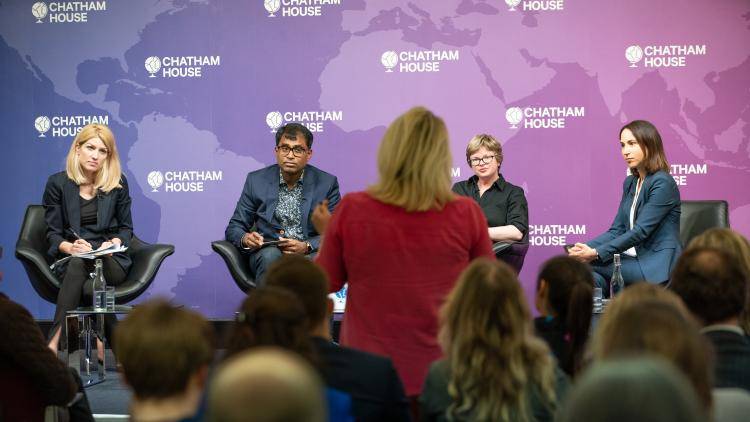
Hello and welcome, everyone. This is Galip Dalay. I am Senior Consulting Fellow at Chatham House. Today, we will be discussing the Israel – the Iran-Israel War and its Broader Regional Implications. Following the 13th June Israel’s attack on Iran, the two countries have engaged in the most intensive escalation to date and today, we will be unpacking the strategic objectives of the both countries in this war and what is the possibility for diplomatic de-escalation? What will be the broader regional implication of this war? And whether the region countries, the Gulf countries, can play a role in a de-escalation.
To do so, we have a stellar lineup of speakers. Here with us we have Sanam Vakil, the Director of Middle East and North Africa Programme at Chatham House. We have Ksenia Svetlova, who is our Associate Fellow at Middle East and North Africa Programme here at Chatham House, as well. We have Renad Mansour. Renad is also the Senior Research Fellow with us at Chatham House and also, Director of our Iraq Initiatives, and we have Mohammed Baharoon who is the Dubai Public Research Centre, the General Manager of – General Director of the Dubai Public Research Centres.
So, we are very pleased to have you all here with us. Just some housekeeping notes. This is livestreamed, so we are on the record and for the Q&A, for the questions, please use the Q&A box there that you can see and after the initial remarks, after we have done the first or possibly the second round of the conversation with the speakers, I will be looking at the Q&A bos as – box and pose your questions to the relevant speakers.
With this, without further ado, Sanam, let me start with you. I mean, first, very – a very generic question. So, what is the implication of this war for Iran, for Iranian leadership? But most importantly at this stage, what are the strategic objectives for Iran in this war?
Dr Sanam Vakil
Thanks so much, Galip, and great to be here today with a stellar team, as you described. This is a very most severe moment for the Islamic Republic, for its leadership. You know, I think it’s safe to say this is nothing short of existential, the most profound. Of all of the crises that the Islamic Republic has faced, this is the greatest and most serious one. And, you know, it’s worthwhile, of course, remembering the last time Iran was in a military war of this kind, it was with Iraq. And I’m struck every time I’m reading, and my brain has been used to seeing Iran and Iraq together, and this is an Iran and Israel war that I think is very much designed to decapitate the leadership of the Islamic Republic and degrade the nuclear and broader military capabilities of the regime, as it’s oftentimes referred to.
Over the past four days, we’ve seen deep Israeli intelligence penetration inside Iran, that is both embarrassing, but designed to, of course, suggest broader aims, and we can talk about what those might be. We’ve seen, of course, direct strikes against Iran’s nuclear facilities, specific damage to Natanz and to the Esfahan facilities. But there are many more on the ground that remain operational, with, of course, the principal and most important facility being Fordow, that is heavily fortified underground and has yet to be taken out by the Israelis. And of course, there are questions whether that is possible by the Israeli Military Forces on their own.
I think Iran has been exposed as – you know, those of us who’ve been watching Iran for quite some time have known it is the weaker party. Its military capabilities have been asymmetrical, but it’s, of course, been exposed to be really vulnerable in this moment, and we’ve seen attacks on energy facilities. I think psychologically, the war has also been very damaging in terms of confidence to a system of governance that has been struggling to maintain legitimacy. And the targeting of Tehran in particular has created, you know, real pressure on the system, on the state, has alarmed ordinary people. The high loss of life and the lack of protection by the government, the lack of facilities to manage this war, I think will have a longer-term tale, depending on how this all ends, or if and when this ends.
To answer your second question, what are the goals here for the Islamic Republic? Which is separate, perhaps, for the people and other constituencies here. I think the primary goal is to prove their staying power. This is a test of time, of how long the Iranian system can resist, as the weaker party. And if you do the math, I’m not someone that counts missiles, but if you do the math, of course, Iran can only hold on for so long. So, Iran is just going to try to demonstrate its resilience, show that its command structure is intact, show that the government continues to operate despite the penetration, the strikes, the targeting of cities, which is reminiscent of the Iran-Iraq war, and they want to avoid capitulation. So, knowing that this will somehow end at a negotiating table, they want to be in the best terms possible.
At the same time, they do want to inflict damage on Israel, and they want to demonstrate their, albeit limited capabilities to do so, that they can still do so. I think it’s important to put ourselves in the mindset of the leadership that does still exist in Iran. It’s an institutionalised system. There’s a very big bureaucracy and a command structure under the IRGC, that will continue to rebuild and replace key individuals that have been taken out. But the mindset is very much a David versus Goliath, and they see themselves as the David against the Israeli Goliath.
Ultimately, they would like to wear the Israeli political and population down and see international pressure grow and mount to stop this war and to get to a ceasefire. But I don’t think that ceasefire is going to take place while the military campaign and the strikes on the cities very much continue. So, we’re in a bit of a moment where also, we’re waiting to see what the US and President Trump does. I think this is a key fork in the road moment where the US entry into this war or the US staying out of this war will be really critical for how the leadership and Iran in general emerges from this conflict. But perhaps we can come back to that later.
Galip Dalay
And Sanam, maybe just, actually, what you emphasise in terms of the political psychology impact of this war and of – particularly for the regime, and today, if I’m not misquoting you, I read one of your quote, basically, you were saying, I think in Financial Times, “Survival is the victory at this stage for the regime.” And given that Israel is not hiding its intention of the regime change, how the regime itself do you expect to be affected from this process? Do you see the possibility of the regime collapse?
Dr Sanam Vakil
Well, of course, you know, that’s the $10 billion question that I spend hours a day trying to answer and anticipate. ‘Collapse’ I don’t think is the immediate outcome. I think what we can see is an unravelling over time, and I think that the Israeli objectives are not to be responsible to – or responsible for regime change, but to take credit for it when it comes. Iran has already been in transition. Israel is pouring an accelerant on the process, but unfortunately, this process has – is no longer going to be managed or controlled by external actors or parties, or necessarily by the internal alignment, as well.
So, I certainly see change in the regime, but it’s – and there are many outcomes, we could talk about what that could look like. Israel is looking for a contained, weakened, militarily constrained Iran, where Israel can always have the right to attack and the right to respond, similar to what we’ve been seeing in the Lebanese or Syrian frontier. Or we can imagine if you dust off your history books, an Egypt-like scenario after the Six-Day War.
Galip Dalay
Hmmm. Well, another interesting point maybe for the second round would be the intertwining between the regime and states. So, if, let’s say, there is an – the unravelling of the regime, would that means, also, the unravelling of state? And obviously the very dire consequences for the region will be very much discussed, as well.
Ksenia, very similar questions, what are the strategic goals that Israel is pursuing at this stage? And how does the Israel viewed the US response [inaudible – 10:27]? Is it optimistic that the US will join the fray, or is the US is resisting this temptation?
Ksenia Svetlova
Thank you very much. Galip, and thank you for Chatham House for having this important discussion today. Well, first of all, you know, the declared goal by – of Israeli Government, of the Israeli system, also the military, it’s of course, the degrading of Iran’s nuclear and ballistic programmes. This is what we hear repeatedly from Prime Minister Benjamin Netanyahu, from military speakers, from Minister of Defence, you know, and so on.
Read between the lines, you also hear a bit of a doubt that Israel can alone – and here, you know, your two questions are interwinded [means intertwined], of course, whether Israel can achieve some of the nuclear goals without the involvement of the US in this war. So, you hear from day one, or from people such as Tzachi Hanegbi, the Head of the National Security Council, that everybody knows that’s what he said in interview to Channel 12, that “Israel cannot accomplish this goal alone and it’s impossible to destroy completely the Iranian nuclear programme.” So, therefore, their goal is to weaken significantly Iran, the Iranian regime, to degrade its capabilities, but then eventually, to get it to the negotiation table. And perhaps to strike a deal that will be much more acceptable, like, you know, by the US and of course, by Israel, and by the rest of the world, by the way, as well, that today is also sounding – it’s voicing out its concern for the accelerating of Iran’s nuclear possibilities.
In the regards to the question of the survival of the regime, so there is a debate that’s ongoing in the Israeli political and diplomatic and security milieu, about, again, you know, the possibility to achieve their proclaimed goals without their downing of their Iranian regime, without eliminating the current Iranian regime. So, I have to mention that there is an unbelievable consensus about this war, unlike the war in Gaza, unlike the war in Lebanon, unlike any other war perhaps that Israel waged so far. And their population is, indeed, very supportive, despite the deep divides of the society, despite the ongoing protests that, of course, you know, they were postponed because of the security situation. But nevertheless, there is this unbelievable support and also, expression of resilience. So, there is a significant price that Israel is paying and again, it’s not resembling the previous Iranian attacks last year and the war in Gaza or the war with Lebanon. The price is much more painful and nevertheless, you do hear from the ordinary people, “Yes, we are ready to pay the price, but only if you are ready to go all the way.” ‘All the way’, it means including they’re, you know, toppling over the Iranian regime.
So, I will switch now to the question of the US and its involvement in what is happening today. So, I would say, you know, this is the state of, I would say, this wishful thinking, I believe, that, you know, from day one, there was this hidden, but well displayed, still, desire to see the Americans involved in the war. So, it – although, you know, there were statements by officials that were made about Israel designing this war blue and white, meaning only Israel will, you know, fight eventually the Iranians, and not counting on the US. But you do see through the promotional videos that the IDF is publishing, through the declarations, you know, for Prime Minister and other Ministers as well, that there is an understanding that. at least, as we discussed, the fate of the nuclear object at Fordow, it will impossible to goal of really degrading this site, the – degrading seriously the Iranian nuclear project, without involvement of the US and its weapons and its fighter jets that have different capabilities than that that are available in Israel.
So, we have to understand that, you know, the Trump factor is unpredictable, and I think that’s nobody today with certainty can say that – you know, whether US will eventually join this military adventure or not. But I can tell you that you have more and more voices. These voices are traditionally affiliated with the opposition, such as this of the ex-Prime Minister Ehud Barak, that express criticism towards the government, not in regards to waging the war against Iran, not about the timing, even. Because the opposition, of course, could suggest that it is happening in the context of the ongoing protest, the war in Gaza, the hostages, the draft bill, in the end of the day, many other reasons. But what we do here, from key opposition figures, such as Barak, is that if this war was designed with the hope that the US will join, but eventually it will not, then it’s a serious miscalculation that can cost Israel a dear price and even…
Galip Dalay
Exact…
Ksenia Svetlova
Yes, can even bring Iran closer to the nuclear bomb than today.
Galip Dalay
Exactly on this point. So, assuming that US didn’t join, like, what strategic objectives can Israel plausibly achieve, and will we see an Israel after this war emerging within the regional context, worse off or better off without the US participation?
Ksenia Svetlova
Yes, well, this is, indeed, like Sanam said, the $10 million question, or even more, considering that every day of this warfare costs to Israel, as we understand, billions and billions of shekels. So, well, you know, I can tell you that there is still an ongoing debate about whether Israel will be better or worse. The majority of the voices that we hear today, even from the more critical part of the map of the think tankers and the analytics and so on, believe that Israel will still be better off. Because we do see that right now, and according to IDF, about 40% of the launches were exterminated on the ground. And we do see that despite the promises of their leaders of this Islamic Republic, to put a deadly blow on Israel and to use all of its possibilities and some new weapons that were tried yet, and so on, they actually see that the amount of rockets that they use in every launch is diminishing.
So, they started with 100 rockets per launch and then 50 and for the last 24 hours, it’s 20-30 rockets. So, it means that they are trying to save and to make their remaining rockets last as long as possible. And basically, news for Israel, that was always concerned, not only of Iran’s nuclear capabilities, but also of this ballistic programme, and this was something that was, of course, expressed during the discussion about the JCPOA, that the ballistic element was not considered there, was not present there.
So, today, you know, I think that we understand that there is some achievement in this regard. So, considering that point, you know, I can tell you that there is this satisfaction in the military command, at least, you know, about what was achieved so far. As for the nuclear capabilities, well, I think that again – and, you know, despite all of the achievements that are presented to the Israeli people, such as the strike on the Israeli television, I personally don’t, you know, think that striking Iranian television will, you know, help Israel in a pro – avoid the scenario in which Iran will brandish a nuclear bomb, you know, within six month or one year or, you know, whatever it takes.
So, at the end of that, in the end, the question is whether the nuclear capabilities were harmed. From what we understand, and it’s only been four days of this war, they were not seriously harmed, to the degree that we can really talk about game changer here. And the big question is whether, you know, they will accelerate, whether they will be able to, according to their capabilities, to accelerate this programme after the war will end. Whether it will end at the negotiation table, or…
Galip Dalay
Who…?
Ksenia Svetlova
…in any other way.
Galip Dalay
Hmmm hmm, and one of the paradox that I see from most of your remarks that the possibility of degradation Iran’s missile capabilities, while at the same time, potential acceleration of its nuclear capability, and I don’t know what kind of strategic picture that will present Israel, going forward.
Renad, I mean, Iraq particularly, probably one of the countries that will be the most affected, potentially, along the world, with this war. So, a) how is the – Iran’s regional allies are responding to this, and more specifically, how the world is redefining Iraq’s – Iraq?
Dr Renad Mansour
Thank you, thank you, Galip. You know, this war, but definitely the post-October 7th climate, is a Middle East that’s changing, and many of the regional allies, many of the regional groups and regional states, are uncertain where it’s heading. So, it’s, right now, it’s mode of survival. Every group – every state is in survival mode. As they begin to see the unravelling of an old order and the kind of transition to war, it’s a new Middle Eastern order, that no-one knows where it actually will end up. So, you know, when we talk specifically about the groups, Iran’s traditional allies, be that Hezbollah in Lebanon, which has been weakened and degraded, of course, the Assad regime was removed at the end of last year, some of the PMF groups, the Popular Mobilization Forces in Iraq, the Houthis in Yemen, for them it’s all survival mode. Obviously, Assad [inaudible – 21:01], but for Hezbollah, the Houthis and the PMF.
And crucially here, the word ‘proxy’, which for a long time we have been pushing back against, you know, these being Iranian proxies, is further being challenged. Because for each one of them, it’s about local interests. How does Hezbollah and Lebanon re – you know, try to fight for its very existential position in the Lebanese state as it’s transforming? Similarly, in Iraq, where many of the PMF groups, including those linked to the Axis of Resistance, haven’t – you know, in – notwithstanding all the conflict we’ve seen, they’ve had less conflict, and in fact, the economy is booming. So, they’re making a lot of, you know, money and they’re being very successful in the Iraqi state. So, as many of them tell us, it’s not the time right now for resistance, right, fundamentally. So, it’s – and the Houthis, as well, yes, you know, October 7th has been an opportunity for them to put themselves on the global stage as such an in – you know, influential actor that could stop global trade.
The point here is each one of these groups is not just a proxy of Iran but responding first to their own local interests. And for many of them right now, business – you know, conflict is bad for business and business means we need some stability, you know, at least at the local level. And this is all part of another change we’ve seen, which is actually – which began at the end of Qasem Soleimani, when Qasem Soleimani was assassinated by the US, which is the Iranian model began to unravel after then, in that it was no longer a top-down organisation. The IRGC of brute force no longer commands the Axis of Resistance, but actually, it turned into a horizontal movement, where even people like Hassan Nasrallah were making decisions, you know, as Hezbollah, or PMF leaders or Houthis.
So, it’s a much more decentralised and a much more horizontal movement, as I say, as each group pursues their interests. And at the end of the day, you know, as the Middle East continues through this transformation, something important, I think, to note is that, you know, this idea of spheres of influence, or this idea of ideologies, as important as they are, right now are being challenged by very, very, sort of, primary survival modes which are economic, which are political, much more than this wider, broader, trend. As I say, they don’t know where the – you know, they don’t know where this will end, but they want to make sure that they aren’t, you know, completely removed from this. Hezbollah’s lesson is learned throughout the region.
So, PMF groups know that okay, we could start firing at Israel more than we already – of course, PMF groups have done, but what would this mean for our own stability? And to go back to your question about Iraq, in this new Middle East, Iraq isn’t the centre of the conflict. Whereas Iraq, for many decades, was the centre of conflict. So, Iraq has somehow remained insulated from the post-October 7th violence. So – whereas everywhere else where you’ve seen an Axis of Resistance, Lebanon, Palestine, Yemen, Syria, you’ve seen attacks, Israeli attacks, Iraq has largely remained insulated. And this is very important for the group, to keep that insulation, because conflict is, again, bad for their local interests.
So, I think to, sort of, to conclude, then, there is a changing Middle East world order. There are no rigid, you know, spheres of influence. There is many, many economic deals being made here and there and, you know, the region is awash with economic deals, but sadly, these deals, you know, aren’t necessarily – are happening at the same time when you have war. So, something still, fundamentally, isn’t there. You have so many deals and so much war, much more conflict in the region than in the last few decades. And so many of the groups, they don’t know where this is going and for them, again, to conclude, it’s about survival.
Galip Dalay
Renad, I mean, it seems that I ask everyone $10 million question and will be asking you one as well. So, assuming that the war is expanding and the US is also joining the fray, would this mean that Iran’s regional allies, most importantly, in Iraq, would also join the fray in one way or another? Do you think – or even in this scenario, do you think that they will stay out of it?
Dr Renad Mansour
Well, Iran has had a problem in Iraq for many years, primarily that the groups in Iraq aren’t united. There isn’t one Hezbollah or one Houthis. There are many different groups that make up the Popular Mobilization Forces. As I say, some of these groups are in the state, they’re in the government and they’re doing really well with the current government in Baghdad. And they’ve seen the lessons learned. I mean, you know, they were attacked by the US in January 2020. The leader of the PMF, Abu Mahdi al-Muhandis, was killed at that point, so they know the consequences of this.
And again, to, you know, to make another point clear, these groups, at some point, yes, developed from the support of Iran, but for many, many years, these groups have their own economic independence, have their own political independence, and so, they will make their own assessment. There will be some rogue groups, like Kata’ib Hezbollah potentially, or Harakat al-Nujaba, that, you know, see themselves as part of this resistance ideology. But for many of the PMF groups, you know, we’ve been going to, you know, to Iraq over the last few years, since October 7th, many of them conclude that this conflict is bad for their business right now [pause]. You’re on mute, Galip.
Galip Dalay
Yes. Mohammed, Gulf is, basically, probably the most important thing the – in this war, both in terms of the effect of this war on the Gulf geopolitics, but also, the potential role that the Gulf can play in de-escalating the tension, mainly through the US. So, how do you see the Gulf’s actors responding to this escalation, but more importantly, what roles can they play in de-escalating the tension? And I also see in the Q&A there are quite many questions that is very much directed to the Gulf dimension, so I will be posing them afterward, as well.
Mohammed Baharoon
Thank you, Galip, and thank you for the opportunity to discuss this ongoing issue. Let’s talk first about the implications for the Gulf. Is this a conflict similar, let’s say, to Gaza, where we can try and help with it, but we are not directly impacted by? I don’t think this is the case right now. There is serious worries about the radiation in the Gulf. People in many, you know, Gulf countries can actually see the missiles passing by, either from Iran to Israel or vice versa.
This is now a clear and present danger. It is already touching national security of the region. The very latest collision off the shores of Khor Fakkan between two ships is a new duel, but a lot of, you know, speculation that this has to do with electronic warfare and GPS jamming that is affecting. An accident, I mean, we’ve already seen an attack on Pars field, which is connected to Qatar. So, the debris is coming closer and closer to the region. This is not an – a conflict that we can watch on TV anymore, it’s a conflict that is touching to us.
And here comes the bigger implication for countries, particularly like the UAE. At a certain point since Gaza started, we’ve been saying that well, we wanted Israel to be a partner in peace. Israel wanted to be a partner in security. Today Israel is becoming a source of instability. I mean, if we are afraid on getting water from our desalination because of a possible radiation, there is an ongoing direct attack on active reactors in Iran, then this is not a partner, neither in peace, neither in security. Actually, it’s a source of insecurity in the region and that is quite difficult.
If the US participates, and of course, the participation of the US is based on bombing Fordow and a possible impact of that happens, then things would become even worse. And we’ve heard, for instance, a lot of criticism to Russia during the war, during the operations as at Bushehr, on the possible impact on the nuclear reaction, we’re not hearing from the international community similar type of discussions. So, the implications for us is beyond the regional and the global, there is an actual direct impact, or a possible direct impact, on national security, on people’s food, on people’s, you know, water. But also on the ability to export oil out of Hormuz Strait, which will affect, of course, oil prices, but also, shortage of energy security across the region.
Another element, which is a strategic element, we will not see its impact today, but we will see it a little bit in the future, which is this continuous failure of the international global governance. There is no entity today that can stop Israel. It’s not the UN, it’s not the EU, it’s not the GCC, it’s not the Arab League, it’s no – not the, you know, Islamic Co-operation Organisation, no-one can do that, let alone the US itself. Actually, the US now is participating, and this poses a bigger question. What type of fallback do we have when wars goes on? This – these have the type of questions the world has faced during World War I and World War Two. This is the – these are the kind of questions that have changed the League of Nations to the UN. I don’t know what it’s going to do.
But the one thing that we know for sure is that when states and international organisations fail to do their job, they create a void and it’s individuals who fill in that void. So, this is a problem where we could see a resurgence of things like Al-Qaeda, of things like Daesh, in the region, because people cannot really take. And that’s, as I said, it’s a strategic implication that we might see in the future. I think at this point, it’s very difficult for us to say that there is a clear outcome expected by Israel when it comes to the conflict, because we haven’t seen a clear outcome out of Gaza operation. That has always been a bit confused and it has expanded. The same thing can happen. The nuclear programme cannot be taken out fully without huge implication on the Iranian people, but on the region around it.
The issue of decapitation, or even regime change, which is quite obviously becoming now a major part of the discourse, is not going to be an easy change. We’ve seen Hezbollah go and its leadership killed almost overnight, but until now, Israel is conducting a treasure hunt for the missiles that are not accounted for, and that also brings, you know, a major concern.
Galip Dalay
Mohammed, actually, it was very notable that you said that we – you – Israel was supposed to be an partner for regional ‘security’, but now it’s becoming the social and regional ‘insecurity’. So, what does that mean for the Israel-Gulf relations going forward, particularly the fate of even Abraham Accord, let’s say? Secondly, the paradol – parodox with the US is, on the one hand, it is the only country that can rein in Israel, on the other hand, it’s an active participant, maybe not directly, but indirectly and at times directly as well, in this conflict. So, where does lead – where does this lead us in terms of the Gulf’s diplomacy with the US, but also, Gulf’s broader effort in terms of de-escalation?
Mohammed Baharoon
Well, on the first part, and we will possibly see something similar to what’s happened in Europe, when the tariff came out. The entire discourse in Europe was about realignment. We used to depend on the US as a major ally and now, we are left alone, we will need to start thinking about strategic autonomy. Stay – these type of discussions is possibly going to be a reconsideration, a re-evaluation, of our views about the region and the role of Israel. And I think possibly, the UAE has been one of the forthcoming in trying to find a way for Israel to exist within the region, not only exist, extend its economic reach and cultural reach, all the way across Asia, with the hope that this would convince Israel that there is a way for them to exist within the region once the Israeli and the Palestinian issue is sorted. I think that’s a major setback. I cannot say today we don’t want to make big, you know, speculations when an operation is going on, that this is going to happen or not, but I’m saying definitely, at least within circles of people like me, these questions, these scenarios, are put down on the ground in the discussions.
On the US, the US did not join yet, and I think right now, possibly, President Trump is pitching two different factions. There is a faction who’s trying to get a deal with Iran and there is a faction who’s preparing to bomb down, and you say, “Well, whoever gets there first is going to have it. If Witkoff can get Iran to accept a deal, then that’s fantastic, well done, but if he cannot, then the war is coming in. This can be seen as some sort of a pressure on Iran, maybe, but it’s a very, you know, dangerous game if the Iranians think that we cannot submit to a deal, a deal that we will not be able to honour or a deal that we will try and overcir – you know, circumvent in the future, then that is a problem. What we were hoping for was a deal that in our – Iran wants because it saves it economically, but a deal that Iran is forced to take is possibly going to face, you know, an attempt for circumvention in the future.
Galip Dalay
Mohammed, also, in your remark, you laid the complexity or the multi-layered nature of the security challenges that the Gulf are facing from this war, from the tradition in geopoli-security to the maritime security, to the water security or food security, nuclear security. So, the goal, in the States, for Gulf cannot be higher. Does that mean we should expect a concerted common Gulf diplomacy to put pressure on Israel and the US to find a diplomatic solution, or will it be more like an individual Gulf countries will be pursuing individual diplomacy to try to achieve the same result?
Mohammed Baharoon
Hmmm hmm.
Galip Dalay
By the way, I’m already combining questions that I see, because we are receiving many questions in Q&A, so I am combining them, paraphrasing them, so I’m monitoring words. So, please post your questions that I am asking.
Mohammed Baharoon
I think what we’re seeing is most of the Gulf leaders are moving very fast on this. If you mean by ‘consolidated’ as under the banner of the GCC, that is not the case. But the leaders of Saudi Arabia, of UAE, of Oman, of Qatar, they’re all moving around, they’re talking to everyone to – trying to get a stabilisation for – I think part of it is to try even to convince Iran to see a certain compromise on a deal, but I think, also, the time is running short.
Galip Dalay
What kind of compromise are we referring to? Was it not nuclear from – because Iran was already at the table? So, what is…?
Mohammed Baharoon
The…
Galip Dalay
What else?
Mohammed Baharoon
Well, Iran was already at the table, but there were also differences on how much enrichment, where is the enrichment is going to happen? Is it national, is it international? These were very technical issues that frankly, needed time. I think Witkoff and his team wanted a provisional deal, an interim deal, that would allow for more technical discussions. And did it happen? My understanding, and this information might not be accurate, but my understanding, what I hear, is that the response from the Iranians on Witkoff’s final proposal had a lot of the elements within the pro – Witkoff’s proposal, but there were also elements of what was described as “face-saving measures from Iran,” that they wanted Witkoff to accept, and it doesn’t look that Iran has surrendered everything. But the attack happened before those discussions could happen on Sunday.
Galip Dalay
Thank you. I mean, there are also, obviously, questions about the energy price, so the impact of the war on energy prices. So, you can maybe, like, briefly, touch what implication do you expect there?
Mohammed Baharoon
On the energy aspect?
Galip Dalay
Yes.
Mohammed Baharoon
Well…
Galip Dalay
A few question on…
Mohammed Baharoon
…as I mentioned, there’s already an incident at the Strait of Hormuz. Other incidents, if the attacks start hitting – you know, if we’ve got an oil spill because one of those incidents, then we’re already in a position where the flow of tankers is going to be decreased. The prices of insurance are getting high, and price of oil is getting high. This is not good, you know, news for the GCC. High prices of oil are very disruptive, and I think people, not only in the GCC, but India, Japan, Korea, China, these are the biggest buyers of GCC oil, are definitely, and, you know, are calculating the impact on their own economy.
Galip Dalay
And Sanam, if I paraphrase few questions that I see in the chat box, I mean, one of them, one line of the argument that I see in the chat box, for Iran to de-escalate, it has to further escalate first. So, do you think that this problem might be the case with Iran, with the calculation in Tehran? Secondly, I mean, all of us, we are talking about what US will or can do, but there are also quite many questions that is asking which other actors that can play a role there, like China, Russia, Gulf, Turkey? So, which other actors can play a decisive role…
Dr Sanam Vakil
Hmmm hmm.
Galip Dalay
…in reining in this war, de-escalating?
Dr Sanam Vakil
Sure. Thanks, Galip. I mean, I think Iran is trying to escalate, albeit it is relatively boxed in. I mean, if you look at the scenarios, and I’m happy to list a few of them that are more openly discussed, there’s not much Iran can do without risking further attacks, further isolation. I mean, if you look at the list, Iran can certainly, you know, start advancing its nuclear programme. It could, of course, formally kick out Inspectors, it could exit the NPT, it could, over time, and this is by no means something easy, it could break out. And so, the weaponisation aspect is still there, and all not good options because I think Iran is trying to preserve what leverage it can to then use it at the negotiating table. So, in that area, I think Iran is relatively boxed in.
Iran has threatened to close the Straits of Hormuz for as long as I’ve been alive. It has yet to do so, really, because, obviously, that would harm Iran’s interest, harm China’s interest and of course, harm its neighbours’ interest in the Gulf. And again, here, it ties us to the threats of strikes and the blackmail Iran has used against its neighbours for quite some time. I think in this moment, striking Gulf in – this is not 2019. This is 2025, Iran has worked to rebuild these bridges and tensions still exist between Iran and the Gulf states, so attacking its neighbours would really be, I think, a case of last resort.
And ultimately, I think these moves would also bring the United States into the conflict, and Iran is looking to have this really be an Israel-Iran war, not a regional war. So, that, I think, is important to consider there, as well. I think Iran probably still has tools in its arsenal of missiles that haven’t come out yet. By estimates of those that are doing missile math, there are still quite a bit left that can be used. And again, it’s a question of not overwhelming Israel, but tiring and wearing down Israel and showing some impact and survivability, that I think is important.
Other actors, I think that’s very important to think more broadly. Here, I think that there are, of course, players in Asia that are perceived to be more balanced in their approach. I think Europe, at this point, has completely wiped itself as a relevant mediator and relevant player and compromised its ability to defend principles and law. I think here, you know, other actors with interests in the region can include South Korea, for example. We haven’t heard very much about what they’re – what role they are playing. I think Turkey has been playing a very forward leaning role. Erdoğan, despite many tension points with Iran, recognises that this is a moment of regional instability and it’s really interesting that for most of the region, this is a 2003 moment and there’s unity in preventing the regionalisation of this war, if not the regime change in Iran, you know.
So, I think what regional states do worry about and maybe don’t want to say out loud, is an outcome where Israel is the dominant military actor in the Middle East and they are going to be pressured by Israel over a longer period of time. Israel has certainly got that military prowess, intelligence, that is very striking, and regional states have been very pleased to see Iran degraded, the proxies, the militias, brought down to size. And the landscape is definitely an opportunistic one for the region, but at the tail-end of this, I think everyone is still concerned about Gaza, like, about the issue of the two-state solution that looms very much on the horizon and of course, is not at the forefront of our minds. The conference in New York has been cancelled, the issue of statehood has been, sort of, tabled for the time being, and I think that’s problematic.
And I think a third actor that is trying to make the most of this crisis is Russia. Russia is a close partner of Iran. I’m careful not to use the word ally, because they have signed a mutual – they’ve signed a defence treaty and so, the question is how, if at all, can Russia play a role? I’m sceptical that the Russians will come to a real support for Iran, but I think that they are trying to and can pick up the phone to Washington and find off-ramps here that would be important.
Galip Dalay
Well, thank you. I think one interesting observation that you also mentioned, the 2003 Iraq moment, whether we will see a similar regional diplomacy now, because, like, there was the Iraq neighbouring conferences, diplomacy, that was trying to prevent a war. Unfor – obviously unfortunately, it did not, but it will be interesting that we will – whether we will see a similar scenario that will be unfolding now.
Ksenia, again, there are quite many questions around the specifity [means specificity] of the Israeli expectation from US in terms of does it the US directly joining the war, or is it the capability, it provided the B-2 ‘bunker buster’ bomb? So, what are the exact expectation from the US? And secondly, how this war is affecting the war on Gaza, itself, as well, so how is the picture there is evolving?
Ksenia Svetlova
Yes, Ga – thank you, Galip. So, you know, on the first question, I think it’s clear that there is a scale of possibilities in regards to the aid that the United States can offer, or the involvement – the level of involvement and so on. I think that the minimum that the Israeli leadership expects now from the US is not to stop the Israeli offense against Iran before Israel is done with all of its targets, before it believes that it completed some of their missions it stated. And again, not everything is published, not everything is known. The matter of this fact, some of this – of course, some of these plans are secretive and it’s hard to say, you know. So, how much of their goals that the IDF has right now, you know, was – you know, so what was accomplished, was less accomplished and so on, you know? So – but there is an expectation that at least Trump will not pressure Israel into the ceasefire before its time, you know.
So, anything else, seems that at this current stage, it’s more of a bonus than anything else, because it’s been now four days and then, you can say that four days it’s not long, but we remember a certainly war that lasted four six days and it was practically over on the fourth day. And, you know, sometimes four days, it’s enough to understand what is going on. So, again, the expectation maximum, the maximum edge of the scale is, of course, full involvement of the US in this war, the use of the B-52, you know, the anti-bunker bombs, you know, the larger bombs, the mega bombs, the “mother of all bombs,” if I remember Trump’s expressions about that specifically.
I think that it’s – there is this growing realisation in Jerusalem that nobody is in a hurry, nobody’s in a hurry in Washington to do that, and just as my friend, Mohammed Baharoon, mentioned, there is the war of camps. In Washington, it may take time to understand, you know, who has the upper hand, but for now, you know, the – it’s, you know, attempt of Trump to explain that he both advances the America First, but at the same time, he believes that, you know, America should do everything that the Iran will not have its nuclear bomb. Well, you know, in Israel, it’s being perceived with a dole of – dose of reality, so there is currently, at least, no expectation of immediate involvement of the US.
And regarding your second question, you know, so I think that the answer on, you know, that, you know, what is the effect of the war in Iran on the war in Gaza? Well, unfortunately, at the very first day of the warfare with Iran, there was this vote that belonged to somebody from the military command that right now the war in Gaza, it’s not the first priority of Israel, it’s secondary at best. The first priority is, of course, it’s of course, Iran. And so, it was perceived by the relatives of the hostages and, you know, by the parents of the soldiers, who object the continuation of the war, that yes, you know, so this will be on a slow burner, this will continue until there will be clarity about what is happening with Iran.
But for now, most importantly, the public discussion about the goal of the war in Gaza, it’s over, it’s done. There are no demonstrations, there are no debates about it in the, you know, the [audio cuts out – 51:08] [studios]. The attention of the whole world and, of course, of the Israeli, is focused solely on Iran, not Gaza. And I – you see that there is also, of course, less pressure on the Israeli leadership. Netanyahu, who was, basically, you know, you can say it persona non grata for many European leaders for the last, at least, you know, eight/ten month, you know, he has the – there is this warrant of the High Court. His Ministers are sanctioned by UK and by other countries, as well, other countries in Europe and other countries outside. Suddenly, he is getting all of the calls, all of the attention from the whole of the world, he is in the centre.
He likes to be in this position. He presents himself, finally, as a winner, something that he cannot do in the context of Gaza. So, you know, this is a psychological dimension of that. I think it’s important and yes, the war is ongoing, there is more – there are more victims and unfortunately, the human suffering continues.
Galip Dalay
Very briefly, a whole lot of questions. I mean, there are a lot of questions in chat box, which basically, if I paraphrase, without the US involvement, to how long Israel can sustain the – this military confrontation with Iran? Given that, you know, Iran’s tolerance for pain probably is higher than that of the – that of Israel, because of, like, you know, the country has been in war, under the sanctions, for almost now half a century, so what – how do you see the threshold of pain for Israeli politics and society when you compare to – for the Iranian one, if we are in for a longer game?
Ksenia Svetlova
It was believed, indeed, that – for years, that Israeli leaders actually prefer not to go to war and that was something that Netanyahu also said repeatedly, “We do not want to see the coffins of soldiers. We do not want to see the coffins of the citizens.” So, therefore, you know, he explained his policies vis-à-vis Hamas in this kind of fashion. But it seems that after 10/7, the threshold had changed and also, the public perception of how should you treat the unfinished business? You know, so their business in [inaudible – 53:17] vis-à-vis the Hamas was – is perceived now as the unfinished business and it’s what brought to, you know – the mismanagement of this was brought to this horrific tragedy and the massage of 10/7 and then the war that is still ongoing.
So, I can tell you that for now, at least, I will repeat it, the consensus in the Israeli public is overwhelming and you can see how online, the rare critics of this war and those who ask about the endgame are being viciously attacked not only by the supporters of Netanyahu, you know, the traditional forces that we know, but also by anybody else, you know, who finally wants to feel this satisfaction. This pride that Israel traditionally had, you know, pride – taking pride of its military, something that was put under doubt after 10/7. So, now you have again, you know, this significant change in perception of what Israel is, what IDF is, you know. So, this is something that perhaps can change in the future if [audio cuts out – 54:16] Israelis are ready to sacrifice, still.
Galip Dalay
Hmmm, and very quickly, actually, I will ask you, because I know Mohammed have to leave, and then to Mohammed and to Renad, a very similar questions. There are a few questions in terms of how this war is affecting the region’s approach and perception of the US, so – and how will this affect the region’s approach to countries like Russia and China, going forward? Like, Mohammed, in terms of Gulf, so, how this is going to shape the region’s view of UN, and applies to Russia and China, as well.
Mohammed Baharoon
Sorry, Galip, that question was to me?
Galip Dalay
Yes.
Mohammed Baharoon
Well, I can…
Galip Dalay
So, particularly how this war is affecting the Gulf’s view of the US and then its approach to Russia and China.
Mohammed Baharoon
Until now, the US has been on the side of negotiations. Actually, it took the side of the GCC when it comes to engagement with Iran. Until now, the US is not part of the war. So, I mean, we will have to wait and see whether – to what extent is the US is going to participate, if it does participate, or will it actually manage to pull off an agreement that can put things aside? Iran has so far mentioned, said that they’re willing to go for a ceasefire, if there is a ceasefire from the Israeli aspect. They also said that they’re willing to engage with the nuclear talks.
We haven’t heard something similar from the Israelis yet. On the contrary, Israelis are talking about a larger bank of targets and again, as – I agree with Ksenia, these are operational issues, you wouldn’t know what are those targets are. But even the idea that the number of missiles has went down from 100 to 70, to something like 30, I mean, there are two ways of looking at it. One of them is what Ksenia’s mentioned, that this is a depletion of Iran’s ability to launch. But on the other side, it could also be a message to the US, look, we’re already reducing, we’re already scaling back, we’re giving you a small carrot to carry, this is an, you know, an intention that we can actually reduce.
It would possibly go back to the first question that you’ve asked Sanam, which is, you know, what is this all about? And I think right now, at least from the Israeli aspect, it’s an elimination, rather than just decapitation or even degrading. They want to elaminate – eliminate the missile programme, they want to eliminate the nuclear programme, that’s why the zero enrichment came up, and they also want to elaminate – eliminate the leadership. They’ve talked seriously, obviously, about, you know, an assassination of Ali Khamenei, which means practically a regime change. So, these are objectives that are very difficult to achieve without huge repercussions in the region.
Now, the question that you’ve asked about Iran and China, sorry, Iran and – India and China and others, and I would bring in Is – Brazil in this, I would bring in South Africa and a huge number of countries, what we call the Global South. These are countries with huge number of people. Their wealth is not as the G7, but the G77 compromise 134 countries. These countries are taking a position, you know, that looks at Israel as a potential danger. Now, if Iran used to be the destabiliser, it is not. It’s actually playing according to international law. They’re saying that we are having a proportionate response to an attack. Israel says that they’re having a pro – you know, a, you know, an attack that is trying to pre-ement [means pre-empt – 58:25] a certain programme, but it is an unprovoked attack in international law.
So, these are type of new dynamics that we haven’t seen in the past and it’s definitely going to affect the way people are – look at what security means. It will affect at – what does international security – if US used to be the guarantor of international security, now with this type of war, we’re back into the war on Iraq. And we’ve seen how that affected the US standing in the region, even almost until today.
Galip Dalay
Hmmm hmm, yeah. Thank you very much. Renad, almost exactly the same question, how do you expect the US presence in the region to be affected by the – by what is happening?
Dr Renad Mansour
Yeah, I want to pick up on the – on this point that Mohammed made, that the region, but the world, is a far more dangerous place. I mean, we just published this report on [Accept – 59:25] and last year, 2024, had the highest number of conflicts since World War Two. So, the number of conflicts each year is increasing and I think, you know, the post-October 7th Middle East, Israel’s violence, you know, as well, in Gaza, in Palestine, elsewhere, and the war with Israel and Iranis, are all parts of this global transformation where human rights, international laws, terms, you know, are no longer relevant. And in the Global South, you know, as Mohammed is saying, many, many people are no longer seeing there being either a US security architecture, or even this rule-based order that supposedly governed the world.
I mean, this is all out the door and, you know, Israel, both in terms of military, assuring the world what war will look like, but also in terms of, sort of, international law, is showing the world what war will look like, as well. And I think, you know, from the region then, yes, there’s still – you know, many of the – in the region, especially the countries that we cover, are no longer buying this post-World War Two idea of spheres of influence, you’re either East or West, you’re communism or democracy, good, bad. All of these binaries don’t work anymore. This is a region, you know, where yes, it’s awash with economic deals, yet, at the same time, it’s embroiled in wars. So, something is not happening here. Peace settlements aren’t leading to sustainable peace, and so, relationships with China, with India, with others, become really important in – as the region begins to see where this global order is moving towards.
Galip Dalay
Well, thank you very much. We are one minute beyond our allocated time, so I am very much grateful to both speakers and participants. I think it has been a very lively conversation about, you know, a subject. I mean, well, I would have one last question, I would have, because everybody talks about deal, but without specifying deal. So, normally, I would have, actually, one last question, potentially, so Sanam, about a deal, but I don’t know whether we have two min – more minutes. Do we have – because I want to get what a deal would look like. Sanam, would you like to step in?
Dr Sanam Vakil
I’ll just give you a one-minute answer. I mean, I think…
Galip Dalay
Okay.
Dr Sanam Vakil
We, you know, we can’t get into the technicalities of a deal, but I think there is certainly room for an off-ramp, you know, a temporary ceasefire, to test the appetite for dealmaking. I think it is the space that could be created, and this is where President Trump and the US administration’s influence is certainly going to be important. If a Vance-Witkoff meeting takes place with the Iranians and with Gulf support, to build out the contours of a be – deal, a trial run for a deal, that could really open the window and see if the Iranians are serious. And then, if the Iranians are not serious, obviously, then you can all go in and pile in and get the job done, with the United Stats.
But to get the job done without having tested what the parameters of a deal might look like, I think is, of course, very dangerous, particularly for all of the prognosticators of regime change, knowing the history of regime change and, of course, the uncertainty on the horizon. I would think this is a better outcome to manage the transition in Iran, the change in the regime that is inevitably coming, rather than, of course, to be driving a uncontrolled car and letting it fall off of a bridge.
Galip Dalay
Well, thank you very much. With this one, once again, I would like to thanks all the speakers and all the participants that has been, as I said, like, a quite lively discussion about quite a concerning and distressing developments in the region. So, hope to see you for our other events, webinars, publication around the subject, so please keep following our works, both through our social media channels, but through our website. So, I hope to see you for a next event soon. Thank you very much, again.