Dr Marion Messmer
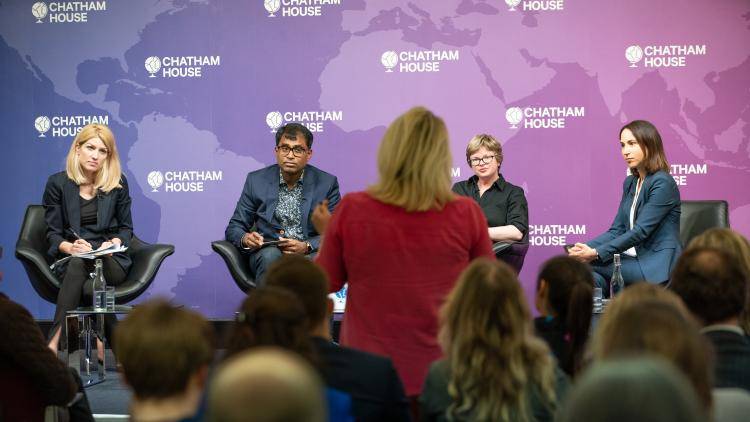
Hi, everyone, welcome to Chatham House. Looks like the lights are coming down, which is my cue to get started. Thanks very much for coming out for tonight’s discussion on the state of the global nuclear non-proliferation architecture and what we can do to strengthen it further. I’m Marion Messmer. I’m a Senior Research Fellow in International Security here at Chatham House, and I’m really looking forward to chairing tonight’s event and leading you through the conversation.
Before we get started with the conversation, I just wanted to say that this is, of course, a topic that Chatham House has been working on for a long time, and our brilliant magazine, The World Today, did a dedicated summer issue on this topic. So, if you want to read more, if you find the conversation interesting, there are some copies of The World Today on the table at the front, so please do pick some up, and we’ve also made the relevant nuclear-related articles freely available on the website. So, if you prefer online content, or if you don’t get a chance to snag one of the magazines, please do check that out. Also, as a reminder that this event is on the record and not under the Chatham House Rule. This is particularly important, of course, for our speakers, but I just also wanted to remind you of that, in case you wanted to tweet about it, share it on social media, or in case that’s relevant for any of the comments or questions that you’re going to ask us later.
So, this evening, as you know, we will discuss some of the challenges that the global nuclear order is facing at the moment, especially when it comes to proliferation risks. We’re now just over six months away from the Non-Proliferation Treaty Review Conference at the UN in New York, which is going to start towards the end of April 2026, and even if you’ve just been following nuclear-related news over the last two weeks, there’s a lot that has been going on. The situation around Iran’s nuclear programme seems to have become much more unpredictable, and could, of course, throw a spanner into the works ahead of the Review Conference. But even if it wasn’t for the situation in Iran, the relationship among the P5 has become much more polarised, it’s become much more difficult to get things done. And at the same time, we also know that nuclear states outside of the NPT framework are engaging with each other in a way that could threaten global strategic stability and increase nuclear risks.
So, we are really lucky tonight to be joined by three incredible experts who will help us make sense of the complex nuclear non-proliferation landscape. We are joined online by Alex Bell, who’s the CEO and President of the Bulletin of the Atomic Scientist. And before joining the Bulletin, Alex was the Deputy Assistant Secretary for Nuclear Affairs in the Bureau of Arms Control, Deterrence and Stability in the US State Department. And on stage with me, we’ve got Darya Dolzikova, who’s a Senior Research Fellow in the Proliferation and Nuclear Policy Programme at RUSI, and we’ve got Dr Jamie Kwong, who is a Fellow in the Nuclear Policy Program at the Carnegie Endowment for International Peace.
So, I think we are in good hands tonight, and I’m really looking forward to the conversation. We’ll spend about half an hour talking as a panel, and then I will open things up to the audience. So, if you are in the room with us today, please raise your hand, wait until a microphone gets to you, briefly introduce yourself, and then ask your question, and if you are online, you can post any questions that you have in the Q&A function. I’m going to keep an eye on the screen and read out some of the questions for everyone to hear.
But let’s get started with the conversation, since that’s what we are all here for, and I first wanted to ask you all, what can we expect at the NPT RevCon next spring? I tried to outline some of the challenges, but of course, there are many more, so I don’t expect you to be comprehensive, but maybe if you just want to focus on some of the main points that we can expect, and, of course, do you think that there is still a way to have a successful Review Conference? And, Alex, I would love to hear from you first on this point.
Alexandra Bell
Thank you so much for inviting me here into Chatham House. I’m joining you from New York. It’s the UN General Assembly High-Level Week, there have been already interesting events happening here, but I think it’s important to think ahead to May and the NPT Review Conference. It is unclear, on some fronts, you know, sort of, what will be the tension points, what positions countries are going to take. It’s unclear what will happen in the international security space between now and, you know, next April. But I think it’s important to keep in mind that lack of progress on US-Russia nuclear arms control will certainly be a feature in terms of the Article 6 discussions, China’s continuing nuclear buildup, the concern about proliferation writ large, access to civil nuclear technology, the dangers of a mass investment of civil nuclear technology, while the structures that safeguard and govern that infrastructure are crumbling.
But the NPT is valuable to every member that is a part of it. It is a valuable treaty to the world; it is the glue that’s holding the arms control and non-proliferation infrastructure together. It is not a perfect treaty, but no treaty has ever been perfect. The NPT comes pretty close in terms of its stability, its longevity, its support from countries around the world. What I think states should do at the NPT RevCon is focus on the core elements of the agreement and, you know, recommit to those central pillars of disarmament, non-proliferation, and access to civil nuclear technology.
What does success look like? I think success is what we want it to be. There’s nothing written into the treaty that demands a consensus document. This is something that we, sort of, evolved for ourselves. We can evolve in a different direction, you know, to an assessment of success that makes sense for this particular moment in time, when consensus is rather difficult on the fine points of what tends to end up in a consensus document. We can choose to do something different, and I think that’s something that states should be thinking about in the coming months ahead, and really focusing, if you can get that core recommitment from every member state, that every article, every requirement of the NPT is important, that member states are committed to all of those requirements and obligations. And, you know, focus on, sort of, the finer details, perhaps in ad hoc groups, perhaps, you know, looking to the future a little bit.
But the NPT is too important to lose, so I think that’s the framework that countries have to go into next year. Understanding it will be difficult, but this is something that people need to be able to rise to the occasion and put the treaty, and the importance to global security of the treaty, above the tensions they have with other member states.
Dr Marion Messmer
Thanks, Alex, makes a lot of sense, but might be harder to get to than we might imagine. Darya, what do you think? What do you expect from RevCon?
Darya Dolzikova
Sure. I mean, I think Alex has covered a lot of the key areas of focus that will probably be, yeah, kind of, of import at the conference. I think the point around disarmament and where we are on efforts to reduce the role of nuclear weapons and strategic stability globally, will be an important point. Particularly the distinction between, you know, where a large part of the world is and the expectations from a large part of the world, versus those, you know, among the P5 and other states, that still perceive a value in maintaining nuclear weapons, and in some instances increasing their reliance on nuclear weapons, given the current conditions of the world. So, I expect that that will be, as Alex pointed out, quite an important focus of the conversation.
I mean, again, just to dig into some of the points that were already mentioned. The importance of safeguarding civil nuclear facilities I think is something that will be of – a central part of the conversation, both as a result of the military assaults that we have seen, or the military threats, rather, that we have seen against Ukraine’s civil nuclear infrastructure, and the conversation that’s been happening for a few years now around the military threats to those facilities. But also, coming off the back of Iran’s recent experience and the attacks on Iranian nuclear facilities, I would – and we can go, maybe, into this in more detail in the Q&A, but I would very strongly urge to have a distinction between those two conversations.
I wouldn’t necessarily compare like-for-like, the targeting of Iranian nuclear sites, where there were concerns over proliferation, with attacks on civil nuclear infrastructure, but I think, you know, oftentimes, that does get bundled into a single conversation. It does point to, again, a broader conversation around what do non-nuclear – what value do non-nuclear weapons states continue to see from the NPT, both as they see efforts stall on the disarmament conversation, but also as they perceive increased, or at least consistent, threats to civil nuclear facilities, or at least facilities that are not, kind of, nuclear weapons facilities?
So, yeah, so I think that’ll be an important part of the conversation, and what do we do in terms of strengthening protections of nuclear facilities? And, you know, what more can be done, whether it be regulatory, normative, etc., on strengthening nuclear facilities? And again, which facilities get protections, and which don’t, and why, and how we distinguish that. So, I think that’ll be an important focus of the conversation. And another thing that’s, I think, certainly front of mind for me, in the broader context of the NPT, is where we see Iran in relation to the NPT over the coming months.
Because, you know, I don’t think it would be too controversial to say that Iran is really, I mean, ‘skirting compliance’, I think, is to put it mildly, with its obligations when it comes to safeguards and its Comprehensive Safeguards Agreement. And, you know, if – there have been threats from Iran to withdraw from the NPT, and I think, for me, an interesting, kind of, conversation to be had, and perhaps it does emerge during the NPT, as well, is, you know, how do we deal with a case where we have a state that if Iran does not withdraw from the NPT, it stays in the NPT, but is so, again, skirting, I’m using that word, but skirting compliance with its NPT obligations and there are concerns over potential proliferation weapons development, and it’s, you know, it’s not engaging with the International Atomic Energy Agency, where do we fit Iran into that NPT framework? And what do we do with potentially, future cases where we have a state that’s technically still in compliance with the NPT, but again, is in a little bit of a class of its own, if you will?
So, those are, kind of, things that are front of mind for me.
Dr Marion Messmer
Thanks, Darya. What about you, Jamie?
Dr Jamie Kwong
Yeah, so picking up on some really great points here. You know, just to foot stomp this point around Iran, you know, there is a possibility that we see a RevCon with one less treaty member.
Dr Marion Messmer
Hmmm.
Dr Jamie Kwong
I think actually the scenario Darya outlines, where you have an Iran that is skirting its compliance obligations while being – while still a member of the treaty, poses some significant challenges. Having an Iran outside of the treaty is also of concern for RevCon, of course, and, you know, can, of course, flag that even if the snapback mechanism is triggered later this week, and Iran does move forward, for example, with its parliamentary effort to withdraw from the treaty, NPT withdrawal would not be immediate, right? That Article 10 clause in the treaty still requires a three-month notice period. We saw in the North Korea case, for example, that extend over ten years, though there are some legal disputes around that. So, of course, there is still, hopefully, some room for diplomacy. Doesn’t mean that’ll be easy.
You know, I was going to touch on some of these dynamics that I think Alex and Darya have already pulled out, around tension, around nuclear states and their allies really leaning into deterrence and really doubling down. Whereas, we see other states parties, and in particular, those members of the Treaty on the Prohibition of Nuclear Weapons, the TPNW, really questioning the concept of deterrence, and whether that’s a legitimate tool for security. And then I think this group of states that probably sits outside of that debate, largely because their interests are really driven on the civil side of the treaty.
In terms of, you know, is there a way to get to a successful Review Conference? I echo Alex’s sentiment around, you know, recommitting to the foundations of the treaty itself. I think also what we need to consider a successful RevCon being is one where we prevent this notion of what some folks are calling a ‘quiet quitting’ within the treaty. So, this idea that states don’t necessarily withdraw from the treaty, but they stop seeing as much value in it. So, they’re not, you know, investing the time, the resources, the people, the personnel, to show up to these types of meetings. And so, preventing that type of quiet quitting, I think, requires enhancing the value of states’ NPT membership, and that will look different for these different states that have different interests, and again, perhaps there is more plausible success routes along the peaceful uses pillar, but I think we need more than that, as well.
Dr Marion Messmer
Thank you. I mean, I think something that’s so interesting in what all three of you have said is that we obviously, can’t look at these challenges to the NPT without also seeing some of the shifts in the security environment globally, right? So, something that’s been on my mind a lot when I’ve been thinking about the NPT and the conversation we’re going to have at the Review Conference next year, and essentially, the challenge of ensuring that there is a successful RevCon that is meaningful, while also making sure that the treaty continues to facilitate access to peaceful nuclear technologies, while also making sure that there is no further nuclear proliferation in other ways, is that we have had various leaders make various statements. And we can, you know, debate how serious they were, or to what extent they even fully understood what they were saying when they said it, but we have various leaders from Poland, you know, from South Korea, from other states, going on the record over the last years, essentially, saying that if the security environment was going to continue to deteriorate for their states, they might also be interested in acquiring nuclear weapons, because – essentially, because, as several of you have pointed out, nuclear weapons have become that much more important for states in terms of ensuring their deterrence.
So, I’m wondering how you assess these statements, right? Do you think that we are essentially on the cusp of another proliferation spiral? Do you think this is political hedging? What do you make of all of that? And, Alex, maybe I can bring you in first on this one again.
Alexandra Bell
Sure. Well, I mean, the short answer is it is not good that we have come to a place where countries are thinking about, or at least talking about, potential proliferation. You know, we’ve done so much work as a collective global community to make sure that didn’t happen, and when I talked about the NPT being ‘imperfect’, you know, the hope was that you would have the five nuclear weapons states and never go beyond that. The fact that we had, you know, now less than ten is an indication that it didn’t work completely, but it has held the tide back on proliferation.
A world in which there are 20, 30, 40 nuclear weapons states is an inherently more dangerous world for all of us. Each potential proliferation threat, you know, changes the dynamic, has the ability to spur on more a cascade of proliferation, has been a concern for some time. So, it should be taken seriously. At the same time, I find it, sort of, problematic for states to put out that, you know, sort of, viewpoint, you know, as almost, sort of, a threat. In so far as these are states, I think, by and large, that are committed and have committed to the NPT, to the idea of not proliferating, you know, and it’s a serious obligation that they undertook whenever they did join the NPT. So, to, sort of, intimate that they may leave, you know, is a form of threat to the other global states parties, and I think we should have conversations about that.
I think countries should be, for better or for worse, you know, called on their bluff. Are they willing to take on the economic, diplomatic, military risks involved in proliferation? You know, what is it that they think would be improved by their security if they, you know, were to proliferate? Have they thought about the consequences of that action, including, you know, to potentially, you know, create more conflict and more instability for their particular country? What does that change in terms of alliance relationships that a country may have?
I think those things need to be discussed, but I do think the fact that it’s happening is an indication that we need to have a discussion about global security. That if countries are starting to feel that this may be necessary, that’s an alarm that’s going off, and we need to take it seriously. We need to have those conversations. We need to not just say that we want to uphold the principles of the NPT to include disarmament but actually take on the burden of making sure that we live up to our obligations, not just in word, but in actual deed.
Dr Marion Messmer
Thanks. I mean, I think that makes sense, and I think what’s also really interesting is looking at to what extent the states that have made such statements have actually also contributed to strengthening the NPT and upholding it, or to what extent they’ve been more passive partners in it. And, you know, I think it’s interesting that there actually isn’t a clear trend, and if you look at each of the states that has made such a statement over the last three years or so, they all have various levels of engagement with the non-proliferation treaty regime. So, I think there’s some interesting diplomacy to be done to engage with them and try to bring them back into the fold. But Darya, what do you think on this? And, you know, perhaps if you also want to comment on access to peaceful nuclear technologies…
Darya Dolzikova
Hmmm.
Dr Marion Messmer
…and how that might play into that, as well.
Darya Dolzikova
Sure, yeah. No, I think we’re always, kind of, working in the non-proliferation space, this is a question that we get often, around are more countries going to get nuclear weapons? Especially when you hear statements, like, from, you know, the leaders of, be it Poland or Germany, or Ukraine, even, that are concerning. In the immediate term, I’m personally not – I’m not super concerned that we’re going to have a ‘spiral of proliferation’, as you called it, for a number of reasons. First and foremost, that a lot of the states that have come out and, kind of, said these things don’t have the technical capability to break out anytime soon.
The International Atomic Energy Agency is very good at what it does. Any effort to try to break out secretly would most likely be detected by the agency, and again, there are just still such disincentives, especially for states that are allied, whether formally or informally, with nuclear weapons states, but in particular, kind of, the US, Europe, UK, France. So, I think the disincentives still outweigh whatever incentives there might be for these states to pursue a nuclear weapons capability. But again, I think from a technical perspective, I think we need to be realistic in terms of what threats are actually credible and which threats are, again, bluffs.
So, I’m not too concerned from that perspective, but I will – just want to, again, highlight what Alex had pointed out. It is worrying that we are throwing around threats, like, we’re hearing threats like this being thrown around, even if they’re not actually meant to be serious. I think, you know, in some of the statements that we heard, the intention was perhaps even not to threaten, but again, I’m thinking in particular of the comments that President Zelenskyy had made around, “Well, if we don’t have security guarantees, the alternative” – I don’t remember how he phrased it exactly, and I don’t want to put words in his mouth. But, kind of, the – what was extrapolated from that is that, oh, Ukraine, you know, is threatening to develop nuclear weapons.
I don’t think that’s what it was at all. I think he was trying to make the case that the Budapest Memorandum and the security guarantees that we have been provided previously did not work, despite the fact that, you know, as in exchange of that, we gave up our nuclear weapons. So, I think he was just trying to, kind of, make that contrast. But regardless, I think leaders have to be really careful in throwing around statements like that. And I think the fact that we are seeing, again, increased reliance on such statements, again, whether they’re serious threats or not, to me, is concerning because it does normalise that conversation. So, that is concerning, and I think we need to take them seriously to an extent.
But I think while, in the short-term, again, I’m not super, super conspur – concerned that we’re going to see the spiral of proliferation. I think oftentimes, you know, the statements from the Polish leadership were more related to, kind of, extended deterrence and the possibility of placing nuclear weapons on their territory, not necessarily developing indigenous Polish nuclear weapons. But I think longer-term, you know, when we’re looking out – I don’t know if I want to give a timeframe to it, but let’s say ten, 15/20 years, I do think we need to start addressing some of the trends that might turn what are, for the time being, potentially empty threats or fringe conversations, into more serious conversations in some of these countries around, do we need to actually get a nuclear weapons capability? And start addressing some of the underlying security concerns that these states have, again, be it Ukraine, be it countries in the Middle East, or elsewhere, that again, might turn what are otherwise, for the time being, fringe conversations into potentially more serious ones in the future.
Dr Marion Messmer
Thank you. Jamie, what do you think about proliferation risks?
Dr Jamie Kwong
Yeah, so would agree with the point that I don’t think a proliferation cascade is imminent. Though certainly, there’s some concerns with the Iran programme, you know, including following the strikes and us, you know, the IAEA, no longer having those eyes and ears on the programme and, you know, being able to account for that. My concern really rests around this notion of, sort of, a fraying non-proliferation consensus, right? This idea that traditionally among the nuclear weapon states, the P5 recognised under the NPT, there’s this broad recognition, historically, that non-proliferation is in their interests, right? That gets back to why the US and Soviet Union and Brits negotiated the NPT with allies and partners in the first place, and there’s a number of reasons why, right?
Non-proliferation cements the nuclear powers’, kind of, primacy and status, right? And it also enhances their security. Fewer nuclear states means fewer threats, means fewer risks of regional nuclear conflicts escalating to great power, all-out nuclear war. But today, I think we’re seeing a fraying of this non-proliferation consensus in a really concerning way, where the P5 are prioritising their short-term and increasingly diverging interests. So, Russia is probably the most easy case to point to, where we’re seeing it prioritise its support for its war on Ukraine. You know, that’s really shaping its deepening relationship with North Korea, and its role in, kind of, the unfolding Iran issue. But also, you know, arguably, we could point to US discourse around the traditional alliance system, and raising these questions about burden sharing, as potentially undermining confidence in the US extended deterrent. And to the extent that we view US extended deterrence as a key non-proliferation tool, that raises some key questions and concerns for me.
And I think now we’re seeing this unfold as a big challenge for NATO of how do we shore up the credibility of the US extended deterrent, while also encouraging European states to play a greater role on the conventional deterrence side of the house? And that’s a key challenge, which, of course, then we’re also seeing emerging discussions around the potential assurance role for the UK and French arsenals.
Dr Marion Messmer
Thanks, and I spotted while scrolling past that there was a question on US extended deterrence in the chat, so we can probably come back to that in the Q&A, as well. And that also leads me onto my next question. I – so, something we saw just last week is that Pakistan and Saudi Arabia have just signed a mutual defence agreement, which could be interpreted to also extend Pakistan’s deterrence capabilities to Saudi Arabia. So, Pakistan, of course, isn’t a member of the Non-Proliferation Treaty, but Saudi Arabia is. And Saudi Arabia is also one of the states that has been on the record in the last few years essentially saying that if Iran was going to develop nuclear weapons, they would want to do so, as well, because they would be concerned about their security.
So, of course, a lot of the time when we talk about ‘US extended deterrence’ in NATO or in the Pacific, we talk about that as being essentially a ‘non-proliferation guarantee’, in a way, because it means that allies can rely on US nuclear weapons and don’t need to develop their own. So, it’s really interesting in this case to think about whether we can maybe think about this mutual defence agreement in a similar way, given that we’ve heard that Saudi Arabia is interested in developing nuclear weapons. So, obviously, a very developing situation. I don’t expect any of you to have any complete answers, but just, you know, in terms of your assessment, what do you think? Should we see them as something similar? Am I completely off the mark here? Just really interested in hearing what you think. Alex, what about you?
Alexandra Bell
So, I think there’s a lot that needs to be determined about what this relationship means, and I think there’s, sort of, an obligation, of both the Pakistanis and the Saudis, to be explaining the nature of this agreement. And I think that, you know, it’s not just the two of them. I think there’s questions that NPT states parties may have about the agreement that the UK and France just put together. I think there are legitimate questions about Russia’s updated nuclear posture, and whether that extends deterrence to North Korea, for example. These are the kinds of questions that countries should be asking. Not just showing up in a room and reading their prepared statement, you know, and, sort of, going back to their corners, but actually asking for a deeper understanding, so people aren’t operating based on misperceptions, miscalculations.
At the same time, the overall issue of extended deterrence, which has been of a debate, really, for a long time in the NPT – not a debate. I think if you, kind of, go back through the record, it’s only subsequent to Russia’s initial illegal invasion into Ukraine that this issue started surfacing in the NPT context. China has now joined the conversation. I guess it’s become awkward for Russia, since they have now deployed weapons to Belarus, you know, in generally most people’s understanding. So, the conversation needs to be had, but we also need to talk about what the purpose of extended deterrence was in the first place. And that is simply, would you – you know, if you take it down to the brass tacks, would you rather have a country getting their own indigenous nuclear capability or be under the protection of another nuclear weapon state, you know, which would obviate the need for an indigenous nuclear capability?
And I think we need to talk about it in those terms. I think we need to stop dismissing the security concerns of countries under a nuclear extended umbrella and, sort of, diminishing their own view of what is and is not a threat. And actually talk about how we might mitigate those threats, you know, as we try to implement the ultimate goal of the NPT, which is a world without nuclear weapons. But, you know, in sum, we need to be asking questions. Countries need to be explaining their positions. It’s not enough to just put out a paper, or do a press release and say something once. People really need to understand the motivations behind any, sort of, agreement between countries. And, you know, we also want to make sure that no other countries get nuclear weapons.
So, if this extended deterrence is a route to that, we need to talk about the legitimacy of using this as a tool, and how long that tool can be useful, you know, given the ebbs and flows of relationships between countries and levels of trust between countries. It’s not an easy conversation to have, but again, I think a better use of NPT states parties’ time, their delegates, to actually be digging in on these things. Rather than just, sort of, talking at each other, to really start talking to each other.
Dr Marion Messmer
Yeah, no, absolutely, and I think having as a, sort of, bottom line, ensuring that there is no further state that develops nuclear weapons, that would be a really good baseline for everyone to have globally. Just for the audience, with an eye on the time, after we’ve been through with our speakers, I’ll open it up to you all and same goes for our online audience. I see that many of you have already been putting questions in the chat, but if there’s anything else that comes up, please do put it in. And I’ll start with questions from in the room, just to give myself a moment to look at the questions that are in the chat, but I will bring you in, even if you’re online. Darya, what do you think?
Darya Dolzikova
Yeah, I mean, I don’t know that I have much more to add on the Pakistan-Saudi question, precisely because, yeah, the information that we do have is so limited. I mean, there are others that are probably better placed to speak to the Saudi-Pakistan relationship and to Pakistan’s interests in the Middle East. But I mean, on the one hand side, yes, I think it’s important that, yes, there’s more transparency in terms of what security guarantees mean in practice, not just in the Saudi-Pakistan context, but more broadly. At the same time, you know, ambiguity around how far security assurances and “extended assurance,” actually go in other relationships. You know, there’s a certain aspect of ambiguity in all of those, precisely as Alex pointed out, in all of those relationships, as well, where it’s not entirely clear whether the use of nuclear weapons is included in the – in, I guess, the scope of what the response would be in an extended deterrence relationship, or a security guarantee relationship.
But yeah, I’m, sort of – I’m talking around the question because I don’t have much to say, because we don’t know too much about it. And again, I’m not an expert on, kind of, Pakistan’s interest in the Middle East, necessarily, but considering, you know, the relatively limited size of the Pakistani – relatively speaking, of the Pakistani nuclear arsenal, and really, the, kind of, the fundamental security threats that Saudi Arabia perceives, certainly from Iran, a nuclear-armed Iran. Again, speaking just, sort of, off the top of my head, I would struggle to see a situation in which Pakistan would, again, feel that it faced the same level of threat as what Saudi Arabia would perceive from a nuclear Iran and would want to get involved.
But again, I’m speaking a little bit out of line, because it’s not my area, but I’m a little bit sceptical about Pakistani assurances being sufficient to stop Saudi proliferation if Saudi Arabia decided that actually, it felt threatened enough by an Iranian nuclear weapon, I’m assuming that’s their primary concern, that it would stop Saudi proliferation, ultimately. So, I’m a bit sceptical, but again, it’s talking a little bit in hypotheticals, ‘cause we don’t actually have a lot of details.
Dr Marion Messmer
That’s fine, thanks. Jamie.
Dr Jamie Kwong
I just go back to something you said, Marion, that Pakistan is not a member of the NPT, and so, because of that, I’d exercise caution in extending this logic chain of your question. You know, at minimum, it means that Pakistan is not invested in the non-proliferation regime in the same way as the US is, for example, as part of its extended deterrence mission in Europe and Asia. And so, you know, for example, where we see concerning South Korean statements around its potential interest in an indigenous programme, the response is then, okay, there’s greater assurances on the extended deterrence side of the house, and as part of that statement, South Korea reiterates its confere – its commitment to the NPT.
We probably wouldn’t be able to expect that same type of commitment in, you know, a Saudi-Pakistan exchange, just given Pakistan’s membership is outside of the treaty. So, you know – and then I think to Darya’s point, there’s a number of relationship dynamics in South Asia and the Middle East that I’m not well placed enough to comment on, but I think would also play an additional role here.
Dr Marion Messmer
Thank you. Great, well, I think now it’s over to all of you. Do you have any questions for our speakers? We have a question in the second row, here. Thank you, Eliza.
Euan Grant
Thank you all very much. Euan Grant, United Kingdom Defence Forum. I remember having a very interesting conversation when I was working in Islamabad, with a member of the Asian Development Bank from a Western country, who really didn’t get the leverage Pakistan had in the Gulf because of its nuclear weapons. My question is, a no-first-use policy, I’ve heard people talk about that seriously, but frankly, is the idea of putting any weight on no-first-use policies for the birds, it – because it can be changed within minutes?
Dr Marion Messmer
Thank you. Any other questions? I’ll take around three in this. We’ve got one just behind, I think that’s probably logistically easier, and then we’ve got one over here in the second row. Thanks.
Nick Camargo
Hi, my name is Nick Camargo, I’m a master’s student at KCL. Thank you all very much for this informative event. You guys talked – touched a bunch on the recently inked Saudi-Pakistan bilateral defence agreement, and I think it’s – the nuclear angle there is very interesting. Do you think that there are other cases of risky ambiguity with these, kind of, one-on-one defence agreements? Like, if I’m not mistaken, the one that Russia and Belarus signed at the end of last year, which I believe contained some portions concerning nuclear weapons deployed on Belarusian soil that Alexander Lukashenko, for what it’s worth, claims would be under Minsk’s command, even though that seems frankly a bit doubtful. But, yeah again, thank you very much.
Dr Marion Messmer
Thank you. Final question.
John Sartorio
Hi, this – I’m John Satorio, Chatham member. I think a few of you mentioned that you’re not too concerned with cascading or spiralling proliferation, bu, I was curious, in light of geopolitical considerations, as well as capability, and setting aside Iran, what country are you particularly concerned about in terms of being the next proliferator?
Dr Marion Messmer
Thank you, great question. I’ll leave other questions for the next round. I’m sure we’ll have another one, but I’ll add one online question into the mix, just because I think it fits quite well and picks up on the, kind of, questions we’ve had so far. And the question asks about the different groupings within the NPT. So, the question essentially says that “We’ve seen various groupings active in the NPT throughout the PrepCon, RevCon cycle, NPDI, Stockholm Initiative, etc., etc. Listing, essentially, a range of different groupings, and asking what role we think those groupings will play at RevCon this time and what, kind of, influence they have.” I’m adding this on for the question asker, but I’m guessing they mean that whether the influence has changed given the changed security context and given the changed political environment. So, let’s just add that on.
So, we’ve got something on no-first-use policies, and I guess how credible declaratory policies are generally. Then a question about the level of nuclear ambiguity in other defence agreements, such as Russia-Belarus. I know Alex said a bit on that already earlier, but perhaps we can add a bit more to that, whether there’s any country you’re particularly concerned about. And then the role of various groupings in the NPT at RevCon this year. Please pick and choose what you feel most able to speak to, and, Alex, if that’s okay with you, let’s start with you.
Alexandra Bell
Sure. I’ll start with the last question on influencing and groupings. From my experience in these conversations, they’re extremely powerful, and they could be, you know, sort of, helpful in, you know, driving conversations that wouldn’t otherwise happen. There’s strength in numbers, but I think – you know, again, where I think people fall short is it’s very easy to say you want to see progress in something. It’s harder to, potentially, take on a, you know, a position that would put you in conflict with a state that you wish to pressure. You know, there are potentially economic consequences, political consequences, for demanding things. And, you know, not to be oblique, but I think, one of the big problems I’ve seen is on China and their, you know, opaque and rapid nuclear build-up. I think there are countries that want to see advancement and disarmament but aren’t keen to upset their Chinese interlocutors. And so, I think, you know, these groupings are good, but, you know, use that group, use that collective pressure, you know, to, kind of, create some defence for yourself in terms of pushing these positions.
In terms of declaratory policies, this is something that I worked a lot on in the Biden administration. There was a lot of interest in whether or not the US would shift to potential new policies, like a no-first-use policy. And what I can really say, from the process of interacting with both US adversaries and US allies and interested parties throughout the world, that inherently declaratory policies are based on trust and we are operating in a very trust low environment. That I think, you know, even the countries that have no-first-use policies, like China, even if they have a mostly no-first-use policy, I think there are circumstances, in my estimation, that the Chinese would consider first use if they felt it was in their strategic or existential interest. That means a mostly no-first-use policy is not, in fact, a no-first-use policy. It’s like being a little bit pregnant, it’s just not possible.
And I think let’s actually have a conversation on what it is that you want the no-first-use policy to do. I would assume it’s inherently to prevent nuclear use. There are other things that we can do together, particularly among the P5 and other nuclear armed states, to reduce the risk of potential nuclear conflict, potential nuclear use, that would allow for the building of trust, to potentially then shift declaratory policies. But right now, I think we should be focusing on the actual problem, which is, you know, what is driving those particular policies? What is the thing that you’re trying to prevent? And really focus down at that base level, while we are in this very low trust environment.
And as I said, in terms of understanding what countries’ relationships are to each other, Darya is right, there is ambiguity, that’s purposeful in some of these. There’s also, as I said, misunderstandings or misperceptions that could actually increase danger. That is why I think, you know, in particular, Russia, you know, went to the trouble of revising its nuclear posture, you know, pushing it out to the world. People should be asking questions, countries should be asking questions about what is their relationship with Belarus vis-à-vis nuclear extended deterrence, a potential employ – deployment of weapons there on Belarusian soil? What is their relationship to North Korea in terms of how they talked about who they would protect in the event of a potential conflict?
You know, these are the kinds of things that we need to ask. They’re not easy conversations, and again, you need countries, not just a one-off country asking, but countries collectively asking for that kind of elucidation, and I’m hoping that we can see that, that countries will be brave and ask the tough questions.
Dr Marion Messmer
Thank you. Darya, any of the questions you want to pick up?
Darya Dolzikova
Sure. I can give my two cents on a couple of things. I think Russia-Belarus is probably an example of an instance where there’s less rather than more ambiguity, in terms of how much of – I guess, how much nuclear weapons play in that relationship. I mean, considering there’s been reports that those weapons have been deployed to Belarus, and Belarus had then went and – I think it was back in 2021, actually, at the end of 2021, that it had revised its commitment to not hosting nuclear weapons. So, I think that, to me, actually is, kind of, on the lower spectrum in terms of ambiguity. But yeah, so that’s, kind of, my two cents on that.
In terms of, yeah, I guess, no-first-use policy and declaratory policies, I don’t know that I have much more to add to what Alex has said. I mean, I think that’s precisely right. Declaratory policies are useful to understand when a state might seriously consider maybe thinking about using nuclear weapons. Take that for what you will. I think they’re helpful guidance, but, again, I think when it comes to an existential threat, what guarantees do we have that the Chinese or whoever might not resort to whatever means are available to them to address that existential threat?
And vice versa, you know, even with the more precise Russian declaratory policy, doesn’t necessarily mean that, again, on the inverse of that, that just because certain conditions are met, as ambiguous as some of the details in the declaratory policy are, if we believe that certain conditions are met, that doesn’t necessarily mean the Russians will use nuclear weapons in those instances. So, I think they’re, kind of – they’re a helpful guide towards the concerns that each state has and the role that they see nuclear weapons playing in their security, but not necessarily, kind of, a map as to when they would and wouldn’t use them.
About the which states I guess I’m most concerned about, for when it comes to proliferation, I would – I have to be careful, because it’s always really annoying to have to make predictions about these things, especially on something like this. Precisely because, again, I don’t think that there’s a massive risk in the immediate term that there would be nuclear proliferation. If I had to, kind of, flag a state that is of particular concern, I do think we need to take a look at our own and the US’s allies. South Korea and the state of the debate in South Korea I think is concerning. Jamie, I know you’ve done a bit more work on Asia, so you can speak to that a little bit more.
But I think short of which weap – which countries will develop nuclear weapons, I think we also need to have a look at which countries might, kind of, try to do what Iran has tried to do, right, which is to develop a threshold capability, which in and of itself, can act as a bit of a deterrent, but can also be threatening. And I think there, I think we do need to look at Saudi Arabia and what the future of its civil nuclear programme looks like, and what role Western countries play in that, and I think we have to be a little bit careful with regards to Saudi Arabia. But I think that is, kind of, a more likely scenario in the short-term, that we see more countries, and again, even then, I’d be cautious about predicting too much of a risk there. But I think, you know, the likelihood is greater that we see more countries moving towards, kind of, an advanced threshold capability that they could then leverage. But I’ll stop there.
Dr Marion Messmer
Thanks.
Dr Jamie Kwong
So, picking up on the no-first-use policy question, as well, you know, I agree with what’s been said. What I’d add is if that’s a way in for discussion with China and allows us to then have a conversation about why we don’t see that as a credible policy, and to try to get to more mutual understanding, great, happy with that.
Yes, so, on the proliferation question, you did caveat that excluding Iran, and, you know, with Darya’s additional caveats around not wanting to predict things, I have been paying a lot of attention to South Korea, right? You know, Former President Yoon had made some concerning remarks about South Korea’s capability to pursue a nuclear weapon should North Korea’s nuclear arsenal continue to develop and expand in quite a concerning and threatening way. He, of course, walked those statements back, but that was, you know, the first time a sitting South Korean President had, in decades, brought up this prospect.
You know, some of the key drivers here, of course, are North Korea, the nuclear programme. Increasingly China, if you look at some of the opinion polling in South Korea, you know, ten years out, folks are increasingly concerned about this rising threat from China. And more recently, of course, we’re seeing concerns about US extended deterrence commitments and whether South Korea can rely on the US’ nuclear umbrella. I just want to caveat that that’s a newer conversation and yet, we’ve been seeing this broad public support for nuclear weapons for well over a decade, right, before Trump entered office, to put a fine point on it.
You know, we’re seeing public support generally over the last decade at 60 to 70% in favour of nuclear weapons, an indigenous nuclear programme. But I’ll also flag, you know, Researcher methodologies are important, a lot of those opinion polls don’t ask questions about consequences. You know, what happens if this leads to a US withdrawal from South Korea? What happens if this leads to huge economic consequences for South Korea? And so, we don’t quite have enough data to really understand if that conversation has been teased out. Nevertheless, we do see, you know, some elites, including some officials in the parliamentary body, really advocating for an indigenous programme, so it’s certainly something I’m continuing to watch.
Dr Marion Messmer
Thank you. We certainly have time for another round of questions. We had Joyce in the first row, here, in this block, and any other hands? Great, okay.
Joyce Hakmeh
Thank you. Thank you, everyone. Joyce Hakmeh from Chatham House. President Trump, at the UN earlier today, called for the “cessation of development of nuclear weapons,” and my question to you is, do you think this administration might take any realistic efforts in order to follow up with this, kind of, position? Or does this panel believe that, in fact, the US recent actions, particularly with regards to, you know, like, the retreat from European security, is indeed encouraging countries to, you know, develop a nuclear arsenal? Thank you very much.
Dr Marion Messmer
Thank you. Do you mind just passing straight down? Yeah, thank you.
Jim Simpson
Jim Simpson, Chatham House member. Actually, broadly, you’re quite positive about the future of the NPT, largely on grounds of inertia for – if I’m reading the room right, but I just wonder whether we should be thinking about a post-NPT architecture and then, what that would look like.
Dr Marion Messmer
Thanks. Could you pass just back? Yeah, thanks.
Kirsten Rousseau
Thanks. Kirsten Rousseau, Chatham House. My question was quite similar to Joyce’s actually, but I might just add onto that. Given what we know about the Trump administration’s, sort of, hesitance for global multilateral or – institutions, organisations, forums, etc., coming from amateur perspective, you know, how does that affect his view of the NPT and the conference coming up next year? I’ve heard a lot that, you know, the one thing Trump is really afraid of, let’s say, is nuclear weapons. So, how does that affect the administration’s, sort of, security outlooks?
Dr Marion Messmer
Thank you, and I think I saw one hand over there. Yeah, just there, thanks.
Sam
Thank you. Hi, my name’s Sam. I’m a recent UCL graduate. My question was, there’s been a lot of discussion, obviously, about the American deterrence and protecting NATO and its Eastern allies. I guess my question was more related to conflict within its allies. So, we saw Israel attack Qatar, obviously, in the last month, and I was wondering, maybe not something we need to be concerned about in the short-term, but in the longer-term, how we can address this and how the West can maybe address some of the conflicts within its allies, and the need for, say, countries like Saudi Arabia, even, to protect itself or present a credible deterrence against even countries within – that we consider, yeah, allies.
Dr Marion Messmer
Thank you, and I’ll add two questions from the chat, because I’m pretty sure this is going to be our last Q&A round, and I just wanted to bring those in. So, we had one question around whether the role of extended deterrence as a non-proliferation tool is overstated. The question asker says that “Security assurances and security guarantees often focus much more on conventional capabilities and conventional means.” So, any comments you might have on that.
And then the other question was related to the North Korea discussion, so I thought that was interesting to bring in, as well. And the asker says that “Something that has come up in the South Korean discourse recently is whether it’s more realistic to freeze the North Korean arsenal, rather than pushing for full disarmament, which, of course, has been the goal for a long time. So, how do you assess that in terms of success, given that engagement with North Korea has not been successful recently?”
So, we’ve got quite a few questions to go through. The two from the chat, then, of course, the question around whether it’s realistic for Trump to call for an end to the development of nuclear weapons, or whether the current administration’s posture is essentially encouraging nuclear proliferation. What a post-NPT architecture could look like, whether Trump’s attitudes to nuclear weapons are going to affect how the US is going to show up at the NPT next year, and then how we can manage conflict among allies better. All really relevant, lots there, we’ve got seven minutes to get through it, so please just pick whatever you want to comment on, and Alex, I’ll pass over to you for one last time.
Alexandra Bell
Great. That was a number of things. I would start on the DPRK issue. You know, we’re over 20 years into this crisis, and each successive administration in the US, our, you know, allies and partners, our adversaries abroad, have thought about how to manage this problem. We’ve all failed. This problem has gotten successively worse over time. North Korea has a, you know, a small but dangerous arsenal. We have to think creatively, and we have to be willing to push ourselves to assess why the things that we’ve tried have not worked and what it is that may actually, you know, bear some fruit. And the idea that Kim Jong Un is prepared to give all his nuclear weapons up all at once in one pretty package, single, elegant solution, I think is unrealistic.
So, I think we need to be ready to engage in a dialogue. I very much welcome, if you have ideas, if you want to write about them, into the bulletin, because I think we need to really reinvigorate the discourse around that particular challenge. I was almost surprised at some of the NPT meetings I’ve attended over the past couple of years where North Korea just wasn’t even coming up as an issue. It was, sort of, you know, pushed to the back that this is an – a problem that has become worse, because we didn’t see the urgency in managing it, and so that needs to change.
In terms of a post-NPT environment, I always think it’s good for people to think about new ideas, but honestly, in my assessment, it’s much easier to break things than it is to build things.
Dr Marion Messmer
Hmmm.
Alexandra Bell
The NPT, like I said, is imperfect, but it has purpose, it has meaning, and we need to do everything that we can to protect and strengthen it. So, while I think it’s always good to be thinking, you know, in various views of what if scenarios, I think the primary focus should be on how we preserve the structure that we worked very hard to preve – to build and preserve, and that does, you know, does need to be here. If we didn’t have it, we’d have to build a structure almost just like it. So, let’s focus on what we’ve got.
In terms of integrated, conventional extended deterrence, of course that’s a part of it, and it’s why the US is really trying to push the idea of integrated deterrence. That extended deterrence and our ability to protect our allies and partners was about all the tools that we could bring to bear, you know, from kinetic tools, all the way back to diplomatic tools, economic pressures, etc. That this is all part of what we need to do. And I think, you know, the idea that a nuke is only – you know, is the best solution in every instance, I think is something that we need to get people out of thinking. There are all sorts of scenarios in which a nuclear weapon would not be the right response in, you know, a potential conflict. So, I think, you know, more work to be done there. I’m very interested in what we think about in terms of conventional arms control in theatres around the world. Not just what we do in the Euro-Atlantic, post-Ukraine conflict, but what does it look like to think about conventional arms control worldwide?
And then, finally, is Trump serious? Trump has talked about the threat of nuclear weapons, has said that “Nuclear weapons present an existential threat.” He wanted President Reagan back in the ‘80s to make him the Ambassador to Russia so he can negotiate these kinds of deals. I think he very much internalises the nuclear threat and wants to do things. His heart and his head aren’t necessarily always aligned there. The people that he’s had around him have not been necessarily pro-arms control, pro-disarmament, in terms of who’s been staffing him.
I can tell you right now, if he and Putin agreed to negotiate a New START follow-on, the team in D.C. could be in Geneva tonight, or wherever they would want to meet. The Civil Servant experts, the military experts, the nuclear weapons experts, the Civil Servants in the US administration, are ready to go. They know exactly what it is that we need to talk about. What’s lacking here is the political will. So, you know, if President Trump wants to win a Nobel Peace Prize, you know, a nuclear deal is probably the shortcut route to it, but he won’t get it if he doesn’t empower the experts in his own government and he doesn’t apply the patience that’s necessary to negotiate a deal like this. It’s not one meeting, it’s not one week. You know, this is months and months of work that goes into creating any kind of deal like this, and, you know, patience is, unfortunately, not one of his strong suits.
Dr Marion Messmer
Thank you so much, Alex. Darya.
Darya Dolzikova
Yeah, again, to – not to parrot, but just to reiterate what Alex had said. I think on that last point, he’s clearly keen to have, a) some quick wins, but also, clearly concerned about nuclear weapons, has been for a long time. But again, just taking a foot stomp on what Alex has said about ‘patience’ and ‘expertise,’ I mean, I think we saw the lack of patience and the lack of expertise not that exists in the US Government, but that he has not tapped into, necessarily. I think we’ve seen the consequences of that with what happened during his first term with North Korea. There was a lot of potential there that was largely fall – that he allowed it to fall to the wayside, and I think it was largely scuppered.
Same thing with Iran and the JCPOA. The fact negotiations had restarted, and yet again, the patience and the expertise was not engaged there to actually get it across the line to where it needed to be. I mean, there are lots of challenges with the Iranians, as well, but I think, again, that that was a missed opportunity, probably. And with the Russians, I think that is a cautionary tale. I mean, we saw Putin in the last, what, 24 hours suggest that he’d be willing to extend the New START limits. Broadly speaking, you know, a pro – a positive sign, but I would just really caution against jumping on that without really thoughtful engagement and engagement of expertise across US Government. And the patien – and engaging with the patience that it takes not to just agree to the first thing that Putin puts out, but to actually have a thorough negotiation over what the future of New START might actually look like. Yeah, so there’s that.
Extended deterrence, whether the nuclear aspect of that is overstated. Again, I think you can’t talk about ‘nuclear’ and ‘conventional’ separately, and I think we do have a tendency to do that, especially, kind of, in the West. Somebody – I keep saying this, and I don’t remember who put it this way, but somebody put it really well that we tend to – whenever, you know, we have workshops around deterrence, or roundtables around deterrence, we talk about ‘conventional deterrence’, then we take a lunch break, and then we talk about ‘nuclear deterrence’.
And I think we need to integrate that a little bit better, because, you know, when we talk about ‘extended deterrence’, really the way I see it is, you know, at the end, when you’re dealing with a nuclear ally, at the end of the conventional deterrence spectrum, presumably there is the nuclear deterrent. And again, it’s not that linear and that neat, and then vice versa, a nuclear deterrent is not credible without the conventional aspect of it, both as a tripwire and as a facilitator to the nuclear capability. So, I think we need to, I think, de-silo those conversations quite a bit.
And then, yeah, on North Korea, I think we’re largely – and perhaps others who are bigger experts on North Korea than I am, I think we’re largely past the ‘disarmament’ conversation. I think we need to – I’m going to be a bit sacrilegious, but, like, maybe we need to talk about ‘arms control’ in the North Korean context. But again, I won’t go too far because it’s not – it’s a little bit outside of my line.
Dr Jamie Kwong
Okay, bullet points, ‘cause we’re over time. Firstly, in terms of the question on Trump and multilateral, I think the biggest win that Trump could do ahead of the RevCon is staff up the right folks in state and beyond and empower them to have a positive impact at RevCon. In terms of the extended deterrence question, I think conventional deterrence is at the heart of extended deterrence, and on DPRK, I think advancing risk reduction efforts, and really leaning into the fact that no country should want to see a nuclear war on their footstep, and so, can we use that as a starting point?
Dr Marion Messmer
Great, thank you so much for a…
Dr Jamie Kwong
Rapid fire.
Dr Marion Messmer
…very, very succinct answer. Thanks to all three of us for joining us tonight, really great discussion. Thanks to all of you for coming out. Please remember to pick up a copy of The World Today before you head out, and have a good evening, and, Alex, good luck at UNGA, hope it’s good. Bye, everyone [applause].