Dr Sanam Vakil
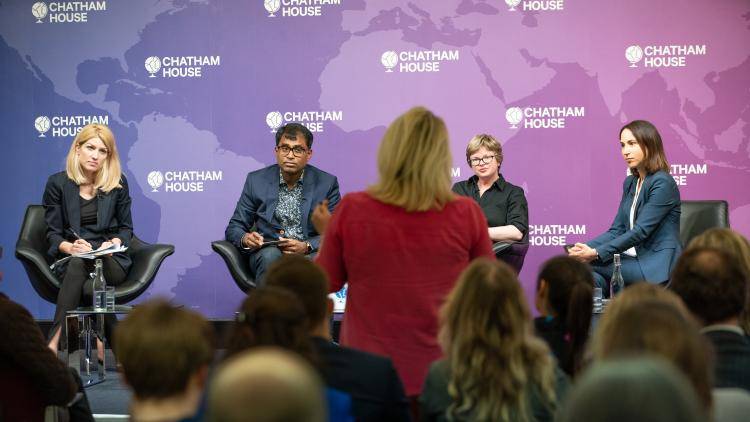
Good afternoon, everyone. Welcome to a discussion on “What Happens Next?” now that a Palestinian state has been recognised by a number of countries, the UK included. Thank you for joining us. My name is Sanam Vakil. I’m the Director of the Middle East and North Africa Programme here at Chatham House. And we have, also, a good size audience online, so we’re looking forward to having a forward-looking discussion on what comes next, with my colleagues. We have an all-star Chatham House lineup and also looking forward to engaging with you here and online. Before I introduce our panellists, just a little bit of housekeeping. The event is being livestreamed, it’s also being recorded, and we are on the record, so no secrets from this conversation is to be revealed.
So, to get started, I’m really excited to have a discussion with my colleagues. We talk amongst ourselves all the time, but very – it’s very rare that we’re all on the same stage. So, let me briefly introduce them. They have illustrious careers, but I’m going to keep it brief. I have immediately to my left, Zizette Darkazally, who is an Associate Fellow in the Middle East and North Africa Programme. And Zizette has previously worked for the United Nations and other international organisations covering a variety of political, economic and humanitarian portfolios in the occupied Palestinian territory, Egypt, Lebanon, Tunisia and Libya. Zizette is a Lawyer by background and has served as a Legal Advisor to the PLO’s Negotiation Unit. So, thanks for being here, Zizette.
Next, I have Professor Yossi Mekelberg, who’s a Senior Consulting Fellow in the Middle East and North Africa Programme, and Yossi has been working with us here at Chatham House since 2002 and has been a Professor of International Relations at Regent’s University, working on their International Relations and Social Science Programme. He has also taught at King’s College and has expertise on Israeli politics, the Middle East peace process, US foreign policy to the region. He writes for Arab News, has written for Al-Arabiya, and is an avid writer for us, as well, at Chatham House. So, welcome, Yossi.
Last, but certainly not least, I have Stephen Farrell, the Head of News and Comment in our Communications and Publishing Department here at Chatham House. And Steve joined Chatham House just a few months ago and has hit the ground running. Before that, he was a Foreign Correspondent and Video Journalist for The Times of London, the New York Times and Reuters. He’s been based around the world, but also in the Middle East, South Asia, London and New York. Reporting from Kosova during the Balkans, from Afghanistan and Pakistan before and after 9/11, from Iraq, from Israel, the West Bank, and has written a book, “Hamas: The Quest for Power,” charting the group’s early years in Gaza and its victory in the 2006 elections. Steve is also part of the New York Times – was part of the New York Times team that won the Overseas Press Club Award of America and has worked on American troop surge and a video doc – was on the Video Documentary Team that won the World Press Photo Prize for coverage of New York politics. So, welcome to you, Steve.
There’s much to talk about and, of course, just a quick scene-setter. We’re, you know, always trying to keep on top of everything that’s happening. Obviously, it’s the UN Generali – General Assembly week and this week has seen important meetings, but the week, sort of, began on Sunday for much of us, expecting the United Kingdom to recognise Palestinian statehood, alongside Canada, Australia and Portugal later that day. France kicked off with Macron’s speech and a ovation at the UN on Monday and this, of course, has implications, which we hope to discuss, at UNGA. We’ve seen speeches by the Palestinian President, Mahmoud Abbas. Tomorrow, Prime Minister Netanyahu will be speaking and of course, President Trump has been engaged in meetings with Arab and Muslim Ministers from various countries around the world.
And all the while, the Israeli military campaign that, of course, is devastating, is ongoing in Gaza City, placing huge stress on the population. There is a Gaza Aid flotilla moving towards Gaza. And last, but certainly not least, we’re very much concerned about events and activities on the West Bank side, where tensions are high and people are under enormous pressure and there is uncertainty, of course, over the issue of annexation. So, that hovers in the forefront of everything, as well.
So, maybe to kick us off, just a, sort of, a light one, I’d love to hear all of your brief reflections on the recognition of Palestinian statehood. Maybe to start with you, Zizette, does this change and impact the diplomatic landscape? What are your thoughts?
Zizette Darkazally
A light one. Look, you well portrayed the outline, the context of what – where this is happening, within which this is happening, which is an unparalleled tragedy with – for the Palestinians. So, this recognition comes as a boost for acknowledging reaffirmation of the Palestinians’ right to self-determination. Now, will it stop the loss of Palestinians’ lives, limbs and lands, immediately? No, it won’t, but nevertheless, it is an important step that can be definitely built on and taken forward. In terms of change, and we can elaborate later on what changes that might make, but at the moment, it is an important step, it’s a step in the right direction, and – but there’s lots to be done. It needs to be accompanied with concrete actions, as well.
Dr Sanam Vakil
Thank you, and I want to come back to you and actually hear your thoughts and what you’re hearing. I mean, obviously, the Palestinian community is by no means homogenous and there are divergent opinions about the impact or importance of this moment. So, keep that in the back of your mind, alongside the bigger picture, the forward-looking next steps. How do we translate this into changes on the ground? But Yossi, briefly over to you. How do you see recognition from a number of these, you know, big European and global players? Does this impact diplomacy? Does this impact the landscape in Israel, at all?
Professor Yossi Mekelberg
Yeah, thank you. I think if I had my priorities, ceasefires will come first, because the only thing that can stop, you know, the killing, the destruction, the devastation, is a ceasefire. And it’s good that there is diplomatic efforts to change the discourse around the Israeli-Palestinian conflict. And, you know, you get, many times, kind of, people use symbolism and say, like, “Symbolism always equates meaningless.” No, I think it’s important, because it sends a very clear message. It’s not only this, it’s when 145 countries in the General Assembly support the New York Declaration, and there are only a handful of countries against them, among them the United States and Israel. Very few abstain.
So, there is country recognition in the international community the way forward is a two-state solution, and in order to advance the two-state solution, it’s not anymore conditional for Palestine to be recognised as a state that, basically, that they almost cave in to all the demands and negotiation. But a Palestinian state, as far as these countries are concern, exist and it’s recognised. So, I think this is important. And we know when it’s, you know, six out of the seven member of the G7, when it’s four out of the permanent members of the Security Council, so it’s, basically, there is single vote between recognition admitting to the United Nation, which is the United States, of course, and recognitions. So, I think it’s important, this is a move forward.
I think without trying to look backwards, as we promised, I think almost – I mean, philosophically, it’s regrettable that it takes such a war to come to a point that the international community recognise that it has to be proactive and do something to bring to this point.
Dr Sanam Vakil
Thank you for saying that. You’re right, it is regrettable and of course, I didn’t mention that this has been two years, and we’ve seen so much death and destruction. I’m taking that as face value, because two years on, it’s just…
Professor Yossi Mekelberg
Hmmm.
Dr Sanam Vakil
…unbelievable that we’re still watching from the sidelines without too much impact. But hopefully, as you say…
Professor Yossi Mekelberg
Hmmm hmm.
Dr Sanam Vakil
…this could have some movement on the facts on the ground. So, Stephen, over to you and your thoughts on this moment, what it means.
Stephen Farrell
Well, I think the Labour MP, Emily Thornberry, on this stage only a couple of months ago, put it best. She said, “If we don’t do it now, there won’t be a Palestine left to recognise.” You mentioned, in a sense, looking on powerless. To a certain extent, I think that’s what Britain has been doing. I think that’s most of the Western powers have been doing. They don’t have the power. There’s only one country in the world that really has power over Israel, sometimes, and Mr Netanyahu, you know, is quite capable of defying US Presidents. But doing this, it was symbolic, it did send a message. It would have sent a much worse message if they hadn’t done anything. I mean, as you say, if this amount of destruction and carnage and humanitarian, just appalling situation, is not, well, what is it ever going to take?
So, I think they had to do something. Does it amount to real pressure on Israel? No, but it is adding to the momentum of Israel’s isolation, and I’m not sure that the British, the French, were entirely right to recognise Palestine in almost – as a form of punishment for Israel. I mean, it – Palestinians actually either have their own inalienable right to self-determination or they don’t. It shouldn’t be conditional on how many hundreds of yards Israeli Soldiers move. But given that, we are seeing momentum. There have been reports in the last couple of days that Trump is increasingly concerned about Israel’s isolation. He’s increasingly perhaps thinking less about the transfer expulsion and more about how can we stop this – stop myself looking bad, in his thinking, and move on from there? So, it’s too early to say.
Dr Sanam Vakil
Okay, thank you, and an also, really, I think, excellent point that you’ve made. It – we – this certainly should not be framed as a ‘punishment for Israel’ or a reward for Hamas. I mean, hearing that trope over and over again is unfortunate, as well. This is very much about Palestinians and their right of soverei – self-determination and sovereignty. And so, I think that’s a great opening, maybe, in terms of looking forward and the, sort of, next steps.
Let me ask you a two for one, Zizette, if I may. First of all, maybe you can lay – give us a lay of the landscape of, you know, various voices. You know, are people thinking that – in Palestine, the West Bank, in Gaza, what are you hearing? Is this something to celebrate? Is this some – is there frustration? I’m sure there is a mix of both, but maybe you can talk us through some of those nuanced opinions. And then, secondly, you’ve written just yesterday, I think, or the day before, for us here at Chatham House, about next steps and how can Palestinians, but the Palestinian Authority, perhaps, harness this moment? So, you know, what are the next steps in order to translate this recognition into something more tangible on the ground?
Zizette Darkazally
Well, to start with, I mean, ‘celebrate’ is not a term that, you know, can be used in any ter – to any shape now with what’s – all what’s happening. There is definitely – there has been welcoming of the step because of the recognition, just because there is nothing else at the moment. Palestinians feel completely abandoned and that they’ve been, as you said, for two years now, facing these atrocities on their own. So, there’s no celebrations, definitely. There is welcoming, but cautious, of course, welcoming, as well. There is some – there’s peop – Palestinians of – within the Palestinian communities that are wary about the conditions are attached to the recognition. As you know, much of the recognition is within the space of two-state solutions and a demilitarised state and lot of conditions that have been imposed that the Palestinians don’t feel comfortable with. That “The decision should be ours, not the international community that come and tell us what the state should look like.”
There’s also the argument that the conflict has stripped – the conflict has – the Gaza War has stripped the conflict to its basics, to its essentials. That even the two-state solution now should also be reconsidered. So, some Palestinians think that this – the recognition could also limit options to only two states. There’s also the idea that – there’s also the argument that it cements and solidifies the current leadership grip on decision-making. The current leadership at the moment has a legitimacy on the issue and Palestinians are not all very satisfied with the way it’s going, and they say that “We need to be part of the decision. There needs to be elections,” and so on and so forth. So, these are a range of sentiments that are among the Palestinian society.
Now, in terms of – oh, and there’s just one more that I want to add, is actually what Stephen was talking about earlier, is the evasion of responsibility that this step, if not accompanied by other concrete steps by the financial community, it’s just seen as an empty gesture, because it’s where the Western countries evade the responsibility towards the Palestinians to stop the war.
In terms of next steps. Look, it happened, we’re here to talk about looking forward. There are – while it hinges, to a great extent, the Palestinian state hinges to a great extent, on the Americans, on Israel, of course, on the ceasefire, on the Arab and European countries, there are still steps that the Palestinians themselves can take. First and foremost, for example, you – we keep hearing about reforms are required by the – from the Palestinian leadership. There isn’t a defined package of reforms that is required. I think the Palestinians should be – the Palestinian leadership should push the international community to have an identified, defined package of reform, that’s one, so they can deliver, and they can also measure the progress of delivery.
The second thing is the Palestinians would need to reset their national agenda. Now, it looks like the Palestinian leadership are the only ones that are taking forward what’s going on. I mean, there’s – there needs to be a more inclusive approach to involving Palestinian institutions, civil society, the diaspora, the refugees, and they all should come together. The Palestinian leadership should facilitate an inclusive process to bring everyone together in order to have a national action plan for going forward.
Other things is like – is reconciliation, and I’m not talking about Fatah and Hamas. I’m talking Fatah within itself. Fatah, within itself is in a crisis, that – also, within the PLO, Fatah has alienated – managed to alienate factions that are within the PLO, and that needs to be this inclusive dialogue, as well. Elections, President Abbas yesterday in his speech talked about elections “within a year after there is a ceasefire, after the war ends.” Others lots to do going to elections, lots to do in order to make the process also inclusive and transparent. A quick example is there’s no political parties’ law in Palestine, for example. That would be important in order to enable other segments of the society to gather together and take part in having a say in the Palestinian future going forward.
Other measures could be also they’re the thematic committees that are being established by the Saudi-French led coalition, that I think the Palestinians should have a say in it and they can work in collaborations with this committee to also enhance, or to put forward their national demands, as well.
Dr Sanam Vakil
Thank you. There’s a lot to pick up on, and I would love to dial – drill down on a few things, including the issue of demilitarisation, the issue of elections. But just quickly – I’m going to come back to you on those issues. Just quickly, are you saying that the Palestinians are not involved in the French-Saudi committees themselves? Are they not feeding in, and are they not being included in that process?
Zizette Darkazally
I was saying that there needs to be a more inclusive involvement of the Palestinians.
Dr Sanam Vakil
Okay.
Zizette Darkazally
Having the current leadership have a say, if they have a say. It’s not enough to reflect the inclusivity that needs to be taken into consideration.
Dr Sanam Vakil
Okay, great. I’ll be back. Yossi, over to you. I’m really keen to hear – we see – we saw, obviously, in the news, on social media, responses from not just Prime Minister Netanyahu, but from, you know, potential opposition leaders within Israel, to recognition. And I’m curious, if you could, first of all, tell everyone what you saw and, you know, were you surprised? But secondly, I mean, I’ve read that Netanyahu is going to hold back his response until after he sees what I think Mark Rutte called ‘Daddy’. So…
Professor Yossi Mekelberg
Yeah.
Dr Sanam Vakil
…after he sees Trump, you know, what are you anticipating the response would be? And this goes to the point that Steve made. I mean, the fact that the Palestinians have to be further punished for this recognition surely is troubling.
Professor Yossi Mekelberg
Yeah, the idea they have been punished enough. I mean, they don’t need to add to this further. I promised myself not to be surprised by anything anymore, so…
Dr Sanam Vakil
Okay.
Professor Yossi Mekelberg
…I won’t be surprised. It’s very difficult, almost, to explain outside Israel that the Israelis are still in October 7 2023. Mentally, they are there, while all the world moved. It’s not that anyone wants to forget and to excuse anything that happened there, but mentally, it’s still October 7 20 – the clock stopped there. So, as a result of that, everything is permissible and everything that is then – has come from the point of view of a victim, not of a victimiser. And there is no constituency as a result of that to say maybe something is moving there, we need to challenge the paradigm that it’s no Palestinian state, oh, the regional partner.
No-one in the opposition, including, yeah, take here Yair Golan, leader now of what’s supposed to be the left, which I’m, kind of, so hesitant to call it left anymore, but for the sake of this discussion, we’ll call it left. They won’t challenge it, so who is going to challenge it? If you look at the opinion polls in Israel, who is leading right now, is Naftali Bennett, and maybe Gadi Eisenkot, former Chief of Staff, will join in, as well, in some [inaudible – 22:37]. None of these, with the exception of the Israeli-Palestinian parties, no-one actually support right now, at least not in public. In private conversation it’s different, but in public, support a two-state solution.
So, the immediate reaction, because they know that’s what the public expect, is, “Oh, it’s a reward to Hamas.” And no-one will pay attention, actually, the fact that the Arab League says that Hamas shouldn’t be in part of governing of Gaza and Palestine in the future, that this is what the New York Declaration says. So, there is actually a consensus that, in my mind, Israel should take with both hands. Look for a Palestinian partnership after reforms, election, which doesn’t include Hamas, because that’s what Israel keeps saying, “We don’t want Hamas.”
Dr Sanam Vakil
Hmmm.
Professor Yossi Mekelberg
And when the international community actually supports it, they see the recognition Palestinian state as a reward Hamas and not a way forward. And the Israeli society is in a dark place. So, when you talk about the, kind of, the ‘isolation’, Netanyahu delivered one of the strangest speeches in the eve of the new Jewish year, you know, just last week. He said about Israel is supposed to “become a super-Sparta.”
Dr Sanam Vakil
Yes.
Professor Yossi Mekelberg
Not just Sparta. This is not enough. Let’s have a super-Sparta. Meaning he acknowledges that Israel is isolated. This is not the Netanyahu that we know from the past. He’s a New Labourer. When he was the Finance Minister, it’s all about deregulation in order to be part of the global economy. This is the idea, it’s a, kind of, the product of, sort of, the years of Reagan and Thatcher. And none of his [inaudible – 24:20] no, brace, yourself, ‘Sparta’. It’s about military and it’s a bit isolationist. It’s interesting how in order to be autoc – I don’t know how we’ll find cigars and pink champagne in super-Sparta, but this is a different coercion. But the reality that actually his vision now, is dystopian for Israel, and there is no challenge. The only, actually, institution to challenge him on this was the stock market. It dived immediately, said, “No, this is not – Israel can’t survive like this.”
So, I think, actually, there is – something works there, it’s slow. And just one more point. You see there is the flotilla. No-one mentioned – you know, takes much notice of the flotilla. It’s nice some activists are taking a boat and they’re on the way to Gaza. This is great, it’s activism, but Israel attacks it. It sees the, kind of, part of the psychology. Even the flotilla, if a group of kids became a real threat to security, but what is the response? And this goes back to the isolation. Spain will send Navy to protect it, Italy. So, what happens now? If Israel start to attack Spanish and Italian boats, then they’re involved with NATO, attacking NATO. It’s get to the bizarre area of which this isolation.
I think more important than, by the way, that Trump says to stop it, is how all of this is going to affect the Israeli society. How they’re ready, actually, in the hundreds of thousands to take to the streets for indefinite time and show they had enough of it.
Dr Sanam Vakil
That was very interesting. I mean, I certainly see, through my own engagement, but believe you, the trauma, of course, is lingering on and without, of course, leadership. Because leadership is so key to steer a society or to mobilise society, and if all the leadership just ref – you know, reflecting what people are feeling or fearing, obviously, Israeli society will stay stuck. But nevertheless, we have seen protests in Israel now for quite some time, and those protests haven’t moved the dial at all.
Professor Yossi Mekelberg
But what the protest about? About the hostages.
Dr Sanam Vakil
Yes.
Professor Yossi Mekelberg
The hostages is a really sensitive issue.
Dr Sanam Vakil
Yes.
Professor Yossi Mekelberg
It’s really– it’s genuine. You know, in the Israeli society, between the way Hamas deals with the hostages and Netanyahu treats the hostages, Israeli society’s there. But they are not going there in the thousands of people – or in the tens of thousands, to say, “Stop the war because what we inflict on Palestinian – stop the war because now Israel, you know, of all countries, is accused of genocide. Stop the war because” – and many will say that, “Stop the war because we want the hostages back and then, do whatever you like.”
Dr Sanam Vakil
Right.
Professor Yossi Mekelberg
And they say it publicly.
Dr Sanam Vakil
Yeah, that’s important.
Professor Yossi Mekelberg
So, it’s different.
Dr Sanam Vakil
That’s important. So, when I come back to you for a last round of questions, it will be about the future and elections and what’s going to wake up Israelis to, you know, that future? Including, I mean, I’ve read there’s a Reservist Party, there are, you know, people mobilising on the ground, but, you know, certainly, Netanyahu has his ambitions, and I guess this election is coming sooner than we might anticipate.
Steve, tell me what you’re seeing at the UN and in terms of external movements in convening and thinking about the next steps? And, you know, there’s been an Arab Plan, there have been – I mean, Trump has convened leaders at the UN over the past few days. It – there’s a 21-point plan. Yeah, who knows what – really, which plan is which and what is actually going to be meaningful? But what are you seeing as viable? What are you seeing as on the table? There have been so many plans that have come and gone. You know, what’s being discussed today, and is it a result of recognition or is it because there has been so much pressure to be thinking about the two-state solution and next steps?
Stephen Farrell
I think it’s hard to separate recognition from all of the other things we’ve seen, the ICC awest – arrest warrants on Netanyahu and so forth. I mean, it’s incremental, but what – it ha – a month or two ago, I think certainly, I was looking at the news thinking, are we really headed for mass transfer? Are we really headed for, you know, sort of, just opening up the wall into Egypt, pushing it through? What you’re hearing now – and it’s only now, who knows how it could change again? What you’re hearing now is that Trump and Witkoff are talking to Arab leaders, they’re talking to European leaders. There’s talk of well, maybe a deal that would involve Israeli troops pulling out. Obviously, return of the hostages, that’s a given for Israel. The – they’re talking about Arab states being involved in the rebuilding of Gaza.
So, the – those noises that are circulating around, and I totally defer to Zizette and others, they would – might have more insight into that, you’re seeing more talk of a solution which doesn’t involve mass transfer of Palestinians from Gaza. Will that be the case in a month, two months? I mean, only – frankly, only Trump and Netanyahu will know. Even if Trump, however, does come up with a plan, I come back to this, even if Witkoff does, even if everybody does, will Netanyahu go along with it? Because, and on this I totally defer to Yossi’s expertise, but the day that it’s over, I think Netanyahu’s political career, effectively, goes into steep decline, because he has a lawsuit against him. He’s got a very, very deeply angry Israeli public who remember that he was in charge on the single worst atrocity committed on Jewish people since The Holocaust. And I think that will all come back on him, and the – it is going on and on and on and on and on.
I – so, at the moment, what we’re seeing is talk of a deal, but we’re also seeing talk of movement on other fronts. It’s rare that you cite Sky Sports in an international affairs forum, but they’re reporting that there’s big pressure to throw Israel out of the World Cup, the soccer World Cup, and that Trump is resisting that. There’s the possibility of cultural boycotts, the model of South Africa many years ago. There’s will the West now double down on recognition with refusing to do arms – refusing to sell arms and weapons to Israel? Will there be more sanctions on Israeli leaders? All of those things are possible, and we’ll see if they come into play.
Dr Sanam Vakil
Thank you. Okay, just very quick, going back to you each one more time, before I open it up to the floor. Zizette, I wanted to come back to you on some of the key points you laid out. I mean, I – every time I read “demilitarised Palestinian state,” I just – my heart sinks, ‘cause I think that’s a non-starter, alright, that’s not a state, because the traditional definition of a state is one that has a monopoly of the fourth – know – you know, on the force of violence.
So, thoughts on that and elections. I mean, now, you know, bringing back legitimacy and agency to Palestinians certainly should be part of this conversation. And time and again, I find myself discussing this issue and in discussions, and we’re not talking about Palestine and Palestinians, is everyone else talking about, you know, doing different things. So, how do we get there? What sort of steps could be made to, you know, involve Palestinians into this process? Certainly, it’s…
Zizette Darkazally
Yeah.
Dr Sanam Vakil
…about time.
Zizette Darkazally
Okay, there’s lots to unpack in your question.
Dr Sanam Vakil
Sorry.
Zizette Darkazally
The thing is that the Palestinian sovereignty is under occupation. As long as there is occupation, all our conversation within this context is, kind of, speculations and analysis, to be honest. There is – because it’s under occupation, there’s IC – just I will have to refer to the ICJ ruling in July last year that Israel’s obligations and third-party obligations to end the occupation, because otherwise, this conflict – this is the root cause of the problem, this conflict is going to continue.
While that in mind, demilitarisation. Look, this was in President Abbas’s letter to Macron earlier. This, I think, was also incorporated into the New York Declaration. You talked about your heart sinked. Lot of the Palestinians heart sinks as well, because they see it as an imposed characterisation of a state by the West, and they feel uncomfortable with it, and they would like to have a say about the nature of their state when it happens. But then again, it’s still – we’re still in the very early stages, and it’s still too early – it’s not like there is a state and sovereignty and control of our leadership over a territory and that we can go forward in the luxury of debating whether it’s the ma – a demilitarising state – demilitarised state or not. It’s not like this is the only issue that is keeping the Palestinian state from being realised.
On elections, it’s – there have been some movement on elections. There’s a lot of technical and legal challenges…
Dr Sanam Vakil
And logistical.
Zizette Darkazally
…to have elect – and logistical to have elections, of course, elections, now that there’s a war is going. I mean, President Abbas talked about elections “when the war stops,” but nevertheless, there still needs to be done within the technical aspect of elections. There are some movements on issuing laws and there’s a Constitutional Committee that is also meeting. The only thing I would say here that it needs to be a more transparent and inclusive process for that to be – for that to go forward. And then again, occupation, occupation, occupation, you – they need the tools to also be able to act and to be able to perform and to be able to, kind of, have reforms, to be able to take this whole thing forward.
Dr Sanam Vakil
Thank you. Yossi, two points very quickly. I know, we can get ba – I mean, do you expect Netanyahu to respond by annexing further parts of the West Bank? Is there going to be a retaliation? We’ll just maybe let other people ask about elections and…
Professor Yossi Mekelberg
Yeah.
Dr Sanam Vakil
…the future.
Professor Yossi Mekelberg
Well, it – as you said earlier, all depends what’s going to happen in the meeting here with Trump.
Dr Sanam Vakil
Right.
Professor Yossi Mekelberg
I think from – to appeal to the base, it will be, kind of, appealing for his base to annex at least parts of the West Bank. If I may, something pointed is that – I just may – I think the tragedy of both of Israelis and Palestinians were the most secular, pluralist societies, probably, in the Middle East, at least in the Levant, became more and more authoritarian and more affected by religious fundamentalism. And sometimes, how we regain this ground of more democracy, more rights, by changing the leadership. Netanyahu will decide eventually election when he think it’s best for him. He’s in the middle of it – of a coalition crisis. He doesn’t have a majority in coalition right now, because the ultra-orthodox left, it has to do with drafting ultra-orthodox into the military.
You mentioned the Reservist, actually impressive young people that serve sometimes 300/400 days in reserves, it’s not fun. You know, we always look at it, and rightly so, what these Soldiers are doing and what they inflict. But this many of them are traumatised from PTSDs, you know, many injured. You need alternative to these Soldiers. The ultra-orthodox don’t want to serve. So, he needs to deal with this crisis within his own coalition. So, he looks for the right time. But as Steve said, the minute that the war is over – and now, when you said it’s Abbas – that Abbas will declare elections when the war is – ends, then Netanyahu ensures that the war never ends. We won’t have election here, we won’t election in Israel as well, because he might play the same trick and say, “We are still in the middle of a war,” and elections are due in Israel not later than next October, and then both of them stay for longer.
Dr Sanam Vakil
Steve, quickly, just keen to hear your views on what you think the PA should be doing next. I mean, it was Abbas that, sort of, kicked off this drive to Palestinian statehood over a decade ago. So, any thoughts on what should be their next move or how to exert more agency, if at all, in this process?
Stephen Farrell
Right. It was Abbas. I mean, there are – many people have many, many criticisms of Abbas and many, many of them are justified. But in 2011, when Israel and Hamas were, sort of – he was caught in between the middle of them, he just stepped off the domestic chessboard and he went to the United Nations and said, “Recognise us.” And much though it’s been picked by the Saudis and French since then, that was something that briefly gave him a surge of momentum, infuriated Hamas, infuriated Israel. Things have stag – things stagnated before then for him and they stagnated after. I saw a poll earlier this year, 81% of Palestinians in – I think in May, want him to step down.
So, he leads a gerontocracy, as did Arafat before him, but they’re even older now and mostly the same people. There needs to be fresh blood. I doubt that – you talk to Palestinians in the West Bank, so few of them have any time for the Palestinian Authority as it is. I – in – many of them see it as a subcontractor for the Israeli occupation, in many ways. So, the – you would be hard pressed to find, in a discussion of four or five people, two of them who support a two-state solution anymore, they’ve just lost so much hope. So, there is an awful lot to be done there in terms of renewing his democratic mandate. He hasn’t faced elections for 21 years. That’s not all his fault. Israel, war and so – I mean, it’s absolutely acknowledged with – that the Jer – East Jerusalem, West Bank, Gaza election now obviously unthinkable. But still, 21 years, so I think a fresh slate of people in order to possible re-engage with the people who will, ultimately, have to vote for his party, would be a good start.
Dr Sanam Vakil
Thank you. Take a moment to ask some questions. Please raise your hand and I’ll take a couple in the room, and then there are some great questions, also, online that I’ll read out to the panel. But please, if you can also introduce yourself.
Iona Allan
Hi, my name’s Iona Allan, I’m the Assistant Editor of The World Today magazine here at Chatham House. I wanted to go back to the question at the very beginning about the, kind of, timing of the recognition, and I think Starmer said – had always said the UK would “do this, but at a time with” – on – well, “at a time with maximum impact.” So, I wanted to know, like, your – hear your views on whether this at UNGA High-Level Week is just doing this at this time because it’s the biggest, you know, world stage, or as you say, Steve, it is in direct reaction to the escalation, and whether, you know, two years into this war, does the timing even matter at this point?
Dr Sanam Vakil
Okay, thank you. Are there any other questions in the room? Yes, please.
Bhargabi Bharadwaj
Hi, my name is Bhargabi Bharadwaj, and I work in Environment and Society Centre at Chatham House. My question is with regards to this transitionary leadership and the plan for the ‘day after’, let’s say. Yeah, I take your point on, you know, sort of, this need for new blood, but I was wondering, at this point, given how much the Palestinians have, sort of, faced in the last two years, and even prior to that with the occupation, I wonder if there is, sort of, this almost, like, a reaction to have consistency and to have people that have, sort of, stood their ground with experience and that leadership that’s been built, trust over the years, or the lack of. But is there a viable, sort of, candidate that you think of when you think of new leadership in Palestine, or is this, sort of, a hope for later down the line that can, you know, receive the necessary consensus for a Palestinian state?
Dr Sanam Vakil
Thank you. I’m going to read one online, as well, that I think is very good. Where did I put it? Sorry, just bear with me. Okay, Vadim Atnash asks, “In your opinion, can international sanctions, both economic and cultural, carried out by different states, due to UN paralysis, be effective? In the case of South African Apartheid, the sanctions eventually worked.” Because of the, sort of, fragmentation of the international order, the challenges at the UN, can – I mean, do you see that model being relevant here, or should the international community be pursuing other paths, since pressure – external pressure seems to be one of the ways forward?
Maybe Steve, I can start with you, and you can pick up what you’d like, the issue of “timing, day after, new leadership,” or the “South Africa model” of sanctions.
Stephen Farrell
Right, on timing, I think as the recent precedent here, in 1917, the British issued the Balfour Declaration, it was 31 years later, that a – the Jewish Government actually came into being. So, I wouldn’t hold your breath, but I do think that picking UNGA, picking the world stage, and getting Canada and Australia and France all coming together, I think that wa – if you’re going to do it, that was about as effective as a way as you could do it, I think, on a big stage, at a critical time. And as I say, if you hadn’t, it would’ve sent such a massively negative sign, this is, effectively, never going to happen. We’re – if not now, never.
On sanctions, I don’t know if they’d be effective. I will point out one massive difference with South Africa and that is, as I recall, there was nobody at the time of sanctions against South Africa applying countersanctions on those who implied the sanctions. Whereas you now have Trump sanctioning international Judges, sanctioning anybody who he does business with, sanctioning humanitarian aid. So, you – there’s a whole proxy sanction war and counterwar going on here. So, it’s an infinitely more complex situation than it was with South Africa.
Dr Sanam Vakil
Thank you. Yossi, thoughts on the questions.
Professor Yossi Mekelberg
Yeah, about timing, I mean, there is never a wrong time to do the right thing. So, the recognition of Palestinian state probably could and should have taken place a long time ago, but that’s not the way government operates. They always have the calculation, they’re risk averse, and you think, oh, if everything seem more they, kind of, they fell into the trap of the status quo in crisis, oh, and conflict management, so let’s not rattle, you know, the boat. And I think only when you have a huge crisis in the – on the level that we have now, they eff – they end doing the right thing. Timing itself is, yeah, if you do it on the bigger stage internationally, it has the impact.
Also, the thing about leadership, I think that this is one of the biggest mysteries in politics, where leadership emerges. I just sometimes think to myself, you know, so what is leadership? But who knew about Bill Clinton three months before he became a candidate, or of Obama? How many people know that, you know, this – it has to happen organically. There – it’s not – on the assumption that there are always, in every society, very good people that can take the helm of leading the country, they need the conditions for this to happen and the courage to say, “Yes, we are ready to do that.” Whether they’re young or experien – not all leaders come to power experienced and sometimes, anyway, you learn this job. It’s not that you can be – have an internship of becoming a President or a Prime Minister. You have to learn on the job and very quickly. So, yes…
Dr Sanam Vakil
Look at…
Professor Yossi Mekelberg
…there are a lot of…
Dr Sanam Vakil
…Ahmed Al-Sharaa, he’s learning on the job.
Professor Yossi Mekelberg
Yeah, yeah. I mean, I find it interesting that, you know, someone that was asked give a speech – delivered a speech in the UN and he sounds so reasonable. And then, when Netanyahu probably will give a speech tomorrow, and I doubt it will be sou – will sound as reasonable. So, thing can change quickly in politics and it’s on the record, but well – but – and the last thing about sanctions, I don’t believe in BDS, and I didn’t think if they are smart sanctions, they can work. But I’m not so sure about sport and I’m not sure about culture. I admit having [inaudible – 24:56] producer. I know some – you know, some of these people in the arts world in Israel are the ones that spend their lifetime, you know, fighting for a two-state solution, demonstrating and being arrested and sometimes being beaten up by the Police.
If you go and – you know, it’s the baby with the bath. You need to identify who you want, and to stop, for instance, chrom – goods from the West Bank, you know, the international community could’ve done it long time ago. They are waiting for that, but then decide all of a sudden, because they’re upset, to punish everyone, allies and foes, as well. I don’t think it’s working. You have to find all your allies there or on the – and actually empower them and encourage that Israel won’t become super-Sparta, ‘cause it – there’s a need for that. But at the same time, the people that stop two-state, the one that committing acts of violence, even terrorism, in the West Bank, then you can identify them.
Dr Sanam Vakil
Thanks, Yossi. Zizette.
Zizette Darkazally
I’ll be quick. On timing, it’s a recognition of a right, which the right itself it’s timeless. It’s there, it exist, it should’ve been done long time ago in terms of recognition of what it is. Of course, the scale of the atrocities and what’s happening pushed for the timing. I’m looking at you, but I know that you didn’t ask the question, so I apologise. But the timing of the – of what happened, of course, I would imagine that it triggered the incentive for acknowledge – for recognition, but again, it’s a recognition of a right, full stop. So, the timing here, it’s – it linked to that incentive, but it doesn’t justify the acknowledgement timing.
On Palestinian leadership, you asked the Palestinian leadership. Look, I think when the conditions are created for new leadership to come across, they will. In 2021, when there was preparations for presidential elections which didn’t happen, for national elections which didn’t happen, there were some civil society that were mobilised to run. There were – there was some movement, despite the fact that it was dormant up until elections were announced. So, when the conditions are created, and the conditions are created by, also, the Palestinian leadership itself, but also by the international community, to be able to – for this new leadership to come forward, and the Palestinians are capable and can produce really excellent leadership. Now, the thing here is the acceptance of result. There’s – the [inaudible – 48:38] community will have to accept the results in advance of any – results of any Palestinian elections that will come forward.
On sanctions, there are third party obligations under international law on states to do what they can in order to stop the atrocities that are happening, and sanctions should be – yes, sanctions are one avenue of stopping – of putting pressure on Israel to stop what’s happening.
Dr Sanam Vakil
Thank you. I’m going to go to some questions online briefly and I’m going to direct them to each of you. Mohammed Bashein asks, and this is for you, Steve, “Considering the UK’s deep historical responsibility in the region, stemming from the Balfour Declaration and the mandate, to what extent should this recognition be seen as an act of historical atonement?”
Stephen Farrell
I’m Irish, so…
Dr Sanam Vakil
No, no, I’m not asking you…
Stephen Farrell
…there’s no – so, I think it’s…
Dr Sanam Vakil
…as a representative, but is this an act of – circle of atonement?
Stephen Farrell
I think to a certain extent, how could it not be seen that way?
Dr Sanam Vakil
Right.
Stephen Farrell
I think, you know, the – it – yes, that ha – the Balfour Declaration in 1917 didn’t even mention the words ‘Palestinian’ and now they’re recognising a state. I think Starmer was very aware of that. I think everybody was aware of it. It – act of atonement? I don’t know. A wrong corrected many, many years later? Absolutely.
Dr Sanam Vakil
Okay, thank you. Roger Wingate asks, I think, a very important question, Yossi. So, let’s see if we can drill down on this. “You’ve said no to BDS, no to sanctions that impact the cultural or sports sphere,” and I might debate that one with you. “Since a Palestinian state can only happen with Israeli agreement, why are you not discussing what is needed to persuade Israel to agree?” So, really, okay, what would it take for Israel, Israelis, to wake up and understand the necessity, the urgency, the security? We always talk about Israel’s ‘security’, how this would address Israeli security?
Professor Yossi Mekelberg
Yeah, I think one of the mistakes when talking about Israeli security is never talking about Palestinian security, that everyone deserves the same security. They are not more or lesser human beings. So, everyone deserves security. But before we go to – yes, again, it sometimes is the symbolism of all the – I know I contradict myself because I said that symbolism is important, but here I say, you know, when Germany, for instance, suspended some of the supply of wea – this is meaningful. When the United States decide not to supply two-tonnes bombs because they are used in civilian area, this is meaningful. There are a lot of things to do. When people like Smotrich and Ben-Gvir, I don’t know if they want to visit the Netherlands or not, but they are not allowed to go and visit there, this is mean – you know, there are a lot of steps on the way before – you know, you don’t start – you know, either zero or 100. Between zero and 100 there is a lot of things that can be done.
Now, what takes the Israeli society? I think when the war is over, and that’s the most important thing, I will keep saying that, when there is end of war, the hostages are back, I hope some rationality will be regained within the Israeli society and you will be able to have a discussion, which is rational. They’re not – it’s very emotional, part of me understand it and part of it contest it. But again, fine, listen, I don’t – I won’t regret if there won’t be a Eurovision song, an Israeli one, in the Eurovision Song Contest, I don’t watch it. But is this going to solve the problems in the Middle East? Is this what’s going to make a change in the Israeli society? But there are other aspects where – that can, you know, when it comes to weapons that are misused in certain player. When you target, for instance, as [inaudible – 52:39] said – the ICJ said, “The UN – the West Bank, the occupation is illegal. Settlements have to be removed.” So, why this is not dealt with the kind of companies’ debts, trade with the West Bank.
So, in order [inaudible – 52:52] there is a lot more to do, and I think eventually, if, again, the vision of Netanyahu is, basically, of isolation, of what does this mean to go ‘super-Sparta’? It means keep fighting and being poor. This is not – Israelis love travelling abroad, you can see them everywhere. They love the standard of living that came with the economic success, with the hi-tech, with – they won’t fall for it. What stands between this and at least a bit change, is election and it will happen between, I hope so, between now and October. But doesn’t mean that a lot of things can’t be done until then.
Dr Sanam Vakil
Hmmm, okay, so I’ll come back to you and press a bit more on what will it take for Israelis, then, to recognise that, you know, the path ahead is – it’s just going to be the election itself? So, think about that, but I have more questions coming. And Zizette, for you – where did that question go? Bear with me, sorry. Okay, Narayan Kumar asks, and I think this is important to define, and you’re a Lawyer, “What is the legal effect of recognition for Palestinians and for Palestine?” Can you lay that out for us?
Zizette Darkazally
Thank you, yes, that’s a very good question. Look, the recognition has – would affect the bilateral relations between the countries that recognised, would have impact on the par – the countries recognised and the State of Palestine. The relations between countries – between states is different than relations between a state and an entity. So, that should have some implications on that, but also, on bilateral – I would imagine that it would have, also, bilateral relations between – it will impact bilateral relations between the countries that recognised and Israel. For example, now, instead of talking about population under occupation, it’s the state under occupation.
So, when it comes to the settlement product, for example, that are – because settlements are in the occupied state now, in the past the occupied state, rather than only territory. So, that might have implications. There’s also, perhaps on the dual nationals of the recognised states and those who observe in the IDF, in the Israeli Army, in terms of fighting in – against a friendly country. Depends on domestic laws of the countries that recognise. So, this – there is that sphere. There is also, when it comes to trade, bilateral trade agreements, and economic agreements, as well, that the country will – the countries who recognised would have to be bound by the state relations. So, it affect – it bleeds into the foreign policy, it bleeds into bilateral agreements.
Dr Sanam Vakil
Okay, great, thank you. Any other questions in the audience, ‘cause I do have more online? Yes, please, sir.
John Pearson
Just – John Pearson, AEF. I just wanted to quickly comment and say that I think ‘symbolism’ is very important in terms of dignity and re-establishing Palestinian dignity. I was at the ceremony last week at the Embassy and the Ambassador now, the Ambassador Zombler – Zomlot, was, kind of, holding up the sign for the Embassy of Palestine. And I think you can’t underestimate the symbolism in terms of regaining – Palestinians regaining some kind of dignity, given the humiliation that they’ve been suffering over the last two years, especially.
Dr Sanam Vakil
Thank you. Yes.
Stephen Farrell
Just on that, I would say it – I think I agree with that, because when I used to come through from Egypt into Gaza, that’s a massive sign at the Rafah – I doubt it’s there now, there’s a massive at sign at the Rafah border saying, “Welcome to Palestine.” And it was a real moment, it was a real, oh, wow, okay. When you’ve just come from the West, that it was, hmmm, okay, that’s interesting, that’s significant, I – it seemed to me.
Dr Sanam Vakil
Yeah, thank you. Other questions in the room, or is – oh, yes, please.
Aroni Sarkar
Hi, I’m Aroni with International Affairs, also here at Chatham House. My question is about the two-state solution itself. So, since we’re reflecting on historical lessons from South Africa and the sanctions from multilateral institutions being able to prevent the Rwandan genocide, we also have historical lessons of similar policies, like the Partition. And we’ve seen pers – like, effects of that persist still today. So, in, potentially, envisaging how the two-state solution could be implemented, what are some of the lessons that you think that could inform that implementation and how to prevent further violence or ethnic violence from multi – from the two states that would emerge from that?
Dr Sanam Vakil
Okay, thank you. One additional question online that I’m going to take from Hassan [inaudible – 58:17], who asks, I think slightly rhetorically, but “Could the recognition of Palestine by European states and the US resistance lead to the US becoming more isolated?” I know we all keep pointing to Trump and saying, “It’s all in the US’s hands,” but does it have to be? Does it – is it really? Can we not move beyond the United States if they’re, you know, an ocean apart, and certainly, you know, the military supplier of Israel? But is there not just more everyone else can be doing? Zizette, starting with you.
Zizette Darkazally
Lessons learnt, look, one of the important pillars of solving the conflict is accountability and reconciliation, and I think that is – the reconciliation could be lessons learnt, as well, from what happened in South Africa, as well, and in Northern Ireland. Accountability is very important, given what happened in the last two years now, and before, but particularly two years, given the scale of fatalities and destruction that is happening, and that’s an important point to go forward. There’s also the notion of two states in terms of is it two states? I mean, before 7 October, when people talked about – when international community talked about two states, it was two states to live side-by-side in peace and prosperity. And now, well, if people do consider two states, they just want separation. They just want to get out of each other’s faces and would like a long wall between them and just a high wall between then and just, kind of – so, there’s all of these nuances together and we need to think about.
In terms of US isolation, it’s very difficult to imagine a solution without the US being involved in it, a) because of its leverage and tie – the certain ties with Israel. Israel is a big part of the equation. But b) also because of the veto power in the UN. Every solution that goes through, including Palestinian statehood, as Yossi alluded to earlier, how the process happens, which Secretary General recommends and then goes to Sec – to the Security Council. And if one country vetoes, then that’s it. So, it does matter in going forward and in finding the solution to the par – to the conflict.
Dr Sanam Vakil
Yossi.
Professor Yossi Mekelberg
And there are changes in American public opinion. We’ll see that, gradually, more and more Americans actually are more sympathetic towards the Palestinian cause than ever. So, those are, again, the humility changes that eventually Israel will have to take in, they can’t live in complete isolation with what’s happening in the world.
You know, about peace. Peacemaking is not a sprint, is a marathon. You need the patience, and you need to do all the right things in order to get there, and I think sometimes, maybe, you know, reflecting on Oslo, you think that there were lots – some of this was think we can solve it very quickly and not necessarily addressing all the root causes. So, you need to go to the root causes of this, one-by-one, whether it’s security and self-determination and Jerusalem and the refugees, that each of them will be addressed in a fair and just way. Everyone needs to feel secure.
And yes, the idea of the psychology of the conflict is very important. You can’t make compromises with someone that you don’t trust, because it’s actually – you’re handing some of your security, some of your wellbeing, some of your future, in the hands of people that you’ve just been in a war, and you demonised and dehumanised for so long. So, this is that also, in conciliation, needs this kind of process of rebuilding. It won’t happen unless there is leadership that is determined, and even it sometimes prepared to risk its own life. So, that’s – you need, also, and I think this is the major mistake back in Oslo, is to find – to empower and to endanger a critical mass that support. You can’t do it only peace between elites. You need enough people that support you in the streets and not the opposite, as happen in the case of Oslo, handing the peace process into the hand of the most extreme.
Dr Sanam Vakil
Hmmm, okay.
Professor Yossi Mekelberg
And for – just about the United – I think the problem we look at ver – a very special administration right now, which we don’t know from minute to minute. God knows what happen in the hour that are here, what’s changed in the view about everything? So, we did it from speech to speech, from meeting to meeting, but I think going back, you know what you asked me earlier about what will change? Yes, Europe is much more influen – the region. Look, the benefit of normalisation for Israel was – you know, it’s been immense.
Only the idea that yesterday an airplane from Dubai, there was an emergency, it landed in Riyadh, and the Israelis were so surprised that they were not arrested. And Doctors came on the airplane and treated a guy with a stroke and let the airplane to continue to Tel Aviv. Israelis don’t know that. They think it’s all – everyone beyond the country is a dangerous – beyond the border is dangerous. So, it’s part of educating, also, Israelis, that not everyone is your enemy. You can’t emerge from your siege mentality.
Dr Sanam Vakil
Hmmm hmm, yeah, that’s a good point, thank you. Steve, last thoughts.
Stephen Farrell
I mean, just to pick up on what Yossi was saying. I mean, from the conversations I have with Israelis, I know from the – on the social media, the newspapers, I think it’s true to say that Israelis feel isolated. But at the moment, I think you hear a lot of, “We are isolated. Why doesn’t the rest of the world realise that we are right?” It – you know, “Well, how do they – how are they not getting it? How are they not getting after October the 7th?” And Palestinians, I mean, obviously, every day you see what’s going on in Gaza, is, “How does the world not see, they – not act? How can they do this to us? How can they give arms to Ukraine to defend itself, but not to us?” So, the gulf has never been wider, and I think it comes back to what Yossi said, I mean, leadership is going to be absolutely essential, because that’s the only way that gulf could possibly be bridged.
Dr Sanam Vakil
Okay, thank you. Well, this was a fascinating conversation, one of many that we will continue having with our excellent team here. Thank you all for coming. Thank you to everybody online and I wish you a very pleasant afternoon. Please joining me in thanking the panellists [applause].