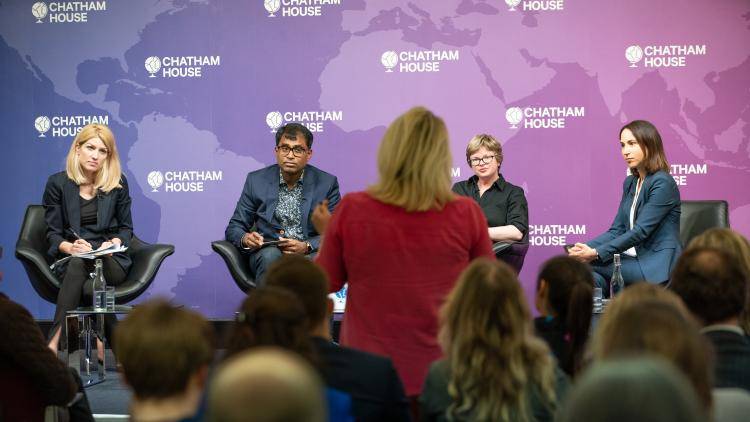
Dr Chietigj Bajpaee
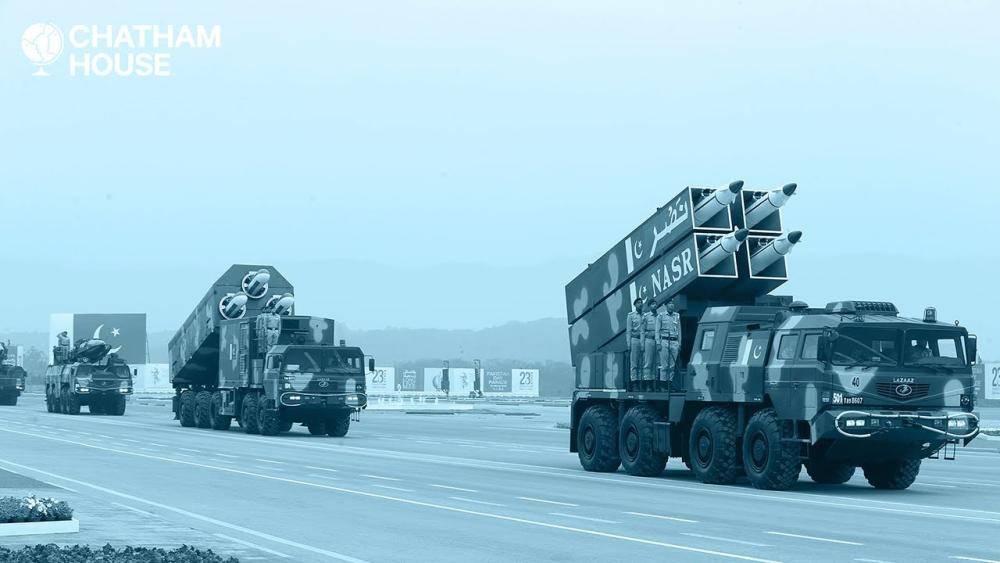
Good afternoon or good evening or good morning, depending on your time zone. My name is Dr Chietigj Bajpaee. I am Senior Research Fellow for South Asia at Chatham House. Thank you for joining this event on the Pakistan-Saudi Strategic Mutual Defence Agreement, which was announced last month. The agreement was signed between Pakistani Prime Minister, Shehbaz Sharif and Saudi Crown Prince, Mohammed bin Salman, in Riyadh on the 17th of September. The joint statement notably referred to “any aggression against either country” being considered “an act of aggression against both.” So, the pact further intertwines the geopolitics of South Asia and the Middle East. These are, of course, two very volatile regions and it adds to the risks of instabilities in one reging – region bleeding over into the other.
So, there are many aspects of the agreement that we want to unpack today. What does it say about Saudi Arabia’s military posture in the Gulf, Pakistan’s extended nuclear deterrence in West Asia or Middle East policy? And then, adding to this is the impact of mo – the most recent developments, the precarious ceasefire in Gaza, the hostilities between Afghanistan and Pakistan.
So, to discuss this, we have an excellent panel of speakers with us today. Ambassador Talmiz Ahmad, who’s a two-time Former Indian Ambassador to Saudi Arabia, as well as the UAE and Oman. He’s published several books on the Middle East, the most recent one being, “West Asia at War: Repression, Resistance and Great Power Games.” He’s joined by our Associate Fellows in the Asia-Pacific and Middle East Programmes, Dr Farzana Shaikh, who’s author of a book, “Making Sense of Pakistan.” And Bilal Y. Saab, who was the former Senior Advisor at The Pentagon and now a Senior Managing Director TRENDS US, based in Washington D.C. So, I will pose questions to our panel for the first half hour or so, and then we’ll open up for audience questions. Feel free to type your questions in the Q&A box during the course of the event, and I’ll direct it to the relevant panellist on your behalf. This event is on the record, and it will be posted on the Chatham House website.
So, on that note, let’s get started. There have been a lot of assessments about the Defence Pact, you know, what does it entail and what it doesn’t? So, I think a helpful starting point would be to perhaps walk us through your interpretations of the agreement, and Farzana, perhaps I can start with you here. Islamabad, of course, has a longstanding history of providing security assistance to the Middle East. Defence co-operation between Pakistan and Saudi Arabia goes back to the 1950s. There’s also the IMCTC, the Islamic Military Counter Terrorism Coalition that was established just under a decade ago, with former Pakistani Army Chief, Raheel Sharif, as its Head. So, from your perspective, is the Defence Pact merely the logical progression of this co-operation that we’ve seen, or is – do you see it as a potential gamechanger? And I think you’re muted.
Dr Farzana Shaikh
[Pause] Thank you, Chietigj. I just want to say it’s a great pleasure here to be on the same panel as Ambassador Talmiz Ahmad and my colleague, Bilal Y. Saab, and thank you, of course, for inviting me to join this panel. Now, this Defence Pact, of course, is being widely touted by some as a ‘game changer’ but frankly, I think it’s really far too early to say. I think the trajectory of CPEC, which was also hailed as a game changer, offers some sobering lessons about projected results that fall short of expectations.
Now, that said, it is still worth exploring the claims made about the significance of this Defence Pact for Pakistan, but in doing so, I think it would be better, perhaps, to rephrase the question by asking just how important is this Defence Pact and for whom? Now, within Pakistan’s ruling establishment, there seems to be little question, little doubt, that the pact represents a significant diplomatic breakthrough insofar as it is seen squarely to position Pakistan as a key net provider of regional security that is set to redefine the strategic map of the Muslim world.
At the same time, there are also some serious questions at home and abroad about Pakistan’s capacity to deliver on these expectations, and that is because according to every metric, Pakistan is still struggling to provide minimum security to its own citizens. As we know, with insurgencies raging in two of its four provinces, KP, Khyber Pakhtunkhwa, and Balochistan, which have involved the loss of more than 2,400 security personnel in this year alone, and with armed hostilities against all three of its immediate neighbours, India, Afghanistan and Iran, in the last 12 months, Pakistan’s standing as a viable partner under the terms of this pact look rather mixed, one might say.
Nonetheless, the value of this pact, especially for Pakistan’s dominant military establishment, should not be underestimated, if only because, as you intimated earlier on, it formalises longstanding security arrangements between Pakistan and Saudi Arabia. And as you said, there is a long history of military and security ties between the two countries. There were defence and military training agreements in 1967 and 1982, and more than 20,000 troops were stationed in the kingdom at one point in the 1980s.
Although, of course, one has to remember that a Saudi request for Pakistani troops to help see of threats from Houthi rebels was rebuffed by Pakistan’s Parliament in 2015. Nevertheless, even then, Pakistan’s formi [means former] Army Chief, General Raheel Sharif, who you also mentioned, stepped in after his retirement in 2017 to heal the breach and assume command of a multinational Muslim force based in Riyadh. Though I should remind our viewers that that, too, sparked controversy for drawing Pakistan in what was seen as a Saudi inspired Sunni alliance against Iran. Yet, having said all this, I think it needs saying that there is something noteworthy, if not exceptional, about this Defence Agreement, and that I would argue is the visibly prominent role played by Pakistan’s powerful Army Chief, Field Marshall Asim Munir, coincidentally, a fluent Arabic speaker and formally Military Attache in Riyadh, which brings me to the question of the real significance of this fact.
For there are, I think, good reasons to believe that its importance may lie elsewhere than what is commonly supposed, because many suspect that the real value of the pact is to help rehabilitate Munir’s army, badly tarnished by allegations of gross interference in domestic politics. Burnish its credentials as a formidable fighting force following its performance against India in hostilities earlier this year. And last, but not least, enhance Munir’s own image as a world class international power broker, with rare and direct access to The White House. He is, after all, President Trump’s favourite Field Marshall.
This is not to say that Pakistan’s national interests are not served by this pact. They may well be. The pact is expected to stimulate Pakistan’s fragile economy by attracting billions in foreign investment, chiefly from Saudi Arabia, and by lending substance to Pakistan’s desired gearshift from geopolitics to geoeconomics. The pact is also expected to serve as the nucleus of an Islamic NATO, so-called. The suggestion being that any such organisation would see Pakistan emerge as primus inter pares, a first among equals, a status it has long coveted and craved, as the only Muslim nuclear weapons state. I’ll leave it there and let the others step in to complement…
Dr Chietigj Bajpaee
Thank you.
Dr Farzana Shaikh
…some of my observations. Thank you.
Dr Chietigj Bajpaee
Thank you, Farzana. You’ve raised many interesting points, and I think we’ll unpack some of them over the next hour or so. But Bilal, if I could turn to you, I mean, for – to get the perspective from the Middle East. I think the key issue here on the pact was the timing. You know, it came days, I think it was nine days after Israel’s surprise airstrike on Doha on the 9th of September and then the earlier Iranian strikes on Qatar. You know, is the agreement primarily about strategic signalling to the US in the context of concerns about the robustness of US security guarantees, or does it have, actually, real practical implications in altering the regional security order in the Middle East? Over to you.
Bilal Y. Saab
Alright, am I – is my connection stable? Can you guys hear me?
Dr Chietigj Bajpaee
Yes, we can.
Bilal Y. Saab
Alright. Truly an honour to share the panel with such distinguished speakers and thank you so much for moderating, Chietigj. Always preferable to hear from the Saudis on Saudi – here I am, so let’s just make the most of it. I will speak bluntly, I guess that’s the reason I was asked to participate, as I always do. When you get a chance to team up with a nuclear power, you don’t say no.
Dr Chietigj Bajpaee
No.
Bilal Y. Saab
You sign the document and then you ask questions later, and this was a massive opportunity for the Saudis. I think you hit the nail on the head as far as the curious timing of it. I think there was some concern in Riyadh about Israeli military conduct in the region, obviously the tit-for-tats between the Iranians and the Israelis. So, it was a – not exactly the most peaceful time in the Middle East, and so, to seek some help from some powerful friends was quite beneficial for the Saudis. That said, put aside the timing for a moment, I think this doesn’t come out of the blue, and Farzana very succinctly summarised the relationship between the two countries. This has been an evolving security relationship for some time. It does have some legs, but boy, did they dramatically escalate it now with the signing of this Defence Pact.
So, you know, every time I talk to the Saudis about, “Where did this come from?” they said, “Well, we’ve been working on this for many years now.” So, this didn’t come out of the blue. Once again, the timing is curious, I think related to what was happening in the region. If you ask me why the Saudis did it, I can probably think of four reason, in addition to the first one that I mentioned where, you know, if you team up with a nuclear power like that, with one of the largest standing armies in the world, that’s always a plus. So, that enhances your strategic position, that almost by default, adds you to the nuclear club, if we all assume here that the extended deterrent that was just provided to the Saudis is actually credible, right?
So, overall strategic position of the Saudis has increased and then, there’s the deterrence aspect. Now, we’re all going to talk about the details here, the contents of this document, how credible is it? But even if it is ambiguous, even if it is ambiguous, that ambiguity might somehow actually serve deterrence, right? If I’m an adversary and I’m contemplating some kind of an attack against Saudi Arabia, I am not really sure how credible that Defence Pact is with the Pakistanis, I think it might actually make me think twice, right? So, that ambiguity, even though it is there, it might actually serve the cause of deterrence.
Third, it does – and to Farzana’s point, it does solidify the relationship at a level that we’ve never seen before between the Pakistanis and the Saudis, and it opens up opportunities for greater collaboration on multiple levels and in multiple domains, right? Defence industrial, joint training and so on and so forth, right? That opens the aperture, the appetite for much greater collaboration and much more comprehensive collaboration, now that you’ve got the high-level authorisation, right, that hopefully, will trickle down to various structures and various entities.
Last, but not least, I will be remiss not to mention that, boy does that give you some leverage with your negotiations with Washington, right? It’s a bargaining chip. You know very well that the Saudis have been trying to get a Defence Pact with Washington for some time, be it through a trilateral process with the Israelis, which we all are very much familiar with, right? There are some conditions there. The Israelis have to, you know, agree to a two-state solution with the Palestinians. The Saudis have to normalise relations with the Israelis, and then their gift would be a Defence Pact with Washington. Now, we’re stuck there because some people are not honouring those terms, right? Primarily the Israelis.
But if you have this now in your pocket, you – if you are adept in your negotiations, you could use that to try to negotiate with the Americans on something quite similar, right? So, a number of strategic benefits that the Saudis gain, now it comes down to details, it comes down to execution, it comes down to credibility, and it comes down to effectiveness, right? I think what they went with here – I’ll finish with this point – is a top-down approach, right? Let’s just sign the damn document, right, at a high level, and then figure out the details later.
Now, typically, if you ask me, my preference, because I am boring and I am an avid supporter of process, right, I love process, I would have done it bottom-up to make it as credible and as incremental as possible, right? So, that when it graduates, when it matures to a level of Defence Pact, you actually have a foundation. You actually have an infrastructure for co-operation. They did it the other way around, and that’s fine, okay, you can still do it, you know, bottom-up at this point, but I would like to see what they’re going to do now or whether they’re actually going to take advantage of what they just signed over the next few weeks and few months. Thank you very much.
Dr Chietigj Bajpaee
Thank you, Bilal. I think we’ll come back to some of the operational aspects of the pact, but if we could – if I could then turn to you, Ambassador Ahmad. You know, to what degree does this agreement have an impact on India-Saudi relations, yeah? The India-Saudi relationship seems to have gone from strength to strength over the last few decades. Prime Minister Modi has visited Saudi Arabia I believe three times, most recently in April, coinciding with the Pahalgam terrorist attack in Kashmir, and both countries established a Strategic Partnership Council back in 2019.
Could the pact, for instance, make New Delhi less forthcoming in sharing intelligence with Saudi Arabia, particularly during periods of heightened India-Pakistan tension, or could it even make India think twice about future military operations against Pakistan, if we see there are more Saudi military personnel or assets on Pakistani soil? Welcome your thoughts on that, Ambassador Ahmad.
Talmiz Ahmad
You know, in India, our media is Pakistan obsessed, and their focus is on Pakistan. They have very little knowledge of Pakistan and even less knowledge of the – of West Asia, Middle East. But there was this obsession, as soon as the news came, all the entire media said, “Failure of Modi’s West Asia policy. Pakistan has triumphed once again. They went to The White House, and they went now to Saudi Arabia and what is left for India?” At that time, I had a very hard persuading our commentariat that “Look, this is nothing, nothing to be agitated about. There is a long history to Saudi-Pakistan military ties which go back to the Cold War days, and they have been maintained.”
There have been ups and downs, certainly. In 1988, the Pakistani Armed Forces were abruptly removed from Saudi Arabia. 25,000 of them were forced to leave in 1988 in three or four months’ time, because there was this problem with Iran. Iranian pilgrims had been killed and the Pak – and the Saudis, it appeared, according to reports I heard at that time, that the Pakis – that the Saudis wanted Shias to be purged from the Pakistani Armed Forces. And when Zia-ul-Haq could not agree to that, the entire bunch of people was sent back. And then, also, there is this, but then when you had the problem with the Houthis in 2010 and the National Guard didn’t do very well against them, at that time, again, you had a kneejerk reaction and the Pakistani Military Attaché was told, “Please send somebody here.” He sent his own battalion and which later to that became a brigade.
What I have – then I tried my best to convey to people here and finally, the whole thing has died away. The main point was that Saudi Arabia looks at Pakistan and India as part of two separate files, with ea – a separate track. As far as Pakistan is concerned, it is a security provider. It is a go-to country when you desperately need security. Sometimes they let you down. In 1988, Pakistan refused to purge its Armed Forces of Shia and refused to guarantee that they will fight against an Iranian invasion and therefore, they were all removed at one stroke. In 2015, when the Pakistani Prime Minister refused to provide troops in that invasion of Yemen, once again, you remember that the oil credits were terminated abruptly, $1 billion was demanded back and it took a whole year to restore the relationship. It was finally restored.
But there is this, you know, problem with the Saudis, they – many of their decisions are kneejerk. It is for us Commentators to see deep strategic thinking in all that. Very often, there isn’t. It’s our business to see it, but it isn’t. Very often, these are very impulsive kneejerk reactions. You remember this business of the Islamic NATO? Nothing happened, but in a certain set of circumstances, in the wake of the Arab Spring uprising, concerns relating to Iran, the Shia Crescent, etc., the Pa – the Saudis came up with this idea of an Islamic den – of an Islamic NATO.
So, basically, there are two separate tracks. Where India is concerned, the relationship is based on energy, trade, investments, joint ventures, the presence of our community, now looking at frontier areas like artificial intelligence, biotechnology and inter – information technology, etc. It is a very substantial and a very stable relationship. There’s a lot of conversation about the strategic content of the relationship, and that goes back to 2010, but do recall, it is purely bilateral. India does not look at West Asia in a collective sense, like China does. All our relationships in West Asia are bilateral relationships and therefore, while we have armed forces’ exercises with the Saudis, we have had naval exercises with the Saudis, we’ve even had some air exercises with them, and lot of visits of defence personnel, there is no substantial relationship in that regard. And India is not a security guarantor as far as the kingdom is concerned.
What we are looking at more seriously, in fact, is defence industry. That is where we come in. We don’t provide personnel for your security, but we can help to develop your industry and that is where we are. So, by and large, you know, in India, the media sees in zero-sum app – has a zero-sum approach. Every day, if Pakistan has gained, it means India has lost. So, we – it’s our effort to try to explain that “Look, it is not a zero-sum scenario. They get something from the Pakistanis, and they get a lot from India, nothing has changed on the ground.”
Dr Chietigj Bajpaee
Thank you, Ambassador Ahmad, and it’s good that you can help us to quash some of these more alarmist, sort of, media rhetoric that we see. I’ll come back to you, but Farzana, if I could come back to you on one of the – I think the – one of the key features of the agreement which has received a lot of attention, is it marks the first instance of extended deterrence by a nuclear arms state that’s not officially recognised by the Nuclear Non-Proliferation Treaty. You know, Pakistan’s nuclear weapons capability has sometimes been touted as a so-called ‘Islamic bomb’, you know, but how does this work in practice? Anyway, it appears unlikely that Pakistan, you know, would deploy its relatively small nuclear arsenal to Saudi Arabia.
And perhaps then framing this in a broader context, you know, is Pakistan – and I think it goes back to the point that you made in your initial comments, you know, is Pakistan willing to, you know, en – further entangle itself in the instabilities of the Middle East? Would it – is it wiling to get itself involved in a confrontation with Iran or Israel? You know, and as you have pointed out, you know, can Pakistan be considered a credible security actor in the Middle East, given its own plethora of challenges that it’s facing internally and within its own region?
Dr Farzana Shaikh
[Pause] Thank you, Chietigj. Yes, there has been much concern about the treaty’s nuclear element or so-called ‘extended deterrence’ and what this might spell, you know, for the region and more generally. But the lack of transparency around the terms of the treaty, as Bilal so – well, you know, put it so well, has really been unhelpful in this regard. It’s fuelled speculation in Pakistan that Pakistan’s commitments under the terms of the treaty will oblige it to offer its so-called nuclear umbrella to Saudi Arabia in the event of an attack on Saudi Arabia. And there is really a great deal of ambiguity around these questions, as well as, I might add, questions about who precisely this pact is aimed against, or intended to deter.
So, on the nuclear question, there’s no doubt that there is a great deal of what might – what one might call obfuscation, and it’s not helped by conflicting statements from Saudi and Pakistani Officials about whether or not Saudi Arabia would gain access to Pakistan’s nuclear weapons. Saudi Commentors and some Saudi Officials have insisted that in the event of an attack on Saudi Arabia, the country could, under the terms of the treaty, call on Pakistan’s nuclear weapons – nuclear umbrella. Pakistani Officials have been cagier. Pakistan’s Defence Minister, who suggested recently that under the treaty, Pakistan’s nuclear weapons would be “made available to Saudi Arabia,” was made to roll back, apparently under pressure, and clarify that in fact, Pakistan’s nuclear weapons were “not on the radar.”
Now, what all this means, given that Pakistan is not a signatory to the NPT, the Nuclear Non-Proliferation Treaty, and has consistently maintained that its nuclear weapons are exclusively India-centric, is really anyone’s guess. But it has certainly widened the room for speculation, and I think it is worth remembering here, this is an important point, that more than a month on, this Defence Pact, which is meant to be so momentous, is yet to be brought before Pakistan’s lawmakers, you know, for debate in Parliament. I’ll just leave it there.
Dr Chietigj Bajpaee
Thank you, Farzana. So, in – Bilal, I mean, if we look at this, the nuclear issue from the Saudi perspective, you know, does the pact serve to, in some way, weaken Saudi Arabia’s own nuclear ambitions, which have been expressed on occasion? And hence, is it good from a nuclear non-proliferation point of view, I mean, in terms of regional stability?
Bilal Y. Saab
I don’t think it has a direct bearing, frankly, on Saudi nuclear aspirations. First of all, we got to distinguish between civilian, right, and nuclear and then, I guess, military or weapons-grade. So, you know, that conversation obviously is limited to the US-Saudi conversation, although there might come a point where the Saudis say, “To hell with it, we’re not going very far with the Americans and we’re going to have to, you know, co-operate with other nations who could provide us with nuclear power.” But no, I don’t think it really has a direct bearing on what the Saudis do on the nuclear front.
Farzana’s absolutely right. I think that, you know, this comes down to, really, two elements when we talk about any kind of defence pact, be it with the Saudis and the Pakistanis, or even within the most successful alliance in history, which is NATO, which obviously has its own Article 5, and it comes down to two ingredients. Whenever you want to judge how effective or successful a defence pact is, you have to look at the first metric, which is political credibility and then the second metric, which is military effectiveness. Political credibility gets to the question of what we’re all talking about here, which is willingness. Am I actually willing to come to the defence of the person I just signed with if the chips are down? And then military effectiveness, do I actually have the capabilities to do that?
Frankly, we do not have clear answers whether it’s the Pakistani side or the Saudi side, or the Pakistanis, that do have the capability, but I’m not sure about the willingness. The Saudis, there are clear questions about both. So, to me, frankly, if I were to label this arrangement, I would emphasise the deterrence aspect of it and much less the defence aspect. Now that they signed this agreement, I feel like, and I’m almost half joking here, like Officials on both sides are just praying to God that nothing happens, so that they don’t have to test, right, the validity and the credibility of Defence Pact.
And once again, there is nothing unique about what we just saw between Riyadh and Islamabad. Those questions have been there for any nation that signs a Defence Pact with any other, even during the Cold War. We’ve always wondered whether if there is an attack against, you know, a European ally of the United States, if the United States will come to the rescue of that country. So, I don’t care how legal, how formally committed you are to a country, you still have the opportunity to sit down and consult with your lawmakers, with your own people, whether you actually want to intervene or not. There is nothing automatic about anything. I mean, we all know this, in international relations you still have a shot to sit down and talk to your own people first, and then you consult with your – actually with your allies. Even within NATO there is a clause where there’s nothing automatic about Article 5, right?
That said, I don’t want to go to the extreme of this conversation and say that this whole pact is irrelevant. No, I think it’s a big deal, I really think so. Now it comes down to how serious the Pakistanis and the Saudis are of taking advantage of it and really coming down with some measurable, demonstrable progress and filling in the gaps and putting in some really very clear ingredients to make this successful. If they are that ambitious, then I’m willing to listen. I want to see the joint command structures that I would typically see between us and the Japanese and us and the South Koreans, or anything in the NATO alliance, right? Or if they’re not that serious, keep it as is and just hope for the best and right, keep it as ambiguous as possible, that’s fine too. It really is up to them now to take advantage of this. That’s all I want to say. This presents an opportunity; it’s up to them to seize it.
Dr Chietigj Bajpaee
Thank you, Bilal, and I think this speaks to one of the questions that’s been posed by one of our part – attendees, you know, about whether Saudi Arabia – what it brings to the pact in terms of defending Pakistan in the case of aggression by a third party. But I wanted to ask maybe another question, a follow-up question, for you, Bilal. You know, we’ve seen Gulf Arab states playing a more proactive role, or peacemaking role, Qatar, of course, being the most notable. Doha recently hosted Officials from Islamabad and Kabul, following hostilities between Afghanistan and Pakistan. We could also include the UAE’s role in helping to secure the ceasefire along the line of control which demarcates India and Pakistan administered Kashmir back in 2021.
So, what role do you see for Saudi Arabia in South Asia? You know, does the pact reduce Saudi Arabia’s credibility, potentially, as a possible mediator during future India-Pakistan hostilities, or could it push Riyadh to play perhaps a more proactive role in trying to quell regional instabilities?
Talmiz Ahmad
I don’t see…
Bilal Y. Saab
Sorry, I lost you for two seconds there.
Talmiz Ahmad
…any role – hmmm. I don’t see any role for any Gulf country, or any other country, including the United States, in entering as a mediator between India and Pakistan. On that, let me state that very emphatically there is no future in that and it’s not going to happen. Saudi Arabia, also, I think, has minimal interest in South Asian matters. When we used to try to tell their Royal Family members about the Kashmir issue and if you were looking at them, you would immediately see that they had switched off, and they have. The last thing they wanted was to get embroiled into any of that.
From time to time, when our Prime Minister met King Abdullah bin Abdulaziz in 2010, he just said, you know, “Prime Minister, just solve the Kashmir issue.” Now, that’s it, you know, and he also suggested that “Look,” you know, like, “guys, solve the Yemen issue, the Yemen border issue, 50-50. Whatever is the demand, divide it 50-50, one 50% for you, 50% for me, and the problem is solved.” You – we – my leaders have conse – and Diplomats, have very politely listened to any of this. I do not believe a single Gulf Diplomat or leader has even the basic knowledge relating to the Kashmir issue. They would like to leave that far away.
There was a concern about – they knew there is a Kashmir issue, because they have relations with Pakistan and Pakistani Armed Forces all through the Cold War, and when we were not there. We didn’t have a political relationship through the Cold War with them. When we tried to explain to them about cross-border terror and threat trap, you would again see them switch off, because they were convinced that it is a Pakistani – it is the Kashmir issue, because Pakistan had told them that, that these are – we – India has alienated its Kashmiri population and when they are angry and bitter and upset, they blame Pakistan for that.
Then it all changed and that is where the scenario changed very dramatically, was the attack on Mumbai. When the attack on Mumbai happened, on their television screens, the entire Gulf saw that this had nothing to do with the Kashmir issue. There is nothing to do with any Kashmiri uprising. Clearly, these people have been trained in Pakistan, they have been provided logistical support from Pakistan, and this is a Jihadi attack. The wanton violence made it very clear to them, and they immediately turned to us and we – I saw it. I visibly saw the change, both in UAE and then within a year, I went to Saudi Arabia the second time, and it was this. They finally understood that there is a problem.
And the basis for our strategic partnership was counterterrorism, and you cannot imagine the extraordinary support they gave us with regard to counterterrorism, giving access to us, to the people they had arrested. We started sharing intelligence in real time, actionable intelligence. They would tell us what they know. We would tell them what they know. They said, “We have got this bad character travelling by air to your country. Catch the fellow at the other side. We will do the same.” You cannot imagine how it built up, and it is on this basis that we were able to go forward.
And since then, you find that Pakistan is a security provider for them and that pattern has continued and India is the substantial partner as far as energy and economics is concerned. And while we speak of a strategic partnership, that strategic partnership is really entirely bilateral. So – and it does not have any provision, as I said earlier, for any Indian troop movements to take place. Exercises, yes, we will put it down to capacity building, exchange of knowledge, exchange of information, exchange of, you know, information about strategy, tactics, etc. We have, in fact, even started taking some of their people to show our own capacities and the kind of challenges we have in different terrain, entirely bilateral.
So, this is where we are and I think this is not going to change significantly. There was a concern in India about that clause and, you know, all the entire Indian media talked about Saudi Arabia coming to the assistance of Pakistan in case you had another operation [inaudible – 36:33]. And it took a lot of effort on my part and some other colleagues of mine, basically saying, there is no scenario that we can end with that where you will have a problem with Pakistan, and the Saudi troops will come and arrange themselves against that. It’s not going to happen in any set of circumstances, and that matter also has since then, withered away.
The last issue was about nuclear matters, and this was something serious, because it was, like, you know, nuclear proliferation, Pakistani nuclear capabilities now available. It is going to destabilise India’s neighbourhood. What will be the reaction in Israel? What will be the reaction in the United States? All these issues. My own colleagues very seriously said, “There is no scenario” that they envisage “where Pakistan will at all – will ever ship its nuclear weapons capabilities to another country, including Saudi Arabia,” which is – in this background, Scholars have started writing about ‘extended deterrence’ where you don’t ship weapons, but you give the assurance to the other side.
My own sense is, and I’m repeating myself here, this is a kneejerk reaction. Saudi Arabia’s real source of support and security is going to be the United States, and you are aware, even before the Hamas attack and now, when Crown Prince Mohammed bin Salman goes to the United States, goes to Washington next month, in November, he’s going to demand a security agreement of the kind – maybe an improved version of what has just been given to the country, but he’s going to demand that. You and I know, and I don’t know if my other colleagues will agree, no agreement with the Americans is worth the paper it is written on. They are going to – I don’t think any of them is going to come rushing to defend anybody if their interest is not involved.
So, I’m not sure, but it seems as if the Saudis desperately want that piece of paper from Donald Trump. And of course, the American media, led from the – led in the front from the – by The Wall Street Journal, now talk about ‘normalisation’ as if two years of carnage in Gaza never happened, 60 and 70,000 people never got killed. As far as they are concerned, Mohammed bin Salman goes to Washington and he’s really looking at normalisation with the Israelis. There is an alternative universe in which many American Commentators, and indeed, even their leaders live, and we are seeing manifestations of that from time-to-time. None of that is going to happen.
I do – Pakistan is the one that will provide troops instantly where there is a need for a degree of security comfort. You know, like the Houthis, for example, in the bad old days, there were – Pakistani troops were stationed at the Iraq border and the Jordan border, etc. Now you need them against Yemen to a much lesser extent, but those troops that came in in 2010 are still there. In fact, their number may have slightly gone up. But when you have this still very silly situation of this Islamic NATO, which has a General, but if you see the General, he has not a single Soldier behind him. I mean, it’s a very strange scenario. He’s sitting in Riyadh, he’s called the Head of a so-called collective Islamic force or what have you, Raheel Sharif, but there is nothing.
There is no project, no programme whatsoever, and therefore – and we know so little about the agreement that Bilal has just pointed out. That you can sit and speculate as much as you wish, it was a com – source of comfort for the Saudis in a set of circumstances. I think they have got over that, they are turning back to the Americans. We – what is important now in the regional scenario is what is going to be the content of that kind of relationship that will be rebuilt between the kingdom and the United States in the post-Gaza scenario, post-Gaza situation? We don’t know enough about it. We will have to wait and see.
Dr Chietigj Bajpaee
Thank you, Talmiz.
Bilal Y. Saab
It should…
Dr Chietigj Bajpaee
And I – Bilal, I wanted to ask you to come back on this and on this point of whether you, yeah, concur with…
Bilal Y. Saab
Sure.
Dr Chietigj Bajpaee
…Ambassador Ahmad’s point, but also how you, yeah, you know, see the role of Saudi Arabia and maybe the broader other Gulf countries in the geopolitics of South Asia.
Bilal Y. Saab
I concur with the Ambassador. I just wanted to offer you an analogy very quickly, just in the interest of simplifying, perhaps oversimplifying. Let’s pretend that I went to a restaurant tonight and I want to have dinner, and I sit down and ask the Waiter for a menu. He comes in, he brings me a menu, and I look at the menu and there are only five options. I don’t get excited, so I call him back and I tell him, “I only have five options here. Would you mind giving me another bigger menu?” And then he says, “Well, I’m sorry, the bigger menu is reserved for the VIP room, but I’m happy to give it to you. He comes back, gives me the larger menu. Now I have 17 options, and I get excited, but at the same time, I’m looking at my wallet, and I only have 50 bucks. So, I can’t really choose many of those additional options.
That is, essentially, the Saudi-Pakistani Defence Pact. So, what it has provided for these both nations is – these two nations, is now a set of activities, consultative mechanisms, joint structures that you typically see between other serious allies, once again, Philippines, South Korea, Japan, any NATO member. Now they have the opportunity to model their own, tailor it to their own needs, right, but at least the – you have the ability, the opportunity to do that. Before that, before they signed any of that, it wasn’t even possible, right? So, it’s up to them to leverage it and then time will tell whether they will do.
Look, will the Saudis ever really commit military resources to any kind of contingency or crisis with the Pakistanis? I highly doubt it. I would suspect that most of their, you know, concerns are limited to defending their borders, protecting their sovereignty, defending their own people, critical infrastructure and you know very well that they’ve struggled with that during the campaign in Yemen, which is precisely why the ended it, right? And so – but I don’t think that that’s what the Pakistanis are expecting from the Saudis. The Pakistanis are expecting something far more limited from a security point of view, but I think the biggest prize for them is funding. It’s money, obviously, there’s no question. Let’s not, you know, beat around the bush here. And the fact that, you know, once again, it openages opport – opens up opportunities for perhaps defence industrial co-operation, collaboration and so on and so forth. But the financial compensation is key for the Pakistanis.
Dr Chietigj Bajpaee
Thank you, Bilal. On that note, let’s open for questions. As mentioned, feel free to type your questions in the Q&A box and I’ll ask them on your behalf. I think we’ve answered one of them, but there’s a question here about the – President Trump’s interest in Bagram military base in Afghanistan. But I think it speaks to a broader point about a country we haven’t talked about so far, and that is China and the degree to which maybe China’s a third party to this pact. You know, given Pakistan’s heavy reliance on Chinese military hardware, I think the question here is, you know, is the deal in some ways a back door for China’s growing security presence in the Gulf or the Middle East? Perhaps I could start with you, Farzana. You know, where does this – on the issue specifically of President Trump’s interest in Bagram military base, but also in the context of the China-Pakistan all-weather or ironclad relationship between both countries. How do you see – do you see India – China as a potential third party to this pact?
Dr Farzana Shaikh
Well, there are actually two questions. One is the…
Dr Chietigj Bajpaee
Yeah.
Dr Farzana Shaikh
…sort of, the US side, one the China side. And I’m glad you raised Afghanistan and the whole question of Bagram base. I mean, at the present time, relations between Pakistan and Afghanistan are rock bottom and we have seen, you know, two rounds of talks in Doha and Istanbul, both of them, you know, without any concrete results to show for, and by all accounts, you know, those talks were extremely acrimonious. Pakistan, of course, has hit targets in Kabul, because it accuses the Taliban Government of aiding and abetting attacks by so-called Pakistani Taliban, TTP, attacks against the state in Pakistan. So, the situation there really is very bad, and in the midst of all this, President Trump has put out his view that, you know, he intends to and would like to regain Bagram Air Base, which of course, you know, the Taliban Government have strongly rejected.
But I think I would like to draw your attention to these as yet unconfirmed reports which have surfaced over the last 24 hours that one of the reasons why the talks – the recent talks between Pakistan and Afghanistan broke down in Istanbul is because Pakistan used US drones to mount these attacks against targets in Afghanistan. And one of the key demands from the Taliban Government is that Pakistan should refrain from and desist using US drones, something that Pakistan has flatly refused to do or says it is unable to do under the terms of some kind of arrangement with the US. But there is no doubt that, you know, what we’re seeing in this scenario, in this setup, is something extremely murky and we must wait to see how it actually pans out.
Now, with regards to China, I think it’s worth noting that there has been a very studied silence, if one may call it that, with regards to its view on the Saudi-Pakistan Pact. There’s been no official statement as such, but it is understood that China may seek to use this pact to draw Saudi Arabia more tightly into its own orbit through, let’s say, regional investment initiatives under the auspices of CPEC. China may also, of course, and I think you may have alluded to this earlier on, be looking to use the pact in some way to expand Chinese defence programmes by pursuing joint defence production lines with both Saudi Arabia and Pakistan.
And then, let us know forget that Beijing has increasingly come – played the role of a potential – of a mediator and I think, you know, its role as a potential mediator will remain relevant. And just as it facilitated the Saudi-Iran rapprochement in 2023, I think, China may position itself again as the, sort of, understated convenor, if you will, and able to step in if Saudi-Pakistan ties invite regional friction, say over Iran, precisely. Should Pakistan balk at the risk of alienating its own very large Shia population by wanting to respond to an Iranian attack against Saudi Arabia?
So, again, as – you know, I’ll just leave it there and allow some of the others to come in, but that would be my response to the questions you raised just now.
Dr Chietigj Bajpaee
Thank you, and yeah, maybe I wanted to get the – also, from your perspective, Bilal and Ambassador Ahmad, also. I mean, China, of course, is not a new actor in the region, as we’ve heard from Farzana. It – but it’s – you know, it’s recently become more proactive on the diplomatic front, as noted by Beijing’s role in the Saudi-Iran re-normalisation that took place back in 2023 and then the agreement between Hamas and Fatah that was signed in Beijing last year. So, I mean, is the pact evidence of potentially, a growing Chinese security presence or interest in the Middle East?
Talmiz Ahmad
Do you want…
Bilal Y. Saab
Ambassador, go ahead, please.
Talmiz Ahmad
…Bilal or me?
Bilal Y. Saab
Go ahead, Ambassador.
Talmiz Ahmad
No, you.
Bilal Y. Saab
Well, I have very little to say, frankly. No, I don’t see the relationship whatsoever. I think China will continue to free ride on US security. I think it works beautifully for the Chinese. Yes, so, you know, I mean, they could up their game diplomatically speaking, but very little interest on the part of the Chinese to commit more military resources when someone else is doing it for them, to be honest with you.
Dr Chietigj Bajpaee
And Ambassador Ahmad?
Talmiz Ahmad
Yeah, may I?
Dr Chietigj Bajpaee
Please, go ahead.
Talmiz Ahmad
You know, you are – it’s very correct that the Chinse have not said much on the last two years. They have not took – taken a tough statement. We see the polls from Israel that they are a little distant from Israel. They are not – you know, the, kind of, earlier relationship they had with the Israelis, obviously, it’s not there. I have a feeling, and this is my personal view, I’m not a China expert, just my personal view, that China is really thinking through what has been happening, the full implications of what happened. They tend to function very deliberately, very slowly, no je – kneejerk reactions ever, and they put together a very large number of committees and groups who look at different aspects, and I suspect that is what is happening.
If I was – and my own sense is the following, that they would be looking at a series of issues that have come up. Firstly, the engagement with Donald Trump, which you have seen already taking place right in front of – like this morning. The issues relating to Taiwan, connected with that, I’m sure there has been some discussion there, we don’t know about it. Then you have the issues relating to the - to West Asia. With regard to West Asia, I think the Chinese would prefer not – they’re not – never going to be involved militarily. To the extent that they want to be involved, it would be from the economic point of view and the logistical point of view, and I think as of now, that is still going through.
Americans talk from time-to-time about some logistical initiative or the other. This laughable project called IBAC, and, you know, they’re, “Hey, ho, we are going to compete with Belt & Road.” That’s not going to – Belt & Road has been around for, I think, 12 years and has made a lot of progress. Almost all the countries of the region are a part of that. But I think what they are discussing among themselves is how to shape their posture regionally and globally, in the context of the present scenario, where they are going now. Every year you see that they’re – they have reached a certain threshold of capacity and power. I don’t think they want any military confrontation, and I think that is how they will be playing their own game, but at the same time, I think we should not rule out a major role.
See, the American presence in the Gulf and indeed, in many parts of the world, is overwhelmingly discredited and no country in the world is going to ever believe that the Americans are there and therefore, we are safe or we are secure and they will be looking after us. You will recall that it was in Donald Trump’s first term when the run – when the region got totally disenchanted from the Americans and started talking the language of strategic autonomy and building up substantial relations with the Chinese and the Russians. That has not fundamentally changed. Certainly, Biden did not fill anyone with any degree of confidence, and he has gone to where – gone back into oblivion, and you have Donald Trump, who is dramatic, a megalomaniac, lot of drama, but very little – we still have to see how far the man can go.
In fact, it is the Americans who have to worry more than we have. He has a capacity for short-term, very quick military action against the extremely vulnerable and you have seen that with regard to those boatmen. They are getting hammered by the day. They don’t have any weapons, can’t hit back, can’t kill anybody, and he feels like a macho presence there, “I’m a tough guy, I showed those guys where they get off.” That is what you have there, but I – nobody – there is a serious instability with regard to strategic posturing coming from Washington and that is another factor that many of the capitals of the region, both in West Asia, South Asia, Northeast Asia, have to take into account, that this is a phenomenon of Donald Trump, who’s going to be with us for another three and a half years, and he is going to have a very strong propensity for chaos and anarchy.
And that is a factor, though, many of us are thinking through our positions as to how we can position ours – how we can shield ourselves from the Trump phenomenon without alienating him and angering. So, on the one hand, you will find many leaders pos – you know, prostrating themselves and making him feel good, like Emperor Nero, and on the other hand, building up alternative options so that they can safeguard their real, genuine interest.
Dr Chietigj Bajpaee
Thank you, Ambassador Ahmad. I’m conscious of the time and I want to see if I can squeeze in maybe one or two questions. So, there’s one question here, it’s going back to the points you made earlier about, you know, it’s very unlikely that Saudi Arabia would commit military assets to protecting Pakistan during a possible conflict, India-Pakistan conflict. But the question here is about diplomatic support for Pakistan, so could it take other actions to voice displeasure towards India, so whether it – becoming more vocal in regional and international forums, for instance?
And then there was another, slightly more, again, operational question, about Saudi-Pakistan defence industrial co-operation. So, one of them – you would come…
Talmiz Ahmad
To respond to your first question.
Dr Chietigj Bajpaee
Yes, please, go ahead.
Talmiz Ahmad
I do not imagine any situation where Saudi Arabia, even diplomatically, will take it upon itself to counsel India. As I said, these are two separate files. They run on parallel tracks and never the twain shall meet. So, I think let’s leave it there. None of that is going to happen. This agreement is really about Saudi security, not about Pakistan and certainly not about Pakistan and India. Our two neighbours, India and Pakistan, will have to deal with each other and make a mess of things when they can, or get good sense sometimes, but I don’t think anyone else is going to be involved in this mess.
Dr Chietigj Bajpaee
Thank you, and Bilal or Farzana, would you like to respond to the question on Pakistan-Saudi defence industrial co-operation?
Bilal Y. Saab
Oh, just on the first point. Look, at the end of the day, it is a mutual defence pact, which means that the Saudis do have some obligations. I mean, you got to keep it at some level credible and if on the military side of things there is very little that they could do, my suspicion is and my hope that they can actually up their game diplomatically speaking, right? So, this is what they can probably make more contributions. I don’t know where those would be. I do agree with the Ambassador that, you know, there’s a – there’s value in separating the files, right, Pakistan and India? But I mean, if I’m Saudi Arabian and I know that there’s very little I can commit militarily speaking, I need to show my new ally that I could do something else in another domain, which is diplomacy, right? What the details are, what the circumstances are, I don’t know, but this is where I feel like the Saudis could contribute a little bit more, be it support in the United Nations or elsewhere.
On defence industrial co-operation, I suspect that it has to do with more, you know, manpower and workforce development and less so technical expertise, which is something that they get, typically, from Western countries, from the Americans and the Brits and the French. But boy, is there a large defence transformation process in Saudi Arabia that invites, you know, as many countries as possible to get involved. And now that there is this opportunity with the Pakistanis to elevate the defence relationship, perhaps there might be some areas there, perhaps niche, right, where the Pakistanis could up their co-operation and collaboration with the Saudis. I don’t know the details, but once again, it opens up the aperture for greater collaboration on the defence industrial side of things.
Dr Chietigj Bajpaee
Thank you, Bilal, and Farzana, you have the last word.
Dr Farzana Shaikh
Well, you know, I will just, you know, add to that by saying that, you know, for me, really, the nub of this fact boils down to ver – to put it very crudely, you know, you, Saudi Arabia, give us money and we, Pakistan, might let you have some of our weapons. But of course, as Bilal and, you know, the rest of us all agree, the terms of this agreement are completely opaque. We simply don’t know what the spat is all about, but I think it is still quite instructive and I would like to end on this note that, you know, it’s a risky one. It’s a risky one, I think much more for Pakistan than for Saudi Arabia.
And globally, what does it spell? Well, yes, okay, we’ve got an agreement between a nuclear and a non-nuclear power and, you know, this takes me back to something that Bob Woodward said in his 2024 book, “War,” that, you know, we don’t have to worry here about nuclear proliferation because, you know, the Saudis have assured the Americans that “Look, you know, we’re rich enough. If we need a nuclear weapon, we’ll just go buy it from Pakistan.” So, you know, all of this, really, I think does not fill me with great optimism about where, you know, we’re going at a time when Ambassador Talmiz, himself, has emphasised, we live in a wholly ‘chaotic’ international situation.
Bilal Y. Saab
There is value in ambiguity, though, Farzana. I 100% agree with you that the lack of transparency on the terms could, you know, be a disservice to both nations, but I still feel like this ambiguity could play a deterrent role somehow.
Dr Chietigj Bajpaee
Well, on that ambiguous and – note, we will have to draw this event to a close. We will, of course, moni – continue to monitor developments on this front through our analysis and events. If you’re interested in the work that we’re doing, please keep an eye on the Chatham House website and in particular, the Asia-Pacific Programme and the Middle East Programme pages. But please join me in thanking our excellent panel of speakers, Ambassador Talmiz Ahmad, Dr Farzana Shaikh and Bilal Y. Saab. Thank you all and goodbye.
Talmiz Ahmad
Thank you.