Professor Roland Paris
Well, welcome, everyone, to this Chatham House discussion. My name is Roland Paris. I’m an Associate Fellow in the US and Americas Programme at Chatham House, and I’m the Director of the Graduate School of Public and International Affairs at the University of Ottawa. And I want to welcome everyone to this discussion of, “What a hostile America means for Canada’s next Prime Minister.”
Before I introduce our guests, let me just give you a little bit of background, for those of you who haven’t been following necessarily the Canadian election campaign. The election will take place on Monday. Two parties and their Leaders are effectively in contention, Mark – the Liberal Party, led by Mark Carney, the former Governor of the Bank of England and Bank of Canada, and Pierre Poilievre, the Leader of the Conservative Party of Canada. Back in January, very beginning of January, Poilievre’s Conservatives were 26 points ahead of the Liberal Party that was led by the then Prime Minister, Justin Trudeau, and then an earthquake.
First, Justin Trudeau indicated that he was planning to resign, and then we had Donald Trump with his now infamous threats, not just economic threats, but expressing an interest to subsume Canada into the United States. Then Mark Carney was selected to be the Leader of the Liberal Party, and today, just a few days before the election, Carney’s Liberals appear to be about 5% in the polls ahead of Pierre Poilievre’s Conservatives. But whoever wins this election will face a monumental challenge, a challenge faced by many countries, but for Canada, it’s particularly acute because of the extent of Canadian economic dependence on the United States. And that is how to navigate the relationship with a very different United States, with a very different kind of President, and, also, to do that while strengthening Canada’s relations and partnerships around the world, with partners in Europe and elsewhere.
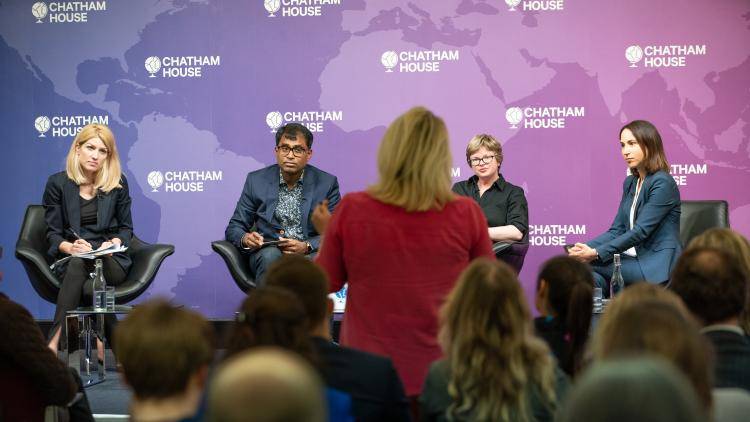
So, there are lots of questions about how Canada should deal with this, or will deal with this, challenge, what it means for our partners, and we’re very lucky to be joined by two excellent panellists today to help unpack some of these questions. Ian Austen, who is Canada Correspondent for The New York Times, welcome, Ian, and Angela Murphy, Foreign Editor at The Globe and Mail newspaper. Now, a quick note that this event is on the record, it is being recorded, it is being livestreamed and the recording will be posted to the website of Chatham House afterwards. So, I encourage you, all of you, to share the link of the recording with your colleagues after the event.
And after our initial discussion with Ian and Angela, we will move to audience questions, so if you want to submit a question, you’ll need to click on the Q&A box at the bottom of your Zoom screen. So, let’s get right to it, we do have an hour and a lot of ground to cover, and I’d like just to start by asking both of our panellists about the campaign itself, whether anything has stood out for them as noteworthy, and what they expect in terms of the election results on Monday, and maybe I can start with Ian and then go to Angela.
Ian Austen
Well, I was – excuse me, I was talking to a pollster the other day – pardon me, and we both remarked on how little has happened in this election, which is extraordinary, because this is one of the most consequential elections, arguably, in Canadian history. We have an American President who talks seriously about annexing the country, his tariffs, although he’s pulled back on them somewhat, are potentially devastating, particularly to the manufacturing sector. Yet, you know, this campaign, sort of, started, it’s a brief campaign, just over a month, and it’s about to end, and I’m hard pressed to, you know, discuss any pivotal moment. I mean, I guess the pivotal moments were the days Mr Carney took off from campaigning to deal with Mr Trump. You know, those were, sort of, the high points.
That being said, if the Liberals win, it will be an extraordinary comeback. I mean, if you – as you discussed, I mean, the – under Mr Trudeau, they’ve been in power for nearly a decade, it’ll be a decade come November, people were very tired of them, I think, on the whole. They – there was this animus towards Mr Trudeau, I think there were a lot of causes for that. He’s not the only leader in the world who led a country through the pandemic who was then rejected by the country, you know, I think bad memories, it’s, sort of, I guess, a bit like Winston Churchill in the Second World War, for example. But they looked – I mean, we had a meeting of the Canada Bureau with the Editors from New York in December, and I was the lone voice saying, “Well, don’t assume that the Conservatives are taking over,” which, I mean, was, you know, our planning assumption at that point in time, and events have conspired to overturn that.
And you mentioned, Roland, that they’re ahead by about five percentage points, that’s deceptive, of course, because the Conservative vote is highly, highly concentrated in Western Canada, where they win, kind of, Soviet like, 80/90% of the vote in some constituencies. So, 5% ahead in the polls is definitely majority government territory, if that holds through to Monday.
Professor Roland Paris
Yeah, they – because of the way the vote breaks out, the Conservatives would probably need to be significantly ahead in terms of the national polling in order to be able to be in a position for those vote splits to produce a victory for them. But you never know. It was pretty remarkable what we saw in the change in the last few months, and there are a few days left and we’ve all – we’ve been surprised by many elections before. Angela, what did you make of this – or what have you made of this campaign, and what do you expect in terms of the result?
Angela Murphy
Well, honestly, I’ve been, kind of, surprised that the Conservatives haven’t gone harder on the Trump issue. It took Poilievre a little while to turn his attention to it at the beginning of the campaign. And I’ve also been surprised by this, like, how they’ve approached it with this “Bring It Home” as the slogan. This idea that Canada could go it alone just by building – rebuilding our infrastructure and interprovincial trade and, you know, building up our military. Those are all important things, but he hasn’t talked much about his outreach to Europe and other allies, which Carney has.
Professor Roland Paris
Hmmm hmm.
Angela Murphy
And given Carney’s history with the Bank of England, etc., he does have those ties to Europe. So, yeah, that has surprised me. I don’t think it’s necessarily been great for his campaign, but I guess we will see.
Professor Roland Paris
Yeah, I got to ask you both, just on the campaign, you know, there are elections in other countries coming up in the not too distant future, in Australia and elsewhere. If you’re sitting in Australia, or you’re involved in party politics in a European country or in democratic countries of Asia, and you’re looking at Canada, are there any lessons that you might draw, or implications from this campaign in this election, in the era of the second Trump administration, that might shed light or be applicable to another context? You know, Pierre Poilievre has been a – has a – there’s a populist aspect of him as a Politician and of his campaign that doesn’t seem to have gained traction this time around. Is that something that you see as relevant? Are there anything – any other features of this election that seem to be potentially applicable elsewhere? Angela, is there anything that stands out to you?
Angela Murphy
I think the idea of – well, Carney’s campaigned very hard on standing up to Trump, even last night in some of his comments after Trump spoke yesterday evening about Canada being the 51st state again, which hasn’t come up a lot in recent weeks, but did come up last night. So, everyone is, like, “Oh my goodness here we are again.” I think the idea in – while he’s campaigning, he can talk as tough as he wants to, and by talking tough, I think Canadians have been rallied around that, but when you govern, it’s a whole different ballgame.
And we certainly are not in a position to, like, go head-to-head with the US on every issue, and we rely so heavily on them for our defence currently, and while we talk about beefing up our defence, it’s going to take years, years. So, it’s going to be an interesting dance that he has to do. As far as other countries go, I think, yeah, like, campaigning on your nationalism and the importance of defending your populace is probably a good idea, but keeping in mind that, yeah, it’s going to be a different situation once you get into power.
Professor Roland Paris
Ian, yeah, Carney has been talking tough and emphasising the importance of standing up to the United States. This is a position that, essentially, is held right across the Canadian political spectrum right now, that you have to resist, and including retaliate proportionately, to American tariffs. But other countries have taken a different approach, or seem to be drawing different lessons, including the perception that Claudia Sheinbaum in Mexico has taken a more – a softer approach to Trump, and she’s gained support in Mexico for that approach, just as Carney seems to have been gaining support in Canada for a tough approach. What do you make of that difference? What do you draw from that?
Ian Austen
Well, I mean, I guess what I draw from it is no matter what you do, it doesn’t seem to have any effect on Trump whatsoever, because Mexico ended up in exactly the same spot with tariffs that Canada did. I mean, the only thing Mexico’s escaped is Trump’s calls for its annexation, but of course, his approach to Mexico is very much to drive Mexico away from the United States. So, I don’t know that, you know – I mean, this is the thing that I – all of these things, retaliatory tariffs, I think most people will – most Economists will acknowledge they have no effect on the US administration. They may bother some industries, they may bother some Governors, but the United States ha – is in itself, a huge economy. It’s mostly reliant on its domestic economy, not exports, except for companies like Boeing and the film industry.
So, the retaliatory tariffs are, I – for the domestic market, it’s to show, you know, we’re rough and tough, and we’re pushing back and we’re not going to be shoved around. But I don’t think anybody who – and I’ve covered trade for a long time, anybody who covers trade thinks that no amount of retaliation by Canada is going to affect Mr Trump.
Professor Roland Paris
Or maybe ‘cause of the size of the Canadian economy, I suspect Chinese retaliatory tariffs will contribute to some thinking in The White House…
Ian Austen
Oh, yes…
Professor Roland Paris
…but eve…
Ian Austen
…well, the Canadian ones, yeah.
Professor Roland Paris
Yeah, but it – so, let’s move ahead then beyond the campaign, and get right into this discussion of, what comes next, and how Canada can manage the situation and also what it means for Canadian partners elsewhere. But, Ian, this is not the first time that Canada has faced a, kind – acute economic challenges from the United States. What does the previous history tell us about how Canada might, or should, respond to these current challenges?
Ian Austen
Well, on trade, we’ll leave aside manifest destiny and the various previous American attempts to take over Canada in the 19th Century, or what became Canada, there’s been two key points. One was the Smoot-Hawley Tariffs, which started out initially as agricultural tariffs, mostly aimed at Canadian exports, and then blossomed into this – or blossom’s probably not the apt word, but into this nightmare of tariffs that contributed perhaps to The Great Depression.
Canada’s response at that time was to prod Britain into organising an Imperial Conference in which those imperial preferential tariffs were set. So, Canada isolated itself from the United States with very high tariff barriers, but expanded its trade, primarily with Britain, but with other Commonwealth countries. So, you know, like, Ford Motor Company ran its British division through Windsor, Ontario, for example, and, you know, that worked fairly well for a long time. Although there were issues in the 1960s with a flood of British cars into Canada, leave that aside at the moment.
Then the second time Canada had a crisis like this was when Nixon took the United – the US dollar off the gold standard and imposed a 10% global tariff, which was a huge problem for Canada. That set off a chain of events initiated by the Liberals, but that culminated in a Conservative Government negotiating the free trade deal in 1988 with the United States, that subsequently was expanded to include Mexico and become NAFTA. So, there were two historic responses.
You look forward now, and you know what? I mean, we al – Canada already has a free trade deal with Europe, has a free trade deal with Japan. You know, I guess the country that’s most interested in Canadian exports is China, and that’s a very fraught, a very, very fraught issue here, right? So, I don’t know what the next Prime Minister does in terms of effectively – you know, if there is any replacement for US trade this time, I don’t think so, though.
Professor Roland Paris
Angela, you know, coming out of that history, it’s interesting, because Carney himself has talked about – and he got a lot of attention for remarks that he made about how the longstanding relationship between Canada and the United States that was built on the assumption that there would be increasing economic integration on the continent, that that relationship is over. Now, a lot of times, that was shortened to a quote that said the – he – that said, “He supposedly declared the end of the Canada-US relationship.” That’s not what he said. He said that “The relationship built on the assumption that there would be increasing integration,” that that’s over.
At the same time, he has said that Canada has to adjust to a new world, it has to reach out to more reliable partners. He’s – his first trips – in the first week as being Prime Minister, his first trip was to France and then the UK, and he’s talked about really reducing Canada’s vulnerability to economic pressure from the United States, building up more of a Canadian industry and market. How much potential is there for Canada to really diversify its trade relationships, such that it can reduce its vulnerability to, let’s say, capricious decisions from The White House?
Angela Murphy
Yeah, I think to say “it’s over,” again, I think that’s campaigning as opposed to actually governing, because it’s more like 70% of our trade or more, right, is with the United States. And also, we have to remember that Donald Trump is only in power, hopefully, for four years, so to say “it’s over,” is, like – that’s short-term thinking. But we do – I do think we do need to diversify. I think that’s why China has been able to talk so tough, because their experience of the previous Trump administration was a lesson to them and they started diversifying their trade and focusing more on their domestic trade. You know, booting out so many US companies, and, kind of, creating Chinese versions of said companies, like Starbucks and their Chinese coffee chain.
So, I think there are opportunities for Canada to at least wake up and start, you know, proactively looking for opportunities. We do have free trade with Europe, to a degree. I think Canada’s got to examine some of its own protectionism. There is a kernel of truth to some of what has been said about, you know, the non-tariff tariffs. Supply management is always a huge, kind of, block to trade abroad. You know, our dairy industry is one, like, the sacred cow, and I know it was a huge stumbling block with our tra – with our free trade agreement with Europe. So, if we’re going to trade more with Australia, say, New Zealand, you know, other places, then – and Brazil, and, you know, we’ve got to…
Professor Roland Paris
UK.
Angela Murphy
…open up and re-examine, yeah, re-examine supply management.
Ian Austen
Hmmm hmm.
Angela Murphy
And we can gain through interprovincial trade. I think it was, like, a huge – like, a third of our GDP, if we actually opened it up.
Ian Austen
Yeah.
Professor Roland Paris
I…
Angela Murphy
Well…
Professor Roland Paris
Maybe I could pick up on that and ask Ian, so both of the party – the major party leaders who have – are in contention to potentially win on Monday, Pierre Poilievre and Mark Carney, have set out economic strategies over the course of their campaigns that are – they present as partly designed to be able to protect Canada and strengthen Canada at a moment of economic challenge, particularly from the United States. What do you make of the strategies that these two men have put forward? How realistic are they? What are the key similarities and differences? What should people who are following Canada from abroad, or Canadians at home, what should they expect from a Conservative or a Liberal Government when it comes to the economic strategy for managing the challenges of the Trump administration?
Ian Austen
Well, I guess, you know, there’s a lot of similarities and a number of differences, and one of the similarities is the lack of specificity between the two. I mean, most of these plans are extremely vague. Another common issue is this, you know, talking about interprovincial trade barriers. I’ve asked the finance department to detail where these numbers come up from, that – you know, this unleashing of economic power in the country, and I’ve got nothing back.
I mean, you know, most of these barriers are things that, you know, provinces like to have their highways built by local contractors, engineered by local contractors. They’re not all of a sudden going to start building more highways because they’re going to start using large contractors from Alberta or Ontario in New Brunswick. I mean, I don’t understand where this, like, this blossoming is from eliminating interprovincial trade barriers. You know, if Ontario Construction Workers can cross the river here in Ottawa and work in Quebec, as Quebec ones can do here now, how is that going to change – fundamentally change the economy? I – so, that one, I don’t understand as a panacea. It sounds good, but there’s very, very little to that.
Where they diverge is Mr Poilievre’s approach is that “Well, the way to deal with the United States is to fix the Canadian economy,” which he argues, not always accurately, was destroyed by the Trudeau Government. And his solution for that is mostly things like tax cuts, reducing the size of government, although he doesn’t explain what that is. You know, it’s attrition, you know, he talks about billions of dollars in savings and then cites programmes that are measured in tens of millions of dollars. I’m not sure if there’s a recession induced by Trump’s tariffs, that that’s really a time you want to be cutting back the economy, but, you know, voters will weigh in on that I suppose.
Mr Carney talks tax cuts too, but, you know, he has some very activist government initiatives, particularly around housing, to get the federal government back into building houses. I – you know, that – well that – you know, if – I mean, the problem is we’re already seeing demand for housing drop precipitously, and now prices, because of the turmoil created by Trump. I’m not sure building more houses is going to suddenly make people who are losing their jobs because of tariffs buy houses, so, you know, I don’t know there.
And then as, you know, as Angela said, there’s this vague talk about, you know, ‘expanding’ and ‘diversifying’, which is, you know, easily said, but not – you know, Mr Carney has this, to my mind, highly unrealistic idea of making sure that cars that are ma – assembled in Canada contain mostly Canadian parts. Well, I don’t know how the federal government is going to tell Toyota and Honda and Ford and GM and Stellantis who they should buy their parts from. I mean, it’s just, you know – it seems fanciful.
So, I think – but I think for both of them, what it’s going to come down to is there are probably going to have to be very, very difficult decisions made for the – by the next Prime Minister, around what industries, what sectors, will survive. I mean, I don’t think, and I say this as someone from the city where – the auto capital of Canada, Windsor, Ontario, you know, I think the long-term outlook for the auto industry in this country is very, very bleak. And, you know, maybe – and maybe the next Prime Minister is going to have to decide, “No, that’s done for now, you’ve got to find something else,” but the question then becomes, what’s something else?
Professor Roland Paris
Angela, did you want to weigh in on this?
Angela Murphy
Yeah, I wanted to build on the point of cutting budgets, as you approach these, you know, huge challenges with the US. The Conservative platform came out, was it yesterday, the day before, and there’s the significant cuts to foreign aid, which I find, kind of, puzzling, given we need every soft power lever that we have. And if Canada has influence in the world, I think a large part of it comes from being a good world citizen in our foreign aid programmes. Like, I’m thinking particularly of Africa, even the Middle East, like, why would we have a seat at the table if we aren’t contributing to foreign aid? So, I found that a little puzzling. I think, yeah, like, because it’s so challenging with the US, and we do need to look ahead to building partnerships in Europe, I don’t think the Europeans would be too pleased if we started cutting all of our foreign aid programmes.
Professor Roland Paris
Since this conversation is hosted by Chatham House, maybe we can just spend a few moments talking about Canada and Europe, Canada and the UK, Canada and the EU. This is obviously an area where at least Mark Carney has placed a great deal of emphasis, but I would expect that that Pierre Poilievre would, as well. And based on my own recent travels in Europe, I think there’s a great deal of interest in exploring ways of strengthening and deepening relations with Canada from the European side.
So, there is a provisionally applied free trade agreement between Canada and the EU, the terms of that have been applied to the Canada-UK trade relationship, even though negotiations for a specific Canada-UK free trade agreement have been in abeyance for a little while. But even more broadly than trade, where are there opportunities, in your view, for Canada to – and Europe, together, to rec – to see each other as the partners that can help to diversify their own partnerships, whether it’s in the economic realm or anywhere else?
Ian Austen
Well, I…
Professor Roland Paris
Which one of you…?
Ian Austen
…guess…
Professor Roland Paris
Go ahead, yeah.
Ian Austen
…we have this, sort of, looming thing over all of that relationship, which is, what’s going to happen to NATO? I don’t know what Mr Trump’s going to do with NATO, but I think this is going to be a big – you know, an enormous topic of conversation between Canada, Britain and Europe, and probably quite soon. I mean, is there a future for NATO without the United States? I don’t know, I don’t know. And it’s…
Angela Murphy
And for Ukraine, right? Ukraine, like, what it’s…
Ian Austen
Yeah.
Angela Murphy
…like with Ukraine? I mean, I mean, Europe’s not abandoning Ukraine, I don’t believe, from everything I’ve seen…
Ian Austen
And Canada isn’t.
Angela Murphy
…even though – and Canada is not, no. So, there’s an opportunity there to be a player in the future of Ukraine for Canada, with Europe as a partner, that could strengthen other relationships, I think.
Ian Austen
And…
Professor Roland Paris
And they’re a key area – sorry, go ahead, Ian.
Ian Austen
And there’s Canadian troops, of course, in the Baltics, right now, right?
Angela Murphy
Hmmm hmm, yeah.
Professor Roland Paris
What – just on the Canada, Europe bit, what about areas like co-ordinating these massive in – defence investments that Canada and European countries are going to be making in the years to come? Not just as a means of solidifying a security partnership between Canada and our European NATO allies, but also building the, kind of, industrial and innovation supply chains that will be involved in a lot of that – the investment and the defence renewal. Or even areas in which Canada and Europe and other partners in the world can be talking about pieces of the international multilateral system that the United States might be withdrawing from financially or politically, that perhaps can be sustained in – with that, kind of, co-operation. Do you see those two areas as something that are – that could be usefully explored?
Ian Austen
Oh, yeah, absol…
Professor Roland Paris
Angela?
Ian Austen
Go ahead, Angela.
Angela Murphy
Yeah, I was just going to say, critical minerals. Like, Canada is, you know, blessed with huge deposits of rare and critical minerals that everyone needs to build computers and chips and cars, and the list goes on. So, like, that’s definitely a lever that we have, and to build on that trade with Europe on a defence level would be important, I think.
Professor Roland Paris
Ian?
Ian Austen
Yeah, I mean, I disagree a little bit on critical minerals. This is another thing, like interprovincial trade barriers, I think gets inflated to a degree that doesn’t match with reality. But first of all, it’s a very vague description. I mean, sometimes nickel’s put in there, and there are lots of countries that are friendly to the West around the world with nickel deposits, but most of the ones people talk about and want for electronics are theoretically available in Canada, but I don’t know how practical mining is in the Arctic, in Northwestern Ontario, both economically, socially, and how you get buy-in with indigenous groups. So, I think, you know, critical minerals are a bit of a, you know, a maybe. I don’t think they’re – it’s a solid way forward for Canada. I mean…
Angela Murphy
Hmmm.
Professor Roland Paris
So, before going to…
Angela Murphy
They’re…
Professor Roland Paris
…audience questions…
Angela Murphy
…cleaner, though.
Professor Roland Paris
What’s that?
Angela Murphy
I was saying, they’re cleaner than Congo minerals, I mean, if you want to start looking…
Ian Austen
Well, yeah, but they’re also not – like, they’re also – it’s very debatable whether it’s economically viable to extract…
Angela Murphy
Hmmm hmm.
Ian Austen
…them. And you know, are they cleaner than Congo minerals if you’re overriding the indigenous people who live in those areas?
Angela Murphy
Well, yeah, I’m not suggesting that we do that.
Professor Roland Paris
Obviously…
Ian Austen
It’s – okay.
Professor Roland Paris
…no simple solutions there. I think it depends on the mineral you’re talking about. If you look at this obscure element called ‘germanium’, you know, the own – the major production facility in North America is in British Columbia, and this is one of the metals that China has banned for export to the United States, including transhipment to the United States. So, it’s, kind of like, the story about leverage and assets for Canada depends, in part, on breaking this down and looking into the details.
But I wanted to go to audience questions, but before doing so, I want to turn both to you – to both of you to ask about the security relationship we’ve touched on so far, but which is obviously a central part of the relationship between Canada and the United States. For listen – for the attendees at this webinar who may not be as familiar, Canada and the United States have a deeply integrated security relationship, not just through NATO, like our other NATO partners, but within North America, with a binational command for the defence of North America. At the same time, Canada is one of the lowest on the list of NATO countries in terms of expenditures for the military as a percent of GDP. And this is one of the issues that the Trump administration, and not just the Trump Administration, he’s just ruder than his predecessors…
Angela Murphy
Hmmm.
Professor Roland Paris
…but previous presidents have also pointed out that Canada has, in their view, not been carrying its weight. At the same time now, there’s a discussion, and in our pri – chat prior to this event, Angela, you reminded us about the issue of the F-35, which Canada has said it will buy from Lockheed Martin in the United States, but now is say – now has placed on a, kind of, hold as it reconsiders whether this meets Canadian interests. So, things seem to be in flux. What, Angela, you know, what does this F-35 discussion mean for the future of the security partnership between Canada and the United States?
Angela Murphy
Yeah, that partnership isn’t going away anytime soon. Canada does not have an aircraft carrier. Canada has 12 submarines, but not in very good condition, some of them. Some of them, which we bought from the UK, turned out to be lemons. So, there is a plan to buy more submarines. There is – it’s ten years on the books, I think it’s 2036. So, we are still extremely dependent on the United States for our defence, especially if you look at Arctic waters, you know, the possibility of Russian incursions into the Arctic and claims of sovereignty in areas there. The Northwest Passage opening up every year, unfortunately, due to climate change, but Canada still needs the United States.
I think what Carney is – or whoever is elected Prime Minister, will be doing with Trump, it’s going to be carrots and sticks. So, I look at the F-35 contract as, kind of, a big carrot, like, we’re going to have to give ‘em something to get something back. If we do go with a different supplier for the jets, it creates a very complex situation for Canada’s Air Force having to main two – maintain two completely different styles of jet computer systems. How do you integrate that? It’s a, kind of, a costly challenge. I think dangling the prospect of looking at another supplier is a worthwhile, kind of, bargaining tool, but I’m not sure it’s realistic.
Professor Roland Paris
Ian?
Ian Austen
Well, I mean, I guess the F – one funny thing about the F-35 now is even Trump seems to sour on it. So, you know, I don’t know, but I mean, I agree with Angela, I mean, Canada went through one protracted process of buying the F-35s, then reviewing it, then deciding to buy them again. I don’t – I’m not sure it’s willing to go through all of that all over again. It seems there are many arguments against the F-35, but just, like, to go through that process again, now they’re committed and now they have to buy 18 of them, you’re going to have 18 of them and then X number of something else, like, 60 of another kind of plane, that doesn’t make a whole lot of sense.
And as you mentioned, the air defence is a joint command with the US Air Force, under NORAD. You know, surely Canada needs planes that, you know, don’t require special training, don’t require special Mechanics, don’t require special parts. It – I don’t think there’s any practical option. I don’t think any of the submarines are working right now though, are they, Angela? I think one of them…
Angela Murphy
I don’t know, honestly.
Ian Austen
One of them is – I got a news release, one of them I think is supposed to go in the water next month, but I think they’re all in dry dock.
Professor Roland Paris
I thought that there were – that at least one was operational, but anyway, that’s for a…
Ian Austen
It was, but they – it’s all…
Professor Roland Paris
…time…
Ian Austen
…to find out something, so…
Angela Murphy
Well, I think Europe is eyeing us as a potential market for defence. I mean, the French came and parked a sub just outside the port of Halifax for a little while, and I wondered if it was, kind of, a display, like, for us to take a look at.
Ian Austen
Yeah, in the…
Professor Roland Paris
Without question, the French and the Koreans and others are looking at the – at Canadian defence market, but I think the Canadian Government’s also considering, you know, how can these decisions both put Canada in a position of having sovereign control over its own weapons systems – which is not obvious in the case of the F-35, since it’s basically a flying top secret computer with some of the code, you know, and updates, responsibility residing in the United States. But maybe there are also ways of building more technology transfer, so to speak, through defence contracts.
Ian Austen
Well, and it…
Angela Murphy
Yeah, this idea that the F-35, that the Americans will turn it off so we can’t defend ourselves, is crazy. I’m sorry, like, if the Amer – if we’re at that point with the Americans, then we’re toast. Like, we can’t defend our border, right? For all the talk of us, Canada, defending their border against United States is also, kind of, ludicrous, so…
Professor Roland Paris
Ian, you wanted to jump in?
Ian Austen
Yeah, on the flipside of all this though, it gets back to what you raised earlier, I mean, things like procuring expen – I mean, I think many heads of state are basically Arms Salesman, right? Particularly Monsieur Macron and the various Presidents in the United States. So, I mean, you know, making major defence commitments, purchasing major goods from other countries is perhaps a way into…
Professor Roland Paris
Hmmm hmm.
Ian Austen
…expanding trade with Europe.
Professor Roland Paris
So, let’s turn to some of the audience questions. And we’ve talked about tariffs so far, but here’s a question that says, “What are your thoughts” – and this might be of interest to people in, you know, in many countries, depending on what the Trump Administration does, and how crazy it gets, but, “What are your thoughts on Canadians and other countries standing up to the United States by boycotting US products and services?” Angela?
Angela Murphy
Well, there’s been a bit of that here, right…
Ian Austen
Huge amount.
Angela Murphy
…with the “Buy Canadian,” right? Like – and Canadians are not travelling to the US in the numbers that they normally do. It has hit the US, you know, tourism industry, for sure, and you know, Governors of those states, maybe with the exception of Florida’s Governor, you know, have noted the lack of Canadians coming down. So, I think, you know, it is effective in that it does, you know, hit people in their pocketbook there, and they complain to their representatives, who complain, and maybe Congress will eventually re-empower itself to be a bit noisier about all of this. So…
Professor Roland Paris
Ian?
Ian Austen
Sorry, I was just…
Professor Roland Paris
The boycott.
Ian Austen
…reading. Oh, the boycott. Well, it’s been – I thi – you know, we can get into a debate about how effective boycotts are, with Economists, but I mean, I’m amazed, and I’m sure both of you have been, how quickly companies have been able to repackage goods to put big maple leaves all over them, you know. And we’ve seen in the past week a, sort of, public outcry about the fact that all the cloud computing services companies approved by the federal government are US-based ones. Well, that’s because there isn’t a Canadian one, really. But, you know, it does get down to a thing, though, that’s it’s easy to talk about ‘boycotts’, but for a lot of things, it’s not, you know – there isn’t an alternative.
Professor Roland Paris
Hmmm hmm.
Ian Austen
You know, are you not going to watch American pro – films and television series? I guess, but you might – you know, the BBC’s going to run pretty thin pretty quickly, right? So…
Professor Roland Paris
Yeah, I guess the interesting bit about the boycott is that it has both an inward facing and an exter – and outward facing dimension. The outward facing one is the explicit part of the boycott, which is, you know, try not to buy American goods in order not to be able to, you know, reward American producers at a moment when the United States is threatening Canada’s economy and sovereignty. But the inward facing one is that it’s a way in which ordinary citizens can be participating in a collective national effort. And that, kind of, sense of coherence and unity has been a unique feature, I think, of the Canadian response to Trump, that has been different than what we’ve seen in many other countries faced with Trump threats, perhaps because of the seriousness of the threat from Trump, which wasn’t just an economic one, but one about the existence of the country itself.
But it’s an interesting set of questions. There is another question here that comes back to whether – and thank you, Dina, by the way, for the previous question. Duff asks the question about whether it’s “shortsighted to see this problem as only a Trump or even a MAGA problem that might be gone in a few years.” And then Duff goes on to say, “Rather the problem could be more long-term, even multi-generational, as the US struggles with a ‘counter revolution’, where extreme right-wing values, politics, at the state, federal and societal level seek to displace what are viewed as extreme liberal values.”
I guess let me just rephrase the question a little bit, which is, you know, the last period of really significant populism – Presidential-led populism in the United States was in the 19th century, in Jacks – the era of Andrew Jackson, and it persisted long after Jackson left office. So, how should we, in Canada and elsewhere, be thinking about the Trump phenomenon and what, kind of, tale it will have? Ian?
Ian Austen
Yeah, I mean, I’ve wondered long about this one, right? I mean, do we just – you know – it’s next JD Vance and more of the same? I think one of the big differences between now and, you know, the time of Trump’s heroes, like Harding, is that we’re looking at a United States that is more divided than entirely behind this. I mean, we’re not – you know, MAGA is not strong in California, it’s not strong in New York State, both, you know, huge population centres. I would argue its – you know, in the Midwest, its support is, kind of, variable amongst some of the large urban centres. So – but I – yes, I think this is a, you know, a very real concern, whether or not Mr Trump actually leaves in four years, what succeeds him.
And, I mean, the other – I guess also tied with this is a lot of his policies are affecting supporters in ways I don’t think they anticipated. They’re seeing…
Professor Roland Paris
Hmmm.
Ian Austen
…neighbours deported, maybe the economic turmoil is going to affect their job, they’re going to see the price of things go up significantly at Walmart, or they’ll see empty shelves when they go into Walmart. So, you know, that also leads me to wonder how – you know, if Mr Trump will also erode his support to a significant degree. But yes, I don’t think that anyone can view these things as just a we can wait it out for four years, or we can wait it out ‘til the midterms.
Professor Roland Paris
Hmmm hmm.
Ian Austen
I think that would be a big mistake.
Professor Roland Paris
Angela?
Angela Murphy
Yeah, I think regardless of what administration is in power in the United States, we have things that they need, water being a huge factor. If climate change does continue apace, America needs more water, fresh water, and we have a lot of it. So, I think there’s always going to be an element of what, you know, that relationship is going to mean in the future, if there’s still going to be continued agreements on it or whether that becomes a point of conflict. So, yeah, I think we’ll always have to be wary of the elephant on the southern border. It’s always been so, right?
Professor Roland Paris
There’s a question here from Heidi about ‘pipelines’, and the idea of pipelines running East to West, and the idea of governments owning pipelines. But maybe I can broaden – and thank you, Heidi, for that question, which everybody, including our panellists, can see, but maybe I can even broaden it a little bit further. Because when, you know, we’ve seen at least as recently as late last year, visits by leaders of countries that are partners of Canada coming to Canada and saying, “We would love to be able to have access, more access, to some of your energy resources,” whether it’s liquefied natural gas or whether it’s hydrogen. And that’s part of the context in which there’s been a debate in this country about how and whether to dramatically expand the infrastructure in – potentially including pipelines, to get some of these resources to Tidewater so that they can be shipped.
Now, I guess my question is, what do you make of the seeming consensus now between the two leading candidates for Prime Minister that there has to be a new push, not just for resource development and the critical minerals that we were talking about before, but to build the infrastructure to get these resources to market? For the benefit of the Canadian economy, but also for the benefit of the partners that we want to strengthen our relationships with, and who have been expressing a wish to gain access to more of those resources. What do you make of this seeming consensus now, which has been one of the things that’s been the turbulent effect of the Trump moment? Angela?
Angela Murphy
I think we’ll see on Tuesday Quebec’s support and where that goes, and I think if Carney does get a good amount of support in Quebec, the odds of building that East-West pipeline go up considerably. So, I think, you know, we’re going to see what happens, but I – you have the feeling that there is consensus around that, for sure. I’m just thinking back to when Olaf Scholz came to Canada to talk to Mr Trudeau, and it was actually an event that took place in The Globe and Mail building on the 17th floor, so I went up to listen. And there was a lot of talk about liquid natural gas, a lot of talk and there was, like, the potential of, you know, having those, kind of, ports on the East Coast, but I don’t know how far along that ever came as far as the actual building of them, so…
Professor Roland Paris
Ian, are we going to be an energy superpower?
Ian Austen
No. I asked a former Energy Minister from Alberta recently if there is any market interest in building any pipelines, and he said, “Zero, without,” you know, “100% government backing.” We’re talking – so, I mean, there’s two issues here. One is the oil sands production, it is a very high cost, very low-grade form of oil, which is largely only in demand in the United States, because refineries on the Gulf Coast, in the Midwest, need heavy, crummy oil, which they used to get from Venezuela and Mexico. It’s of very, very little interest to the rest of the world. I mean, the government, of course, bought and expanded the Trans Mountain Pipeline, expanded the port facilities in British Columbia. We’ve seen no surge in exports from that. Most of those ships have been sailing down to California refineries.
Angela Murphy
But should we be refining that oil ourselves? Like, is that…
Ian Austen
What…?
Angela Murphy
…an option?
Ian Austen
What would we use it for?
Angela Murphy
I don’t – well, to export.
Ian Austen
I mean, it’s not practical to export like gasoline, right? I mean, it’s…
Angela Murphy
Yeah.
Ian Austen
…not economically practical, so we’ll leave that aside. LNG, again, you know, there’s lots of sources of LNG around the world, why would you necessarily buy it from Canada? Would that justify, you know, a massive investment? $200 billion perhaps to build a pipeline and the attendant facilities in New Brunswick, it just doesn’t – there’s lots of oil, there’s lots of natural gas in the world, most of the oil is higher quality, lower cost production. It just doesn’t – you know, it’s one of those things where it sounds good for Canada, but I just – it just doesn’t seem even vaguely economically viable. Sounds good, but…
Professor Roland Paris
There’s a question from Christina, coming back to our discussion about Canada and the European Union, and, you know, they – as I said, I, having travelled in parts of Europe about a month ago, I guess, I was really struck by how much interest there was in exploring a deeper connection. Now, this might all be a function of the current sense of emergency and – with the Trump administration. And if the Trump administration suddenly turned down the dials on all its threats and consistently started communicating in ways that were more conciliatory, maybe these – all of these questions, including Canadian energy exports, that the urgency or intensity would diminish. But I think that there will be real opportunities to at least have discussions with European partners, and one of the questions here from Christina is, “What is the likelihood of Canada joining the EU?” And maybe I can add, does it make sense for Canada to join the EU? Angela?
Angela Murphy
Well, I think that would, kind of, be a – throwing the gauntlet down to Mr Trump, if we did that. I mean, wow. I think that there should definitely be more, like, diplomatic efforts, more military co-operation. I just can’t see that happening anywhere in the near future, although I’m sure Greenland would love if we did. We could form a united front with Greenland. So, I think it’s – like, people love the idea of it, but again, like, the harsh reality is that, like, we’re still so intertwined with the US, I don’t think they’d look at it too kindly.
Professor Roland Paris
Ian?
Ian Austen
Yeah, I mean, I get the – I get letters several times a week from readers proposing this idea. I mean, I suppose that everyone watching knows better than me. I wonder what Europe thinks of the idea to begin with, but for a lot of Canadian manufacturing, it just – it’s not a solution, right? I mean, the auto industry being our largest exporter outside of energy to the United States, car companies depend on just in time delivery, not transoceanic delivery of parts for assembly. There’s a glut of car assembly factories in Europe right now, to the point where Volkswagen is talking about shutting them in Germany for the first time.
So, I’m not – it sounds like a good idea, and I also wondered, like, if Canadians fully grasp what it means in terms of giving up Canada sovereignty over various things that, you know – the factors that drove Brexit. You know, I think if people were fully informed about what joining the EU would mean, and how many decisions the EU would be making, you know, that support for this idea might fade pretty quickly in Canada.
Professor Roland Paris
Yeah, not to mention the years long process that would be required for bringing our regulatory and legal arrangements into alignment with all of those of the EU. Nevertheless, I mean, I – in contrast to some of the comments, in the Q&A, I’m – I – and I wouldn’t dismiss it simply because I understand where the interest is coming from. And the underlying interest about deepening the relationship certainly makes sense, and I hope that there will be opportunities to explore very specific ways in which we can deepen our co-operation with Europe that don’t necessarily require, you know, turning ourselves into a part of the European Union.
Coming back to this issue about investment in Canada, there is a question from Mackenzie about – relating to ‘economic security’, and whether there needs to be any changes, in your view, or whether there may be any changes to the investment regimes within Canada. I mean, it seems a little bit of a stretch to be applying national security tests on American investment, but maybe we can broaden this out just to talk about the challenges that Canada now faces, with the threat of losing ready access to the American market in terms of the – attracting FDI – inward FDI into Canada, what that means for the Canadian economy, and what the next Canadian Government can do about that.
And in your answers, maybe you can also, if you have any, kind of, final thoughts here, maybe you can just conclude your answer just by saying what is the one take-away that you would want to communicate about more generally, Canada, and the challenge of dealing with Trump going forward? So, investments and then a concluding thought. Start with Ian and then go to Angela.
Ian Austen
Well, you know, I mean, this is an interesting question. I think it’s, kind of, mired up with the whole issue of Canada’s investment funds being themselves a large source of foreign direct investment, both in the United States, Europe and Asia. And, you know, there is some talk now that maybe pension funds should be made to focus their investments here, which is, you know, an interesting idea, getting away from the independence of their management. But yes, I think, you know, this is going to be a huge – that’s going to be a huge challenge for the next Prime Minister. And regardless of whether it’s Mr Carney or Mr Poilievre, I, you know, I give them only my sympathy for dealing with the President going forward. I mean, there’s no – there are going to be no quick, easy or optimal solutions.
Professor Roland Paris
Angela?
Angela Murphy
Yeah, I think, you know, if you look at Canada, some of the things that we have that are very strong, like our banking system, our healthcare is an asset in a way, right? Because, you know, if you want to take your company and move it to the US, all of a sudden, you’re having to deal with issues of health insurance, etc. We have great productivity here, which is why, like, GM, you know, maintained companies here, their lines of cars in the first place. So, I’m not really an investment expert, that’s not my area, but, you know, I think, you know, let’s not sell ourselves too short as a place that money could be made, just put that way.
Professor Roland Paris
So, we only have, like, under two minutes left. Maybe – I want to get you both on a concluding thought, and here’s the question. The question is, thinking about the Canadian – the next Canadian Government, let’s assume that they have four years in office, so, four years from now for the next Canadian Government, what is the best case scenario in terms of how it’s managed or not, or, you know, how it’s dealt with its relations with the United States? What’s the worst case scenario and what’s the most likely outcome? So, I’m throwing this at you without any warning and giving you, basically, 30 seconds each. Give me top of mind, top of mind, best case scenario for four years from now, worst case, and what’s the most likely? And we’ll start with Angela and then finish up with Ian.
Angela Murphy
Okay, I’ll do worst case scenario, ‘cause I tend to think that way first, would be that we’re, kind of, a vassal state similar to, like, I guess…
Professor Roland Paris
Belarus?
Angela Murphy
Yeah, something like that. Although, like, without, like, an overt American takeover, at least American influence over our politics, our economy, to an extent that’s much greater than what we have now would be the worst case scenario. Best case scenario that we’re wily, that we’ve found a way to diversify at least somewhat, and that we’ve managed to, kind of, find a way to maintain some of what we have with the US, while building in those other areas. I think the next Prime Minister, whoever he’s – it’s going to be a very interesting way to approach Trump. I think Macron has done it the best so far. He manages to flatter and still make his points, so if we can be like Macron.
Professor Roland Paris
Okay, Ian, 30 seconds, best worst, likely?
Ian Austen
Well, I’ll start with likely, uncertainty. I think that’s, you know, a given with Trump. Best case, you know, we – yes, we do make these ties with Europe. We – I am completely wrong about oil and gas and, you know, we have a diversified global market for them. The worst case, perhaps not even so much a vassal state, but just, like, we are completely isolated from the United States.
Professor Roland Paris
Hmmm hmm, and the world.
Ian Austen
And the world.
Professor Roland Paris
Okay, well, listen, this has been a spectacularly rich discussion, and so I want to thank both of you, Ian Austen, Angela Murphy, for taking the time and for sharing your insights. Thank you everyone who joined us today, and for those who asked questions, I apologise for not being able to get to all of them. And I encourage everyone to check out the – regularly the Chatham House website for not just the events and the recordings, including the recording of this event, but also the regular expert comments that are posted on that website. So, with that said and no further ado, thank you, everyone, and I wish you all an excellent rest of your day. Bye, bye.