Dr Marion Messmer
Hello, everyone, welcome to Chatham House. Really great to see that we’ve got a very disciplined crowd tonight, so, where you essentially fell silent as we walked on stage…
Dr Comfort Ero
Hmmm, it’s scary.
Dr Marion Messmer
…and as the lights dimmed. Yeah, just a really warm welcome from me to members and friends of Chatham House who have joined us tonight. This is an event that has a really long tradition of Chatham House and International Crisis Group working together to discuss the “Ten Conflicts to Watch.” I’m Marion Messmer. I’m the Programme Director for International Security here at Chatham House, and I will just have to go through a few housekeeping things before we actually get into the content of the event.
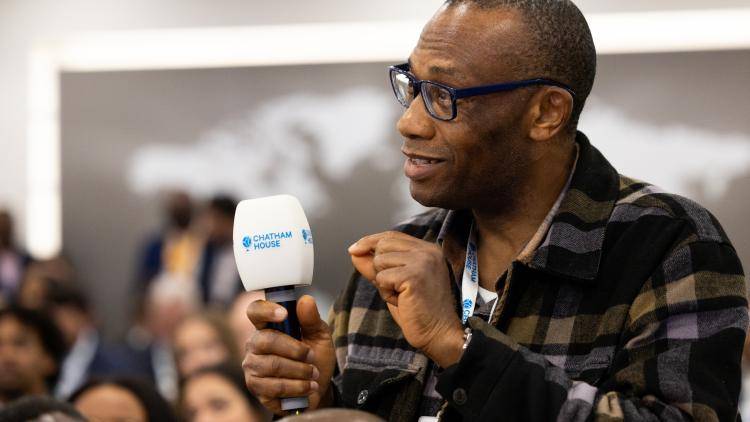
So, this discussion is on the record, it’s being livestreamed and it’s recorded. If you want to share about the event on social media, you can do so using the #CH_Events and @ChathamHouse. And if you want to ask a question after the discussion that Comfort and I are going to have, if you’re here in person, you can raise your hand, we’ll have colleagues walking around with microphones, so I’ll identify who’s got their hand up and then a microphone will find its way to you. When you ask your question, please briefly introduce yourselves, because we may not know who you are, and if you are joining us online, thank you so much for doing that, there is a Q&A box that you can add your questions into. I’ve got this laptop here next to me where I’m going to keep an eye on the questions, and I’m going to collect a few questions to also add to the discussion. But yeah, now it’s, essentially, time to get into the discussion.
So, as I’m sure you know, every year the International Crisis Group puts together this report on the “Ten Conflicts to Watch,” which examines key conflicts across the globe. And this event has a really long tradition and I’m really glad to be able to welcome Dr Comfort Ero, who is the President and CEO of the International Crisis Group, to discuss the report and to discuss the most pressing wars and crises that we can expect to see over 2026. So, Comfort, to start us off, could you tell us a bit about the methodology that underpins…
Dr Comfort Ero
Hmmm.
Dr Marion Messmer
…the report? How did you determine those ten conflicts, and, essentially, how do you choose what makes the cut and what doesn’t?
Dr Comfort Ero
Thank you and thank you also to Chatham House for hosting us every year, and despite everything, Happy New Year, first, on a personal level to all of you, despite the state of the world. I mean, it’s a good question because a number of people often ask us why certain countries are not on and why certain countries are on. Often you get into a country and a country, through its Foreign Ministry or its Head of State will ask why our country is on the list, as well, you know, and then they ask you another interesting question, which is, do – “Will we be on the list next year?” And I say, “I’m not going to give the list answer away,” as well.
But there’s no science behind it, it’s not a predictive tool. Crisis Group doesn’t do crystal ball gazing. It is a list of ten conflicts to watch. We’re not making any predictions about those conflicts, and it’s not just about the deadliest conflict, although that’s – those countries could be easily labelled that, but it’s a way, also, to set the agenda for the year. Certainly, when you look at the introduction, for example, the two themes in the introduction that help underpin everything else is around ‘peacemaking’ and ‘spheres of influence,’ as well. And then, in a sense, it is a conversation with our Analysts.
There is an overwhelming choice to choose from. There are at least 60 live conflicts in the world, so it really does become a tussle as to which one gets to be put on the list, and it tends to evolve around ideas of the human cost of conflict, the humanitarian catastrophe, the opportunity cost. Sometimes you see the possibilities, the opportunities for peacemaking, peacekeeping. There’s the geopolitical factors that underpin the decision why certain countries or conflicts make the list, as well. Of course, there are other issues, as I said, around mass suffering, displacement, and all – things you can imagine from a, sort of, a conflict prevention perspective, as well. But it really is about things we believe that you can watch for various reasons.
And as an organisation that spent a lot of its time thinking about making sure that conflicts that are off the radar are put on the agenda, it is also about making sure that those that are often deprioritised or not getting the type of international action behind them are given some spotlight, as well.
Dr Marion Messmer
That makes sense. I think for many of us, the year started out quite shocking watching the US action unfold in Venezuela, and that is one of the conflicts that did make your list, even though your report is published right at the very start of the year. So, I wanted to ask how you see the situation in Venezuela unfold and what wider implications you see from US actions that took place.
Dr Comfort Ero
It’s a good question. I mean, I said it’s not predictive, but then a number of people said, “Yeah, but Venezuela is number one on your list,” and said, “Yeah, last year Sudan was on the top of our list, as well, and the year before Ukraine was at the top of the list, as well.” You know, I think the surprise, at least for Crisis Group, and I imagine for a number of you, and I want to recognise Ambassador Patriota from the region, the Brazilian Ambassador to the UK, I think for a number of us it wasn’t a question of whether he was going to do something on Venezuela. I think that was pretty apparent. The question is, what was it going to be? So, we’re already seeing, you know, the ups – you also don’t make that massive investment on the seas of the Caribbean without doing something, as well, and Trump, you know, very performative, very theatrical, was always going to do something.
We did put that line into the ten conflicts about the risk around ‘decapitation’. We did put the question about, the risk about some, kind of, military strike battle in Venezuela, but these were ifs and buts. This was not definitive. So, I think even there’s a sense of surprise, shock and awe that he went that far. And I borrow the phrase that my colleague, Phil Gunson, our man in Caracas, used, it was, kind of, like a ‘snatch and grab’ of the President and his wife in quite a neat, spectacular type of theatrical performance, and you can see it in the way that Trump describes it. But that aside, and all the awe and all that aside, I think the question you’re left with is the day after…
Dr Marion Messmer
Hmmm.
Dr Comfort Ero
…as well. Now, there may have been – I think there are elements within Trump who were maybe thinking of a, sort of, a regime change, and I think there was the calculation, recognising that you don’t have the entire military on your side, there’s still support for Maduro, there’s still – you know, you can get into this awkward tussle with the regime. And I think also, given what happened in 2019 with Guaidó, question marks as to whether Trump wanted to back the opposition, you heard what he said about María Machado as well. So, in a sense, there had to be some, kind of, deal with Chavismo. So, we called it a Maru – ‘Maduro-less,’ but with the regime, sort of, still intact as well, and now it’s about how those two work together.
Dr Marion Messmer
Hmmm.
Dr Comfort Ero
I mean, for Trump, you know, the – it’s pretty – there’s the – there’s what he’s told us publicly, “It’s about migration, it’s about drugs,” we also know that the fentanyl is not in Venezuela, it’s elsewhere. But we also know, and he’s made it very explicitly, and he said it 24 times, if you counted, “It’s about oil,” it’s transactional, and, “I am the one who’s going to control.” Like some viceroy, virtual viceroy, saying, “I’m now the one who’s going to control the levers of that production capacity.” What it means to the rest of the region is also quite worrying, because we’ve all…
Dr Marion Messmer
Yeah.
Dr Comfort Ero
The other thing that was very clear about Trump is that he has a view about the internal politics of Latin America, as well. So, we saw it in Argentina, we’ve seen it with how he’s interfered with the politics in Honduras, we’ve seen the pressure point around Mexico, and we’ve seen the way he’s leaned into other of the politics, as well, and even in Colombia, as well. So, there is the drugs, there’s the migration, but there is the bending of politics in Latin America to the right, and it’s playing out. And you saw the wariness, but also the way in which some countries were careful in how they projected themselves, but I think also frustration by a number of Latin America countries that this is not what they wanted to see in their region, as well.
Dr Marion Messmer
Yeah. I wanted to pick up on one of the conflicts that was on the 2025 list…
Dr Comfort Ero
Hmmm.
Dr Marion Messmer
…which is – which was the conflict between the US and Mexico. And you just mentioned, you know, some other threats we might have heard President Trump make about the wider region, and Mexico was one of the states that he mentioned right after the action in Venezuela. And so ha – what kind of discussions have you had internally as you were putting together this report around the US and Mexico, you know, given that it made the list in 2025, but not in 2026? Has anything changed in your assessment now that we’ve, essentially, heard a resurfacing of these threats?
Dr Comfort Ero
Yeah, what we’ll never do is go beyond ten, even though there’s a real conversation in the organisation, you know, we always have to leave something off. Actually, what was interesting about Mexico last – in – when we were having the conversation in 2024 to put it on the list in in 2025, it nearly never made the list because there were other, sort of, choices that we needed to make. But, you know, we had seen the politics in the US Congress, we’d already recalled what Trump had already said in his first term, and it was pretty clear when you looked at his electoral campaign and when you looked at issues around fentanyl, around drugs, about migration, and as I said about his views on Latin America politics, it made sense to have Mexico back in 2025.
Because, I mean, one of the things that we’ve been very consistent with, even in telling the Venezuela story, was also to tell the story about the regional ramifications, about what Venezuela means for other countries, and the message also you take away from Venezuela. So, a number of people would say, you know, “You called him a ‘narco-terrorist,’ you said he was the ‘kingpin’ involved in fentanyl.” When you look closely about the – where fentanyl was coming, people also understood that Mexico was also in the line of fire. And Mexico itself, you know, Sheinbaum has been very careful and very smart in how she has handled President Trump, facing extreme pressure, but also a President that also gives her the respect, as well.
But the key to that – so the pressure is there, the pressure is real, they recognise that they have a real challenge with the US, but Senator – so Secretary of State Rubio has also been key stabiliser, where he pursued a regime change agenda in Venezuela, it’s a more stabilising position that he’s adopted. And, also, when I was there, certainly, in Mexico in November, and you listened to various government officials, you know, they recognise the pressure, but they also tell you quite candidly about the security implementation strategy that they are pursuing with the US. They have done – as a result of the pressure from Trump, they have done a number of things, deployment on the borders, handing over, extraditing some key, sort of, narco drug dealers over to the US to face prosecution, and trying to deal with those issues.
But she faces a delicate balancing act in terms of not giving up sovereignty at home but also making sure that she also responds to the US, and, quite frankly, unlike Venezuela, Mexico’s choice really at the end of the day is really the US, its biggest trading partner. It doesn’t have those choices that Venezuela had with, sort of, China and Russia, though neither country came in to save Maduro at the same time.
Dr Marion Messmer
Hmmm, yeah. You already mentioned that there are, essentially, two key themes in the report. One is around peacemaking in an era of spheres of influence, which you also recently wrote about in an essay in Time Magazine, in case people are interested in reading a little more about that, and then, of course, the Donroe Doctrine. Could you expand a little more on these?
Dr Comfort Ero
Yeah, I mean, look, we are all students of international relations and international peace and security, and I – we have our Director of Policy here and I was actually having a conversation with him. Because at the start of last year, Ivan said to me, you know, “It’s going to be about spheres of influence, Western hemisphere. Everything that Trump is projecting is about the control of my backyard.” But international relations has always been about some, kind of, regional spheres of influence, as well. You know, every regional hegemon wants to claim that they have – they are the shapers and the makers of their region, so that was already baked in international relations.
This is of a different order, because here you have a leader who makes it very clear, and with his own staff, Stephen Miller, makes it very clear, “This is our backyard, we detate – we dictate the terms and conditions, we will grab a President, we will seek to bend the politics of a region, we will neutralise non-hemispheric rivals. It’s about compliance on the one hand, and if you don’t comply, we coerce.” And that is – I mean, and Venezuela is, if you’re looking for the poster child of the beginnings of what you saw outlined in the National Security Strategy, the best guideline that you could have in terms of where Trump is headed to, although he gets to cha – the prerogative, he gets to change his mind at any time, but it’s all described in there, and so – and it’s highly, as I said, transactional. So, you know, Venezuela gives you the framing and the model, as well.
Now, and then you get the more expansionist agenda. You know, for Trump, he’s been very intoxicated by what he’s managed to achieve so far in Venezuela. It’s not over yet, but he’s intoxicated, and that success – and he gets to define the success. The matrix of success is shaped and defined by Trump. He pulls out if he feels it’s not going to go away, and he’ll find a way in which to explain it and still be successful, as well. So, you look at that and you begin to understand the musings a year ago, but now even real, around Greenland. He’s already…
Dr Marion Messmer
Hmmm.
Dr Comfort Ero
…told us about the re-annexation of Pan – of the Panama Canal, he’s already told us about the menacing around Canada, and then you get Greenland in the mix. But it’s also a clear message to Russia and China, “Stay in your lane, this is our lane and you’re not welcome.”
I think the key issue for Crisis Group in terms of conflict prevention and warning and looking, sort of, where the next great contestation looks like is it’s not – I mean, yes, we’re a – there’s no big surprise, although I think for Europe, this is exis – pretty existential, and we can talk about that in more detail. I think the big question for Putin and Xi Jinping is, what does the spheres of influence mean in our backyard vis-à-vis…
Dr Marion Messmer
Hmmm.
Dr Comfort Ero
…America? And where does your spheres of influence end? And where does it bump against our interest, as well? So, for Putin, what does that mean in the near abroad and in parts of Europe? And for Xi Jinping, of course, it’s around the – it’s around Taiwan, it’s around the China Sea, it’s from Japan to the Philippines to Borneo. And you could see, I think, you know, Trump hasn’t completely figured it out on China and I – one – on Asia, and one could argue, slightly a weak link on there, but in Europe, this is quite a real problem, especially…
Dr Marion Messmer
Hmmm hmm.
Dr Comfort Ero
…with the Greenland, and the question is whether you take him seriously or whether this is just negotiating tactics, and then we’re beginning to find out where we all land on this, as well.
Dr Marion Messmer
Hmmm, and of course, it’s not really in the interest of the majority of states internationally to have three countries divvy up the globe…
Dr Comfort Ero
No, well…
Dr Marion Messmer
…in spheres of interest.
Dr Comfort Ero
…so – and I don’t talk about the other countries who also have a very clear view of their own regions. So, if you break it down into Latin America, you see Brazil has a very clear understanding of the rules of the game within the region. You’ve got it also with the Gulf countries, you’ve got it with Turkey and things like that. Again, I see – what is really worrying is not that there hasn’t been an understanding about the balance of power, and in a sense, it’s the old classic version of the pounds of – of spheres of influence, had an understanding built in it about balance of powers and about an understanding between other countries.
But what do you do today, in the 21st century, when gunboat diplomacy is back and with a – with quite a vengeance, as well? What do you do, also, when, you know, the President of the United States makes it very clear that ‘might is right’? What do you do when international law is defined as ‘international niceties”, that it’s our way and the American way and nobody else gets to determine? So, this is the international – for everybody who’s clinging onto the international order, you know, we need to really think about how we – now that sits alongside a United States that is willing now to at least, you know, revise and be very cavalier about the use of force, and whenever he feels like it, decides, you know, based on his level of risk, decide that, you know, this might be up for grabs…
Dr Marion Messmer
Hmmm.
Dr Comfort Ero
…and that we set the terms and conditions of what the international rules are according to the America First logic.
Dr Marion Messmer
Yeah. Well, I think something that also really plays into that and that we’ve seen in 2025, but also earlier, is that traditional conflict prevention and mediation actors are changing their investments, are stepping back from those kind of actions, and there’s also new actors arriving on the scene.
Dr Comfort Ero
Hmmm.
Dr Marion Messmer
How do you see that and what kind of opportunities are there in the shifting of who’s interested in conflict prevention and in mediation? ‘Cause I mean, there are, of course, a lot of risks, but are there any opportunities in that, as well?
Dr Comfort Ero
I mean, there are always opportunities and as I said, the list is made up of where we see some of those opportunities. Syria is still one that we see opportunities – we see all the challenges. I will say one thing, the headline at the start of this year, also because it’s been shaped by Venezuela and now Greenland, especially within the European sphere, as well, is that we shouldn’t get too – you know, it’s an interesting conundrum, except if you’re Denmark at the moment. It’s an interesting study of how far the Donroe Doctrine is going to go, but we’ve still got those classic crisises that keep – that should worry us, as well. And I said to you that, you know, we are at a – talking at the time of at least 60 or so conflicts worldwide. So…
Dr Marion Messmer
Hmmm.
Dr Comfort Ero
…we should make sure that we keep an eye on the rest of it, to your point about conflict prevention and the work that mediation – which has gotten harder, I would say, not because there are more actors, always welcome actors. The question is whether those actors all share the same value, are working within those institutions, institutions that, quite frankly, that have been sidelined, that no longer have the trust on their side. They’ve been increasingly delegitimised. Sometimes are not seen as a primary core act – core principle…
Dr Marion Messmer
Hmmm.
Dr Comfort Ero
…navigator of those crisises, as well. So, the approach to peacemaking that we would have all been familiar with, I think we’ve got to get out of the business-as-usual mode and recognise what is happening in front of us. So, it’s private diplomacy, it’s state-led diplomacy, different constitutions of actors. Trump himself sees himself as the ‘President for Peace,’ Rubio declared it. Also, you know, when he came up to give his own speech on Venezuela the day after the capture, you know, he defines himself as the ‘President of Diplomacy,’ and he shapes the terms and again, the references of those peacemaking.
But in the end, it’s not really peacemaking, it’s about deals. What – when you look at Gaza, when you look at Cambodia-Thailand, when you look at the Pakistan-India, these are truces. They tend to be temporary because there is nothing in there that’s going to convert it into something that’s more sustainable. That then becomes the job of others, you know, because you’ve got a leader who says, “I’m going to make a big deal,” and then you need the mediators, you need, you know, somebody – I see the CEO for International Alert here. You need people like those who are invested in peacebuilding, who stay the course of crisises, who’ve got to remind mediators of – about who the key actors are, the local dynamics on the ground, but the space to do that kind of work is shrinking. The space to be serious about conflict prevention is shrinking, because you are also dealing with deep-rooted geopolitical context.
I mean, like, you know, look what’s happening in Sudan, 20 years ago, the US was the leading actor. Today, the fate of Sudan hangs in the balance in the Gulf, not in the United States. The – in the Sahel, the – France was the leading actor in shaping politics in the Sahel. Today, it’s the region with Russia providing some kind of security architecture. In Myanmar, we’re about to give the crown of the country, entrench it further in the hand of the junta. The fate of that, to navigate that, is in the hand of China, and it’s less and less your classic mediator, which makes it more difficult to make sure that these processes become viable long-term.
Dr Marion Messmer
Hmmm.
Dr Comfort Ero
And meanwhile, people are suffering, people are displaced and the numbers are pretty tragic in a moment where aid is shrinking, as well.
Dr Marion Messmer
Yeah. You mentioned the 60-something conflicts around the globe.
Dr Comfort Ero
Hmmm hmm.
Dr Marion Messmer
What are some other conflicts that are not high on the international agenda, but that you think we actually ought to pay much more attention to?
Dr Comfort Ero
I mean, look, the bandwidth of Europe – you know, Europe for a long time was seen as, you know, the – one of the leading players…
Dr Marion Messmer
Hmmm.
Dr Comfort Ero
…for conflict prevention, and here is now a region that is having to deal with a war in its backyard, one of its key allies being a mediator, not necessarily a bad thing, being a mediator between itself and Russia, but questions about the reliability and, you know, and trust or whether you see it as an adversary. So, all the key actors that you would often have relied upon do – no longer have the bandwidth, the legitimacy, are not nec – and are no longer the first respondents, as well.
So, I spend a great deal of my time, like you do, like Bronwen does, you know, in other centres, in other theatres, with other capitals that we see do have leverage, do have legitimacy and have significant pressure that they can apply to a number of these crisises, as well. And it’s – and I would say it’s not necessarily a bad thing. I think it’s actually important that we start looking clearly at others who are invested or have a clear interest in key conflicts. So, as I said, for me, it’s Sudan, when it comes to – it’s the Gulf region when it comes…
Dr Marion Messmer
Hmmm.
Dr Comfort Ero
…to Sudan. With Syria, it’s also about the role of Turkey vis-à-vis Syria. When you’re looking for Haiti, it’s the region, it’s Brazil, it’s CARICOM, but it’s Canada who are also going to be key to helping to shape and define what a political agenda is. That is not necessarily a bad thing. What is worrying is that we do have a tsunami of crisises in front of us at the same time when global politics is going in a wrong direction.
Dr Marion Messmer
Hmmm.
Dr Comfort Ero
When, you know, it’s – the spheres of influence is not the problem. It’s whether there’s a miscalculation or a misreading of the intentions of key actors. The unpredictability, we’re watch – I mean, we haven’t talked about Iran, for example and what’s going to happen there. Everybody’s in a wait and see mode to see what’s going to happen there, but the idea that the US may strike hasn’t gone off the table. Despite the headlines around de-escalation, there is still a concern about what happens in Iran. And, quite frankly, I think this is going to be a pretty miserable year for the people of Gaza, despite the announcement by Envoy Witkoff that we are onto phase two of the Gaza peace plan. And quite frankly, the fact that we are going to preside over a junta that has bombed its people, its civilians in Myanmar, also is a devastating reminder of just what has been given up in terms of international conflict prevention, as well.
Dr Marion Messmer
Yeah, I think you’re right, unfortunately, that 2026 is going to be a pretty difficult year for the people in Gaza and in many conflicts. You’ve mentioned the conflict in Sudan a few times.
Dr Comfort Ero
Hmmm hmm.
Dr Marion Messmer
Would you like to say a little more about how you see the prospects of finding a diplomatic solution there, given that there are so many different…
Dr Comfort Ero
Yeah.
Dr Marion Messmer
…actors involved?
Dr Comfort Ero
Well, first, I think we should congratulate Chatham House for even recognising the Sudanese emergency response grouping, as well, in terms of, you know, a grouping that has been very innovative about how to get aid to its people. So, you know, we should recognise your role in trying to put a spotlight on Sudan. Look, it goes back to your question about the cast of characters who are involved now in peacemaking. You want at the table, at the negotiation table, the dealmaking table, or the sea – whatever table, you want those who are – who have a core interest at the table, as well.
But the challenge also is whether any kind of peace deal will be trusted by any of the sides, if they believe that those who are backing the – backing any one of the sides will continue to do that even after the peace has – peace deal has been signed…
Dr Marion Messmer
Hmmm.
Dr Comfort Ero
…and that is the challenge right now. Neither side sees a reason to stop fighting. It’s ebbed and flowed. We have a situation, the Prime Minister of Sudan, you know, announced that, “We’re back in Khartoum,” but what does that mean? Quite frankly, in practice, it’s symbolic, as well. Meanwhile, the Rapid Support Force – one would have thought that 22 years after Save Darfur, after the horror of what a number of, you know, officials deemed back then as what appeared to be tantamount to war crimes or genocide, that what happened in El Fasher in November would have been enough of a rallying point to generate international response. There was a moment, but that moment was fleeting, because, you know, you reduce Sudan to a mess.
Dr Marion Messmer
Hmmm.
Dr Comfort Ero
It’s not a mess, it’s geopolitics, it’s proxy war. It’s no different from any of the challenges that you’re facing. So, why doesn’t Sudan deserve the same kind of attention that you have es – given also the countries that are involved, Egypt, the UAE, Qatar – I’m sorry, Saudi Arabia, and the US, as well? So, what makes Sudan, sort of – why do you describe it or reduce it to call it ‘in a mess’? Why do you decide it’s complicated, as an – like, any other – when every other conflict is complicated, as well? Simply because it’s not seen as the same kind of strategic interest. And yet, it’s very clear to us that the stability that is required on the Red Sea, the stability that’s required for the Gulf countries, is very much contingent on what happens in the Horn of Africa, as well. That’s why they’re there, because they have a definition of stability that they want to see, and Sudan is part of that, as well.
Dr Marion Messmer
Hmmm.
Dr Comfort Ero
So, just getting all the actors to agree, at a minimum, what does stability look like? How do you get to civil – how do you get a ceasefire? How do you get a truce, and then how do you begin the work, the hard work, of defining what a transitional process looks like? And when the balance of forces weighs against the civilians, also, it becomes very difficult to think about what a viable future looks for – like for the Sudanese, as well.
Dr Marion Messmer
Thank you. I’m now going to open it up to questions from the room. If you are online, I see that there are a lot of good questions already in the Q&A box, but please keep them coming. I’m going to have a look in a moment, but if you’d like to ask a question, please raise a hand. I’ve seen someone in the green jumper there first. Yeah, please go ahead and remember to introduce yourself, as well.
James Silverman
Hello, my name is James Silverman, Head of Humanitarian Programmes at WJR. I noticed you didn’t mention the UN one single time during your entire talk, so how do you see their role, if at all, in conflict resolution? And if not, in their current state, what should they do to change to become more relevant? Thank you.
Dr Marion Messmer
Hmmm. We also have a question up here.
Thomas Cole
Thank you. Thomas Cole, Global Innovation Fund. You said that institutions have been ‘sidelined’ and you see “global politics going in the wrong direction.” How much harder does that make your work, and how do you ensure that the work of Crisis Group remains relevant this year? Thank you.
Dr Comfort Ero
Hmmm hmm.
Dr Marion Messmer
Good question, and then I’ll also take one question from the online crowd. Because you already mentioned Gaza, someone is essentially asking, you know, what prospects there are for greater stability for Gaza, and essentially, ensuring a better future for Palestinian people.
Dr Comfort Ero
Hmmm hmm.
Dr Marion Messmer
And so, we’ve got the role of UN, we’ve got relevance of international organisations, and we’ve got the future of Gaza.
Dr Comfort Ero
Yeah. I talked about international institutions, and in – by default, that’s the UN. Look, this is – I think even the UN officials will tell you that their job is going to get harder. I mean, I leave this fun – the funding aside. That’s a – that’s always a perennial problem. But the UN has two challenges, and it happens to also be the year in which we’re going to be selecting a new Secretary-General. Two challenges, one is it’s increasingly sidelined by its core member states. Not all member states, I think, you know, there are a group of like-minded, important geographical players, countries, that still believe in the idea of an international rules-based order, small states, middle – some of the mid – so-called ‘middle powers’. Although I do agree with Ambassador Patriota that we shouldn’t necessarily label them as, sort of, ‘middle powers’ but recognising their regional, sort of, heft as they are.
But increasingly, the Security Council has been dysfunctional. Even the members of the P5 do more harm to the UN as an institution, and they marginalise it, but oftentime, the mar – the UN itself marginalises itself and doesn’t play or use its political capital to – and – or use its good offices in a meaningful way. But also, we have seen the effort to crush, delegitimise core institutions of the UN. Like when you look at what’s happening with UNRWA, for example, and the effort to delegitimise it and to extend to it labels that are not true to the mandate or the mission that it’s trying to pursue. You also see in certain conflicts, you know, I talk about – I’ve mentioned Sudan, I could mention other places where the UN officials, staff, are caught in that humanitarian space and are kidnapped, taken hostage, you know, and they have to negotiate their way through very difficult frontlines, as well.
So, it’s an institution that is under a lot of stress, not – no more graver than before. The difference this time is when one of the key architects of the UN seeks to undermine it and seeks to delegitimise it, then I think it becomes existential. Having said that, they did take the resolution to the Security Council, and yes, it wasn’t a perfect an – in relation to Gaza. And yet it wasn’t a perfect resolution, lots of flaws, but nonetheless, they took the debate into Security Council, ‘cause there was a recognition that you wanted to get international buy-in to the Trump plan, as well.
And I’m going to use that to just dive straight into Gaza, before coming to this last question, as well. As I said, this is going to be a pretty bleak year for Gaza, to the question that was asked online. You know, the, sort of, the occupation is on speed dial, you know, and I would add that – the West Bank, to that. You know, Witkoff has just announced that we’ve moved from phase one, which is all a – which is focused on the humanitarian question, and also, focused on bringing back the – all the hostages, including, unfortunately, those who had died while they were in Gaza, as well. Now we’re moving to the most contentious aspect, phase two.
You know, we were in Doha when there were questions that were being asked about, you know, whether there was going to be any seriousness to get to phase two. And those who were invested in that were very clear that they wanted to make sure that they got to the tougher questions about governance, about making sure the Board of Peace comes into establishment. We expect it, at least that’s what we’ve been told by the US, that there will be some, kind of, announcement of the Peace Board and who’s going to preside over that with President Trump? We’re still waiting for the various people that are going to be there. But you may also get into a situation where that status quo still holds, where there’s deeper occupation into the part that’s controlled by Israel, and then Hamas controls the little parts of what’s left. And then you’ve got the militia tussles within that part of the strip, as well, and, you know, the human suffering will continue.
I should also say that in the midst – in the shadow all of this, of course, is the elections for President – for Prime Minister Netanyahu in June, as well, and in that mix then becomes the wider question of what is going on in the region, you know, with Iran, will give him some degree of domestic legitimacy that allows him to continue with what he’s doing in Gaza. Then you’ve got the question about the fate of Lebanon, and will he go for the, sort of, finish business in Hezbollah? Again, it goes back to the bleakness of Gaza. So, Gaza’s fate also hangs in the balance in relation to what Israel does, both within the region, domestic politics, but also the ability to really get a meaningful phase two around demilitarisation. That’s going to be hard.
Dr Marion Messmer
Hmmm.
Dr Comfort Ero
And then we have to talk about who’s going to be part of the composition for the International Stabilization Force.
As for Crisis Group and our future, but also those that are working, looking in this space, I mean, you know, in the 30 years of the Crisis Group, this is probably the worst in terms of international peace and security, as well. I mean, our job is to, you know, warn early, think early and try to craft what politi – the political will can look like, talk to all sides, and try to think through a through line. It’s – the job is no harder, but it’s become more compelling, you know, and, you know, you continue to look for opportunities. You continue to look for avenues. It’s not linear. Sometimes we’re ahead of the curve in our thinking, and sometimes you’re able to think through what at least you can do today, you know, and leave the more difficult tasks for today – for tomorrow.
But there’s no shortage of choices before us, unfortunately, and I – as I said, I’m talking to you at a moment where more than 60 conflicts worldwide, all our Analysts, you know, from Venezuela right through to Taipei, all of them on the field and trying to work out, you know, what are the opportunities? You know, and also, we are in the end, pragma – we’re realistic, but we’re also pragmatic, as well. So, we’re not – we’re going to try and find the through line on the politics, but engage with the politics, and it’s messy, and, you know, in the end, you’re dealing with ugly peace processes. There’s no – you know, as much as I may have an ideal, I park that in the door and deal with the reality that’s in front of us, as well.
Dr Marion Messmer
Thank you. We have loads more questions in the room and online. We had a hand over there in the second row from the front, in a green velvet jacket. Thank you.
Staff
Thank you, Dr Comfort. [Inaudible – 42:58] from the Chatham House Academy Leadership Programme. So, looking at the list of these ten conflicts, I’m just curious if you’ve observed a common thread across these crises. As you said, whether it’s lack of rule of law, conflicting interest, what do you see at the heart of these, as you said, the most major modern-day crises we’re witnessing?
Dr Comfort Ero
That’s a good question.
Staff
Thank you.
Dr Marion Messmer
Yeah, and then we had a question in the middle here, red shirt, blue jacket. Thanks.
Nick Westcott
Thank you, Nick Westcott at SOAS. The trouble with spheres of influence as a basis of global order is it leaves the fuzzy areas in the middle…
Dr Marion Messmer
Hmmm.
Nick Westcott
…which either the great powers come into conflict over, or entrepreneurial regional powers decide they can grab a bit more.
Dr Marion Messmer
Hmmm hmm.
Nick Westcott
I want to ask about Somalia. You’ve mentioned Sudan, you have Ethiopia, Eritrea on your list, but the highest risk at the moment appears to be that Somalia is going to disintegrate again into another proxy conflict…
Dr Marion Messmer
Hmmm.
Dr Comfort Ero
Hmmm.
Nick Westcott
…and that could ignite the whole of the Horn, which seems to me one of these perhaps fuzzy areas that is at high risk of conflict.
Dr Marion Messmer
Yeah, thank you, and then we had two questions online. So, there was one, “how international actors can reshape incentives when conflict can benefit some actors economically.” So, essentially, how can you disrupt the economic benefit that some actors are getting…
Dr Comfort Ero
Hmmm.
Dr Marion Messmer
…from conflict to prioritise peace? I would, sort of, rephrase it. And then there was a question about concern about “escalation in the Balkans” and what can be done…
Dr Comfort Ero
Hmmm.
Dr Marion Messmer
…and I guess whether this is one of those areas or one of those potential conflicts…
Dr Comfort Ero
Hmmm.
Dr Marion Messmer
…that – falling off the European radar, given all the other concerns that are going on.
Dr Comfort Ero
Hmmm hmm, hmm.
Dr Marion Messmer
And I took notes of the question, so if we need a reminder, we can do that.
Dr Comfort Ero
We held our 30th anniversary in Sarajevo. So, the Balkans was definitely high in our minds, and I think with – sort of, with the current, sort of, focus, I think there are a number of parts of the edges of Europe that I think are definitely keeping Crisis Group up at night. And I know Olya is here and, you know, it’s pretty clear in our Europe Programme, beyond Ukraine, you know, the other places that we’re keeping an eye on, for us, and 30 years on from, you know, the founding of Crisis Group at the height of the siege of Sarajevo, we’re still far from unfinished business in the Western Balkans. So, it’s still going to stay as a core interest and concern for Crisis Group, alongside all the other near abroad countries, as well.
Nick, I thought you were going to make a case for why Somalia was left off our list. What I will say, also, is that we have – we put out another list every year that sits alongside the ten conflicts, the “Africa Priority List.” Normally we tie it to the Africa Union, and when our colleague at the back was asking about the UN, the other multilateral institution that I think we are gravely concerned about is the Africa Union. You know, Somaliland has also added to the anxiety as to what’s going to happen with Somalia. And then the Great Power Competition is also now complicating politics in Somalia and, you know, it’s not just the Donroe version of spheres of influence that exists. I think there are a number of countries who see the Horn of Africa as part of their orbit in terms of the spheres of influence, and Somalia is, unfortunately, part of that, as well.
So, I do worry that again, the old classic issues, Nick, that you were dealing with when you were the Managing Director, you know, and the Africa Director at the EU haven’t gone away. Which is the tensions between the federal states and Mogadishu, which is the fact that you can’t really think through what a federal solution looks like, and then which is partly that Somalia has been carved out by the various interests of those on the other side of the Gulf. And then, on top of that, you’ve got the views and the interest of its neighbours, Kenya, Ethiopia are part of that, and then you’ve got – you know, you add what’s happening in Yemen and the spike on piracy, and you begin to see that Somalia is again, going into the wrong direction. So – and it’s a Security Council member, and it is under severe pressure from one of the key member states of the Security Council in terms of how it manages its own affairs.
I also think it’s been – it’s on the list of countries that is also banned. So, I don’t know how the – how they continue to conduct their work effectively, but, you know, there – these are worrying times, especially because Somaliland is now being brought into the mix in a – in – as part of that tussle between a number of countries linked to the Gulf and linked also to the Abraham Accord normalisation of relationships with Israel, as well.
In terms of the economics of conflict?
Dr Marion Messmer
Yeah.
Dr Comfort Ero
When you have leaders that have made it very clear that peacemaking is now is largely transactional, and the reason why I grab a country is because of the oil, the reason why I’m interested in this mass of land is ‘cause of critical minerals, and you’ve effectively upped the stakes in terms of the economics of a conflict, as well. So, we are in this curious situation where having spent a lot of time thinking about how you deal with conflict resources and how you help countries think about economic governance, now you – suddenly, you find yourself where some of the core mediators or actors engaged in conflicts are not shy in articulating that the reasons why they’re interested in a particular country and its conflict is tied to its resource. And when – also when you dangle, or when you put trade and tariffs in the mix in terms of trying to use it as an instrument to cajole, to urge, or to get people on side, it does complicate the whole process of peacemaking, as well.
And then you were asking me about one of the themes. It is that – I mean, there’s always been transaction in international relations, but it’s – you know, one of the – there are a couple of – the two key themes and threads in the ten conflicts is about ‘spheres of influence’ and is about ‘peacemaking.’ And, in fact, because, you know, Trump positioned himself as a, sort of, President for Diplomacy and the first few pages of his national security strategy are a, sort of, a glorification of all the, you know, peace deals that he’s done – and we lost count at one point in Crisis Group, was it eight, was it six, was it 11? So, we wanted to test that out and understand the definition of ‘peacemaking’ à la Trump.
And in the end, it’s about deals and truces, and deals and truces are not bad in themselves, because in the end, what do we care about, and what you should all care about, is about ending and stopping the guns, you know, so that you can get, you know, the aid to people, to reduce the suffering, to reduce the displacement. That’s what you should care about, but the next difficult part about the ‘currency conversion,’ to borrow a term of my colleague’s, and converting that truce into a more sustained outcome, so you don’t continue to see this burst and recycling, that’s the bit that I think we have to judge the process on, and that is one of the themes that comes through in the piece.
The other piece that comes through is – I think, one of the things we’re worried about is this normalisation of war and this lawlessness and this cavalier approach to, oh – and making a bet. You know, as I said, the intoxication of Venezuela may now lead to testing and probing other places, and when, you know, the United States itself turns round and reduces international law to international niceties, then that is a worrying concern. And when a region like Europe, that has made its own bed and said, you know, “We are wedded to this notion of international law” to a certain degree, you know, the big question is what does this mean for a region like Europe? And it’s pretty…
Dr Marion Messmer
Hmmm.
Dr Comfort Ero
…existential for Europe. This is, sort of, a terrible, sort of, moment for this continent that has invested in this way, but other parts of the world, and I think we need to start thinking about new alliances. You know, not everything is – was – is perfect anyway in the – in whatever is left in the current order but start thinking about what kind of rules of the games will guide international relations and what kind of institutions. Because we should also not be – romanticise the current institutions. There are – there’s a lot wrong with the current multilateral system, there’s a lot that’s wrong with the current international institutions, and we have to recognise that and think through, you know, what we – what happens next. But we’d also said in the piece that, to be fair, President Trump brought a degree of energy, where diplomacy itself was suffering before and where leaders before, President Biden, for example, hadn’t, you know, effectively helped change the dynamics, for example, in Gaza, so…
Dr Marion Messmer
Thank you. With an eye to the clock, we probably have time for two more questions. So, we have the gentleman in the blue shirt, fourth row from the front. Thanks, and then I’ll take one more question from online.
Houman
Thank you very much for the amazing speech. My name is Houman. I’m a PhD Researcher over financial crime with focus on Russia, China and others.
Dr Comfort Ero
I’m interested in the others.
Houman
Yes. To what extent does Russian money laundering continue to fuel the conflict dynamics in fragile states? And what concentrate – what concrete enforcement gap in Western financial system remain most concerning in 2026? Thank you.
Dr Comfort Ero
Hmmm hmm, hmmm.
Dr Marion Messmer
Good question, and then the question from online was whether you had any thoughts about Yemen’s future.
Dr Comfort Ero
Hmmm hmm, that’s a good question. I mean, there are other organisations, you know, who are – and others in the room that are best placed to zoom in on the money laundering and institutions, corrupt – anticorruption institutions, that are doing the work. I will say one thing about, you know, how Russia ha – you know, when I look at it from, for example, the perspective of the Sahel, or, you know, the Central Africa region, or even part – other parts of Africa, as well, and the intensive efforts, whether it’s disinformation, counternarratives and, you know, the investment made by Russia in an effort to look for other allies at a moment where it’s feeling the pressure, the sanctions, for example, from Europe, as well. So, it’s built a strategy to try and build alliances in other places and look for opportunities, especially where the West itself has become increasingly a problem actor, i.e., in – and France, for example. And the effective information campaign that Russia launched that enabled much of what we’re seeing now in terms of the Sahelian politics, as well.
So, it’s been, you know, it’s been effective. It hasn’t been about laundering of money. It’s been an effective information campaign but also accompanied by a security umbrella. Questi – I’ll leave aside the question about the quality of the security umbrella and whether it’s been a – whether it’s been helpful to the Sahelian countries, and I’ll say the same thing for Central Africa Republic. But also, you know, it’s also lost out by Venezuela, as well, and to a degree, lost out in Syria, so it’s also been questionable for Russia, as well.
On the second…
Dr Marion Messmer
The future of Yemen.
Dr Comfort Ero
The future of Yemen. You know, Yemen, in a sense, is tied to Sudan. An interesting theory was developing in November when Crown Prince Mohammed bin Salman, when he went to Washington, you know, he made the ask to President Trump on, you know, inserting himself into Sudan, and the UAE was not happy with that. So, one school of thought to explain this sudden attack in the south of the Yemen was upset because – you know, by the UAE vis-à-vis the way in which the Sudan question and its role was raised there.
I mean, you know, Yemen, there is Yemen, but there’s also the wider geopolitical tussle between the UAE and Saudi Arabia, and until you address that problem, and until you address who gets to shape the future of the Gulf, and by extension, Sudan, then it’s going to be hard to get a resolution on Yemen…
Dr Marion Messmer
Hmmm.
Dr Comfort Ero
…and I would say the same for Sudan, as well. So, there is – and we were on the cusp of being able to think through or get back onto the table and begin to think through again what a peace agreement could look like, despite the fragility of Yemen. And of course, the Houthis have been very clear that until they saw a vi – until they saw a peace agreement on the table that would continue to bomb Israel, and that has continued, as well.
But in terms of Yemen itself, until we can get some strategic alignment between the UAE and Saudi Arabia – although the way in which Saudi Arabia went into Yemen just before Christmas, or just after the New Year, you know, to effectively remind the UAE who’s in charge here, that may have altered the dynamics, because the UAE then packed its bags and left, as well. But that does – that’s not the end of the story because we still need to deal with an intra-Yemeni problem. We still need to deal with a very fragile government in the country, and we still need to get to an understanding between Yemen and Saudi Arabia. But the big picture really is between the UAE and Saudi Arabia.
Dr Marion Messmer
Thank you so much, and with that, we are very much at time. So, thank you all so much for joining us, and please join me in thanking Dr Comfort Ero [applause].
Dr Comfort Ero
Thank you.