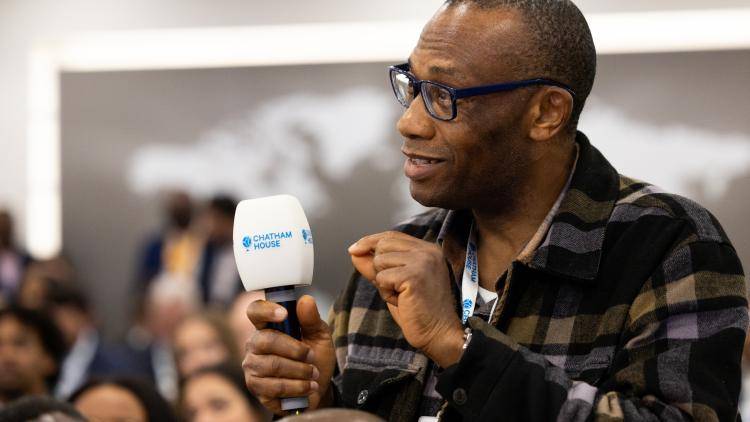
Grégoire Roos
Good afternoon. I see some familiar faces whom I saw yesterday, so you’re putting up with me a second time and a second day in a row. I’m impressed by your resilience. It’s my great pleasure to – are the other speakers online or – yes, they are. So, we don’t see you, but I imagine you. It’s my great pleasure to welcome you all here for a much-awaited discussion on populism. It’s a word that speaks to some of you, I guess, and we’ll see how the last geopolitical developments have impacted those political parties across Europe, and to a certain extent, whether they have changed the very definition of populism.
I was expecting more speakers in-person, but as we know, when one has a Baroness on stage, it’s worth a million in-person speakers, so we’re fine with just one physical speaker. I have with me today Baroness Claire Fox of Dudley, who is a member of the House of Lords, as independent, non-affiliated, I think is the right word. I think every one of you know her. She has had a very long – ideologically, very long career. Started on the Marxist side and now stands, you would say, neutral, you – when I said you are – “I’m not right-wing,” and I say, “You’re Libertarian,” you said, “I’m not.” So, I’m sure we’ll have a discussion about that later on in the discussion. And you were a member of the Brexit Party, and you were actually a Member of the European Parliament for six month. That might have been the most intense month in the whole of the UK history in the European Parliament, but that’s also another discussion.
With us today, as well, Sophie Pedder, who is the Paris Bureau Chief of The Economist, that everyone, of course, knows. She’s been in Paris for more than 20 years, if I’m not mistaken, and she started her career in South Africa, covering the end of Apartheid, and we’re very happy to have Sophie with us. She’s covered, for many years, populism and the rise of the National Rally and its different rock stars, or for that matter, the rock star, Jordan Bardella, and has published well-known book about President Macron, back then on a mission “to reinvent a nation.” I’m not sure that he’s still on that track at the moment, but that would also be the discussion for another panel.
And last, but certainly not least, Professor Timothy Garton Ash, Professor at Oxford University. I’m sure that all of you reads his columns in The Guardian, but I must say the best ones are in The New York Review of Books, and I really advise you all to have a look at them. Professor Garton Ash has published more than a dozen books about central and eastern Europe, part of the world he knows so well. One of them, “The Magic Lantern,” about the impact of the fall of the wall on Hungary, Poland and the – central Europe. And he, Professor Garton Ash, was awarded the Charlemagne Prize for his commitment to the European project and the European ideal.
So, I’m very happy to have you all here. I’d like to start, I mentioned geopolitics earlier, and it came to me as very striking to see that after the, what I would call the special operation of the US President in Venezuela, we saw different sort of reactions. One was that of Sir Keir Starmer here, lukewarm for obvious strategic reasons, but one was that of the French President, that very much sounded like a, kind of, endorsement, although it wasn’t officially. But the fact that he got retweeted by the US President and it being – you know, looking like an endorsement. Mr Farage and Mr Bardella, on the other hand, were actually much stronger in their condemnation. Mr Farage was more moderate, saying that there were “questions about international law,” but he was “very happy for the Venezuelan people.” Mr Bardella, not in a tweet, but in his best wishes to the press, said that question, “New imperialism of the US,” also referring to Donald Trump’s Greenland passion, sudden passion.
So, it’s really interesting to see that while I – looking at the title, the so-called “far right” or populist parties of, for that matter, France and the UK, have come out as more moderate than a so-called centrist leader in Europe. Are they coming out as “the new realists”?
Baroness Claire Fox
So, I – you’ve addressed to me first. I – and I want to suggest that the – there is no interchangeability between populism and far right, and I think that that’s a mistake to do that. So, you know, this idea that, oh, well, I’m moving from the far right to centrist – to the centre, misunderstands the nature of populism, so that’s the first thing.
Secondly, I think it is an interesting observation you’re making, though, because I think that what’s – one of the things that’s happened is, and it’s a, kind of, clash with Trump, is that if there is any such thing as something that unites populists, it’s a respect for the nation state and sovereignty. You know, that that’s what – that’s one of the things that they’re doing is they’re reacting against the ideology of globalisation. And that’s the way they would see it, you know, that the whole rules-based system of international order has been a way of undermining popular national democratic trends, and that’s the critique of the EU, as well. And so, consequently, when you see the American say, “Go in and snatch your President,” right, you – if you’re a populist, you go, “Just hold on, that’s not right, is it?” So, I think you can see that.
I also think, though, that the confusion in terms of the mainstream Politicians in terms of how they deal with this in terms of European leaders is an indication of the fact that the whole international order is in disarray and they don’t know what to think about anything, and there’s a – their reactions are all over the place. I’ve got plenty more to say, but I would be interested in hearing what the others say.
Grégoire Roos
I mean, Professor Garton Ash, there’s – for – it looks to me as, you know, the cordon sanitaire, this, sort of, firewall, I don’t know whether it’s a, kind of, 1989 moment, but all things being equal, the forum seems to be falling.
Professor Timothy Garton Ash
Well, let me start with your first question, are they probing more reasonable and moderate than Keir Starmer or Emmanuel Macron? I mean, I think the answer is a resounding no. But that reaction is very interesting, because what it shows is a certain nervousness. That is to say until now, on the whole, support, and it’s very clear support, coming from Donald Trump and JD Vance for antiliberal nationalist Eurosceptic parties in Europe, has, on the whole, been to their advantage, except with the possible exception of France, and I’ll leave Sophie to speak to that. But it’s certainly helped President Navrotsky to be re-elected in Poland, and it clearly helped the AfD in the parliamentary election last year. But now, and of course, Claire has touched on the reasons, the way he is behaving, and Venezuela but even more Greenland, threatening national sovereignty, is beginning to become a liability rather than an asset for them. And so, I think that’s a reason, rather than any sudden onslaught of reasonableness and moderation, which explains that response.
On the question that you have on your title, are they “selling themselves as the new realists” and “are electorates buying it?” My answer is clearly yes, electorates are buying it, and clearly, no, they’re not the new realists. There’s no question, if you look at the opinion polls, look at the credible results for Reform UK, for AfD in Germany, that electorates are buying it. In other words, they are speaking to certain discontents which are very widespread in our societies and finding a way in which to talk about them. But no if you look at the policies which they are adopting, because they have even less solutions than anybody else.
A very interesting example of this, and I’d be happy to expand on that in the discussion, but just quickly, a very interesting example of this is what happened to Geert Wilders in the Netherlands, where, of course, he went in as the leading party to a coalition, messed up, walked out in a massive fit of pique, and in the resulting election, lost about half his vote. So, that raises for me, the very interesting question whether it is wise at all costs to maintain the cordon sanitaire or firewall, or whether there isn’t a strong case, also from democratic theory, for bringing them into a coalition when they are the junior partner.
Grégoire Roos
But Professor and I – that offers me a transition to Sophie. It seems to me that Geert Wilders, so the far-right leader in the Netherlands, never really wanted power, for the simple reason that he actually brought down his own party and his own coalition. If one looks at Miss Madame Meloni or Bart De Wever in Belgium, those were leaders who ten years ago, were advocating the exact opposite to what they’re doing now. They are advocating for more European integration and there have never been so many legal immigrants in Italy. And now, the German Chancellor is best friend with Madame Meloni. So, what do you make of that? And I would perhaps turn to Sophie and then come back to you, because it seems to me like that some of them are actually showing that they can somehow deliver.
Sophie Pedder
Thank you. Can I ask your – answer your first question first, which is the – this one about the moderation of the far right? I just don’t think that what happened over Venezuela and then Greenland represents moderation. If you look at Bardella, everything he’s been saying, we interviewed him at the end of last year and it – he confirmed very much this distinction in his mind between admiring Trump for winning, admiring Trump for the way he appealed to a certain electorate in France – in the US, which they are also trying to do in France, and admiring for the – admiring the way he stands up for America, so America First. Bardella is for France First. But that’s almost about it.
In terms of sovereignty, that is a key – as Tim just said, that is an absolutely key message for them and therefore, you know, they are not prepared to support, and they know that electorally, it would be damaging for them to be seen as supporting anything about anything to do with the methods that Trump employs. And that’s where Venezuela fell on the wrong side, and so did Greenland. So, I think that it’s a que – the key question is sovereignty for them, it’s about, you know, putting the – respecting national borders, controlling and protecting national borders, and that is why he put out that tweet as fast as he did. And as far as Macron conc – is concerned, you know, I think he corrected his initial response to Venezuela with the rest of his comments, both towards Greenland immediately during the threat, and also in his speech at Davos last week. So, I think, you know, the – a respect for national sovereignty in Greenland coming – I think his – Macron’s made that very clear what France’s position is and what France – what his position is.
On your point about the firewall and the, you know, the Melonis – Meloniisation, I suppose, of the far right, you know, that’s the key question that we’re trying to understand in France. You know, is Bardella somebody who is more like Meloni and then, ultimately, once in power, would be brought round to a, sort of, more reasonable, possibly even European, sort of, accepting, if not supporting, position, or is he more like the, you know, the more of the, sort of, Or – Viktor Orbán school of far right politics?
And I think that you note – you need to be very careful when you look at the policies and where they would really lead you when it comes to the French far right. It – his positions have been very clear in that they are in favour of a very different sort of Europe. They don’t want, anymore, to take France out of the Euro. They don’t want – certainly don’t want a Frexit, which was something that Marine Le Pen in 2016, at the time of the Brexit referendum, was advocating for. But they do, in terms of policy, want to undermine almost all the central planks of European policy, whether it’s to do with energy, whether it’s to do with the budget, whether it’s to do with foreign policy, whether it’s to do with transatlantic alliances.
So, I think that there are distinctions. Even though there has been a, sort of, mainstreaming of the far right in France, there are very distinct differences between Meloni and even Bardella, and that is where I think, you know, we have to be careful not to, sort of, put them all in one category, and look at them on in – in individual cases to try and work out what they would represent in power.
Baroness Claire Fox
Can I come back on a few things? I mean, on the question whether the electorate are buying it, I think the problem with that question is it suggests that there’s, kind of, demagogs who are whipping up an electorate, whereas I see it the other way round. The reason why throughout Europe you have the growth of these populist parties, is because the electorate are searching for any vehicle that will give them an opportunity to say that the status quo is not good enough, that they have been completely squeezed out by technocratic governance, and that they are asserting themselves onto the stage of history.
And in that sense, I think that, you know, the term ‘far right’ doesn’t work any longer to describe these different movements. In fact, if anything, it’s used distinctly as a label, a little bit like the cordon sanitaire label, which is to describe people in such a way as that they are demonised and beyond the pale. The problem with that is that you then end up insulting the electorate and you end up dem – treating them as though they are people who need to be saved, somehow. And my concern with that is, is that the promiscuous use of the term far right, which is, you know – not a day goes by in the House of Lords when somebody’s not accusing somebody – you know, some aspect of Reform’s policy of being the far right and the word ‘fascism’ and ‘Nazi’ are used far too frequently and so on. What happens is you drag the meaning and the value and the strength out of those terms and when they are useful, you can’t ever use them, because you just use them with everyone. So, people are no longer – they don’t hi – pun – hit a punch in the same way.
And I – my final point is, you know, I – despite your introduction, you know, I think of myself as the Director of the Academy of Ideas, which I’ve been running for 25 years and for many of those years, I was, you know, a Radio 4 regular, potentially quite eccentric. I don’t try and suggest I was mainstream, but I was nonetheless part of the ‘chattering classes’ on Radio 4 all the time, and when I – it became known that I was going to vote for leaving the European Union, almost overnight I was cast out of polite society and called ‘far right’ by the same people. And it didn’t matter to me, I don’t care, but that’s what people’s experience of these things are, people then just assume. So, they knew that I was a left wing anti-racist and so on and so forth, and then suddenly, I became a xenophobic, racist, far right lunatic.
Now, that – if you, basically, use that as the way that we’ve dealt with the electorate, no wonder they’re abandoning the mainstream parties, who, by the way, have let people down. They’re holograms of themselves. They are not capable of delivering any longer, and rightly so, there’s a democratic revolution from below and the populist parties, such as they are, are completely inadequate to the task, no doubt about it, full of all sorts of weird cranks, that’s all true. But nonetheless I think it’s much more important to understand what’s happening historically than to get obsessed with the particular personalities who run the particular parties, because that’s superficial guff, in my opinion, and misses the point.
Grégoire Roos
So, if I understand, and I’d like to go back to Timothy here, it’s interesting to hear you say that, you know, overnight you were outcast, as everything you – the list you shared – mentioned. And it seems like the cordon sanitaire, or the firewall, is not just falling, it’s just that people are bringing it down because they’re fed up with that feeling that they – it’s us versus them, and the, kind of, exclusion from the moral centre. Do you see it that way, Professor?
Professor Timothy Garton Ash
So, first of all, I think in some cases the label ‘populist’ is justified. In other cases, I think the label ‘hard right’ rather than far right, is justified. But let’s not get hung up on the nomenclature. Where I very much agree with Claire is that the popularity of these parties reflects a deep unhappiness, genuine concerns in a very large part of our societies about what’s happened to our countries and the way they think they’re heading, and you have to respect the voters in a democracy. So, in my book the notion that one should ban the AfD, which is being seriously discussed in Germany, a party which is getting 25/30/35% of the vote, is profoundly anti-democratic. I think it’s even problematic to ban individual candidates, Marine Le Pen, for example, on legal grounds, but one could discuss that. That doesn’t mean one has to like these parties at all or think they have the answers, but I do agree we have to respect their voters. So, that’s point number one.
Point number two, you, Grégoire, asked, does it turn out that they’re succeeding when they get into power? The answer is occasionally, only if they don’t practice what they preach, or at least have their cake and eat it. Most successful populist, hard right popul – Politician in Europe in our time, Viktor Orbán, key to his success, he gets somewhere between 3-4% of his GDP from EU funds over a period of many years. Funds that he can use to susport – support his own regime and prop up his own system, rewarding, for example, friendly oligarchs, while continuing to win votes by attacking the EU, biting the hand that feeds it, and astonishingly, the EU goes on feeding the hand that bites it.
Example number two, Giorgia Meloni in Italy. How does she succeed? Well, by having the largest single share of next generation EU funds and using them the way Mario Draghi recommends. So, massively trimming her policy and being very co-operative in other ways, while, of course, keeping a hardline policy on immigration. So, sure they can succeed if they don’t practice what they preach or have their cake and eat it. But that said, the one really significant, or the most significant, ‘cause there’s also Land elections in Germany, but the most significant European election this year is in Hungary, 12th of April. And there’s a good chance that Viktor Orbán will lose that election, because if you ever go to a Hungarian hospital or Hungarian school, or a Hungarian street, you realise that the money has certainly not gone to Hungarian hospitals or Hungarian schools.
Final point, it really depends in what context populist or hard right Politicians come to power. If it is, as in the Netherlands, in a coalition where there are strong constitutional constraints and they are, you know, not the dominant party, that’s one story. The prospect with Bardella is, of course, that in the political system of the Fifth Republic, with enormous power in the hands of the President, you would have Bardella there, potentially Meloni still there, Parliamentary election in Poland in 2027, which would mean potentially both President and Parliament are in the hands of Law and Justice or some hard right populist coalition. And there I very much agree with Sophie, that means a weaker, tendentially disintegrating, slowly, softly disintegrating the European Union, ‘cause whatever else, these leaders will have a nationalist agenda.
Grégoire Roos
We have some excellent questions piling up on the chat, but I’d like to pick up what you’ve mentioned earlier, Professor, about the fact that they don’t – they succeed only if they don’t implement what they preach. But then you would tend to confirm that they are the new realists, and when they are the new realists, they do perform well in the polls and they also deliver. Is it the way you see it, Sophie? I mean, you mentioned AfD, for instance. It was interesting to hear one of the members, the Bundestag AfD, saying that, regarding the German energy transition, we should – “They should tell it from the perspective of a child whose mother cannot pay the energy bill.” And it – to me, it sounds like what Jordan Bardella calls the le bon sens, the common sense. Do you see it that way, Sophie?
Sophie Pedder
Yes, in some respects that’s the way that they present their policies as being – and Marine Le Pen has done that, as well. You know, it’s – this is a common-sense politics for the common man, as it were, or common woman. But – and you know, I think that the – one of the points that’s been raised, and it’s important to bear it in mind, is that these are inf – these are ideas that have been mainstreamed over a long time in France. It – this is not something that has just, sort of, arisen in the Trump era. You know, Jean-Marie Le Pen founded that party in 1972, co-founded. We’re talking about decades of, sort of, slowly progressing ideas that have taken root and been expressed in different forms, parties, changing its name, changed its leader.
But these are things that have become increasingly mainstream and that, you know, therefore, you know, one of the points raised earlier about, you know, do – are you ‘whipping up’ fears or are they, sort of – is this part of the way people feel? This is the part of the way people feel now. It’s been taking place over a long period of time, but it is absolutely – if – there was an very interesting poll in Le Monde earlier this month, which was a big sample size, and suggesting that 42% of the French are now – agree with the ideas of the National Rally, that’s huge. That’s far bigger than the percentage of the polls – of voting that they’re likely to get in any sort of vote in France.
So, I think that, you know, that’s the first point, and the second point that I wanted to make is, you know, to – thinking through what this would mean if there is a, kind of, coincidence in power, obviously not in Germany at national level yet, but in some of the big countries in Europe, possibly Poland, certainly possibly France. What that would mean for not only the European project, but a lot of the under – the central policies that Europe has been pursuing as it has tried to act more as a power in the, sort of, Trump era, and that is going to be really difficult. And I’m thinking there, obviously, of support to Ukraine, how to deal with Russia, how to build up European defence.
The situation that Tim was just describing is – would be a very difficult one for countries that were not run by whatever you want to call them, populist, hard right, far right, nationalists. It would be very difficult and the balance of power within Europe would be extremely unstable. And ultimately, you know, in Europe, as we’ve seen over the entire post-war era, if France and Germany don’t have a way of coming together and agreeing, nothing happens in Europe, even today, even in the enlarged Europe. And so, I think, you know, we’re – we’d be looking at an extremely unstable European project and a very difficult time for the continent.
Grégoire Roos
But it would seem to me that should he be the candidate next year, Jordan Bardella would somehow stand out as someone a bit different from Marine Le Pen insofar as he would rather target the traditional right-wing electorate and would struggle winning over the former Communists in northern France. But a thin one to…
Baroness Claire Fox
Sorry, I was going to make a general point, so…
Grégoire Roos
No, go ahead.
Baroness Claire Fox
Oh, well, I just wanted to reflect on a few things that have been said. You know, when we say that, you know, that the populists are, kind of, upturning the energy policies, I mean, as well they may do, because as far as people are concerned, I mean, most of European countries are in a complete mess in terms of their energy, and I don’t just mean the prices in terms of consumers. I mean that an ideology around Net Zero, that’s been taken to such an extreme that we’ve got into a situation where we are now longer committed at nation states to the creation of cheap reliable energy sources. And this has had a detrimental impact on economic development and growth, apart from anything else, and it’s perfectly reasonable to critique that.
So, some of these broad themes are completely appropriate correctives to something which became you can’t question that around climate change. You know, do – you know, no debate is allowed. Now, this is not because, of course, this is what usually happens when I say something like this, “Climate change denier in the audience, she’s a far right,” you know, blah-di-blah. I’m not, I can assure you, but the fixation on a particular ideological approach to the creation of energy for a country, for any country, has got us into a complete mess, and anyone who points that out should not be closed down.
Which just gets me onto the other thing, which is one of the things that’s very important, and just in terms of how, as it were, populism it means anything – if it means anything in terms of this international trend, is an attempt at closing down the debate. I mean, I’m ver – I – you know, I’ve been following the Democracy Shield initiative that’s come out of the EU, which is an absolute classic. It’s, basically, an excuse for authoritarian policies in order to defend democracy. But one of the ironies of this is it says it’s “a very popular campaign” and it’s got “popular support from across Europe.” I wanted to point out that they did a consultation which had 5,000 and 807 responses out of 400 million people, and they say they’ve got popular support.
They then go on to talk about the need for “fact checkers” everywhere, “misinformation tsars, taking down content that will destabilise democracy” and so on and so forth. In other words, there’s a, kind of, censorship “Ministry of Truth” writ large, and I – the reason I’m saying that is because I think that we also have to understand the positive case for a new kind of politics is informing a lot of this, which is people want the freedom to speak, debate, openly and freely. And a lot of the mainstream Politicians’ response to the growth of populism is to immediately want to close them down. And I’m not suggesting that’s been said here, but that has been what’s happened, and that’s why the cordon sanitaire is such a disaster, I mean, if – you know, to bring that in – because you can try and isolate people, but you actually force them into an echo chamber.
And if anything’s going to explode the populist revolution, it’s likely to be where you’re treated as though you’re a basket of deplorables, you know, gammon to be, you know, treated with such contempt. These are milli – this is the electorate. You know, no Politician equals anything without that electorate, so they need to be shown respect and talked to, not silenced and re-educated with the correct ideas on energy, immigration or what have you. It’s our society, we are equal in it, and we should talk to each other with mutual respect. And I think that what the populists have done well is they’ve given a voice to that sense and need for solidarity and a building up of community in a nation state, which people have felt completely eradicated from.
Grégoire Roos
I had a chat with a former – a Commi – EU Commissioner and saying – asking him how he felt about the changes over the past few years and what he missed the most. And he said, “You know what I miss the most? The Brits in Parliament because I like to argue with them,” and I understand listening to you. I’ll go back to some of the brilliant questions online, and I do apologise, because they’ll all terrific. So, I’ll have to select some of them. One that caught my attention is, “Is the depiction of a typical right-wing voter changing and is it a uniform change across Europe, and is this depiction problematic?” I think that somehow echoes some of the comments you – the three of you had about, you know, dropping nomenclature and definition, but I think that that does matter. Timothy, would you want to take that?
Professor Timothy Garton Ash
Yes. I don’t know about the depiction of a – this fictional person, a typical right-wing voter, who I think has probably never existed, but here’s an important point. Historically, after 1945, we got something new in European politics which was called on the continent Christian democracy, small l liberal Conservative, centre right, and that was a reaction to what we had seen on the European right in the decades before 1945, and particularly in the 1930s and 40s. And, you know, by 1995, this personified, if you like, in someone like Angela Merkel, was regarded as normal, if you will. I don’t know about the typical voter, but your typical centre right party was actually something unprecedented in European history of something new.
And what’s happened now, Grégoire, is in a sense, we’ve got back to a more normal pre-1945 European situation where you have a whole spectrum across what is called the ‘right’, from still liberal Conservative, Christian democratic, all the way out to neo-Nazi and fascist, and all points in between. So, that’s the analytical point. Now, strategically or tactically, the question then becomes, so, what do we do about that and what alliances are acceptable and what are not? And here I think it’s horses for courses. You have to look at the actual parties on the, choose your term, hard right, populist, whatever you want to call it, and say who are these guys really? And they are very different. I mean, Reform UK is very different from Vox, which is very different from Law and Justice, which is different from Meloni, which is different, again, from parts of the AfD, which are certifiably far right, indeed neo-Nazi, and so, it matters who you’re getting into bed with.
Then the question is, what’s your political system? Is your political system going to give all power to someone from these parties if you bring to the power, or do you, as in Italy, by the way, have rather strong checks and balances, interestingly, it turns out at least as strong, if not stronger than in the United States? Or do you have PR and do you, therefore, need to have coalition governments, which is another very, you know, important kind of constraint? So, I don’t think there is a simple one size fits all answer to that question. You have to take it case by case. I don’t think the right answer in all cases is cordon sanitaire or firewall, but nor do I think the right answer in all cases is hey, the people are speaking, so let’s let them into government.
Grégoire Roos
Thank you very much. I know Sophie needs to go in nine minutes exactly, so I’d like to take some questions from the audience should you have a question to Sophie, in particular. Yes, the gentleman in the middle. There’s a microphone coming on your left.
Councillor Luke O’Brien
Hi, I’m Councillor Luke O’Brien. I am a Branch Secretary of a local Reform branch, and I can tell you that we have a mix of independents, former Labour, former Conservative voters and everyone’s just frustrated. There are a number of key issues which they feel aren’t being addressed by the main political parties or have been caused by the political parties. So, I think the term ‘far right’ is a bit of a generalisation and we need to be a bit careful about judging people. How do you think we can better understand the concerns of these voters who feel neglected by the main political parties, and how can we address those concerns? Thank you.
Grégoire Roos
Thank you very much. Sophie, is this something you perhaps want to take? Do you think that the National Rally, in particular, is – would provide the gentleman a proper answer, or does, for that matter?
Sophie Pedder
Yes, I mean, I could certainly talk about it in the context of France, because we are looking at exactly the situation that you described. That’s to say that voters feel they haven’t had their concerns addressed by either the left of the right, and now the centre. We’ve had all three, sort of, of those, you know, political par – families represented in power in France and the only one that hasn’t taken power at national level is now the National Rally. And that is, I think, a very powerful way that the party is appealing to the electorate and it’s – you know, it goes a long way to explain why they are in the position they are.
On the – on just this question, and I’ll, sort of, finish on that – this point, I think, on the question of firewalls and keeping out – whether they are [inaudible – 41:10] whether or not they’re useful, whether or not they’re defensible. It’s an interesting case in France because I think what we will look at next year, there’s a French presidential election next spring and it will be followed by a legislative election. And the chances are that even if the National Rally does win the presidential election, the legislative election that follows, it is unlikely – it could, but it’s unlikely to get a full majority. At which point there will be a real question put in front of the parties in France, and that is, does the centre right, the traditional Conservative Party, hook up the re – that, known as the Republicans, hook up with the National Rally to form a government? And that, if it happens, would be the end of any, sort of, effort to maintain that firewall.
It’s not the same firewall as the way it’s used in Germany, partly ‘cause the National Rally, you know, has actually, you know, cut links with the AfD, so they don’t see themselves at all as a, sort of, an ally. But also, because, you know, the National Rally is absolutely part of the furniture now in the French political system. They have the biggest single party represented in the lower house in the National Assembly. They are, every day, sitting there in Parliament, taking part in debates. They have Vice Speaker positions in Parliament, so they will actually chair debates. They are part of the democratic process now, and I think that we will see next year a real moment where the, sort of, cordon sanitaire, which has kept them out of power, could be absolutely, sort of – you know, it could be the end of that in the French system, be – partly because, as I said, of the legislative elections that follow.
But the points that you’re – you were – that were raised by the question that – in – coming from the audience, are absolutely valid to France and explain why things are looking the way they are.
Grégoire Roos
Thank you. Please, sir. There’s the gentleman with the red or brown – or red – looks red to me, but Bordeaux, I’d say.
Peter Hurst
Thank you. Peter Hurst, member. In terms of what Po – what right-wing Politicians would do when they’ve gained power, would the panel agree that things have changed a bit in terms of you could also add to the mix of what they can get away with? Because we have immediate responses to actions these days, at least in the UK. We have polls and we have commentators, so people know when they’ve gone too far, and there’s an example of this, I think, in America at the moment. So, is that – needed to be added to the mix a pragmatic right-wing Politician will try to go as far as they can, but they won’t be able to go further than that? Thank you.
Grégoire Roos
Timothy, is that something you want to take?
Professor Timothy Garton Ash
Just quickly, you know, there’s a sole discussion about what to do if ‘populists’ come to power, and people say, you have to ban them or not go into, you know, coalitions with them at any cost. My answer is that you need to strengthen the constitutional and social and cultural checks and balances on what anyone in power can do. So, really strengthen the independence of the courts, for example, of the civil service, media pluralism and so on and so forth, so that whoever comes to power can’t do what Viktor Orbán has done in Hungary, which is, effectively, to demolish democracy and turn it into an electoral authoritarian regime. So, that would be my answer on that point, that you have to strengthen the checks and balances and as it were, the social consensus on where our shared red lines are in terms of what you can do. You can’t just have ICE Agents going off, you know, shooting American citizens on the street because they are peacefully pros – protesting.
Can I just add one thing quickly, Grégoire, which is I very much agree with Claire about respecting the voters. You know, to dismiss people as “a basket of deplorables” is, itself, deplorable, unless and until what you’re getting from them is outright racism and incitement, and if that point, you do have to say, “Enough, no more, no further,” right? So, I think there’s a – there is a red line there which it’s really important to uphold.
Baroness Claire Fox
Ah, well, that could be an argument in relation to free speech, but one of the problems is, is that the definition of what constitutes racism shifts and certainly what constitutes incitement has become very muddy, but actually, let me focus a minute.
It’s interesting that you were talking about Viktor Orbán. I mean, we’re living in the United Kingdom and we’re worrying about what will happen when the populists take power. We’re living under a Labour Government which I had some hope for after the complete debacle of the Conservatives. We’re lundy – living under a Labour Government that a) has just cancelled loads of council elections for the most technocratic of excuses. It is discussing getting rid of jury trials, something I never thought would happen, the base – bastion of democratic rule. Has really clamped down on free speech and, you know, JD Vance might well have said, you know – come over and lectured in Europe about the crisis of Europe in relation to free speech. But in fact, The Economist last May had a Special Edition saying, “He might be a hypocrite, but he’s right,” and used both Germany and the UK as the most censorious of countries. And every day, let me tell you, when I’m in the House of Lords, I’m fighting off what I consider to be illiberal liberals bringing in more and more authoritarian measures every single day.
And there are huge scandals, like, for example, the grooming gang scandal. And so, just on this – to go back to the racism point. The grooming gang scandal, which some of us were talking about for a long time, the sexual abuse and rape of underage girls and children throughout the country which nobody would talk about and covered up. Now, I know it’s now more widely known. Anyone who raised it, and I raised it from a women’s rights point of view, was accused of being a racist. It was so galling and it was covered up by the authorities, councils, the Police, Social Workers, Teachers. So, local people in those areas were tearing their hair out and they were called racists, and raising it was a – they were accused of incitement.
And I think it’s just really difficult, because we live in complicated times. We have the rise in radical Islamism internationally, a real problem. We have visceral antisemitism in this country, which I don’t think is seriously taken up or looked – is being tackled by Politicians. I’m worried about extremism on the left and on the right, so don’t get me wrong. But the political discourse is not up to it, and that’s why new political arrangements and new political parties people want to give a chance to, and you can see why. And also, by the way, you were asking what a typical – what these days the populist voter’s like. There’s a lot of them are young, right, a lot of them are young and I’m humiliated, as a lefty, to be in a situation where the left is associated with censorship and all of these coverups and self-regard. And therefore, anybody who’s 18/19, doesn’t want – who’s got anything about them, thinks they must be right-wing, because if that’s what the left’s like, why would you be – want to be one of them, right? Identity politics riddling – riddled with divisiveness and so on.
So, what I think is we’ve got to be much more openminded about a new political set of arrangements and undoubtedly, these populist parties will be part of it, but they’re not the end of the story. They’re the start of a new historic area.
Grégoire Roos
I think Timothy’s hand is boiling, I know, but I also have so many hands here. Talking of women’s right, I apologise to gentle – to you gentlemen, but do we have a lady? Yes.
Maria-Letizia Freiin von Bibra
Thank you. I’m Maria-Letizia. I’m from the Journal of Genocide Research, and I have two quick questions, if that’s allowed. One is…
Grégoire Roos
Sure.
Maria-Letizia Freiin von Bibra
…how are transnational networks between right-wing actors, particularly between Europe and the US, changing, and maybe what divisions are forming? And how has the failed co-operation between centre and left-wing parties created more legitimacy for right-wing ecosystems?
Grégoire Roos
Brilliant, thank you so. Timothy, you want to take them both, plu – and reply to Claire, as well?
Professor Timothy Garton Ash
Yeah, you…
Grégoire Roos
And your hand will…
Professor Timothy Garton Ash
Yeah, you guessed, Grégoire, I don’t know how you guessed. So, first of all, Claire talked about ‘illiberal liberals’. Claire, as an liberal liberal who’s spent ten years, as you know, writing a big book about free speech, you totally misunderstand me. You’re assuming that the prescribed response to racism was to ban it and lock people up, not a bit of it. What I’m saying is that’s where respect for the voters end. I don’t respect an antisemite; I don’t respect a Muslim hater. Speak up against it, that’s what I’m saying.
On the very good question from the floor, it is absolutely fascinating in two respects on the transnational or international networks. The extraordinary influence of Viktor Orbán on the American right. He is a hero to the American right. He is the one person who was mentioned by name by Donald Trump in his presidential election campaign, and I can’t think of a – easily of a historical President where a small European country has played such an important role in the thinking of people in the United States and the American right. And at the same time, this is the fist time, I would submit, ever, where we’ve had a US administration which is explicitly and systematically supporting nationalist, antiliberal, Eurosceptic parties in Europe. The US has often intervened in European politics, but never on the side fundamentally opposed to the project of the European Union. So, I think those connections are very important.
And if I understood the second question correctly about, sort of, centre left and centre right getting together and then not delivering anything, this is the, in my view, tragic failure of Emmanuel Macron in France. And I’m sorry we don’t have Sophie still with us to answer that. What’s happened in France is you put all the liberals together in a big centre and then you utterly fail to deliver, and therefore, very unhappy voters have only two choices, an extreme antiliberal left, Mélenchon, or an extreme antiliberal right. So, at least in this country we still have some sort of alignments of left and right, so that whatever happens, it’s likely to be some combination of liberal and antiliberal left or liberal and antiliberal right.
Grégoire Roos
I think the gentleman over there has had his hand in the air for ages, yeah.
Bernard Herman
Yeah, thank you. Bernard Herman, a member of Chatham House. In the la – over the last 70 years, since the 1950s, European countries have used the unitary welfare state as a means of social cohesion. With growing international competition from Asia, we are simply not able to afford an adequate social security net and that – the situation is likely to deteriorate over the next few years. Is this an agent for far-right extremist support, and is there anything we can do to prevent it?
Grégoire Roos
Thank you so much. This is a brilliant question. Claire, you want to take it?
Baroness Claire Fox
Well, yeah, no, that’s fine. I don’t think that the welfare state has been functioning as an adequate security net. Its growth and its huge influence and the costs that it now demands from the state, I think are inappropriate and has created a culture of dependency. Now, I mean, this is my subject, so I won’t go on, because otherwise I’ll go on forever, but everything from special educational needs, the growth of sickness benefit, the number of people who are, basically, not in work who are young, who say they can’t work and so on and so forth, this is not what we would traditionally describe as the welfare state.
So, I think that the over-bloated welfarism that we have in this country, which as we know – I mean, I know that the Labour Government understand this, but they haven’t got the courage to do anything about it, needs to be tackled. And if it’s not tackled, it will bankrupt the country, to be frank. It’s certainly bankrupting a lot of local councils as we speak, but I don’t think that’s just the normal welfare state, you know, the safety net, right? Because actually, we should be able to run a state – a welfare state with a safety net that’s not the way we have it now, but it would take political courage. And it’s through – I’m afraid it’s been political mistake upon mistake, ironically trying to buy off, in some ways, different sections of the electorate, by the mainstream parties, that’s led us in this position, but also, all sorts of cultural problems in relation to pandering to a lack of resilience and so on. You know, there’s all sorts of other things, as well.
I – it – can I just say one other thing, am I allowed? Or no, take another question, I’ll come back…
Grégoire Roos
It’s a free speech…
Baroness Claire Fox
…at the end. But – no, no, no, go on.
Grégoire Roos
But it’s a free speech stage, so…
Baroness Claire Fox
No, that’s fine.
Grégoire Roos
We’ll just collect several questions…
Baroness Claire Fox
Yeah, yeah.
Grégoire Roos
…because I would feel bad. So, the lady in the back and we’ll take as many as we can and then…
Member
Thank you. There have been a lot of comments about the, sort of, bottom-up democratic wave of populism coming from the people, but I’d be interested to hear views on the role of foreign adversaries, so Russia, China, in, sort of, stoking European division.
Grégoire Roos
Thank you very much. Sir, I’m so sorry, I’ve had you wait for a very long time.
Member
This is for Timothy Garton Ash, please. Just coming back to your previous point, that context always determined is relevant to results of an election, method of an elec – results of an election, that’s always been the case. But looking ahead, the next couple of years on the European scene, how relevant and important do you think that’s going to be to individual elections in the European sphere in the next two or three years, please?
Grégoire Roos
Thank you, and perhaps beyond – yes, over there.
Max Traeger
Hi, Max Traeger, Chatham House member. Is there anything that non-far right populist parties in Europe can do to stop being beaten by these parties? And I know there’s been some debate over what far right or what populism means, but I think although there are quite clear differences between some of the parties, there is obviously, a clean through line here, and what can we do to stop them?
Grégoire Roos
Right, we’ll just take those and come back to you. We have five minutes. It should work if your answers are short. Long questions, short answers, does that work? Timothy…
Professor Timothy Garton Ash
Okay.
Grégoire Roos
…are you happ…?
Professor Timothy Garton Ash
Very short Russia, China are trying very hard, particularly Russia. It depends where you are. In a country like Slovakia, Russian disinformation campaigns have been very effective, marginal impact in a country like Britain. Context matters enormously. There’s no such thing as a European election. There are national elections, each nation is different and there is a set of generic grievances, but then there are also very specific circumstances.
Third point, how to respond. Just two things on this, ‘cause this is, obviously, the key, the question of questions. Number one, every day when you listen to the Today programme, someone describes something terrible that’s gone wrong in our country and says, “What we need is more money from the state.” And it is totally impossible for the state to meet all these demands, not least when we’re going to increase our defence spending. So, I very much agree with Claire, we actually need an honest conversation about what the state should do and shouldn’t do in the 2020s and 2030s. And if the small l liberal parties led that conversation and actually started delivering that, would be good.
Secondly, it’s amazing that we’ve got to minute 57, Grégoire, without mentioning the word immigration, ‘cause of course, immigration is the key word for many populist parties. And what I would say very briefly on that is that small l liberal parties of left and right need to have a clear double message. Part one, we get it, you’re very worried about irregular immigration, you’re actually worried about the scale and speed of immigration over recent years, we need to manage and control that. Message two, however, we really badly need well managed immigration to pay your pension and look after you in your old age, and we’re going to have a society, and want to have a society, where people of different religions, different cultures, different traditions, different skin colours, are equally citizens and equally Brits or French or Germans or Dutch, or whatever it is.
And what I miss from the mainstream parties is the second part of the message. They’re always chasing the populists on “take back control, stop the boats, stop the migrants at the frontiers.” They’re not delivering the equally important second part of that message.
Grégoire Roos
Claire.
Professor Timothy Garton Ash
Con…
Baroness Claire Fox
How can we stop them? Try persuading the electorate that you have better arguments, and if you can’t, get better arguments. Build better parties, that’s how you’ll stop them. It’s called democracy and you need to be able to convince more people than the other side that you are the right group. Nowhere the – no shortcuts allowed, and basically, saying that, you know, maybe it’s Russian and Chinese interference is just an excuse. It’s – I’m not doubting that Russian interference in some election – in places as has already been said, but when, you know, Brexit happened or when Reform gets votes, and everyone says, “Oh, it’s the Russians what did it,” you just think oh, grow up, right? It’s an inadequate response, right? Because even if the Russians were trying to interfere, the truth is there’s a problem in this country.
Number two, transnational networks. We haven’t mentioned – we got through without mentioning immigration, we haven’t mentioned social media, which is remarkable. One of the things that has happened is that people now are able to have, for good and for bad, different transnational conversations. So, many people are involved in – they know what’s going on in the world beyond looking at the BBC, if you see what I mean, or through a particular type of narrative. And that’s both been – you know, we all know can be good and bad. But I actually think there are more networks happening that aren’t organised by the EU and we at the Academy of Ideas, have set up a European Free Speech Network, by the way. So, there’s also grassroots networks.
And the final thing is just on immigration. I think that immigration is undoubtedly a lightning rod through which people’s dissatisfaction is expressed. That they said – they were told that they would be listened to, and everybody said, “We will cut immigration, we will deal with that,” and then ignored them. Secondly, they said, “If you go on about it too much, you must be racist,” so that’s enough to wind anyone up. And actually, there is a problem of mass immigration at such speed and scale in terms of the instability of local communities, the nation state and so on and so forth, and we’re not prepared to have an honest conversation about it.
All of these different things, and also, borders do matter. The nation state is so important. Why sovereignty matters, it’s the largest place that you can have for democratic accountability to happen. That’s why it matters, right? A geographic place where everyone living inside it can have something in common and Politicians who are answerable to them. That’s, historically, one of the great gains of the modern period and we throw it away at our cost. And of course, the EU says don’t you worry your pretty little heads about that sovereignty problem, by the way. Well, I think we should, ‘cause we need to be hel – able to hold people to account.
And so, immigration sums that up as a problem and the ignoring of the immigration question has led to the worst kind of divisive, fragmenting impact on the streets. And actually, there will be a racist backlash if something doesn’t happen about it, that’s the truth.
Grégoire Roos
And I understand why the Academy of Ideas has called their annual festival “The Battle of Ideas.” On this I thank you very, very, very much for what has been an extremely insightful discussions. I do apologise to all those who had questions in the room. We tried to take as many as possible. I thank you all online who joined us and share your questions, and I really look forward to staying in touch with all of you and seeing you very soon, again. Have a nice evening [applause].
Baroness Claire Fox
Thank you [applause].