Bronwen Maddox
A very full hall and many people online, as well. Welcome to Chatham House, I’m Bronwen Maddox, the Director. I am delighted we are having this conversation with Alexander Stubb, Finland’s President, on “Why Europe needs flexible integration.” Now, he needs very little introduction. He has been Prime Minister, he has had a multi-sided ministerial career, but he has had, if you don’t mind my saying, a lot to say recently, as Europe’s role in the world and its position in relation to China and the US has become more and more an active question, not just for the countries of Europe. So, I think we’re going to hear more of that today, I look forward to it. Very warm welcome.
Alexander Stubb
Thank you. Thank you very much, and good morning to all of you. When you said he needs no introductions, I’m remind…
Bronwen Maddox
Very small introduction.
Alexander Stubb
…I’m reminded of Henry Kissinger, who said, “Perhaps not, but sure, it is nice to listen to them.” It’s a real privilege and honour to be here today at Chatham House, one of the legendary places to be able to deliver a speech. I’ve actually written a speech. I wrote it on my way back from India about a week and a half ago, but I will not use the script. It either has been, or will be, delivered to you at a later stage. You will have seen that the title of the intervention today is “Why Europe” must embrace “flexible integration,” again, and originally the idea was that I would deliver this at my alma mater, the London School of Economics, where I wrote my PhD on the subject, but we thought we wouldn’t get a crowd at all, so we came here to Chatham House instead.
A lot of times when Heads of State and government come and give speeches in foreign lands, they make a claim in the beginning how important that place is for you, and alliances and the rest of it, but I do have to say that, for me, I think literally, the UK is pretty much a second home. You will perhaps know that my wife was born and raised here, our children have dual nationality. I have studied and done my PhD in the United Kingdom and spent a lot of time here, so it certainly does feel like being at home, and when you’re at home, you can say a few hard truths. I’ll do those towards the end of my speech.
This speech and talk will be about Europe, but also about flexible integration, its past, present and future. And flexible integration meaning very shortly, that not every EU member state, inside or outside, has to do everything at the same time. Therefore, examples, EEA, therefore, examples, the Euro, therefore, examples Schengen, but more on that in a little bit. This is also for me a little bit a walk down memory lane. I noticed when I started writing the speech, the old memories coming back of what it felt to deal with a subject which wasn’t that hot at the time, in the mid-1990s. And what I’ve done is I’ve divided what I’m going to say today into four bits. One is how it began, two is how it has changed, three, where are we now? And four, what about the UK? So, I’ll leave the best bit to the end.
So, let’s begin how it all began. Now, on the subject of ‘flexible integration’, I ended up publishing a piece in the Journal of Common Market Studies in 1996. It had a very sexy title, which was, “A Categorization of Differentiated Integration,” an instant bestseller. But it was a big thing for me as a young student, I had just come out of the College of Europe, done a master’s degree there and written my thesis on ‘flexible integration’. And you might wonder, how was I able to publish it in the JCMS, which after all, was, and probably still is, the hot EU journal? Well, it was because my Supervisor was Professor Simon Bulmer, who was also the Editor-in-Chief of the magazine, and thought this was a great thesis.
It was a big moment for me, and I think from that moment on, I felt that I might want to pursue an academic career, and I certainly wanted to write a PhD. Because a few months earlier, I had – or a year earlier, I had called the Finnish education authorities and said, “I have studied very hard in the United States, I have a Bachelor of Arts, what is it equivalent to in Finland?” They said, “Ah, not really anything, but if you inscribe yourself into Helsinki University, you might get a couple of courses in.” From that moment on, I decided I’m going to do an MA in the Anglo-Saxon and PhD in the Anglo-Saxon system, and flexible integration it was.
I got a little bit lucky because I had a chance to work for the Ministry for Foreign Affairs. We have many Diplomats here in the audience, and that was negotiating the Amsterdam Treaty. And for those of you who are not EU nerds, you will remember perhaps that the Amsterdam’s Treaty was the place where we enshrined enhanced co-operation or flexible integration, into the treaties. So, I had the chance after those negotiations to come back to London in 1997 to basically, combine my idea of a categorisation of differentiated integration and then how it was negotiated, into the treaties. And of course, on the thesis – or theme of really grabbing titles, the title of my PhD was “Flexible Integration and the Amsterdam Treaty: Negotiating Differentiation in the 1996-1997 Intergovernmental Conference.” It is still available in the LSE library; I checked it out yesterday.
So, you know, it was one of these moments where I was able to bring a theoretical framework and then practical experience from diplomacy, and my Thesis Supervisor was William Wallace, who was at the LSE together yesterday with Helen Wallace, meant a lot to me, and my external – internal Examiner was Chris Hill from the LSE, and external was Geoffrey Edwards from Cambridge. And lo and behold, they approved the thesis and were quite happy about it, and I got it out in 1999.
But I think my relationship with flexible integration wasn’t over at that stage yet, because I started working at the EU Embassy, or EU representation in Brussels, with the grand title of Deputy Antici. For those of you who might know, it’s the helper of – the real helper of the Ambassador in Political Affairs, and the Ambassador at the time was Antti Satuli, and the Antici was Markku Keinänen, who later actually became our Ambassador here in London, now retired.
Having said that, the Nice negotiations consolidated flexibility, although it was more about institutional battles, but then we, sort of, spun it onto the Constitutional Convention and the Lisbon Treaty, where everything came together. And interesting enough, Finland proposed the “Ten Commandments of Flexible Integration,” which were the conditions on the basis of which you can actually advance inside the EU. I then, after the Nice negotiations, took about a month off to spun the PhD into a book, and by this stage, I had really developed the title because it was “Negotiating Flexibility in the European Union: Amsterdam, Nice and Beyond.” Bestseller with Palgrave, still available on Amazon, I hope.
So, here we go, I mean, this is, kind of, the first time that I’m speaking about ‘flexible integration’ since I stopped, because it’s one of those things, I’m sure many of you have worked with a certain subject for years, and then suddenly, when you’re done, you just don’t want to touch it. I’ve been asked to talk about it at various occasions, or write about it, but I, sort of, stayed away. And here’s where I come to my second point, how has the world changed since the 25 years ago when I published these things linked to flexible integration? Well, the clear observation is to say that the PhD has aged much better than I have, because it still has some relevant bits.
But we quite often forget how things advance. Remember, when I was writing this, the EU had 15 member states, including the UK. Now it has 27, excluding the UK. We have ten countries that are knocking on the door of the European Union, in other words, wanting to become members. We quite often forget that, that the convening power of the EU is actually quite strong. We’re quite good at bashing it but forget that most countries in Europe nowadays want to join. At that time, we didn’t have the Euro, or it was just about to be launched, we didn’t have the Lisbon Treaty. Our economies were actually doing quite well in the early 2000s. We hadn’t seen the financial crisis, not the Euro crisis, not Brexit, not COVID, and actually, life in the Brussels bubble was quite good.
I was one of those that firmly believed in the “End of History” thesis by Fukuyama, because we had seen a fairly relatively peaceful 1990s, and the end of that i – or the idea of that, of course, was that more or less 200 of the world’s nations would somehow gradually convert toward a system of governance which entailed liberal democracy, social market economy and globalisation. It was all about the institutionalisation of the liberal world order. But of course, now, 25 years later, with the wisdom of hindsight, we can say that things didn’t pan out as we expected. The unipolar moment of the world, led by the US, ended up in a multipolar chaos that we have, a world of disorder. Our holiday from history, especially here in the West, is over. The relative era of peace is over. We have war in Europe, we have war in the Middle East, we have war in Africa, and these wars are wars of both aggression and choice.
So, the things that were supposed to actually bring us together, like interdependence, or value chains, or information, or trade, or even currency, they are now used as instruments of war and disruption. Whether it’s using energy, whether it’s using frozen assets, whether it’s threatening with value chains, whether it’s threatening with tariffs, all of those good things that were supposed to end history are very different.
The EU, actually, since the war of aggression in Russia, in my mind, has never been more united than it has now. 19 sanction packages, the instrument of peace that was used now is, basically, used to finance the war. And of course, the EU, in many ways in those days, was defined as an “economic giant but a political dwarf,” and that’s, kind of, turned around. I’m not saying we are an ‘economic dwarf’ but we are not as powerful economically as we used to be, relatively to China or the United States. But politically, interestingly enough, the instruments that are now being used, such as trade, you know, competition, customs, or even currency, they are instruments that the EU has exclusive power on and can use them, I think, quite effectively.
I think geopolitics drives change, and I think Europe – and with Europe, let me again define the UK is part of Europe. That’s at least what I was taught in my geography classes when I was young, and I still see that very much, albeit I am, of course, subjective. But Europe and the UK, in my mind, are now being squeezed, both by security in the East, in other words, an aggressive Russia, and then from the West, with a shifting transatlantic partnership. This speech is about either, neither, but I’m more than happy to take questions on it. But what I’m trying to say is that because of the change in the world from the East and the West, Europe needs to reconsider how we deal with it.
My personal take is that after the War in Ukraine, we have a new Iron Curtain in Europe, and that Iron Curtain is between Russia and then more or less 47 countries in Europe that participate in something we call the “European political community,” and for how long this will last, we simply don’t know. If you want to understand American foreign policy, read JD Vance’s speech in Munich last year, read Secretary Rubio’s speech in Munich this year, but specifically read the National Security Strategy of the US.
And it says two things to us, one it’s ideological, and it’s MAGA, and MAGA means anti-international institutions, anti-globalisation and anti-EU. The second strand is America First, which is a policy, and there is a pecking order. Number one is the Western Hemisphere, therefore, Cuba and Venezuela, Greenland, even. Number two is the Indo-Pacific, number three is Europe. Number four is the Middle East. Things might be changing now, but that’s what the National Security Strategy says, and then number five is Africa. So, this is the reality that we’re living with, an aggressive Russia and a US which is in transition. As an eternal optimist, my general point of this part is to say that this is an opportunity for Europe and/the UK.
My third point, question, is then, okay, where are we now? And this is where I begin my, sort of, reflections on flexible integration. I think that enlargement is most probably the greatest success story of European foreign policy, in other words, going from an original six to 27. And of course, we’re looking at an organisation which pools sovereignty to an extent in which we have never seen nation states pool in different types of alliances. I mean, the fact that we have given exclusive competence on so many areas that are very close to what is traditionally considered to be national sovereignty, in my mind, is quite a feat.
The interesting thing with enlargement is that usually before every enlargement of the EU, you have a deepening of the EU. So, the Single European Act before the Iberian Peninsula joined, the Maastricht Treaty before the greatest enlargement ever, Finland, Austria and Sweden. Then before the enlargement of Eastern and Central Europe, we had the Amsterdam Treaty, the Nice Treaty, and the Lisbon Treaty. So, there’s always been an element of deepening before enlargement. And what is this all about? It’s really about absorption capacity. So, it’s really about money, institutions and policy. So, how much money does it cost to bring in new ones? What kind of an institutional arrangement do we fix, and then, thirdly, what kind of policies do we have to deal with?
Now, if I go back then to my Journal of Common Market Studies piece and the PhD and the book, what I tried to do was to explain that differentiated integrational flexibility is a really useful tool for managing the EU, especially inside. And I had three categories, multi-speed, so you have the same aim, but you reach that aim at a different time. You do that very often in enlargement, you’re not ready and you get an objective and you fulfil it. Number two, variable geometry, so allow countries to advance with not everyone wanting to join, even in the long run. So, the Euro would not have been possible with unanimity. As we know, actually, the UK had an opt-out, which is a different thing, but nevertheless, already in the Maastricht Treaty, or Schengen is a good example of variable geometry inside. And then, finally, the third category that I had is à la carte. That’s, kind of, when you pick and choose. It’s a little bit more complex, but, nevertheless, a, what I would argue, a fairly useful tool.
Now, I think we need to separate – and this is slightly my academic hat on here, and where the development comes from the thesis, we need to separate flexible integration inside, the stuff I just mentioned. It’s really useful to be able to take a decision on sanctions on Russia without Hungary. You know, it’s a useful tool, right? But we have to separate it from in – flexibility outside. So, inside, it’s a tool for advancing a certain policy area, but outside, it’s actually a tool for organising the way in which Europe decides, and it’s this latter part that I think we really need to focus on right now, and why? Because I think in this, sort of, squeeze in geopolitics between the East and the West, and an increase in conflicts, we need to maximise our power outside the EU, so in international affairs, and then our decision-making capacity inside.
I know that people get upset when the EU doesn’t decide fast enough and it takes time to release the frozen assets, that we have a problem releasing or agreeing on the 20th sanctions package, but usually we get there, but the more flexibility we have, the better. And the problem that I find now, still, and I’m a little bit careful in saying this because I’m sure there are Lawyers in the room, one of the problems we have is that institutional nerds, like myself, we put two fingers on the founding treaties and the Acquis Communautaire, and say, “It’s not possible because the treaties say so.” I fully respect that, but there are now elements in the treaties, in the form of enhanced co-operation, in the form of structured co-operation, which actually makes this possible, and we need to start using these tools in order to have swift decisions and accommodating to new alliances. Get back to the UK in a second.
So, I don’t think flexibility should be a foe, it should be a friend, and we should use it as much as we possibly can. Before I move onto the UK, I just park out there the idea that on enlargement right now, we should use flexibility, on association agreements, we should use flexibility, and on NATO-EU relations, we should use flexibility. The countries that are coming into the EU short-term are Montenegro, Albania, hopefully Ukraine, and Moldova. A country that is having a referendum on whether to restart negotiations with the EU is Iceland. Who would have thought? But it’s there.
I’m not going to put words in the mouth of my best friend in politics, Jonas Gahr Støre, the Prime Minister of Norway, but I sure do wish that they would reflect on this. And while I was running this morning, together with Mark Carney, I was suggesting that, “Shouldn’t you think about it, as well?” That’s not in the speech, by the way. And then, of course, the Western Balkans, more broadly, are knocking on the door, as is, one thing that we always forget, Turkey has been knocking on the door since, what, the 1960s? Shouldn’t we be using flexibility for that in one way or another?
And here is where I come to my fourth and my final point, which is the UK. I have already declared my interests, so I am not subjective on this, but let me begin by saying that I think Brexit was a colossal mistake. I was expecting applause – no. No, you’re just worried what I’m going to say next. I am too diplomatic to express exactly what I think about those who promoted Brexit during the campaign and those who still think that Brexit is a good thing. It is not for me to say, because I still come from the outside. I’m the only person in our family who doesn’t have dual nationality. But I do think it’s not only shooting yourself in the foot, but it’s like amputating your leg without a medical reason for doing it.
Now I have hyperventilated and I’ve been able to express what I really think about Brexit, now is when I count to ten, I become a cool, calm and collected Finn, and this part of the speech I finished right after I took a sauna and had an ice bath. So, what do we do? My first point is, when I work with the UK today in my capacity as the President of the Republic, I don’t differentiate between the UK being in or out. The constitutional reason for it is that I don’t deal with the EU, the Prime Minister does, so I don’t go to the EU Summits. I do NATO, I’m going to host Keir Starmer in JEF next week, I do Ukraine. So, I don’t differentiate on that.
So, my point is that what we need to do is to have a more flexible relationship between the EU and the UK. We need to get out of the mindset, which I quite often see on extremes on the continent and here, whereby you need to continue to punish the UK for having this self-inflicted pain. So, we need to be super pragmatic. So, let me be pragmatic by suggesting that we need to deepen our integration or/and co-operation in at least three areas. One is security, and especially in intelligence and defence. Two is the economy, and yes, on customs and the internal market. Get out of the mindset that the UK should not be a part of the Customs Union, or the UK should not be a part of the internal market. Think about a flexible way of dealing with it. And thirdly, technology, so especially research, education, and innovation.
And to all of my European friends, when there’s a brain drain right now out of the United States, it is coming towards Europe, and therefore, we need to try to find a combination of how we not only split the difference, but the issues between the UK and Europe. I know the extremes won’t like this. There’s still people who, you know, bang their chest and say that “Brexit was a great thing,” but the facts simply don’t back that up, and now we need to get pragmatic. You Brits always consider yourself to be a pragmatic people. Let’s see how pragmatic you can be about it. Let’s work on this together. So, let’s have a functional approach, and all of those who’ve studied European integration will know that functionalism means that integration in one area leads to pressure to integrate in another one. Let’s find the right balance.
The world is changing. Our interests in Europe and the UK are the same. Our values in Europe and the UK are the same. We need a UK voice in Europe. We really miss you guys. I mean, I’m serious, we really do, on the internal market, on competition, on reform, all of these things, on climate change. That’s why I think we should be pragmatic. Okay, we are pragmatic already on youth mobility and emissions trading and sanitary and phyto – phys – phytosanitary, I can never pronounce that – co-operation, but let’s maximise security together and especially in the three fields that are there.
So, let me conclude by saying the following. Number one, we need more flexibility in Europe, both inside and outside the Union. Number two – and the reason is the changing world situation. Number two, we need to be more pragmatic and flexible about the EU and the UK. So, therefore, the EU needs to be more flexible and therefore, let’s move the fog over the channel. Thank you very much [applause].
Bronwen Maddox
President Stubb, thank you very much, indeed. I’m not sure Chatham House has every one of your PhD titles in it, but we can rectify that. Let me ask you just two things quickly, and then people get their questions ready, ‘cause we have to stop at quarter past. The first one is exactly what route you would recommend for the EU to take in Ukraine now.
Alexander Stubb
Well, I’m afraid we’re moving closer to a moment, a, perhaps a potential crunch time, on the peace negotiations. And if that moment doesn’t deliver, I think we’re quite close, I think it’s potentially doable because of the three key documents that we have, the 20-point plan, the security guarantees, and the prosperity plan. I think it will boil down to security guarantees versus land. If we fail on that…
Bronwen Maddox
You see them as a trade-off in going to…?
Alexander Stubb
I see them…
Bronwen Maddox
I mean, land feels like…
Alexander Stubb
Yeah, I see them as…
Bronwen Maddox
…an absolute point?
Alexander Stubb
Yes, but of course, let me specify here, Finland or any European country, will never, ever accept a de jure land swap. De facto might be a reality, but de jure, it’s simply not going to happen. So, we could be facing a moment, if these negotiations fail in the next few weeks, where Europe needs to take more responsibility, and that means that we need to take more responsibility of – to help Ukraine in terms of intel. We need to take more responsibility, which we already actually do nowadays, in terms of financial and military assistance, and then we end up having to take more responsibility on the security guarantees. This is a bad scenario, I think there are three. One is that the war continues, two is that we get a peace agreement, or three, that a failed peace agreement leads to the withdrawal on – of the UN.
Bronwen Maddox
But, to be clear, you’re just – you’re seeing this as Ukraine ends up as a member of the EU in…
Alexander Stubb
Oh.
Bronwen Maddox
…some form?
Alexander Stubb
At the end of the day, again, I have to be very careful here because I’m not the one who takes the decision on this. I sign it off, but I don’t take the decision, and my take is that there have been ideas floated about a reverse EU membership, which I think are quite innovative and quite flexible, but whether that’ll fly at the end of the day, I don’t know. And having said all that, remember that this war has been a strategic failure for Russia. Russia wanted to make Ukraine Russian, but it became…
Bronwen Maddox
Hmmm hmm.
Alexander Stubb
…European. It wanted to prevent the enlargement of NATO and got Finland and Sweden, and it wanted to keep defence expenditure down, we’re moving north of 5%. So, in that sense, I think it’s a complicated situation, but I’m optimistic that – certainly that Ukraine will become European.
Bronwen Maddox
You want to put a time on that?
Alexander Stubb
No.
Bronwen Maddox
There we go. Let’s move onto your next – or one of your other points of flexibility, and UK itself, where you did indeed, as you promised, give us your views, and I mean, it…
Alexander Stubb
I softened them substantially before I – before we let out the speech. You know how it is…
Bronwen Maddox
And I suspect…
Alexander Stubb
…you have to vent it out first.
Bronwen Maddox
…there are many people here who agree with you…
Alexander Stubb
Yeah.
Bronwen Maddox
…but not everyone online does.
Alexander Stubb
Oh, yeah.
Bronwen Maddox
There’s some…
Alexander Stubb
Nigel Farage?
Bronwen Maddox
No, no, Vijay Srao, an Indian name, saying, “Why should the UK continually try to save Europe from itself?” and there’s more. So, Brex…
Alexander Stubb
Was it JD Vance or JV…?
Bronwen Maddox
No, Vijay.
Alexander Stubb
Okay, oh, okay, so sorry.
Bronwen Maddox
Where is Europe going to show that flexibility? Where do you think Britain should show that flexibility? ‘Cause Brexit didn’t come out of nowhere…
Alexander Stubb
No.
Bronwen Maddox
…and migration was, for those who voted for Brexit, one of the big…
Alexander Stubb
Yeah.
Bronwen Maddox
…inflaming points, and it’s still one that many people in this country find very difficult.
Alexander Stubb
Hmmm.
Bronwen Maddox
And so, if you look at some of the current negotiations on youth movement, it’s got stuck on university fees.
Alexander Stubb
Hmmm hmm.
Bronwen Maddox
Not just – not the numbers of people, but university fees, which, you know, British universities say, “Look, we just can’t afford.” If you look at defence procurement, it’s got…
Alexander Stubb
Hmmm hmm.
Bronwen Maddox
…stuck on, I’m trying to avoid the one word, France, but from the British perspective, that has been one of the obstacles. So, you’ve got a government here which would be very receptive to a lot of what you’ve said…
Alexander Stubb
Hmmm.
Bronwen Maddox
…is trying to find its way back in, but it’s not seeing, I think it would say, examples of the flexibility that you say – that you’re calling on…
Alexander Stubb
Hmmm hmm.
Bronwen Maddox
…the European Union to show.
Alexander Stubb
Yeah, I mean, I agree with you. negotiations are always complicated, and obviously, when you get into the nitty gritty and the detail, but I think the momentum right now is there. You know, with this UK Government, we’ve seen in the past couple of years, them coming closer to a strategic partnership. I know that the end goal is not for the UK to join. It – I should probably express my view that it took you seven years to negotiate yourselves out of the EU, it will take you seven years to regret it, and then seven years to come back in, I hope, but fa…
Bronwen Maddox
I wouldn’t – I mean, the polls are fairly steadily for a majority…
Alexander Stubb
Hmmm.
Bronwen Maddox
…not an overwhelming majority, but a majority saying that this was a mistake.
Alexander Stubb
Yeah, I mean, but the poll…
Bronwen Maddox
So, your case may be one in that respect.
Alexander Stubb
Yeah, the polls are – you know, that’s how they end up, when you see that something has been a mistake. And because I think the problem with Brexit, and again, I don’t want to over rationalise the past, but the problem of Brexit was, kind of, the same that the problem was with EU membership. It was a false promise. It’s just that the Brex – Brexit was just a fake promise that you would somehow gain – regain independence and sovereignty in a completely interdependent world. And that’s why I think we should have had more flexibility in the beginning with the wisdom of hindsight.
Of course, you were the guys that in 2004 allowed for the free movement of labour from Central and Eastern Europe. Whereas a lot of other countries put that, sort of, stop on there, and I fully understand why immigration was an issue, but I think sometimes people are barking up the wrong tree. And I think the best way in which I heard, sort of, Brexit summarised, I was in a public debate, BBC, Town Hall thing, and I was there on the, sort of, pro-UK, EU side, and then a British MP, who had been anti-Brexit, pro-EU, said that, “I don’t understand why this happened, because our GDP here in the UK grew from 1973 by X, Y and Z.” Someone spontaneously stood up in the audience and said, “Yeah, mate, perhaps your GDP, but not mine.”
And I think this is very much the sentiment in what we’re seeing, and we need to get over that mindset. But just coming back to it, I think there is appetite for more flexibility in the negotiations on the side of the continent, as well, and I think they’re planning some, kind of, an EU-UK summit, yeah?
Bronwen Maddox
It has been said, yes.
Alexander Stubb
Yes, so if that were to take place, could that be, sort of, the beginning of a new, deeper strategic partnership…
Bronwen Maddox
We certainly…
Alexander Stubb
…between the UK and…
Bronwen Maddox
…have the circumstances…
Alexander Stubb
Yeah.
Bronwen Maddox
…that are concentrating the mind, the competition…
Alexander Stubb
And even if…
Bronwen Maddox
…from China…
Alexander Stubb
Yeah.
Bronwen Maddox
…the US behaving…
Alexander Stubb
Yeah, and…
Bronwen Maddox
…as it is.
Alexander Stubb
Exactly, and even if it doesn’t lead to full membership, just, you know, get the UK as involved as we can…
Bronwen Maddox
Hmmm.
Alexander Stubb
…in a comfort zone. Obviously, it’s going to be a little bit difficult at times, but I think it’s doable.
Bronwen Maddox
And just finally, I mean, I think in terms of this government now in Britain, you’re preaching to the converted, mainly.
Alexander Stubb
Hmmm.
Bronwen Maddox
What would you say to the people who still are backing Reform?
Alexander Stubb
Backing Reform as in the party…
Bronwen Maddox
As in the party, yes.
Alexander Stubb
…or the EU…
Bronwen Maddox
Yes, sorry.
Alexander Stubb
…reform?
Bronwen Maddox
Capital R, yeah.
Alexander Stubb
And, again, I’m not going to – I – it seems to me that there are many countries that are meddling in the internal domestic politics of other countries in today’s world, and I’m not going to do that. I’m just going to give you my two cents of why I think, you know, we need to be more pragmatic and flexible about the relationship between the EU and the UK. And so, in that sense, I’m not going to, you know, take issue with Reform, even though I do know Nigel Farage personally. We were in the European Parliament at the same time, 2004/2008.
Bronwen Maddox
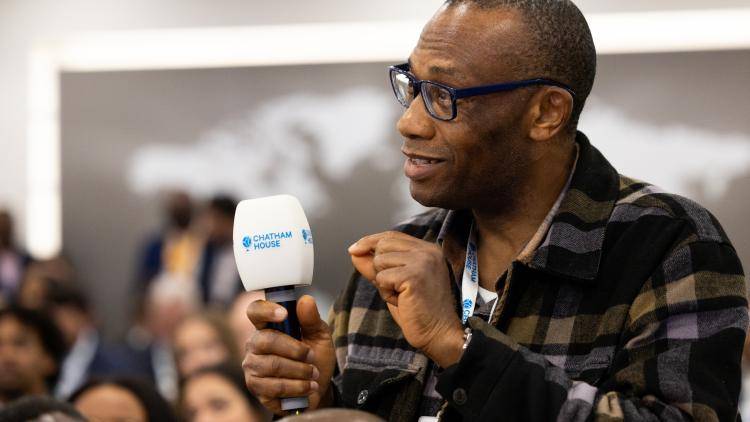
Let me take some questions. Right, loads. It’s – I’m going to take two at a time. In the front and then, on the aisle.
Prashanie Dharmadasa
Thank you, and thank you, Mr President, for that insightful – for those insightful remarks. I think you touched on my…
Bronwen Maddox
Would you say who you are?
Prashanie Dharmadasa
Oh, yes, apologies. My name is Prashanie Dharmadasa from SORAA3 . You touched on the question that I really wanted to ask you, being do you see flexible integration being a governance mechanism to overcome institutional deadlock, or more as something more strategic in how Europe organises itself around defence, technology and economic security? But if I may, also…
Bronwen Maddox
No, I’m really sorry, we’re trying to – we’ve got five minutes.
Prashanie Dharmadasa
Yeah.
Bronwen Maddox
I will…
Alexander Stubb
I would see it as both, to give you a short answer.
Bronwen Maddox
Yeah.
Dominic Nicholls
Thank you, Dominic Nicholls from The Telegraph. President Stubb, at what point does getting oil through the Strait of Hormuz moves become a problem that NATO needs to take a view on? And how far do you agree with Bart De Wever that the EU should now start to talk to Russia? Thank you.
Alexander Stubb
I just gave an interview to The Sunday Telegraph, to David, he got – pfft – so, on the two questions. First of all, NATO is a defensive alliance, so, basically, our job is, through collective defence and Article 5 to protect when attacked. That’s what we did in 9/11, and of course, now NATO has not been attacked. The Straits of Hormuz situation has been caused by bilateral, not unilateral, action, of Israel and the United States attacking Iran, and then Iran attacking pretty much 13 states in the region.
I think those countries bilaterally that have the capacity or will to help the United States can and should do so. As far as Finland is concerned, we take part – or we take care of the security in the northeastern corner of Europe. That is our task, protecting the 1,340km border between NATO and Russia. As far as Bart de Wever, I think we’ve been – we’ve had this conversation for the past two years, and I do think that we are approaching the moment when political conversational channels have to be open with Russia, but that has to be done in a very co-ordinated matter among European allies and friends. Not as a solo act, as we have seen with Prime Minister Fico of Slovakia, or Prime Minister Orbán of Hungary. So, it needs to be very much a unified approach.
Bronwen Maddox
Thank you. Let me take a couple more. In the green there.
Maura Barry
Thank you. Hi, Maura Barry. I’m a former USAID Senior Executive, recovering Diplomat, and currently working as a Senior Affiliate for the Solarium Group, also a dual national. My question is related to, as we see increasing instability around the world being caused by pressures of economic and environmental issues, how do you see European institutions better integrating development and security policy going forward? Thank you.
Alexander Stubb
Okay, so this is not product placement, but I just published a book called “The Triangle of Power: Rebalancing the New World Order,” and the main thesis of that book is that we need to drive a more values-based, realistic, foreign policy combined with a dignified foreign policy. And my main thesis is also that it’s going to be the Global South that decides whether the world is going to tilt towards co-operative multilateralism based on institutions and norms, or conflictual multipolarity, based on deals and transactions. So, I do think that those two things that you mentioned go ahead, but we can’t come with the moral high ground, as we have with, for instance, development policy before.
Bronwen Maddox
Here on the aisle.
Dan Sabbagh
Hi, Dan Sabbagh from The Guardian. Mr President, how do you get Donald Trump to listen to anything? You’re said to have a good relationship with him. I’m interested a bit in the interpersonal dynamic. And following on from that, in the context of, after Iran, do you think you can get Trump into a good place on Ukraine and some kind of sensible deal when he puts a bit of pressure on Vladimir Putin?
Alexander Stubb
Well, first of all, I don’t want to inflate my relationship with the President of the United States.
Bronwen Maddox
You have been called a “Trump whisperer,” but…
Alexander Stubb
Yeah, media does funny things to you. So, I had the privilege of, you know, spending the better part of seven hours in his presence March last year, playing golf and having breakfast and lunch, and of course, my job as a Head of State is to try to forge relationships which are in the interests of Finland. And one of those relationships is the one that we have with the United States, which is very strong right now, especially on the bilateral side in terms of defence co-operation, probably closer than ever. We just bought 64 F-35s. We have thousands of American Soldiers training in Finland in arctic conditions, right now, actually an exercise of 25,000. So, we – and, of course, we sold 11 icebreakers to the US, which they badly need. So, it’s a functional relationship and we’ll continue to have that. I have no illusions about who can convince President Trump on anything and especially I don’t. If I get one idea out of ten in on Ukraine, I think it’s good.
On Ukraine, I think the implications of the War in Iran are negative on Ukraine, mainly because of the oil price, which feeds the Russian war machinery. The Russian economy was actually doing extremely badly a couple of weeks back, now, it’s bouncing back. It’s also taking some of the necessary air defence systems away from where they should be, in Ukraine. I think public sources talk about five to 600 having been used in four years in Ukraine, and already now 800 to 1,000 being used in the Middle East and the Gulf region. And, also, it takes the focus away, I think, from the peace negotiations in Ukraine. So, I hope that the peace negotiations on Ukraine don’t collapse, like the negotiations between Iran and the US did, but time will tell.
Bronwen Maddox
And squeeze in one more, next to you.
Latika Bourke
President, so Latika Bourke from The Nightly, Australia, just following on from that and your point about indulging in realpolitik now, why doesn’t Europe go to Trump and say, “If you want assistance in the Gulf, here’s what we want you to do on Ukraine”?
Alexander Stubb
I think it’s a really good idea. I might pick you up on that. No, I think it’s actually a really good idea, so…
Latika Bourke
I’m available for advice.
Alexander Stubb
Can my team take your phone number, please? No, but I mean – yeah, I’ll think about it. I’ll talk about it with my colleagues. Some of them are here in London today.
Bronwen Maddox
On that, we are going to have to stop. I’m really sorry, this is a short and fast discussion with the President, but we’re very glad to have had this time with him. Thank you. There were so many great questions building up, so many online, but we’re going to have to stop. Do join me in thanking him [applause].