Dr Christopher Sabatini
Welcome. Thanks for braving the threatened tube strike, and we have a lot of people online who were sufficiently intimidated from – about the tube strike but thank you for coming. We have a great panel on a very timely topic, and I didn’t choose the title. We now try to – like any publication, now we try to go with a very attention getting title, can Sheinbaum, basically, manage Trump? And it’s certainly a delicate dance. What we’ll do is we have – I’ll introduce our panellists. I’m going to ask some questions. I’m going to run this as more of a conversation than a panel discussion, and then we’ll open it up for questions from all of you.
Before I begin, let me introduce the panellists. Pam Starr is a Professor at University of Southern California. Just recently published this book, I – because I believe in self-promotion, ‘cause I’m a shameless practicer of it myself, there are flyers here if you’d like a copy of the book, comes with a discount, on many of the things she’ll be talking about here, which is the arc and the evolution, or not the evolution, of Mexico over the pa – well, historically, far more than the – just even the 70 years of the PRI.
And Vanessa Rubio is an Associate Fellow at Chatham House. I like to think that’s what she’s most proud of, but she actually has a lot more things on her resumé.
Vanessa Rubio-Márquez
Absolutely.
Dr Christopher Sabatini
She was Secretary for Latin America at the Mexican Foreign Ministry. She was also a Sec – correct me if I get this wrong, she was also Secretary for Fine – Vice Minister of…
Vanessa Rubio-Márquez
I was Secretary of Finance.
Dr Christopher Sabatini
Secretary of Finance and the Finance – Minister of Finance under Pepe Meade, and now she’s Professor at the School of Public Policy at LSE. So, welcome, again, Vanessa.
Vanessa Rubio-Márquez
Thank you.
Dr Christopher Sabatini
And a great colleague of ours in doing all things Mexico and all things Latin America, so thank you. And Graham Stock is an Economist, an Analyst with BlueBay and is a, sort of, commen – if you will, sort of, commentator on all things Latin America, economics and likewise, in London. So, thank you, Graham.
So, let me get started. Pam, your book talks about, sort of, the evolution of the political economy and the political culture, even, in some ways, behavioural perceptions, institutions formal and informal, in Mexico. It – I’m old enough to remember in – basically, in the 1980s, the 1990s, people thought NAFTA by opening up the economy. People thought the economic reforms. People thought, you know, led first by, well, Salinas de Gortari, who didn’t end well, Zedillo, and then others. People thought this was a new era for Mexico, that it could break the deadlock, the PRI it had, the corporatist deadlock on the economy, but also on society. Is that over? What’s happened? Were we just, sort of, all caught up in that moment of the end of history and we just didn’t – weren’t really sufficiently paying attention to history and legacies and institutional, sort of, holdovers?
Dr Pamela Starr
Yeah, I mean, thank you very much for that kind introduction and for inviting me to be here today. I – the idea of the book is to think about how Mexico, like all societies, is – has unwritten rules of behaviour in politics, in economics, in the security situation, in its foreign policy. And some of those rules have, sort of, recent roots, but some of them have very deep roots in Mexico history and they create norms of behaviour. And those norms of behaviour limit what we think of as normal. You don’t want to go outside of those norms ‘cause you are no longer fitting in into society.
And it makes those norms hard to change. They’re not impossible to change. Mexico’s changed a number of its norms over time, but they’re difficult to change, and as a result of that, it becomes the question of how can you socialise a society to thinking and behaving differently over time? And that was the bet Salinas de Gortari was making, that he could socialise Mexicans to behaving differently. Not in politics, that wasn’t his thing. He wanted to keep the pre-system. But certainly, in terms of the economy and in terms of the relationship with the United States.
In terms of, you know, why didn’t it work? Let me start with the NAFTA side of the equation, or – and emphasise that, ‘cause that seems to be your – part of the question as opposed to the rest, ‘cause it’s a very long story. It’s not that long of a book, but it’s relatively long, just so you know.
Dr Christopher Sabatini
Oh, the Biography of Power by…
Dr Pamela Starr
Yeah, exactly.
Dr Christopher Sabatini
…Enrique Krauze. That’s a…
Dr Pamela Starr
Let me use NAFTA as an example.
Dr Christopher Sabatini
…tome.
Dr Pamela Starr
Yeah, and Mexico’s relationship with the United States has been a prickly one because of the nature of history, and Mexico’s strategy was always to keep the United States at arms’ length. Just to keep it as far away as possible, which would give Mexico more room for its own sovereign policy autonomy. And we all know that Mexico took half of US territory in the early 19th Century. We know that the United States interfered in Mexico’s revolution, its civil war. We sent in a battalion to chase Pancho Villa when he was – at the end of the revolution, when he was on the outs and being rebellious.
What we don’t know, most peoples, we almost went to war in 1927, and that’s when the two sides came to an agreement that I call the autonomy within limits agreement. Where President Coolidge knew that he didn’t have domestic political support for another war with Mexico – another war. We were already at war in Nicaragua; to have another war in Latin America. And so, he decided to step back from almost going to war and sent a new Ambassador with new attitude who negotiated, and they were able to agree on two extraordinarily important things. One, our disputes would not be in verbal public rhetoric. We would dispute quietly behind closed doors. That’s where the degreements – disagreements would take place. In public, we would be more open – more positive.
But secondly, was this autonomy within limits agreement, which is the United States agreed to give Mexico policy autonomy across the board with one very important limit, Mexico would never do anything that threatens US national security. It was on our side in the Co – in World War II, on our side in the Cold War. Even though Mexico never broke relations with Cuba, it became intelligence conduit for the United States, and vice versa. The Cubans got a benefit from it, as well, but always on the United States’ side. Which gave Mexico the autonomy during the Cold War to actually have, in 1970s, a revolutionary foreign policy, where it was supporting all kinds of global changes, backing revolutions globally, but behind closed doors, always telling the United States, “Don’t worry, we got your back.”
So, that agreement and the United States never breaking that agreement, the United States always keeping its word on those two things, make Mexico feel more comfortable in 1994, when it was time to change the big norm in Mexican relationship with the United States, which is keep the United States at a distance, always keep it at bay. Instead, feeling, for economic reasons, that it had to embrace the United States. Mexico had changed its economic strategy. It went through a trade strategy. It needed a market. Tried Japan, tried Europe, they both said, “Yeah, nice idea, but no.” So, they were left with the United States.
So, when Mexico approached the United States, there was this feeling of we can – whatever they say, they will honour. They will not go back on their word. They have maintained that promise since 1927, and they added another coup – another promise that made it even better, which was the United States agreed to keep all of the elements of the bilateral relationship on separate tracks. So, wouldn’t used its increased influence in the Mexican economy to coerce Mexico on migration or security, and we kept that promise for a very long time, and that made Mexico feel less vulnerable to the United States and that situation.
So, that combination made it feel like this is a safe decision to make us more vulnerable, more reliant on the United States. And there was also the belief that you could make the United States dependent on Mexico, as well. So, we’d have an interdependence, and that did develop, but Mexico has a greater dependency on the United States, vice versa, but you did get this interdependence develop. And it worked really well for a long period of time, but there are underlying concerns that are – were always there.
On the Mexican side, there was always mistrust of the United States, not surprisingly. You are a middle-income country living next door to a superpower. You are always going to have a bit of mistrust. That’s always an uncomfortable relationship, and particularly a relationship in which much of Mexico’s internal affairs is actually domestic politics for the United States. So, US Politicians would be concerned now about Mexican politics, Mexican security, Mexican migration, so more interest in Mexico’s internal affairs. And then the world changed for Mexico.
Dr Christopher Sabatini
Yeah.
Dr Pamela Starr
Forum – free trade became a bad word in the United States. Security became a national security issue, even before it was named such by President Trump, and migration became a very, very important issue, and that combination shrunk Mexican autonomy.
Dr Christopher Sabatini
Let’s hold there. Let me get to Vanessa. You know, the old saying, of course, Vanessa, is that, you know, “Poor Mexico is so close – so far from God, so close to the United States.” Seems to now be so close to the United States with a President who likes to pretend that he’s God, at least on social media, kind of, conflated the two. How is – you know, there are a couple of pending issues right now. Obviously, security’s one. We saw that recently with the indictment of Governor Sinaloa and the others. We see this also at the USMCA upgrade or review. How is – besides, obviously, very carefully, how is the Sheinbaum government managing? Let’s start with the USMCA and we’ll get onto security.
Vanessa Rubio-Márquez
Yes, thank you, Chris, for the invitation and it’s a pleasure to share the panel today with you. I think that in opposition to catastrophism, we shouldn’t find optimism, we should’ve – you – we should find realism. And I tend to try to give order of magnitude to the bilateral relation, first of all. So, if we think about the huge border that we share between Mexico and the US of 3,145km, we would…
Dr Christopher Sabatini
You’ve measured it, clearly.
Vanessa Rubio-Márquez
…have to measure it between starting – if we would compare it to Europe, we would have to begin measuring it in the far east of Europe, in Portugal, and end in Belarus, crossing all of Europe. So, that’s how big our border is. So, again, in that border, everything happens. We have the Treaty of Water, we have the screwworm, we have tomatoes, we have flatscreens, we have cars, we have auto parts. We have a – yes, drugs frow – flowing north, but we have a huge market of consumption in the US, and we have arms flowing downwards, basically, arms that give the eight – between 80 and 90% of the gunpower to the cartels in Mexico. So, it’s a very intricate relation. It’s a very complex relation. We trade $1.7 million per minute.
So, considering all of that, I think that we are definitely in a very delicate moment today. We’re certainly in a tipping point of the bilateral relation. We have history of having better contexts, more challenging contexts and today, definitely, it’s a very challenging context. If we also disentangle why we’re in the middle of a – of such a challenging context, the first one I would point to is geopolitics. There’s not a lot that we can do in relation to what is happening in relation to geopolitics. In the second part, we have a very specific leadership, a very specific way of governing the United States today. We can do some things in relation to negotiating better, but again, our margins are very small in relation to doing something there. Then the next tier is domestic.
So, the next tier being domestic is what can President Sheinbaum do today to strengthen her negotiating position vis-à-vis the United States? And there a lot of things, I think, come along the way. I think the first one is you want to strengthen your position and you are more strengthened if you have a better economic stance. The Mexican economy has been weakening since 2021, year-by-year, and this is only comparable to what happened in the 1980s. So, there we have an opportunity to dealing with something that will strengthen Mexican – what will strengthen our position in general and our position in negotiating with the US.
The second part is something that I think Mexico has been dealing quite effectively with the United States, and that’s migration. Again, numbers and data. In 2023, there were 2.5 million contacts from the US authorities in terms of migrants in the border. Last year, there were around 300,000. So, the challenges there and the way Mexico and the US have been negotiating and dealing with the circumstance, I think gives Mexico a good positioning vis-à-vis the US.
And then it’s organised crime, crime, fentanyl and other drugs, and there has been, sort of, mixed results. The mixed results, for instance, is that Mexico sent 93 members of the cartels to have sentences in the US, and I’m saying the – I’m saying sending in purpose because they didn’t have an extradition request. It was, basically, sending them to the United States, and now we have the juncture of what is happening with Sinaloa and the ten members of the government that have been indicted in the United States and all the tensions that he – that this has created, no?
So, my take on this is that there are a number of costs that Mexico is paying in relation to how strong we are today in Mexico, but how strong we are today vis-à-vis the rest of the world and vis-à-vis the US, in particular. What we have done in relation to policies and not doing sometimes what we needed to do in terms of the homework, for instance, in increasing productivity factors. In what we have done or not done in relation to improving the energy matrix and the energy production in the country. Or the summing up of the different costs for labour in relation to the different labour reforms that have been implemented in recent years. The “Hugs, not bullets,” “Abrazos, no balazos,” against organised crimes, no, that we had for six years. All of those actions – the institutionalisation of Mexico, the lacks of checks between the executive, the legislative and the judiciary, the judiciary reform, all of those policies that we have made at the domestic level have put us in the place that we’re today in negotiating with Trump.
But to summarise this first comment, I think that there’s two key areas in which the current government needs to do more and needs to strengthen. The first one, definitely, is growth and the second is how we improve a sophisticated strategy vis-à-vis the US. And definitely there, their polarisation of Mexicans is not helping, because what you would need is a united front in Mexico to support the President vis-à-vis the strategy with the US, but we need to do much better in relation to changing the fundamentals.
And I will end with this. Plan Mexico, it’s a fine plan in order to promote investments. The Special Economic Zones or the welfare polls is a good policy in relation to attract investment. The most recent decree to attract investment, particularly in infrastructure, is good. But if you don’t fix the fundamentals at some degree, you’re not going to be giving the country and the investors the certainty that we need in order to create a positive effect on growth, a positive effect on employment, a positive effect on a – what we need to be better in order to have a more vital and growing – long-term growing economy.
Dr Christopher Sabatini
Before we shift to the economics and Graham, what are those fundamentals to you? What would you tick off as being those fundamentals?
Vanessa Rubio-Márquez
I would say we need to anchor the changes to the labour reforms and their effects through time. We need to make them fiscally viable and to reduce the costs for creating employment at the same time. Fiscal is another part. Fiscal part is of an essence. We had a expenditure spree in that President – in the electoral year in 2024, and now fiscal consolidation is reducing the possibilities of more investment in the country. Pemex is another huge element to consider, and I think that and the factors of productivity create for the most important changes and reforms we need to think about in the country.
Dr Christopher Sabatini
Okay. Before we get to you, Graham, I’m not postponing, I want to go back to something that Pam was hinting at and the argument of her book, too, ‘cause you mentioned this, Vanessa, is the whittling away or down of these checks and balances on executive power. We saw – see this, obviously, with what used to be IFE, now INE, the electoral commission, which was really one of the premier electoral councils in all of Latin America and the US, even. Certainly, if you would ask some people now in the United States. The – and then, you also had, of course, the transparency office, you had information office. You had a whole series of reforms that followed, really, from Zedillo and then accelerated under Fox, that were, if you will, and even Salinas de Gortari, sort of, building in these hard and soft guardrails to executive power. We’re seeing them – is this – I mean, is this the return to nature? Is this the return to the way Mexico was meant to be? Can they be recovered? What’s your sense?
Dr Pamela Starr
I’m not sure I would say it’s a return to nature, but it definitely is a return to the way Mexico had historically done it. So, you had two groups in the pre, right? We call them politic – Politicians or Technocrats. You can call them old school, no school, whatever you called them. But one saw a future for Mexico that was different from its past and tried to begin the process of changing Mexico to go in that direction. One thought that those changes weren’t the best way to go. López Obrador comes out of that other group that was not interested in so much change, and then, when he created Morena, the new party, he brought in a lot of the old pre into his party.
And so, when he comes into office, he has a very different definition of democracy than this liberal democracy that Mexico was trying to build, which is based on processes and procedures. It’s all about having a government that is elected and that does – governs for the people. It’s not about checks and balances at all, and in fact, he didn’t like checks and balances. He wanted to eliminate them, also because he thought the institutions that housed the checks on executive authority were created by the – his predecessors in order to maintain the power of what he called the ‘Power Mafia’, the Conservatives. He didn’t trust them. He thought they would try to undermine him. So, he had double reasons to try to get rid of them. It wasn’t inevitable. It’s something that it’s not too surprising in hindsight, but it wasn’t inevitable. It didn’t have to be that way.
Dr Christopher Sabatini
Yeah, thank you very much. Sorry, Graham, actually this tees up a lot of what I think we were talking about what you want to say now. So, first, let’s start with the fiscal issues. Pemex, it’s – you know, they ha – they’ve go – large gar – gone largely unresolved. So, what is your sense right now, your analysis on the economy in Mexico across the board, everything from fiscal health, debt ratio, but also the fundamentals that Vanessa was talking about?
Graham Stock
Yeah, thank you, thanks for inviting me. So, Mexico is in a difficult position right now, for a combination of factors, including the elements that Pamela and Vanessa have mentioned. And USMCA on top of that means it’s even more risky, because some of the advantages that we’ve seen emerge since NAFTA in 1994 could be in jeopardy. But even without that, the fiscal position has deteriorated, the growth performance has weakened. Potential growth in Mexico now is probably only about 1½%, so weaker than the United States.
NAFTA has been successful, or USMCA has been successful in integrating parts of the manufacturing sector, particularly the auto sector and as a result, the private sector is integrated with some parts of the US economy. But it hasn’t really delivered the growth that was supposed to come from that, or at least the growth hasn’t spread out across the whole country. And that puts pressure on the fiscal performance, because if you’re not growing, it’s very difficult to generate new revenues. You have to introduce new taxes to do it, and that’s unpopular, or you have to cut spending and Politicians, particularly on the left, worry that if you cut spending, then your growth is going to slow even further.
It’s cyclical, to an extent. So, yes, there was more spending in 2024 ahead of the election, but that had all been planned three/four years before that and they were pet projects for AMLO, like the Tren Maya, the Dos Bocas refineries, things that, you know, an objective assessment of how best to boost productivity in Mexico would not have settled on those projects. So, you can call them a vanity project, you can call them white elephants, but whatever they were, they increased spending and didn’t generate much in the way of productivity growth.
So, the fiscal deficit now, the government says it’ll be about 4% this year, the market thinks it’ll be closer to five, and on top of that, you’ve got another 1% of GDP that the government spends to shore up the finances of Pemex and the CFE, the electrical utility, or the umbrella body for the electricity sector, and that’s a big deficit. I mean, there are bigger deficits around the world, but it’s large and debt to GDP is already around 55%. So, you’re already running, you know, large deficits. It’s adding to the debt stock. Even the interest cost is around 4% of GDP. So, even with a primary surplus, you’re running deficits of four or 5% of GDP because of the interest cost.
And as a result, the rating agencies are worried. The market, I would say, is not yet fully reflecting those risks, but both S&P and Moody’s have the rating on negative outlook. The rating is BBB, so there’s a notch to go before they fall into junk, but they’re on notice that they have to deliver on this. And Moody’s might even reach a decision in the next few weeks that they’ve had that negative outlook in place for 18 months and typically, they resolve those negative outlooks…
Dr Christopher Sabatini
And would that increase the spread? I mean, would that increase the de…?
Graham Stock
All things equal, it would, particularly if they were to downgrade by another notch after that. But they could easily put them on negative outlook again, even with a lower rating, to give a signal that you’re at risk of losing your investment grade. And then, yes, borrowing costs go higher and it becomes, you know, self-reinforcing. So, the key is delivering an improvement in productivity and growth that would resolve these problems, but it’s not really the direction the government is going in.
So, Vanessa mentioned the Plan México, which, you know, introduces, or reintroduces, public-private partnerships, allows a bit more flexibility in contracts for infrastructure and energy and so on. But it’s almost papering over the cracks, rather than going back to establishing, you know, more market friendly fundamentals, and in a way, USMCA is the same thing. It’s a mechanism that allows companies investing in Mexico not to deal with Mexican institutions. You have access to arbitration. You have access to the US rule of law, which is good, but it would be better if the underlying institutions were enough to attract investment in the first place.
And investment has been weak. You know, it’s – foreign direct investment is almost all – it’s about $30/35 billion, but it’s almost all reinvested earnings. So, it’s companies that are already operating…
Dr Christopher Sabatini
Already…
Graham Stock
…in Mexico, they’re comfortable with the risks, they’re happy reinvesting. But if you’re looking a greenfield investment for someone who’s never been there before, it’s hard to get your Compliance Committee, your board, comfortable with the risks.
Dr Christopher Sabatini
So – and I guess a hobby horse of mine, that nearshoring rush never happened, is that – I mean, ‘cause what you’re saying is green – it’s not greenfield investment, it’s mostly reinvestment. What happened to that whole idea that they could recreate a regional economy locally?
Graham Stock
It’s happened in some sectors, but it hasn’t been a fresh push. So, nearshoring came up as a theme, really, after the pandemic, when supply chains were disrupted and the argument was that, you know, why would you produce in China and run the risk that you can’t shift your goods to the US, when you can produce just across the border? But, of course, that coincided with risks to USMCA and the threat that the rules of the game might change. So, yes, you would have a logistical advantage, but will the markets still be open? Will you still have zero tariff entry to the US?
Dr Christopher Sabatini
Yeah.
Graham Stock
And at the time, and up until a year ago, half the goods going from Mexico to the US were not certified for USMCA because you didn’t need to. There was no advantage, really. You know, everyone else was paying zero tariffs. You might as well just export and not go through the hassle of doing the paperwork. Because of the tariffs that everyone else now faces and the, you know, the tariff wall, it now makes sense to do the paperwork and more than 90% of Mexican exports go under USMCA. But it’s not because the exports have gone up. It’s just because people have filled in the forms and it makes sense.
Dr Christopher Sabatini
Vanessa, you – we’ve spoken and you’re in Washington. Give us your sense on the USMCA and its importance now, also, ‘cause it has gotten, sort of, lost in all the other noise…
Vanessa Rubio-Márquez
Yes.
Dr Christopher Sabatini
…around US-Mexican relations and just trade policy generally. Obviously, the liberation day of the tariffs.
Vanessa Rubio-Márquez
Yes, there – again, some anchoring of numbers. Mexico depends a lot on foreign trade. 38% of its GDP ex – is explained by trade and there, 80% of our trade is concentrated in the United States, no? There’s wonderful news that we are going to be launching the new EU-Mexico Free Trade Agreement and that we’re about to negotiate another one with the UK. But putting numbers to that, Mexico and the US trade in 2025 was 873 billion USD, trade between Mexico and the EU is 95 billion and trade between Mexico and the UK is six billion. So, again, order of magnitude…
Dr Christopher Sabatini
Magnitude…
Vanessa Rubio-Márquez
…matters, no?
Dr Christopher Sabatini
…of markets, yeah.
Vanessa Rubio-Márquez
I think…
Dr Christopher Sabatini
Hey, nowhere to go but up, though.
Vanessa Rubio-Márquez
Ex…
Dr Christopher Sabatini
On an optimistic side.
Vanessa Rubio-Márquez
Exactly, and you can always diversify, you know.
Dr Christopher Sabatini
Yeah, exactly.
Vanessa Rubio-Márquez
The D word now, it’s something that’s everybody’s looking for, but that would take time. So, given that reality, again, I think what we need also to understand is the difference between noise and reality. After we had the first shocks on tariffs from the Trump administration, 25% contingence on migrat – contingent on migration, 25% contingent on fentanyl, basically, today, we can say that 90% of all the goods going to the United States outside tariffs, so on a free trade basis, only 10% pay tariffs. And then the average tariff has been one of the lowest vis-à-vis the rest of the world. So, Mexico still enjoys that competitiveness and Mexico can still have that competitiveness according to the outcomes of the negotiations of USMCA this year.
There are more positive than negative, but cautiously optimistic. I think that the most important challenges will come out of the agreement between Mexico and the US on when to revise the agreement again. So, I think that it’s highly unlikely that we go for the best-case scenario for Mexico. At least that would be the 16-year rollover of the USMCA. I think we will have a less ambitious timing for that. Hopefully, it’s not a yearly basis, but somewhere there I think will be the outcome of the negotiations in the coming months. And I think we will learn – we would have to learn to live with tariffs, and there will be a special agreement, in my mind. So, the USMCA would be preserved somehow, but there will be tariffs on specific sectors that we need to live with and that we will have to negotiate downwards as months and years go by. So, this is the new normal.
But just as a matter of comparison. I was part of the negotiating team back in the day when we negotiated the USMCA with Trump number one. Back then, the shock of tariffs was very much directed to Mexico and to China. Now we have more company in the world, so that’s a different scenario. And then the other part which I think is a very material difference, is back in the day, and we, sort of, forget these things, but back in the day what Mexico was facing was the cancelling altogether of NAFTA, so disanchoring completely the Mexican economy. Today, either a negotiation of the new terms of USMCA, considering sometimes yes, in some sectors, yes, but at least as of today, knock on wood, there’s no discussion of the cancellation of NAFT – of USMCA altogether. So, that puts us in a very different circumstance today vis-à-vis that – what we faced back in the day.
Dr Christopher Sabatini
We’ve had – in separate conversations, you’ve told me about how the negotiating strategy was in part, to, sort of, res – of Mexico, was in part, to respond to the United States’ pressure on China and other, sort of, backdoor ways in which Chinese goods were entering the Mexican market and therefore, NAFTA. Can you ex – I found that fascinating. Can you explain a little bit how, again, sort of, being diplomatically savvy and wily in this case, Mexico was able to jump ahead, be even ahead of Canada in this case?
Vanessa Rubio-Márquez
Yes, in this case I think we’ve learnt two things. One was already mentioned and this, you don’t negotiate with the US in the public light, no? So, you don’t negotiate in social media, let alone in, you know, in other public spaces. So, follow the diplomatic channels. And then the second part of the negotiations have been basically, I wouldn’t say that we’re tending to have common tariffs to third countries, no, like…
Dr Christopher Sabatini
Custom…
Vanessa Rubio-Márquez
…a customs union, but some sort of that is, I think, beginning to materialise. The fact that Mexico included Asian countries in a new series of tariffs as of January this year, more than 1,400 different fractions of tariffs, tells a lot to that, no? So, I think one of the things, and I wrote here the new National Security Strategy of the United States, basically, speaks a lot about not having external incursion in the Western Hemisphere. About having secure supply chains in the Western Hemisphere. About combatting the cartels and other org – you know, illegal organisations. If we read that document, basically, all the Western Hemisphere policy in terms of national security of the US materialises significantly in the bilateral dialogue between Mexico and the US.
Dr Christopher Sabatini
Interesting. Okay, Graham, and then, Pam, I want you, then I – prepare your questions, if you have questions. We have a couple online, too, but Graham, go ahead.
Graham Stock
One other aspect that has impressed me around the Mexican Government’s negotiating strategy is getting the private sector onside. So, because of the integration between the private sector of Mexico and the private sector of the US, they’ve worked very effectively with the lobbies in the US to encourage them to make the case to the US Government that this things matters and it’s worth preserving and it creates jobs in the US when the car goes back and forth across the border six or seven times in its manufacturing process. And that’s – I think that’s been effective.
Vanessa Rubio-Márquez
Hmmm hmm.
Dr Christopher Sabatini
Thank you. Pam, do you want to add anything and…?
Dr Pamela Starr
I just want to add that in the USMCA process, I think that there’s one thing that Trump has done is broken that agreement that we’re going to have each of our – the silos for each of the elements of the bilateral relationship. And my concern is that security has already been brought into trade, because in the statement of U – of non-tariff barriers that the USTR put our a couple of months ago, pointed to organised crime’s involvement in the illegal fishing and illegal logging and those – and goods entering the US market at prices that are lower than the production price in the United Staes.
So, it’s already entering and my concern is it’ll even enter more as security becomes more and more important in the bilateral relationship. So, it’s just a wildcard that’s out there, and I think we need to keep an eye on the…
Dr Christopher Sabatini
Not to mention the avocados, too.
Dr Pamela Starr
Not to mention the avocados…
Dr Christopher Sabatini
The blood oranges.
Dr Pamela Starr
…and the tomato, yeah.
Dr Christopher Sabatini
Yes.
Dr Pamela Starr
Yeah, and the avocados, yeah.
Dr Christopher Sabatini
Affecting our delicious guacamole. Any questions here? I’m not going to call on anyone. No, again, fair. I’m going to go – so we have a question online. Did you – no-one? Okay. Oh, yes, please, and introduce yourself, please.
Ibrahim Aziz
Oh.
Dr Christopher Sabatini
You, yes.
Member
Round there.
Vanessa Rubio-Márquez
Clare’s coming.
Dr Christopher Sabatini
Oh, microphone coming.
Ibrahim Aziz
Ibrahim Aziz from Kurdistan originally. A Lecturer at the university back home in Kurdistan, Iraq. My question about you assessed and measured the relationship, trade relationship, between Mexico and US and Europe and UK, but how you are redefine the trade relationship with China? Right now, the US, Europe, UK and others redefine the relationship with China and the relationship – international relationship, as well. How you are assessing that, please?
Dr Christopher Sabatini
Thank you. Go ahead.
Vanessa Rubio-Márquez
Honestly, being very realistic, I think that what Mexico is doing today is prioritising the relationship with the US and the relationship with other partners, such as the – such as Europe. In relation to China, one thing about, also, order of magnitudes, if you measure investment in the country, Chinese investment in Mexico is around 1%. So, vis-à-vis other countries, for instance, in South America that have China as their first trading partner, Mexico is very much concentrated in North America. Mexico, geographically speaking, and not many know this, is North America.
So, we are very much integrated there and although there’s a strategy to diversify away from the US at some point in time, we have been, sort of, successful. We changed from 90% to 80% in 20 years. So, that’s as long as we will get. I mean, maybe less, but just to put in some reference there as how difficult it would be with such a big border, which such a huge integration of supply chains. Cars sometimes cross the border six or eight times, to be added value once and again, and again.
So, we should think about the supply chains as being North American and the dependence is very much intertwined between the two countries, and this has been a case that Mexico has been done increasingly with the private sector in the US, with the private sector in Mexico, of course, but also with the local governments in the US. Mexico is not only the first trading partner of the US, the first buyer and the first source of their imports, we’re also between the first and the third trading partner for 34 of the 50 states of the United States.
Dr Christopher Sabatini
Wow.
Dr Pamela Starr
If I can add something.
Dr Christopher Sabatini
Yes, please.
Dr Pamela Starr
On that question, there are three other things that I think are important to keep in mind about the Mexico-China relationship. First of all, they’re not complementary economies. They’re – they compete. They both produce – manufacture goods that they want to sell in US market and other markets. So, its not like the South American countries that they export raw materials to China. Second, coming back to what Vanessa was saying about goods going back and forth in the production process and having cross-border supply chains. The result of that is very often a good that Mexico – the final good that Mexico exports to the United States is about 40% US content. The same number for China is four.
Dr Christopher Sabatini
Okay.
Dr Pamela Starr
And then finally, the US – sorry, so the Mexico-China trade relationship is enormously unbalanced. Mexico exports to China ten times what it imports from China. China doesn’t – backward, I’m sorry, backwards.
Dr Christopher Sabatini
Absolutely, yeah, that…
Dr Pamela Starr
Backwards.
Dr Christopher Sabatini
Okay.
Dr Pamela Starr
Backwards. Mexico imports from China ten times what it exports. China does not buy from Mexico, and so, it’s a less costly relationship for all those reasons, for Mexico to sacrifice for the more important relationship with the United States.
Dr Christopher Sabatini
Here, we have a number of questions online, but I will – we have a couple of questions. Judith and then you had your hand up, too, and then – so, we’ll – let’s take these three questions then I’ll go to online. So, when you – fir – Judith first, actually, right over there. Yeah, she was – thank you.
Dame Judith Macgregor
Thank you. Judith Macgregor, former British Ambassador to Mexico. Talking of norms, as you did at the beginning, Sandra [means Pamela], I was just thinking, to what extent do you think Mexico is going to be willing or have no choice, with its, kind of, eggs in the North American basket, to allow the US to dictate the pace and the extent of security policy, even to the extent of intervention, more intervention inside Mexico? I mean, is this something that Mexico is just going to have to agree to, that the US may or may not push? What’s your general quick view on that?
Dr Pamela Starr
Let me start by saying that the extent to which the US is pushing is unprecedented in the modern bilateral relationship. It’s taking the bilateral relationship into uncharted territory, where we have not been before, and the question is, how does Mexico respond? Up ‘til now, President Sheinbaum has been responding to both the trade and the security relationship in the same way, in the sense of as she calls it, it’s a ‘cool head’. She does not respond to the emotional oust – outbursts from President Trump, as he does negotiate publicly, even though Mexico does it quietly. And she is responding in ways that she feels she can respond. She is deepening what – a security relationship that she had initiated even before Trump was elected, taking advantage of US intelligence to help fight organised crime in the network and the training the United States is offering.
And she is using phone conversations, multiple phone conversations, I believe it’s 18 now that she’s had with Donald Trump. The most recent one was two days ago, trying – and using those to talk him down, and she’s been quite successful at doing that. And it’s a created a strange relationship that Trump likes her very much and has – says very great things about her and then, turns around and says that “But the cartels run Mexico.” So, he has this, sort of, this bifurcated rhetoric about it. But it puts her in a very difficult position because there’s only so far she can go and remain the President of Mexico.
She has limits in what she can do in terms of her movement, but also in terms of broader public opinion in Mexico. The Mexican public does not like President Trump, does not want US trips on Mexican soil for any reason, any way. They’re warmer about extraditing certain Governors, but they’re not warm about US involving itself in Mexican affairs. So, she has problems with her own movement. It has a radical wing to it that will limit what she can do with Trump, but she also has limits in what she can do in terms of Mexican public opinion.
So, that saying is, is my sense is that she’s going to have to draw the red line at some point. I don’t think she knows exactly where that red line is, but she’s going to figure it out pretty soon. She cannot simply do everything the United States is demanding. Every time Mexico does something, the United States moves the goalpost, and that’s not reassuring to Mexico. And there is the concern that the United States will move the goalposts to a place that is completely unacceptable for Mexico and frankly, my sense is, and we have – Vanessa and I have a difference of opinion about this, but I think the Governor is something that she can’t do. That she cannot extradite the Sinaloa Governor to the United States. Maybe the lower-level Officials, but I don’t think she can extradite him, but we’ll see.
Dr Christopher Sabatini
So, since your name was taken in vain, go ahead and…
Vanessa Rubio-Márquez
Yes.
Dr Christopher Sabatini
…do you want to explain it?
Vanessa Rubio-Márquez
Just a brief comment on that. I think that Claudia Sheinbaum is binded or is carefully treading in a very important constraint that she has domestically. She has drifted apart in very few occasions vis-à-vis López Obrador’s policies. One of them is security, very clearly, and that began before Trump. So, she decided to follow a complete different strategy to name a very important figure for her in her party, in her administration, to follow up on that, and I think she carefully needs to tread that new policy vis-à-vis, basically, breaking with the continuation of a policy that was started by López Obrador.
And then, in the other hand, I don’t know how much the US is pressuring to change the institutional response of Mexico, rather on specific trac – transactional outcomes, no? So, it has been one – a list of ten, the other list of ten, one specific Governor, the other list of – so, I think Mexico has the task of changing the infrastructure, changing the institutional responses to organised crime in the one hand. How she does that when it’s very clear that she’s breaking with Andrés Manuel López Obrador, and at the same, negotiating this very, sort of, thin ice with the specific transactionist view from the Trump administration on this.
Dr Christopher Sabatini
Perfect. While we’re – so, we had a question here. So, while you’re passing the microphone to her and then over there, let me read two of the questions online. So, just coming to you in a second, though. This is from Alan Drake. “Does President Sheinbaum have enough leverage with President Trump to conduct bilateral relations with China according to Mexico’s national interests?” A second one, before we go to the audience here, from José Ramón Lorenzo. “Mexico has a large informal economy. That is a weakness for productivity growth and for the sharing of the benefits of NAFTA. What can the Mexican Government do to reduce the size of the informal sector of the economy?” which is a region-wide question, but it’s a good one.
Let’s go to two other and I’ll get back to the other one. So, your name, please?
Valeria
Am I first? Oh, okay.
Dr Christopher Sabatini
Yeah.
Valeria
Okay, perfect. Hello, my name is Valeria. I am only studying here for international relations for a master’s. My question is, a couple of months ago, I read somewhere that the only reason why the United States haven’t invaded Mexico yet, it’s because of how Claudia Sheinbaum is handling the relationships and the phone calls with Trump. Do you think that’s true, or do you think that was only like an exaggeration of how the international and diplomacy it is being handled in both sides?
Dr Christopher Sabatini
Perfect. Let’s go to the question that was there in the back. Yes, thank you.
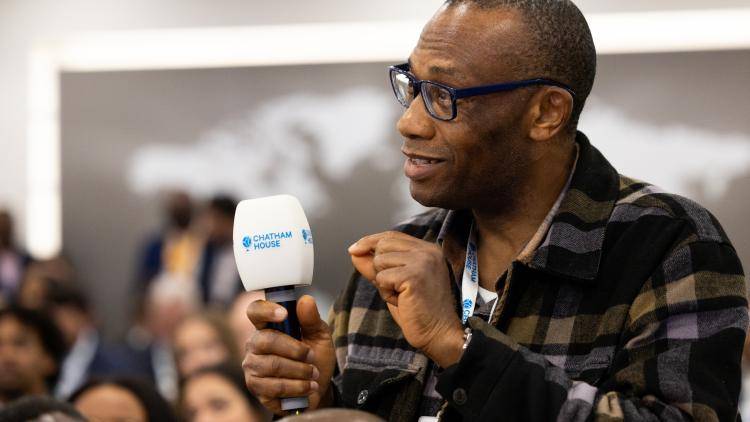
Martin L. O’Neil
I’m Martin O’Neil. I’m a member of Chatham House. I also happen to be in the container terminal business and have a very large successful terminal in Manzanillo, Mexico, which actually, we’re seeing exactly what you’ve described, a huge surge in imports from Asia, particularly China, and it’s not going through Mexico and the United States. It’s actually ending up in Costco and Walmart de México and whatever. But the – what I’m intrigued with is, the way I think about it, we operate in many places in Latin America, I mean, and correct me if I’m wrong on the numbers, but the per capita GDP in Mexico is now, like, $95,000 a year?
Graham Stock
Hmmm hmm.
Martin L. O’Neil
And Brazil’s 10/11,000. I mean, these two countries are increasingly not Latin America anymore, at least the way people traditionally think about Latin America. And I mean, it certainly sounds, from what you’ve described, the original NAFTA deal worked. It’s – you know, there are industries that are very well co-ordinated with each other between the United States and Mexico. I mean, is it – are – you know, shouldn’t we be thinking a little more futuristically about where we could go here?
Dr Christopher Sabatini
So, let’s go – so, just to recap. We have got the one question about the leverage with President Trump on China, the question on the informal sector for productivity growth. Question, is Sheinbaum actually, sort of, preventing an invasion of Mexico, or at least slowing it down, let’s say, less optimistically? And, sort of, the trade – the growth in trade across – and let’s – I’m going to start with you, Graham, since you’ve – were the last on the panel before.
Graham Stock
Yeah, so the growth – I mean, Mexico has grown, but that per capita income level is still low by international standards and hasn’t – and we haven’t seen the convergence between Mexican living standards and the US that you might’ve expected, you know, 30 years after NAFTA, and – because it’s very uneven, exactly. So, there’s – you’re – yes, in Monterrey, in Nuevo León, yes, you’re seeing that and you’ve got a lot of well-paid jobs, but in the south, not much has changed. And that’s why AMLO chose those parts of the country for his infrastructure projects, but they haven’t delivered, either. And I think to get the productivity growth that Mexico needs, you need more investment in education, in particular, and basic infrastructure, so that the country is more integrated, and we haven’t seen that.
One – just one quick comment on the bilateral relationship. I think there are some measures that have unforeseen, or not necessarily unforeseen, but have economic consequences that are risky. So, for example, designating the cartels as terrorist organisations hugely increases the compliance costs for banks operating in Mexico, because obviously, they can’t be seen to be accepting, you know, or transacting on behalf of those organisations. But the cartels are so integrated that it’s a difficult thing to do. So, it increases the barriers for entry for other financial institutions to come into Mexico, to drive down costs and improve competitiveness. So, there’s a – you know, it works through lots of the channels, not just the threat of US troops on the ground.
Dr Christopher Sabatini
Any other thing you wanted to say on the trade with China or the informal sector, on its cost and productivity?
Graham Stock
I think…
Dr Christopher Sabatini
Yeah.
Graham Stock
I mean, trade with China is just realism, pragmatism. You know, China produces some of the things that Mexico wants, but they have – they are being more careful than before about transshipment and, sort of, the rules of origin, you know, are being more carefully scrutinised. And obviously, your precursor chemicals for fentanyl and so on is a real red line, but it’s pragmatism, like all trade relationships. And remember, trade relationships are driven by the private sector, not the government, so the government has a, sort of, monitoring and regulatory role, but where the goods come from for Costco and Walmart is driven by those Purchasing Chain Managers.
Dr Christopher Sabatini
Thank you. Vanessa.
Vanessa Rubio-Márquez
Yes, I’ll take some of the comments. The first one on, basically, the informal sector, I think it touches on a lot of elements, but one of the elements affecting that, and there’s no evidence, is, basically, as I was saying, the accumulation of the recent labour reforms.
Dr Christopher Sabatini
Yeah.
Vanessa Rubio-Márquez
That’s having a negative effect on the creation of new employment in Mexico, so that would need to be revised. Of course, education, skilling and reskilling, bridging the divi – digital gap and again, huge elements of opportunity in relation to the policy in those regards. The incentives, the bad incentives that are, sort of, indiscriminate social programmes is having on the – on employment and formal employment, as well. So, if you mix all those together, together with not investing significantly in productivity and competitiveness factors, I think there you have a lot of questions to answer for that. And then, you can go to, you know, the lack of energy supply, water supply, the la – you know, incentivating investment and other elements. So, I think that’s a very complex question, but some elements to think about it.
And then on the military action that you questioned. I think there’s two worst case scenarios for Mexico today. One of them is the cancellation of free trade, the cancellation of USMCA, for sure, and the other is the – just the thought of any military action in Mexico. And I’m not speaking about troops, I’m speaking about even a drone attack, you know, against a cartel member. So, I think Mexico is doing whatever possible in diplomatic channels, in negotiations, in constant visits to Washington, in engaging a number of actors in order of any of these two extreme measures to happen in the future, no?
If, I don’t know, ten years or 20 years before this, were really black swan events that nobody would consider, to they’re closer in the mindset, but I don’t think they’re imminent whatsoever, because there’s a lot of conversations and engagement and positive engagement in – from both countries to hopefully, you know, leave these possibilities as far as we can.
Dr Christopher Sabatini
Pam.
Dr Pamela Starr
Let me start by following up with what Vanessa was saying in answer to your question. There’s also another advantage that Claudia Sheinbaum has, is that she has, in the US Secretary of State, somebody who understands how much Mexico is co-operating in terms of security. It’s a security relation – a security co-operation that the United States would – could never have imagined coming out of Mexico before. Not even during the Calderón administration did you have this level of security co-operation. And so, the United States has got what it wants from Mexico, is close security co-operation. So, you don’t want to mess that up, and Secretary Rubio understands that. So, that’s a voice that’s whispering in Trump’s ear, as well. So, that’s another tool at Mexico’s disposal.
In terms of room for manoeuvre with regard to China, she doesn’t have a lot and as has been said, she has to prioritise what matters most, where she wants to exercise her autonomy, because it has been so sharply limited by the Trump administration. I don’t think China’s a place where she wants to really push it. Nevertheless, she has a trade mission going to Trump – to China, it’s later this month, I can’t remember, but she has a trade mission going to China.
Vanessa Rubio-Márquez
Hmmm hmm.
Dr Pamela Starr
And there is something to talk about, which is that imbalance in the trade relationship.
And then, finally, on the informal sector. I think something that comes, to restate myself, out of Mexican history, but is extraordinarily important across the board in Mexico, that hasn’t been mentioned yet, is the rule of law. It matters – one of the reasons you have such a large informal sector is your lack of rule of law. One of the reasons that you have so much power in the presidency is a lack of rule of law. And one of the reasons that you have so much trouble with security is weak rule of law, and unfortunately, Mexico’s in the – going in the wrong direction with a judicial reform. It’s not just the judiciary, but it’s weak policing and it’s weak penitentiaries.
That’s something that can be fixed. This is not something that is inevitable in Mexico, but it has been that way for so long that you have an attitude in much of Mexico that much of the law is a suggestion. It’s not the law. It is – it’s more of a suggestion. It’s the way we ought to behave if circumstances were normal, but circumstances aren’t. So, in order to be able to get the outcome we want, we have to behave a little bit differently, and indeed, the Former President of Mexico at one point was famous for saying, before he became President of Mexico, “Don’t tell me the law is the law,” because the law has been historically used unevenly by the President of Mexico.
And so, I just want to say – emphasise that that’s a really important piece of the puzzle in Mexico for moving forward, and the judicial forum has moved us backwards. Thankfully, right now, President Sheinbaum is talking about at least mitigating the damage from the second round of judicial elections, trying to increase the qualifications for people that have to be Judges, for example.
Vanessa Rubio-Márquez
Hmmm hmm.
Dr Pamela Starr
Changing the date of the election so people can concentrate on that election. So, there – it – she’s trying to mitigate the cost. That being said, it’s been a historic problem in Mexico and it’s still a very profound one.
Dr Christopher Sabatini
I’ve got three more questions here. I’m going to synthesise them the best I can. Is there anyone else? There’s another. Peter and then, I’ll synthesise these three questions, ‘cause they actually group nicely. Go ahead, Peter.
Peter West
Yeah, I wanted to ask about…
Dr Christopher Sabatini
Introduce – I know who you are, but no-one…
Peter West
Oh, yeah, sorry.
Dr Christopher Sabatini
Other people, I’m sure, do. Just in case.
Peter West
Yeah, Peter West from EM Funding. I’d like to ask about Mexican foreign policy with respects to the rest of Latin America. Is it being completely dictated by Washington? And I’m thinking in particular of Cuba. I’m sure Sheinbaum would like to help, but maybe the price is just not worth it and – in terms of upsetting Trump and Rubio.
Dr Christopher Sabatini
Okay, a quick round here. So, the other questions, basically, are, essentially, what is Sheinbaum’s margin for manoeuvre in these situations, both in terms of migration, which hasn’t really come up, or what can she really do? And is there a policy, a more humanitarian policy, on migration, that she can pursue relative the Trump administration? Similarly, yeah, is – basically, is Sheinbaum always going to be on the defensive, whether it’s on immigration or whether it’s on security? And last is, you know, what is – you know, how is she balancing the issue of these domestic constraints to a lot of the factors that you mentioned, the fundamentals that you mentioned, Vanessa? What’s driving that? Is that ideology? Is it, sort of, the political economy? Is it – you know, the – just the very nature of veto power that some private sector – some sectors have on policy?
It’s a lot, I know, but we’re going to – I’m going to – Graham, I want to start with you first, so go quickly. We’ve got three minutes, two minutes.
Graham Stock
Quick – a quick comment on immigration. I’m not sure there’s a more humanitarian approach. Mexico’s already…
Dr Christopher Sabatini
Can’t get any more inhumane, almost, let’s be honest.
Graham Stock
But I mean, the humanitarian thing would be to facilitate people…
Dr Christopher Sabatini
Migration.
Graham Stock
…going where they want to go.
Dr Christopher Sabatini
Yeah.
Graham Stock
And that’s clearly not going to happen. But what used to happen was that Mexico would facilitate transit through Mexico and Mex – you know, have it happen as quickly as possible, because that was the least socially disruptive thing for Mexico, and that clearly isn’t feasible now, either. The latest data on remittances suggests that there was – a big part of the remittance flow from the US into Mexico wasn’t for Mexicans, it was for Central Americans and Venezuelans and Colombians who were on their way to the border but hadn’t got there yet. And one effect of the border being closed is that Mexican remittances, or the flow recorded as being into Mexico, has dropped, or at least stayed – flatlined. Whereas remittances going into those other countries, Central America and South America, have continued to grow very robustly. So, it would appear that the effect of closing the border has been to obviously, push the issue back down into Latin America.
Dr Christopher Sabatini
And reduce the flow of hard currency to Mexico, which…
Graham Stock
Well, but that was flowing back out to Central America anyway.
Dr Christopher Sabatini
Yeah.
Graham Stock
So, it shows up in the numbers as a deterioration, but actually, it’s probably not as material as it might’ve seemed.
Dr Christopher Sabatini
Vanessa, all those questions in one minute.
Vanessa Rubio-Márquez
A key feature of Mexico is precisely presidentialism, both illegal presidentialism, constitutional, but also metaconstitutional. And one thing that presidentialism in Mexico gives you is certainty that there’s going to be a government for six years and that there’s going to be no re-election. So, I think that the fact that Claudia Sheinbaum is going to be there for more than four years already have to make the US think that they need a strong interlocutor to deliver in the other side.
So, I think the very tricky part of the US – negotiating with the US is being able to get concessions and to get deliverables from the Mexican side without undermining the role of Claudia Sheinbaum to being able precisely to deliver. So, I think there’s a very relevant nuance there that the US has to consider and another element would be the – how intertwined we are and how mutual interdependence plays a role. So, you don’t want to shoot yourself in the foot.
Dr Christopher Sabatini
Thank you. Pam.
Dr Pamela Starr
In 30 seconds. In terms of Cuba…
Dr Christopher Sabatini
I was going to ask if you can – so, go on, thank you.
Dr Pamela Starr
In terms of Cuba and Latin America, she started with López Obrador’s policy, which was very aligned with the left in Latin America, but the left is reducing in numbers. So, she has less friends than she did before. But when push comes to shove and Trump makes it an issue, it’s still not worth it. Historically, it’s where Mexico demonstrated its autonomy from the United States, but this administration doesn’t want Mexico to be autonomous in Latin America in the way it historically was and so, she’s backed down from it.
So, she is being – in terms of her room for manoeuvre more broadly, she’s being very strategic. She’s trying to figure out where she can carve out areas of Mexican autonomy, of Mexican freedom of action within these very narrow limits that Trump is imposing on her. She has been mostly defensive up ‘til now and finding the room where she can actually make a real advance for Mexican and its interest independent of just simply salvaging the bilateral relationship as best as she can, is limited, and I don’t expect it to increase under the Trump administration. She has to manage this period and hope for better after – what comes after Trump.
Dr Christopher Sabatini
I didn’t think you’d do it, but you managed to answer all those questions that I lumped together, so thank you, very well done. Please – first of all, the book, Pam’s book, is just out. When’s the movie coming out, soon? So, it’ll be in the library after I read it, but if you’re a member, so you can go to the library and read it. There’s flyers there. I want to – join me in thanking our panel, which did an amazing job [applause] of bringing together – thank you, Vanessa, thank you, Graham, thank you, Pam [applause], and well, enjoy the rest of your night. Thank you very much.
Vanessa Rubio-Márquez
Thank you.
Graham Stock
Thank you.