Isabella Wilkinson
I’m sure everyone’s been enjoying our wonderful Pride themed playlist put together by our fantastic Events Team, but I’m sorry, we’re going to have to turn it off because we have a important conversation to have. My proposal is that we kick off. Doing an event at 5:30 means that we often get folks trickling in at the end of the workday. So, we’ll start the conversation. Hello to all of our folks joining online and a warm welcome to everyone joining in person. You know, here at Chatham House we’ve been having conversations on salient issues in international affairs for about 100 years and your participation in the event today is really helping us bring forward that tradition and change it, as well. And so, thank you so much for being part of that change.
Today we’re convening this panel to talk about ‘Where LGBTIQ+ rights sit in UK foreign policy,’ really at a time of momentous change in geopolitics, in the UK’s role in a changing world, amid threats to multilateralism, a degradation of the rules-based international order, the decline of consensus and shared values once taken for granted. Domestically, the UK faces a turbulent landscape, with threats to the rights and freedoms of the LGBTIQ+ community, particularly the trans community, with changes in legislation, in norms and anti-LGBTIQ+ rights political forces.
So, we have a lot of diagnosis to do here today, and I’d like the first part of the conversation to focus on setting out where rights and freedoms sit in UK foreign policy and how they’re connected to domestic and international changes. Now, no tall order, but the more important part of the conversation I’d like to have tonight looks at the path ahead. We are facing a pretty momentous time in terms of investment, of focus, of salience, a real moment of political urgency for fighting for LGBTIQ+ rights, freedoms and advocacy in foreign policies worldwide, in face of this rising tide of threats that I have set out. And so, this is a great opportunity to come together and talk about what prioritisation, investment and spotlighting looks like and how the UK can carve out a role in diplomacy and pushing forward the rule for the rule of law relating to LGBTIQ+ rights for the years ahead.
I am so thrilled to be joined by such a fantastic panel today, who I think are uniquely well equipped to take us on this journey. I’ll start on the far left with the government’s very recently…
Lord Raymond Collins of Highbury
I’m not often called that.
Isabella Wilkinson
I’ll start on the other side of the stage, so yeah…
Lord Raymond Collins of Highbury
Yeah, yeah.
Isabella Wilkinson
…with the government’s very newly appointed Special Envoy for LGBTQ+ rights. Lord Collins of Highbury is the Deputy Leader of the House of Lords. He is the government’s spokesperson for equalities. He’s a Special Representative on Preventing Sexual Violence in Conflict, and if I were to read out his entire bio, we would be here all night, so I’m going to cut it there.
Next to him is Gurchaten (Nanoo) Sandhu, who’s the Director of Programmes at the International Lesbian, Gay, Bisexual, Trans and Intersex Association, which is a global federation of over 200 organisations in over 170 countries for co-ordinating on advocacy surrounding human rights for the queer and trans community. We’re also joined by Moud Goba, who’s the National Director at Micro Rainbow. Micro Rainbow leads programmes supporting migrants, refugees and asylum seekers who identify as LGBTIQ+, including things like safe housing, providing safe housing for, I think, over 25,000 people, social inclusion and employability. And last, but not least, Dr Evie Browne is a Research Fellow focusing on gender equality, the anti-gender backlash, gender norms at ODI Global, a global affairs think tank.
A bit of housekeeping. We’re going to run this event for say the next 30 to 35 minutes. Then we’d like to hear from you. This is an interactive event and so, please start thinking about your questions, as we’ll be opening up the conversation in about half an hour’s time. This event is recorded; it is on the record. We’re joined by a really huge online audience, actually, so I highly encourage them to join the conversation, as well. If you would like to talk about this event on X or Bluesky or LinkedIn, I believe our social media details are on the screens on either side of this stage, and once this event closes, we’d like to invite you to join us all at a reception upstairs.
Before we kick off, I should introduce myself. My name is Isabella Wilkinson. I’m a Researcher here in our Digital Society Team. I’m part of the institute’s Equality, Diversity and Inclusion Working Group, which was set up in 2024 to advance institutional priorities relating to EDI, including events like this one. Now, that’s more than enough talking. I’m very excited to turn over to our fantastic panel and Lord Collins, let me start with you. I mean, let’s do a little bit of scene-setting here before we turn to the path ahead. Can you give us a bird’s eye view of where LGBTIQ+ rights and freedoms are currently situated in foreign policy? How does it work, where are they and perhaps, how has it changed in recent years?
Lord Raymond Collins of Highbury
Well, I think fundamentally, it sits squarely within our overall foreign policy, and I think in 2024, we tried to, sort of, articulate that very strongly by – on Human Rights Day. ‘Cause I don’t see LGBT rights as a separate discussion. I think they’re fundamentally part of our policy and the key areas of that has been, you know, our Foreign Office policy priorities are very much open societies, the rule of law, civic space, which is fundamental in my opinion, inclusive growth and security. And I think, you know, I was, for a period, Minister for Africa and actually, if I’d have simply plucked LGBT rights out of the air and said, ‘I want to speak to you about that,’ they would’ve shut their ears. But if I talked to them about inclusive economies and growth, if I talked to them about the importance of civil society space and fundamentally, the rule of law is absolutely essential for economic growth.
So, that’s where LGBT rights sit, in my opinion. Well, it’s not just my opinion, it is absolutely what our foreign – the United Kingdom’s foreign policy situation – where we situate it. So, not separate, squarely within it.
Isabella Wilkinson
Hmmm, thank you so much. Really, I think, great to position the conversation tonight from a UK perspective and we’ll be returning to some of those themes, on the normalisation, on the mainstream one, that really inextricable connection to human rights programming and the rule of law later in the discussion, but Gurchaten, perhaps I can turn to you. As I mentioned in the introduction, ILGA World works in over 170 countries, and it seems like you’re uniquely placed to give us a global perspective. How is the UK doing on LGBTI+ rights and freedoms in a global perspective and where might a little bit more focus and attention be needed?
Gurchaten Sandhu
Thank you very much for that question, and just want to, sort of, congratulate Chatham House on this lovely event, as well as your recent appointment, Lord Collins. And it’s very – we are very proud to be a part of this historic moment, especially for myself, as a UK citizen who’s working in international diplomacy and working on international LGBTI rights. I think I, you know, sort of, carry that principal voice and ensure that we’re accountable to our communities.
I think globally we are living through both progress as well as backlash. So, as you may know, ILGA is one of the largest – holds one of the largest databases and according to our data, we currently now have 65 UN member states that still criminalise consensual same act – sex acts, and that number has gone up from 63 to 65 within – for the first time in the last decade. And the death penalty is legally prescribed in seven UN member states, as well, as well as at least 63 UN member states still restrict expression related to gender diversity or bodily diversity and 61 have legal barriers on organisations that can openly advocate for LGBTI people to register.
And this goes back to Lord Collins’ place – Col – Lord Collins’ point around civic space. Many of our organisations in these countries cannot actually have – register their organisations. And in fact, if you overlay that data with those – with data from authoritarian regimes, you’ll find something quite – you’ll see some correlation or some patterns there, certainly, even when it comes to things like freedom of association or freedom of assembly.
But it’s not only a story of crisis, as well. You know, we see marriage equality is now reality in 37 UN member states, nine are banning non-consensual and non-medical interventions on intersex youth for the first time with ILGA World’s work. We saw the first intersex UN resolution a year ago. 11 – 18, sorry, allow legal gender recognition based on self-determination at the national level. We see 17 UN member states banning our con – so-called conversion therapies and we’re looking forward to adding the UK to that list, as well.
But on the UK, we need to be a bit more precise. The ranking in – is often referred to the ILGA Europe ranking and that’s very different from ILGA World. We tend to not rank member states because in Glo – in parts of the Global South, especially in Africa, sometimes the reversed argument is used, ‘Oh, we shouldn’t be number one, we should be right at the bottom.’ And in fact, in the UK…
Lord Raymond Collins of Highbury
Hmmm hmm.
Gurchaten Sandhu
…when the UK fell from number 11 to number 22, some – there was a lot of criticism or actually, you know, applause, saying, ‘Oh, we should be lower down,’ in fact, ‘we should not be at number 22.’
So, what the Rainbow Map tells us is something important, that the UK once was at the top of the European ranking. It is now 22nd out of 49 countries, with a score of 44%. That fall matters. So, it shows that rights can go backwards. It also shows that other countries have moved faster because they’ve acted on what movements – what we, as movements, have demanded, bans on conversion therapy, legal gender recognition, recognition of diverse families, intersex bodily integrity and autonomy and inclusive healthcare and stronger protection from violence and discrimination. We know that in the UK, violence and discrimination has gone up against our communities, as well.
So, the UK still has influence, but influence is not the same as leadership and leadership has to be renewed and it’s renewed by listening to our movements, investing in civil society, protecting those most at risk and ensuring that the UK’s global voice is matched by consistency at home, here in the UK. Thank you.
Isabella Wilkinson
Thank you for setting out, I think, core themes we’ll continue to return to, and I really encourage the Q&A to leverage these, as well, on consistency and as you said, the difference between influence and leadership. This also helps situate the conversation geopolitically and in terms of development programming, as well. Ripples from say a change in funding or a change in political administration are felt globally and these have lived impacts on marginally and vulnerable communities.
Dr Browne, I’d like to turn to you here. You know, we’ve seen over the past 18 months to two years, quite momentous change in the funding landscape for programming relating to LGBTIQ+ rights and freedoms, whether these are in education, in healthcare. Can you give us a snapshot of what this might look like on the ground and why it matters for democracy and crucially, why it matters for how the UK shows up for the principles it holds dear?
Dr Evie Browne
Yeah, thanks, Isabella.
Isabella Wilkinson
Hmmm hmm, huge questions, really.
Dr Evie Browne
Yeah, thanks. So, I’m a Researcher, I’m an Academic, so most of what insights are coming from, research that we’ve done with activists, social movements, in places in the Global South. So, since no-one’s quite touched on it yet, so the – since Donald Trump came back in, there have been enormous cuts to official development assistance and philanthropic organisations’ funding which have specifically targeted gender equality and LGBTI+ rights. So, there has been a collapse of funding, broadly, across the globe in the last couple of years, and because of – because where the US leads, others follow. So, there have been other countries and organisations that have cut funding to equalities and rights, which includes the UK, but other countries, as well.
So, that’s had a huge impact on aid recipient countries, however you want to conceive that, and I think we’re actually just seeing the impacts of it now. Probably people – organisations survived the last year and now we’re seeing organisations fold, programmes shut down, service provision, including very vital healthcare, HIV/AIDS programming, has dried up over the last year. So, that has an enormous effect on people’s lived realities, where those countries are dependent on donor funding and don’t have local or national systems in place.
So, I will say that I think the UK generally is perceived as a leader on LGBTI rights and it has been up until recently. So, that’s what I hear from people on the ground, but as you note, it’s – this is under threat from a number of directions, which is not least the increasing transphobia at home. So, I think I will – it was nice to hear you say that you’re framing LGBTI rights as part of a broader package of rights and equalities, which I think is right. We know that LGBTI rights support democracy, support peace, support civil society. So, I think the UK probably is still perceived as being a good ally, but I think it’s moving from being perceived as a strong ally to a weak ally because of the collapse of funding.
So, I did just want to raise one issue on foreign policy, which is about how official development assistance funding is one part of it, but there’s a lot of diplomatic practice that supports LGBTI rights.
Lord Raymond Collins of Highbury
Hmmm hmm.
Dr Evie Browne
So, within embassies and high commissions around the world, there’s a lot of very quiet diplomacy, where people will provide things like office space for people to have their meetings, people will put on queer art exhibitions, signal support. They’re part of social movements, the Diplomats turn up at gatherings, and they open doors for advocacy where they can. So, there’s a lot of that happens, too. So, it’s not just seen in big donor streams, it’s seen in quite a lot of behind the scenes advocacy, as well.
Isabella Wilkinson
Hmmm hmm. Thank you so much for pointing to, I think, the politics of visibility when it comes to what some people call ‘rainbow diplomacy’ and spotlighting the importance of these quiet conversations that are away from the mainstream but do deserve, I think, a bit of a spotlight, but perhaps not too much attention, because obviously, this comes with safety and security risks, particularly in unstable or criminalised context, as Gurchaten…
Gurchaten Sandhu
Hmmm hmm.
Isabella Wilkinson
…set out earlier.
What I’ve heard from the panel so far is that there is this inextricable link between the UK’s international allyship and what’s happening domestically and sometimes this link is strong and direct and other times, it’s relatively tenuous. Moud, I want to turn to you here, looking at UK domestic policy and really, the lived experience of LGBTIQ+ communities in the UK and these international connections on how the UK shows up in diplomacy, how the UK shows up in development. Can you sketch out some of the unique risks and realities faced by LGBTIQ+ refugees, asylum seekers, migrants, that you work with and perhaps give us a sense of how this has changed or worsened in recent years?
Moud Goba
Sure. I think I can start by saying that, you know, what happens globally, politically in terms of anti-LGBT legislation really impacts on the number of people who also seek help and flee, myself being one of them. You know, I left Zimbabwe at a time when our President, Robert Mugabe, used to call us ‘pigs’ and ‘dogs’ and there was a lot of state persecution and lack of protection. So, when we have, sort of, geopolitical stressors, such as the increasing, you know, criminalisation and the enforcement, you know, looking at Senegal, Ghana, Uganda, we also have people coming and seeking support to say, you know, ‘How can I leave? I need help.’ Often, we are unable to help people when they’re still in the home country, but later on, you know, because people simply run out of options, we often find them when they’re here. And from when we started our project to now, we find there’s a number of people who – oh, depending on what happened, we have people increasing in seeking support when they arrive in the UK.
Now, the challenges, you know, when people come to the UK, they face challenges of, you know, violence, as well, from other refugees, challenges of living in poverty, challenges of lack of safe housing, which is what we’re working on. So – and in the past year, the UK asylum policy has changed so many times. It changes through the years. I can say from when I sought asylum, it was really difficult to – you know, you had to get your evidence, you had to prove yourself, you know. Along the way, you had to find Solicitors who knew how to support LGBTQI claims. It was really difficult, there was no support and accommodation, but then there was improvement in, you know, the Home Office understanding how to support LGBTQI people, you know, this engagement, this training, and then depending on who is in place politically, that changes often.
So, at the moment, the policy’s become more restrictive and, you know, it gives uncertainty to LGBTQI people who are already suffering from a lot of issues which they come with, from persecution, there’s uncertainty in terms of protection. So, we have people moving to seek safety and sometimes when they arrive in the UK, sometimes they don’t always have that safety.
Isabella Wilkinson
Hmmm hmm. Let me pick up on something you said. You said that when seeking asylum, one is in the position of having ‘prove’ themselves. Can you elaborate on what that means?
Moud Goba
So, when you seek asylum and you say – for example, when I said, you know, ‘I’m a lesbian,’ and I happened to be pregnant at the time, the question was, ‘How are you a lesbian? You’re pregnant.’ You know, ‘Can you prove that you’re a lesbian?’ I was, like, you know – because I was already an activist and I had been part of UK Black Pride, Black Lesbian UK and I could have my donor write a letter, my wife at that time. So, I had a lot of evidence. So, you have to prove who you say you are and I feel that the burden of proof for people who are LGBTQI in the UK can be quite high compared to other people seeking asylum.
Isabella Wilkinson
Hmmm hmm. Thank you so much for that elaboration. Let’s now collectively turn to consider the path ahead and thank you so much to our panel for scene-setting, for setting out risks and some of the threats the community is facing, both in the UK, in the practice of diplomacy and development abroad, but also some opportunities for meaningful progress, and perhaps that’s where I’d like to focus the second part of this conversation. Lord Collins, you know…
Lord Raymond Collins of Highbury
Yeah.
Isabella Wilkinson
…you’ve very recently been appointed as Special Envoy for LGB…
Lord Raymond Collins of Highbury
Yeah.
Isabella Wilkinson
…TQ+ rights. There have been a slew of announcements, and I think we’re slowly getting a sense of what the UK Government is prioritising on advocacy and diplomacy and development going ahead. Can you give us a sense of what those priorities look like in the next two to three years? And perhaps I could pick your brain on some of the barriers to that operationalisation, looking internationally, some of those geopolitical trends we’ve set out, but also domestically within our own borders.
Lord Raymond Collins of Highbury
Yeah, I mean, one of the – I mean, we are doing some very concrete things in terms of our leadership, not least we’ve – now we’ve got the Conversion Practices Bill published, and I’m doing a statement tomorrow. We’ve also committed £21 million to support these policy objectives internationally, particularly supporting civil society. But I just want to come back to some of the comments we’ve heard, because…
Isabella Wilkinson
Please, yeah.
Lord Raymond Collins of Highbury
…there is a – when I’ve gone around – I – when I was Minister for Africa, I was in South America last week talking to 200 civil society activists, and actually, what I want to hear – because I often say to people, you know, ‘Well, okay, the United Kingdom has a leadership role and we must maintain that,’ but it’s not always been the case. Actually, I became a LGBT activist because the United Kingdom Government introduced Section 28, and Section 28 is now the sort of legislation you’re seeing reappear.
Isabella Wilkinson
Would you mind…
Lord Raymond Collins of Highbury
And I…
Isabella Wilkinson
…for the room explaining what Section 28 is, please…
Lord Raymond Collins of Highbury
Well, it…
Isabella Wilkinson
…in this area?
Lord Raymond Collins of Highbury
…was a Conservative Government that introduced legislation in – you know, to ban the promotion of homosexuality in schools. In effect, it was, basically, saying don’t trust LGB people with children, and it had a really counter-atta – it actually gave permission for attacks on LGBT people, in my opinion. But the positive side of that is that we organised and we created much more effective organisations. And I’m strong believer – you know, I mean, for me, the test of a healthy democracy is a vibrant civil society, and by the way, our job is not just simply to promote the policies of the government, it’s to support those other voices. Because I find when I do go round globally, that actually, if I can amplify somebody else’s voices, I’m better heard, whether it’s businesses or workers.
I mean, when CHOGM, the Commonwealth Heads of Government Meeting, was held in London, I organised a meeting of Africa Trade Unionists. I didn’t say come and listen to LGBT rights. I said, ‘Come and listen to what an inclusive workplace can do for you, not just for them.’ So, acts of solidarity, conveying a message, and I don’t think when we did discuss LGBT rights with African Trade Unionists, I’m not saying that, you know, suddenly they changed their minds, but they, you know, they prepared to talk about what an inclusive workplace is about and that is also about how you actually support economic growth. That’s where all these five priorities come in and are interlinked.
And of course, just one final point. I don’t want to hog the discussion, but we are seeing a rollback of rights, but fundamentally, I think when we had the Commission on the Status of Women celebrating the Beijing Declaration, we have a situation where the political declaration reinforcing the rights of women, particularly sexual and reproductive health, was only – got adopted at the UN with the support, strong support, of Saudi Arabia, in the face of strong opposition from the United States of America. So, we are seeing a merry – very big turnaround, but I’m not cowed by that. I think what that means is that we’ve got to build stronger alliances and build a stronger civil society voice, which is what the United Kingdom Government’s priorities are.
Isabella Wilkinson
Hmmm hmm. Thank you for setting out everything.
Lord Raymond Collins of Highbury
Sorry about that.
Isabella Wilkinson
No, no, no, it was incredibly helpful and I think helps us as a room to, sort of, develop a theory of change. As you said, the UK has not always shown up internationally with credibility, with conviction, for LGBTIQ+ rights. It was grassroots movements, alliances, civil society…
Lord Raymond Collins of Highbury
Hmmm.
Isabella Wilkinson
…and that creates lessons.
Lord Raymond Collins of Highbury
Hmmm hmm.
Isabella Wilkinson
It strikes me that we can learn lessons, potentially from other countries whose rights, freedoms, are either facing rollback, they’re at risk, or who have a really stellar international record. Gurchaten, perhaps over to you. Given ILGA’s global reach, could you speak to this lesson sharing and partnership elements of how the UK can show up better going forward for LGBTIQ+ rights and perhaps prevent backsliding?
Gurchaten Sandhu
Hmmm hmm. I just want to come to a few points that Lord Collin [means Collins] also mentioned here. I think one of the key things is, sort of, maintaining for us what our key important things, like civic rights, sort of, rule of law, inclusive economies, because truth be told, if we lose those, we’ve lost everything and a lot of our communities, our movements, are built on that. And for us, what we’ve seen, actually, and the analogy I make is that we’ve advanced LGBTI rights over the years, but many of us forgot to stay back and look after the core rights, and this is integral to our movements. If we lose those, we lost – we lose everything.
So, here I think one of the key things for us is maintaining that and it’s great to see that the UK leads on that, as well, or uses that, but at the same time, it’s very, very difficult. For us, you know, we do a lot of UN advocacy, we work in multilateral spaces, so one of the key challenges that we have is the argument of double standards, right? You can’t sit here and preach about LGBTI rights when you’re – you know, what’s happening in the UK. I mean, there’s a lot of – we’re part – we host the Equal Rights Coalition, a Secretariat of 44 UN member states, and even there, civil society is saying, ‘Why is the UK part of that?’ ‘Well, we need’ – and one of their answers is, ‘Well, we need to maintain on the table, as well.’
Isabella Wilkinson
Hmmm hmm.
Gurchaten Sandhu
So, one of the key things is that partnership, right, and I think the UK has done a good example of that. For example, the Equal Rights Coalition partnership with Argentina.
Isabella Wilkinson
Hmmm hmm.
Gurchaten Sandhu
You know, a great – one of the most unusual partnerships that we would not have imagined in our history, they maintain that and it can show that you can work with two, you know, different member states who have had that, you know, very unique past, as well, and they also list – so, not just that, but then they listened, as well. When civil society said, ‘No, you cannot hold the Equal Rights Coalition here in London and it would be a shame for you to do so,’ they listened and they said, ‘Right, okay, let’s move it to Argentina.’ But they didn’t say, oh, you know, what? That means we’re pulling our money, right? They funded it, as well.
So, I think there I think is to list – I think one is to listen to civil society but also maintain – and have that accountability and ownership of saying, right, okay, this is how we can do it better and bringing civil society as part of that process. And I think the other part of that is to foster infrastructure, as well.
Isabella Wilkinson
Hmmm hmm.
Gurchaten Sandhu
What we’re seeing is, for example, one of the key things that we’ve done, and thanks – I mean, ILGA World Database and the ILGA World Monitor is one of the key backbones of the movement. You move that and a lot of other databases, sort of, collapse, and we want to, sort of, say thank you to the UK FCDO for our partnership that we have currently with Baobab Tech that allows us to develop better infrastructure, as well.
And I think I just want to go back to this other point, is to build movements, as well, with us, the workers’ movement. It’s a shame that in the UK, and I’ve got a worker’s background, I have spent many years at the International Labour Organization, staunch Trade Unionist, and I think we’ve lost the workers’ movement here in the UK and across the world. We need to bring the workers’ movement back to the table and they are, but not always. Many of their members aren’t and we need to do that better, as well. So, having that cross-movement collaboration, working with partners like workers, Trade Unionists, SR, HR movements, climate just activists are very…
Lord Raymond Collins of Highbury
Even faith groups.
Gurchaten Sandhu
Even faith groups…
Moud Goba
Hmmm hmm.
Gurchaten Sandhu
…as well, exactly. So, those are the key areas for us, as well, and then, also working with a de-colonial lens…
Isabella Wilkinson
Hmmm hmm.
Gurchaten Sandhu
…very, very important. I think we need to move away from having a foreign policy which is, you know, a Victorian lens, you know, that we used to have in the UK, oh, good ‘children are seen, not heard,’ oh, good former colonies are seen and not heard. We’ve got to change that, as well, so that lens is really needed, as well, especially in UN spaces. We see that as well with the UK, what they did with a UN resolution on economic empowerment by women. They brought Qatar to the table, that’s great. Who else can we bring to the table and have that discussion, as well? And we’re – in this ILGA World, we’re interested in having those challenging conversations with people that – who are different to us and often will not agree with us, in fact, do not even want to see us existing.
Isabella Wilkinson
Gurchaten, thank you…
Gurchaten Sandhu
Thank you.
Isabella Wilkinson
…so much. What I’m hearing is that – I mean, ultimately, this is a conversation on LGBTIQ+ rights and freedoms, but more broadly, it’s a conversation on preventing democratic backsliding, on democratic values and freedoms, and it’s been really fascinating to see a sketch of how the rights and freedoms and advocacy that we’ve been talking about are intimately connected to what it means to have a healthy, thriving civic space.
Dr Browne, I know that you’ve recently done some international work on the connection between rights and civic space. Can you sketch out what you’ve been hearing and perhaps lessons for the UK as it re-evaluates and recalibrates its international standing on LGBTIQ+ rights?
Dr Evie Browne
Sure. Yes, there’s some research that we’re currently doing which is partly funded by FCDO, is looking at how LGBTI movements are democratic actors and how they’re supporting civic space. So, you’ve touched on this already. So, I think as a result of the 2025 funding crisis, there’s a bit of a shift underway and about how LGBTI movements frame their work. So, it’s not only a rights or inclusion issue, but it’s about democracy because of this crisis moment that we’re in. So, we’ve doing some research with the Global Philanthropy Project in Thailand, Pakistan and Argentina, which is showing that LGBTI+ movements are upholding democratic norms, they keep civic space open for everyone, they’re working on the basis of not necessarily about minority rights, but on the basis of freedom of association, expression and peaceful assembly, which all of us rely on.
Isabella Wilkinson
Hmmm hmm.
Dr Evie Browne
So, they’re bringing a plurality of voices to the table, they’re participating in the democracy movements and keeping that civic space open, which benefits all of us. So, we can see that things like the reduction of funds to LGBTI+ civil society is dangerous because it also undermines democracy, and we see that some of what’s happening is about trying to shift the narrative, shift the perception of LGBTI rights as a minority issue. Like you said, Lord Collins, it’s not a minority issue, it’s…
Lord Raymond Collins of Highbury
Hmmm.
Dr Evie Browne
…important for everybody, and I think the UK is supportive of that work and is quite – it’s quite good on understanding that LGBTI rights are needed for democracy and peaceful societies.
Isabella Wilkinson
Hmmm hmm. Thank you so much. I think this helps us really draw this connection between grassroots and coalition-based movements, and then international policy standing, I mean, Moud, this is the perfect opportunity to bring you in. In addition to your role at Micro Rainbow, you’re also a founding member and the current Chair of UK Black Pride. Can you talk to us about that connection between grassroots movements and national and international policy and how that connection can help us redress some of the policy blind spots that we’ve sketched out during the course of this panel?
Moud Goba
Okay. I think one of the things why we have grassroots movement coming through is if we are not included in policy. It is our human nature to try and be included, to find support and to find each other. So, in terms of blind spots, I think it’s really important for us to recognise what’s happening around the world and then connect and work together to really cover those blind spots.
Maybe one of the notes that I had here was because of our topic, you know, like, values into action and in connection with UK Black Pride and our work at Micro Rainbow, I really welcome the work that the UK does in terms of international and foreign policy in LGBTQI people. But one of the things is also ensuring that those values align with how LGBTQI people are treated when they arrive in the UK and I – taking back from my own personal experience, when I was in the UK and I didn’t find support. I know that when it’s policies, policies over there in, you know, in Whitehall, or wherever, in spaces where policy’s made, but policy translates into bodies, translates into everyday lived experiences. So, when that policy doesn’t match, that’s when we start the grassroots organisations to really address some of those challenges, exclusions and seek support for what we need, create safe spaces for ourselves.
So, I think in terms of that, we need to really ensure that we have policies that connect with what we’re saying we do with the rights that we afford everyone, so, yeah.
Isabella Wilkinson
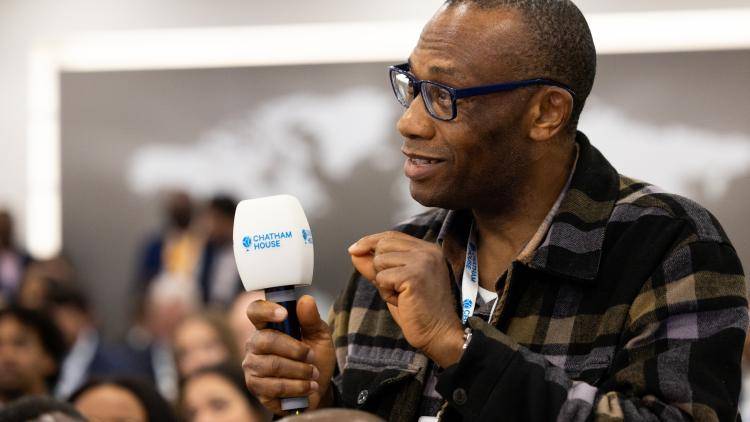
That connective tissue point I think is the perfect opportunity to really open up the conversation to the room. I hope that you’ve been thinking of your questions over the course of this really fascinating conversation. We’ve had some questions come in online. If anybody would like to jump in, if I could request you introduce your name, if you’re comfortable, your pronouns and your affiliation or your organisation and if possible, to keep your question to a relatively brief amount of time so we can get through all of the valued contributions from the market and many, many experts and practitioners present. If I could turn it over to the person with the white wristband, followed by the person with the brown coat and the person with the, also, light brown coat.
Daniel Conway
Hello, and thanks so much for this event. My name is Daniel Conway, and my pronouns are he/him, and I’m at the University of Westminster. And you might have seen today, International Affairs posted the article I wrote, called ‘Rainbow Diplomacy’ with Emil Edenborg, and my question draws from that. So, that article’s really interested in the everyday practice of diplomacy. So, at a high level there can be commitments to LGBT rights, but how do those translate? So, we’d worked for quite a long time with British Diplomats and also, Diplomats from other countries and one of the things that came from that article and it’s the question I have is that states can have quite clear national commitments within foreign policy to LGBT rights, but those can be very inconsistently applied on the ground. And it relates to the things that Evie was talking about, the, sort of, everyday engagement with bringing in activists to high commissions or embassies supporting Pride events, which can be very impactful.
But we found that with things like diplomatic rotation and Diplomats leaving and then also, just the focus on LGBT rights can actually all away from a national context. And I had a sense that with security and trade priorities, those things are very embedded, but with LGBT rights, it’s much – it’s al little bit more precarious. So, I wondered are those conversations and is there an awareness in the FCDO and what kind of processes do you see to help with that consistency? Thanks.
Isabella Wilkinson
Dan, thank you so much. Let’s take the other two questions and then I’ll turn to the panel, and they can pick and choose which ones they’d like to…
Member
Hmmm hmm.
Isabella Wilkinson
…answer. If we could give a mic to the person in the brown blazer. Oh…
Alex Holmes
Thank you.
Isabella Wilkinson
…in whatever order.
Alex Holmes
You’re doing very good job. It’s, sort of like, Question Time vibes here.
Isabella Wilkinson
That isn’t the first time I’ve heard that, actually.
Alex Holmes
Hi, my name’s Alex Holmes, I’m part of a charity called The Diana Awards. I’m sure for many of us Princess Diana was an icon, for multiple reasons, and yeah, my question, really, is a bit closer to home, is to Lord Collins. So, we used to be, along with 15 other organisations, a recipient of a grant tackling anti-HBT bullying in schools under the Conservative Government. Now, we were obviously quite excited about the potential of that continuing under a Labour Government and unfortunately, it hasn’t. Your government isn’t funding any work tackling discrimination in schools and I just wanted to ask you why that is and if you’d be happy to meet with me to talk about some of the great progress that’s been lost and how important it is to tackle that. ‘Cause you talk about what the Conservatives’ ultimate legacy was around Section 28, but that work and those stains on our history and still there and we must continue that work in schools.
Isabella Wilkinson
Thank you so much. This is the very nature of Chatham House events to ask these very direct questions to our panel. We’re going to take one final question, which I believe was the person in the brown blazer in the front row.
Alan Houmann
Hello, thank you very much. Alan Houmann, member of Chatham House Council. My question is, it’s more of a, sort of, should we not be sounding a bigger red alarm about LGBT rights – I meant – I know it’s supposed to be a positive Pride Month, but to me, I think the alarm bells should be very loud, indeed. I mean, it’s not just the trans rights that are being thrown under the bus in this country, but you see it, you know, corporates are pulling back their funding. It seems to me there’s a lot of backsliding since Lord Collins shepherded the Marriage Equality Bill through Parliament. It seems that was a high point and now it’s just going backwards, but if we can’t convince ourselves, how do we convince other countries to make progress, especially in the Commonwealth?
Gurchaten Sandhu
Hmmm hmm.
Isabella Wilkinson
Thank you so much, three really fascinating questions. Just to recap, we have one on the inconsistent application of positions on LGBTIQ+ rights on the ground. We have another on discrimination in schools and then finally, about whether we should be raising a bigger alarm bell for the backsliding that you just set out. Perhaps I could start with Lord Collins…
Lord Raymond Collins of Highbury
I’d love to answer all…
Isabella Wilkinson
…‘cause it seems like a couple of…
Lord Raymond Collins of Highbury
…the three questions, actually. I mean, they are – I’m going to try and link them quickly…
Isabella Wilkinson
Yes, please.
Lord Raymond Collins of Highbury
…‘cause I do – obviously, I don’t want to dominate. I think absolutely right, I’ve been round to many missions. In fact, I think when I was Africa Minister, I visited 19 African countries and, you know, every Ambassador had a very clear mandate, but it didn’t seem to me that they were actually delivering what I was hoping the government could do. Comes back to what we were trying to do in terms of the Africa Approach, which was actually to listen to Africa, listen to the countries and respond to what their priorities were. And actually, the economy and value addition, i.e., creating jobs, was the priority of every African leader, and so, what I wanted to do is our missions to relate that objective, ‘We hear what you’re saying, how do we actually support inclusive economies?’ It – you know, that was a really – and some of the – you know, even – I won’t mention the country, they said to me, ‘Well, we’re not going to introduce these laws, we’re not going to do it, we hear what you say,’ but in the end, they came back.
On schools and certainly, I mean, this government is absolutely committed to tackling this issue and certainly, Bridget Phillipson, the Secretary of State for Education, is obviously, been leading on that and she’s also the Minister responsible for equality, Women and Equality. More than happy to arrange a meeting to talk about, you know, how civil society and other organisations can support that work.
Alan, you know, he – you know, I have known him a long time and of course, he’s absolutely right. I mean, he worked for City Bank, if you don’t mind me outing you, but, you know – and actually, you know, they – many of – you know, Out For Business was a strong organisation. They – many of the financial – global financial institutions, were promoting inclusive, you know, diversity, you know, and really important work. And I would raise the alarm bell, because what I was trying to say about the shift where you have Saudi Arabia supporting a policy and the US – okay, the – and I did an event with a range of strong advocates for LGBT rights and they said, ‘Oh, well,’ you know, ‘we’re determined to do that, but, you know, when we’re in the States, we have to’ – you – and there was a chilling effect, and this was a year ago. And I think actually, it’s – you know, there is a wakeup call, and we shouldn’t just restrict ourselves to workers, civil society, faith groups, as well…
Member
Hmmm hmm.
Lord Raymond Collins of Highbury
…but also go back to businesses, go back to them. And last week I had an event with British International Investment, the, you know, the government’s investment arm for development, a key element and we talked about this and we actually, you know – and the word that came across from all these people is, ‘We have to create solidarity,’ and that’s a word I – you know, LGBT people deserve solidarity, but we must give solidarity too.
Member
Hmmm hmm.
Lord Raymond Collins of Highbury
That’s where you actually bring these things together. So, I challenge, Alan, get – you know, go back to your old colleagues in the banks and make sure that they don’t backtrack.
Isabella Wilkinson
Alright, we have an action point coming out of this panel and thanks for bringing in the themes of solidarity and practising intersectionality. Maybe, Dr Browne, I can turn to you. I anticipate you have an answer or some thoughts on Dan’s question on tying up policy with operationalising all of those sky-high ambitions on the ground. And maybe connected to that, I’ll just read an online question we’ve had from Mark Car – Cornwall, who asks, ‘How far do or can UK diplomatic representatives actively support LGBTIQ+ groups and individuals around the world?’ which I think is connected to this operationalising points. Over to you.
Dr Evie Browne
Thanks. I actually wanted to take the transphobia one.
Isabella Wilkinson
Please do.
Dr Evie Browne
Can we afford to do both? I just think it’s really important that we actually talk about this.
Isabella Wilkinson
Hmmm hmm.
Dr Evie Browne
That as you raised, Alan, thank you, thank you, that what’s happening at home here, with the Cass Review, the EHRC guidance, the media, the abhorrent media discussion about trans people, it seriously undermines the credibility of the UK abroad, and you have to deal with it. Those of us who are in a position to tackle it, let’s tackle it. So, my conversations with activists, Academics, abroad, people frequently now ask me about transphobia in the UK, where they didn’t even a year ago.
Isabella Wilkinson
Hmmm hmm.
Dr Evie Browne
I’d just draw your attention to the 2026 Pride in Vienna which happened a few weeks ago. So, there was a small protest in front of the Diplomats for Equality Group in that Pride, where there was a big sign people held up saying, ‘No pride in transphobia, UK bleep off.’ So, it’s really having an effect on how we’re perceived in the rest of the world. So, it’s not just a reputational damage, but it really undermines the work that people can actually do if others won’t take them seriously or they – Diplomats, etc., can’t do their work if this is the perception of them, of us, the UK. So, that really needs to be dealt with, and I would argue that the IDAHOT Forum next year is the deadline for dealing with it, that if we’re going to…
Lord Raymond Collins of Highbury
I’ll come back when you’re – you know, don’t want to hog it. And…
Dr Evie Browne
Yeah.
Lord Raymond Collins of Highbury
…you’re right, you know.
Dr Evie Browne
And then on Diplomats, yeah, I don – I mean, yeah, individual Diplomats, Dan, as you said, it really dependent on whether that particular person cares about the issues and they have an enormous portfolio that they have to deal with all of the issues. And it can be hard for individuals to – if they’re not part of the community, they maybe don’t know what to say or how to deal with it, and they have their own particular preferences on what they can do, and that really does sway the discussion in particular places.
Isabella Wilkinson
Hmmm hmm. Thanks for taking us back to the point, I think the core point of the discussion, which is accountability and double standards. I mean, Moud, over to you, perhaps, to comment on some of the contributions from the room or this really interesting exchange so far with Dr Browne and Lord Collins.
Moud Goba
Yeah. I think I, kind of, agree with Dr Evie that it depends on the person who is leading the work there and their interests, but also it depends on the country they are. We have to also respect the context of where they are, how the activists on the ground are engaging, how they want to engage the conversation. So, there’s so many ways these conversations are tackled and who leads the conversations, as well. So, it’s complex in how it can be approached, as well. There’s, sort of, a cultural context to it, on top of, you know, the diplomatic element to it and the voices of the people on the ground, is it safe for them to engage, into what context and what amount of work? So, it depends on the location and culture.
Isabella Wilkinson
Hmmm hmm.
Moud Goba
Yeah.
Isabella Wilkinson
A really important reminder on the cultural context. Gurchaten, I’d like to hand over to you, again, for your thoughts on many of the contributions from the room, the exchange just now and a note to the audience, we will be going for another round of questions and so, please do think of them. We’ll be turning the conversation over to you shortly. Gurchaten.
Gurchaten Sandhu
Just want to come to the – I want to co – address both Alan and to the question around international or Diplomats, as well. And I want to put my former turban on, not my hat, former turban in terms of a I was an international civil servant at the International Labour Organization for 17 years and also the President of UN-GLOBE. And one of the biggest challenges that we actually had was this consistency, acr – not just across UK missions, but every single civil service has this challenge. And I think this is where – and this was one of our biggest, sort of, pushbacks internally in – within the UN, and I, as President, would have these conversations with our HR on a daily. If you – you know, it’s their responsibility to stop letting the homophobes in and questions like, ‘How do you practice DEI in your values?’ is not sufficient enough, you know. We need more precise questions to really pull out the homophobes and if they’re working in our civil service, as well.
The other challenge is also, then, on the programmatic level. The ILO worked for so many years to get SOGIE-esque language into the programme and budget. Sadly, in 2022, left the organisation. At the summer of 2023, that language was then challenged by member states and then we wor – had to work from the outside…
Lord Raymond Collins of Highbury
Hmmm hmm.
Gurchaten Sandhu
…to make sure that that language stayed in the ILO, as well. So – and my – that position that – after I left was not – never filled.
When it comes to Alan, that question, I think the alarm bell shouldn’t be our rights. In fact, I think it should be bigger than that. It should be the growing inequalities and disparities in our societies right now, and we’re seeing that and we see that when those disparities grow, our communities are targeted, not just our communities, but migrants, women’s rights, other marginalised communities are targeted, as well. And sadly, the canary in the coalmine, another old workers’, you know, analogy, the canary actually died. We don’t want to be that, and the canary for us, actually, was back in the 80s, when we saw a declining participation in trade unions. That should’ve been the alarm bell, when a lot of membership was declining and workers were just giving up on their own unions, our own democratic processes that had been set up for them. So, we need to go back and address that issue. How do we build that solidarity, as well, in bringing people back to fight for their causes, as well? Thank you.
Isabella Wilkinson
Gurchaten, thank you, a really powerful metaphor on this canary in the coalmine and the really inextricable connection to democratic health, democratic integrity. Let me open it back up to the room for any further questions from some of our experts and practitioners present. If not, I am very, very happy to go online. Ah, yeah, the person in the grey t-shirt and the person in the white shirt. If you want to go to the back row and then to the front. Thank you so much.
Duncan Campbell
[Pause] Hi, Duncan Campbell, he/him. In 1988, at the time of Clause 28, I was one of the founders of Stonewall, which is a British LGBT rights organisation that continues to strongly advocate in these challenging times. I wanted to raise a broader discussion, very much in the Chatham House agenda, perhaps, that there are links that we could draw out of this that go to national and international security, even touch on the harms to children, which is about so much debate, and actually link us back to Brexit and how that came about. And the common strand is the organised drive of division and othering.
Isabella Wilkinson
Hmmm hmm.
Duncan Campbell
And we from LGBTQ, we are obviously very primary targets for othering, but so is black skin and so many other things, but it is systematic and it’s organised and I mean, I don’t say that as a matter of suspicion. We saw 25, in the end, extremely successful years, successful beyond our wildest dreams, frankly, from the time of Thatcher’s defeat through to the Equal Marriage Bill, and I think commonly, and younger generations see this too, that looking back, it was a higher watermark in United Kingdom.
Isabella Wilkinson
Hmmm hmm.
Duncan Campbell
Now, what happened almost immediately after, where you just saw the early flashing lights, was this systematic attack on trans people, and it was coming from everywhere. Even now, with a lot of academic and other research, we can only see glimmers of it, but it’s funded, some of it comes out of Russia, anything will do to do othering and division. The Heritage Foundation in the United States was operational in Britain in the 1980s and is pushing money like nobody’s business. We know that the direct attack on Stonewall and other groups which were active at this time was a [Tuft and Sweet – 54:01] operation on dirty American money. Still not clear, but the effect, for example, Stonewall, many other charities, funding just about halved.
Isabella Wilkinson
I regret…
Duncan Campbell
Pull…
Isabella Wilkinson
…having to ask you…
Duncan Campbell
Pull backs.
Isabella Wilkinson
…to come to your question.
Duncan Campbell
Yeah.
Isabella Wilkinson
I’m so sorry.
Duncan Campbell
My question is…
Isabella Wilkinson
I wish we had more time.
Duncan Campbell
My question is, taking these things together, what thoughts might the panel have about collective international organisation to identify and counter where the rivers of hate are being injected on our society? And might start with Elon Musk.
Isabella Wilkinson
Thank you so much. I – that was perfectly put and I think taking us to, again, the funding and the organisation behind some of these, as you said, structured forms of hate, structured forms of othering. I’ll now hand it over to the person in the white shirt. If you could introduce your name and your affiliation.
Lorna
Thank you. My name’s Lorna. I’m a Pub – Master of Public Policy candidate at the University of Oxford. My question, firstly, to Moud. I mean, most of the conversations we have had here have touched a lot on funding and money. What do you think about alternative sources of funding that don’t rely specifically on the whims and caprices of states?
Moud Goba
Uh-huh.
Lorna
You also talked about, like, contextualising solutions to – in, like, diplomatic missions. What do you think about imbibing typical African traditional values, like values of Ubuntu, in creating alternative sources of funding? I know this happens informally, where something breaks out online of an LGBTQ person being harassed, or I don’t know, in trouble in some way, shape or form, and people rally and, like, contribute. This happens informally, but how do we organise better, what do you think, to make sure that we have not just financial capability, but also leverage and politi – the – like, we create a political economy around the funding for LGBTQI rights?
Isabella Wilkinson
Thank you.
Lorna
To Lord Raymond, I’m sorry, you mentioned…
Lord Raymond Collins of Highbury
Call me Ray.
Lorna
I’m sorr – oh, yeah, you mentioned worked in the, oh, private sector, but I wonder what the implementation of that would look like. What would be the systems of checks and balances that will ensure that they actually commit to the, I don’t know, to the tasks that they take up, especially when the political will or whoever is in power changes?
Isabella Wilkinson
Thank you so much. We have a final question online, which asks how the UK can regain its moral authority domestically to – well, excuse me, I completely, completely misread that. ‘What does the UK do – need to do domestically to regain the moral authority it seeks to exercise internationally?’ As always at Chatham House events, a very rich Q&A. I’m going to hand over to our panel. If you could keep your remarks as short as possible for the amazing contributions we’ve had in the room, and perhaps close by spotlighting perhaps one of the unsung or underappreciated heroes in your own life, in your own career, who’s advocated for LGBTIQ+ rights and freedoms.
Lord Raymond Collins of Highbury
Above…
Isabella Wilkinson
Over to you.
Lord Raymond Collins of Highbury
Firstly, can I start quickly?
Isabella Wilkinson
Please, yes.
Lord Raymond Collins of Highbury
I mean, I agree with Duncan. I mean, what we have seen, we had very good progress and that progress wasn’t without its own pain. We had to fight for it and we didn’t have to – you know, we couldn’t rely on Politicians. It was civil society organisations, and it was organisations like Stonewall that built a broad alliance, and I think that’s what we have to do again in terms of defending and making sure things don’t roll back. And they are very much focused on the trans issue and of course, you know, actually, we focus on the Supreme Court judgment, you know, that was a judgment that – and then the EHRC Code. But the reality is that debate was incredibly toxic and started well before those decisions and actually, I think what I – you know, I am very proud of the GRA, I’m very proud of the Equality Act. We have legislation to defend trans people, and we need to say that is still there
And I think when the code in terms of services applies, you know, I actually want propor – you know, common sense. And actually, I am feeling that actually, people are now responding to that toxic debate by saying, ‘Hang on a minute, this isn’t the sort of people we are as a country.
Isabella Wilkinson
Hmmm hmm.
Lord Raymond Collins of Highbury
We are not like that.’ So, I think that’s a really important thing.
Coming back to Lorna and the other point, and I’ll, sort of, try and conclude on this. Whenever I’ve spoken to civil society groups, including LGBT groups, I actually say to them, ‘Well, how do you make your organisation sustainable?’ The one thing I know that will not make them sustainable is their over-reliance on grants and money.
Gurchaten Sandhu
Hmmm hmm.
Member
Hmmm hmm.
Lord Raymond Collins of Highbury
It’s actually – you know, I was a, you know, not only a Trade Unionist, but I had to spend difficult years as General Secretary of the Labour Party trying to raise money and actually, you know, people giving is actually a real sign of commitment and engagement and that’s something that we perhaps need to spend a bit more doing.
Can I just say in terms of, you know, a hero, I mean, I hope you will give me permission because there is someone who I hugely respect. Sadly, he died suddenly very young, as a hea – with a heart attack, and that’s Jonathan Cooper, because he was a Lawyer that, sort of, took his values into action and established the Human Dignity Trust and actually resulted in very positive changes in legislation, but he never forgot that actually, civil society organisation was vital to sustain that change.
Isabella Wilkinson
Thank you, Lord Collins. Moud, let me turn it over to you and just to let the audience know, we’ll run for another five or so minutes.
Moud Goba
Okay, thank you. I think maybe I will start by the question of Ubuntu, because it’s – for a long time, I used to be interested in that philosophy, ‘I am because you are,’ especially in our cultures. But I always see it as an encounter and it’s almost – it needs to be taken apart because it’s applied to everyone except LGBTQI communities, you know, in people who are different. But for everyone else, it is, you know, a philosophy that can be applied, except the others. So, I think we need to relocate and take it apart.
And then, perhaps I can also connect our – the question on alternative source of funding and my hero, who is our founder at Micro Rainbow, Sebastian Rocca. So, when we started our project, it was looking at how we can sustain it and how we can become self-sustainable and scale-up over years, and one of the things that we did is that we buy our own houses in we’re a community interest company and what profit we make is used to fund our work. So, in time, the vision is that we won’t be relying on, you know, on funding, on donor funding, because it is difficult. Earlier, you talked about, you know, funding drying up. It’s been the same for us with – you know, during Pride we dealt with a lot of funding and, you know, to last year, when people almost shy to fund our work and would give us, sort of, support – or companies would give us support in different ways, without saying, you know, it’s for Pride or it’s for, you know, LGBT care if people seeking asylum. So, we have to be creative or to be innovative in, sort of, creating those alternative sources of funding.
Isabella Wilkinson
Thank you. Gurchaten, over to you.
Gurchaten Sandhu
I just want to come into Duncan’s point around the division. We’re no strangers to this. I come from first generation diaspora communities and 1st of July we’ll be celebrating South Asian Heritage Month. We know divide and rule…
Lord Raymond Collins of Highbury
Hmmm hmm.
Gurchaten Sandhu
…and we’ve experienced. So, one of the key things that we’d need to do is de-colonialise ourselves, stop dividing ourselves. And that also speaks to our own fractions within our own movement, as well, and we’re seeing them and now we have the LGB Alliance international, you know, which now also threatens to divide us, as well.
Then when it comes to the funding issues, indeed, sustainability is one of them and we need to stop donor reliance, but one of the biggest underlying parts of this is tax injustice. We need to address that and the – this government also needs to address that, as well, and improve our funding.
Then when it comes to the unsung heroes, in 1978, of all places in the world, ILGA was founded in Coventry by 14 organisations, and I think Duncan, I don’t know if you were there, but Nigel was there as well and many leaders from the UK were there and especially Trade Unionists…
Lord Raymond Collins of Highbury
Hmmm hmm.
Gurchaten Sandhu
…that helped found our global movement, as well. And then, sorry, just one last point in terms of unsung heroes, as well, we – and we also understand the challenges of having to work within your own governments, as well, and especially with a lot of changes, being caught between these political changes, these policy changes at the national level, versus the UK. And that has to go out to our UK civil servants, especially the FCDO team that we work with, in terms of their LGBTI work, and that’s Stephen at his team, [Elaine Shard – 63:50] Mike Battcock, you know, really there for us, having to find those, sort of, how do we solve this? And then working with us and listening to us, as well. So, some – we have to also give them credit, too, as well. So, thanks very much.
Isabella Wilkinson
Thank you so much, and Dr Browne.
Dr Evie Browne
Yeah, great. Yeah, just a couple of points to close on. None of this is possible without civil society.
Isabella Wilkinson
Hmmm hmm.
Dr Evie Browne
We need civil society to lead. We have to fund them. Grassroots funding is really the key to all of this. As you said, it provides the infrastructure. If funding collapses now, you lose activists, you lose momentum, people all – people have – people burnout and they don’t come back to it, and we lose what we’ve built.
And then, what the UK can do is perhaps show leadership in multilateral spaces. That might be a little bit less politicised and a bit safer than communication directly with national governments but speaking up in the multilaterals is something that the UK could do. And I think it’s really important at this moment in time that the UK gets its own house in order before it advocates elsewhere and that, for me, means some very concrete pro-trans policies, not just inclusion, but pro-trans. You may have seen the European Parliament released a statement in March saying that ‘Trans women are women.’ You can do it; we can do that.
And my final unsung hero is – I live in Brighton and it’s the Founder of Brighton’s local Trans Pride, who’s name is Sarah Savage.
Isabella Wilkinson
Thank you all so much for an incredibly rich conversation, which I hope is not ending now. We invite you to join us upstairs in our Neil Malcolm Room for a Pride themed reception where I invite you all to continue the conversation, meet each other, meet our fantastic panellists. I’d like to extend my gratitude to Chatham House’s EDI Working Group for making this event puls – possible, to our Events Team for programming and production and also to the Lawyer, Jonathan Cooper, to the civil society founder, Sebastian Rocca, to the small group of civil society activities who created ILGA in Coventry in the 1970s.
Gurchaten Sandhu
Hmmm hmm, hmmm hmm.
Isabella Wilkinson
To the tireless FCDO champions who make so much of this work possible and to the co-founder of Brighton Trans Pride, Sarah Savage, and very importantly, to our fantastic panel. Thank you all so much, and Happy Pride [applause].