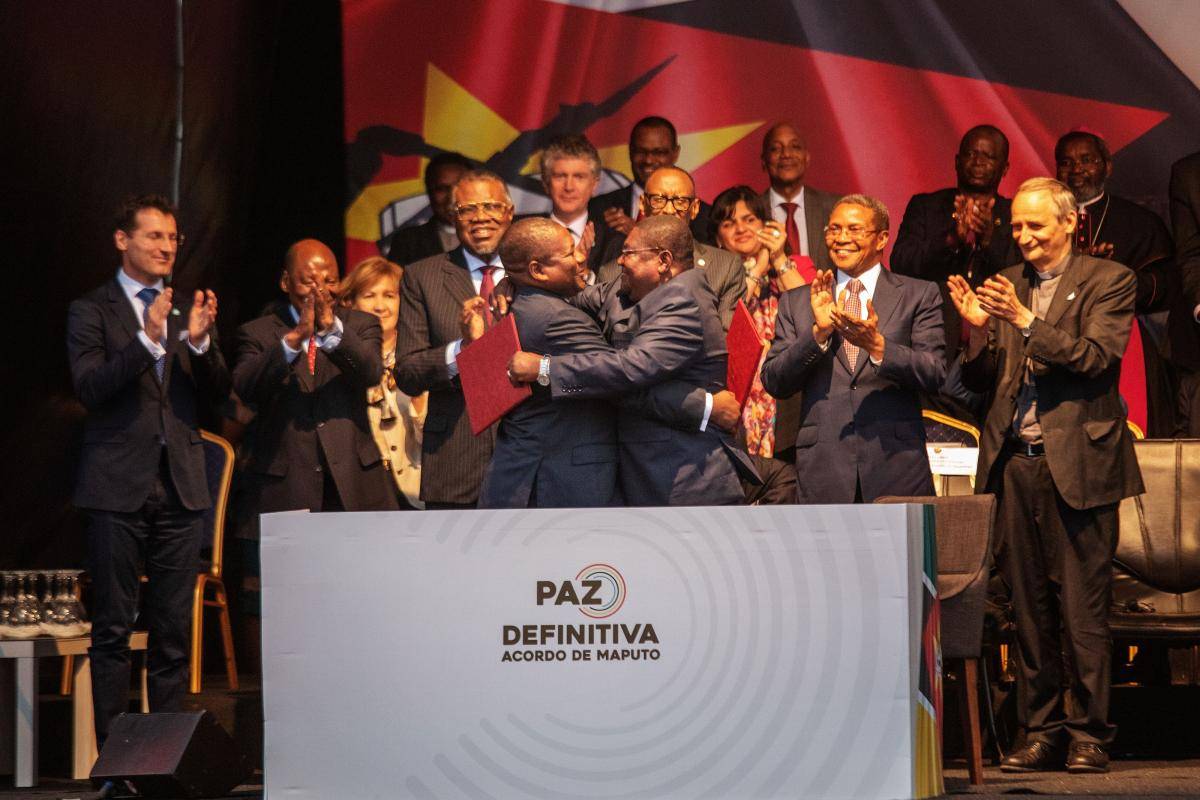

The emergence of a new agreement to end civil conflict in Mozambique is an important development. This paper examines how this deal was achieved and highlights some of the potential risks in the run-up to the October 2019 elections and beyond.
Research paper
Published 5 August 2019
Updated 27 September 2024
ISBN: 978 1 78413 353 5

The emergence of a new agreement to end civil conflict in Mozambique is an important development. This paper examines how this deal was achieved and highlights some of the potential risks in the run-up to the October 2019 elections and beyond.

While many observers have focused on the civil divides between RENAMO and FRELIMO, they have neglected the significance of post-war relationships between RENAMO’s low- and mid-ranked veterans and its leadership. Studies in West Africa show that long after a conflict, military networks remain involved in myriad activities such as election campaigning, illicit trade, private security, mining and criminality.54 In Mozambique, with RENAMO’s rapidly degrading fortunes, Dhlakama has shown that he could still remobilize aging ex-combatants and arm them 20 years after the conflict ended. However, that support had to be earned. When the relationship between Dhlakama and core followers in central Mozambique began to break down in 2012, he moved back to shore up support.55 A Dutch anthropologist who spent several years in this area estimates that some 3,000 RENAMO ex-combatants lived in Maringué district, Sofala province, without any financial support from the party and have been ‘waiting’ for the party to provide them with benefits. Although some observers disagree and think that this estimate is likely more accurate for the whole of the province.56 This demonstrates the local nature of Mozambique’s politics at times and goes someway to explain why RENAMO was unable to return to full-scale conflict, though its structures remained sufficiently intact in central Mozambique to resume targeted violence.
The recent confrontation grew out of a variety of factors, which may also have some bearing on the sustainability of any future elite bargain, including:
Meaningful decentralization by the government and full demobilization by RENAMO have been the key issues of recent negotiations. In early 2018, President Nyusi and Dhlakama negotiated a framework accord on political decentralization. Following Dhlakama’s death there were fears this might not last, but in May 2018 parliament enacted a series of constitutional amendments to prepare for deepened decentralization. These provide for elected provincial, district and municipal assemblies (with the leading delegate with the party with a simple majority, heading them). Following the work of the commission on decentralization, a constitutional amendment on the issue was passed in the National Assembly in May 2019. In June, the president promulgated the Law of Punctual Review of the Constitution of the Republic of Mozambique.
RENAMO had dropped its insistence of directly appointing governors in the provinces it claimed to dominate and accepted the principle of indirect gubernatorial elections in 2019 – as new provincial governors would be chosen based on the winning provincial party list. So for the first time, provincial governors will be elected, not appointed by the president. Provincial assemblies, that currently play an advisory role are to become provincial executive councils and will have some tax-raising authority. A legislative package for decentralization of powers across 10 provinces was announced by Mozambique’s cabinet in February 2019.61 The proposals impose overlapping mandates on provincially elected governors and state-appointed secretaries and this looks like an arrangement designed to preserve FRELIMO power and disadvantage grass-root representation. Under these new laws, crucial tax-raising powers remain with the Secretariat of State, who is appointed by the president – a request FRELIMO insisted on.62
RENAMO’s comprehensive disarmament is the key government demand.63 The government understands that it needs to offer concessions for reintegrating RENAMO combatants into the FADM and police. In this regard, the MoU on Military Affairs includes security provisions for the placement of RENAMO ex-combatants into senior positions in the army and police force. New symbolic senior posts are being created to absorb some of these former fighters and RENAMO has raised the idea of creating a ‘provincial police force’.64 In February 2019, for example, 11 officers from RENAMO were appointed to leadership positions in the FADM and this followed the appointment in January of three top commanders from RENAMO to key army leadership positions. Another positive step occurred in mid-July when RENAMO delivered a revised list of 10 officers it wanted to see integrated into the police force as part of the DDR process. The government rejected the previous list because it included people who had already served in the armed forces and were now demobilized or retired. Finally, on 28 July 2019, RENAMO commenced DDR of its residual forces in Satunjira. This process will cover 5,221 RENAMO militia currently in the provinces of Sofala, Inhambane, Tete, Niassa and Nampula.65
It will be a challenge to manage new ‘opportunistic’ recruits hoping for jobs and benefits following reports in 2019 that RENAMO is recruiting and training armed men.
It will be a challenge to manage new ‘opportunistic’ recruits hoping for jobs and benefits following reports in 2019 that RENAMO is recruiting and training armed men. However, this action is likely more about preparing for the new deal and sending a message that RENAMO could still act as a spoiler, than any real intent to return to conflict.
International partners will need to make long-term guarantees to DDR efforts in hot spots, particularly parts of central Mozambique and Tete province, and focus on bringing Momade into a process that incentivizes non-violent politics. A basket fund has been established to channel financing for DDR activities and a DDR camp has been constructed in central Mozambique, overseen by Brigadier General Javier Perez Aquino and a group of military experts.66 Too much focus on austerity by international donors and the international financial institutions at this critical moment might back-fire – their engagement needs to be conflict-sensitive and not time dependent.67 Like many other guerrilla groups, RENAMO will only gradually disarm its gunmen and is likely to keep hidden arms caches as an insurance policy. As a response, the best strategy is to build up political confidence and economic opportunity so that gradually this armed wing of RENAMO becomes redundant.
A durable peace settlement will require compromise by FRELIMO and an acceptance that RENAMO has in the short term been able to capitalize on some of the government’s shortcomings. A danger for RENAMO is that its armed militia is mostly middle aged and that it will not be able to rely on them indefinitely to provide armed back up.68 The military wing is also divided, split over the appointment of Momade as president and his efforts to pivot the party core away from Manica and Sofala provinces. There is also uncertainty over Momade’s commitment to historical loyalties from the 1977–92 war. Furthermore, there is concern over the impact caused by Cyclone Ida in key strong-holds in Sofala and Manica, which damaged hidden arms caches.69