

During last week’s state visit by Pakistan’s Prime Minister Muhammad Shehbaz Sharif to Saudi Arabia, the two countries announced a ‘Strategic Mutual Defence Agreement’. This marks a significant upgrade in their long-standing bilateral security relationship, stating that ‘any aggression against either country shall be considered an aggression against both.’
The pact is significant for regional security dynamics between South Asia and the Middle East. It also reflects an increasingly multipolar strategic environment, whereby countries hedge against growing insecurity by diversifying their security partnerships in novel ways.
Response to regional threats
Saudi Arabia has had generally warm relations with Pakistan since the latter’s independence in 1947, reflecting in part ideological convergences between their Sunni Muslim majority populaces.
By choosing now to publicly upgrade its security ties with Pakistan, Saudi Arabia has conveyed its concern around the regional threats it faces, even if a Saudi official told Reuters that the agreement with Pakistan is not a response to specific events or actors.
The pact comes amid a period of heightened tensions in the Middle East. It was announced just nine days after Israel’s surprise 9 September airstrike on Doha, Qatar, which targeted the Hamas negotiating team.
The announcement could convey Riyadh’s growing alarm over whether the US’s informal security guarantees to its Gulf allies are robust enough. These concerns are likely to have worsened due to the Trump administration only giving Israel a light rebuke following its strike on Doha. This is despite Qatar being a close ally of Washington that hosts US troops at the Al Udeid airbase.
Riyadh’s confidence in its future strategic relationship with Washington may have also been shaken by the failure to secure a Saudi-US defence pact, which it has pursued for some time to no avail. This is despite the warmth shown by the Saudis to President Donald Trump during his state visit in May, and the numerous defence deals announced by the US with Saudi Arabia, Qatar and the United Arab Emirates, which Trump also visited on the same trip.
The new pact with Pakistan may therefore be Riyadh’s way of signalling some unease to Washington and attempting to enhance its leverage over future defence talks.
Extended deterrence
The Saudi-Pakistan defence pact also has wider significance for how states practice deterrence worldwide.
Deterrence can be projected in two ways. Direct deterrence involves the efforts by a state to prevent attacks on its own territory and against its own assets. Extended deterrence involves discouraging attacks on third party allies or partners.
The most notable example of extended deterrence is the NATO alliance. Through NATO, three of the world’s nuclear weapons armed states (the US, UK and France) have a binding mutual defence pact among the 32 NATO member states. Most significantly, this has provided all NATO members with the US’s offer of nuclear deterrence. The UK’s nuclear weapons are also committed to NATO’s extended deterrence posture, whereas France has traditionally reserved its nuclear weapons for national deterrence only (a position which might now be changing).
Outside of NATO, the US also has bilateral security partnerships extending nuclear deterrence to allies in the Pacific, including South Korea, Japan and Australia. A fundamental feature of the post-1945 security order has involved the US stationing nuclear weapons in Europe and otherwise guaranteeing nuclear protection to Pacific allies without stationing weapons there.
However, other than the US, there are relatively few other instances of nuclear weapons-armed countries formally offering extended deterrence to allies and partners that lack nuclear weapons. Russia and Belarus have an extended deterrence relationship which involved Russia stationing some nuclear weapons there in 2023, forming a part of Russia’s nuclear sabre-rattling towards the NATO countries during its ongoing invasion of Ukraine.
China has had a long-standing strategic partnership with the North Korea, dating back to 1961, but the dynamics of extended deterrence have changed ever since North Korea conducted its first nuclear test in 2006, and has steadily grown its arsenal of nuclear weapons since then. Since October 2024, Russia has its own mutual defence arrangement with North Korea, but once again, both countries already possess nuclear weapons, albeit of radically different sizes.
Nuclear umbrella?
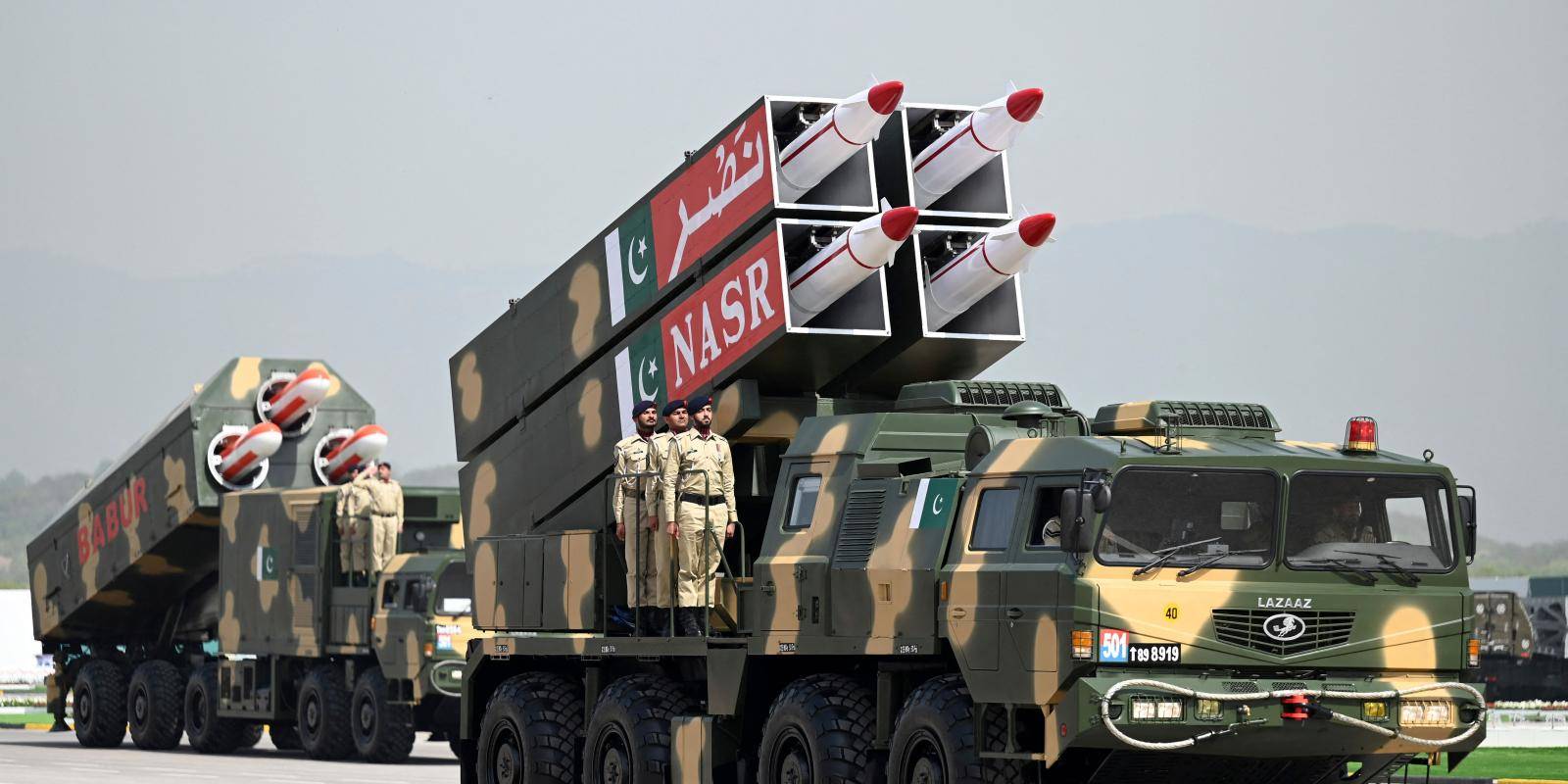
Pakistan, which possesses a nuclear arsenal, is the first country outside of the Non-Proliferation Treaty (NPT) to offer a mutual defence clause to an ally or partner without nuclear weapons.
The announcement of the Saudi-Pakistan defence pact did not explicitly mention nuclear weapons or nuclear cooperation, and Pakistan has not officially offered its nuclear deterrence to Riyadh. There is also no indication that Pakistan would physically move nuclear weapons to Saudi Arabia, especially since Pakistan’s arsenal is on the smaller side. Pakistan is estimated to have fewer than 200 warheads and remains fixated by its strategic rivalry with India.

However, when asked whether ‘the deterrence that Pakistan gets from nuclear weapons’ will be made available to Riyadh, Pakistan’s Defence Minister Khawaja Mohammad Asif reportedly told Pakistani TV that ‘What we have, and the capabilities we possess, will be made available according to this agreement.’ He later clarified that the nuclear umbrella was ‘not on the radar.’ But Reuters also quoted a senior Saudi official on condition of anonymity as saying, ‘this is a comprehensive defensive agreement that encompasses all military means.’
It is unclear what these comments mean in practice for Riyadh’s deterrent. Saudi Arabia has previously expressed an interest in developing its own nuclear weapons capabilities, and has warned that it certainly would seek to do so in the case of Iran developing nuclear weapons.