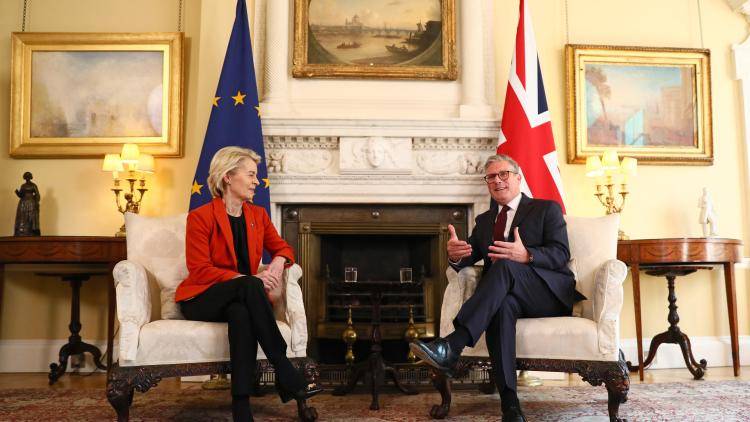
Security and defence cooperation is an important component of the UK Labour government’s ‘reset’ in relations with the EU. Building back relations in this area has been a priority for Labour ever since former Conservative prime minister Boris Johnson excluded it from the scope of talks on a Trade and Cooperation Agreement (TCA) in 2020.
Russia’s 2022 invasion of Ukraine highlighted the urgent need for the UK to work alongside its European partners to support Kyiv – and made the UK’s eschewal of engagement with the EU more costly.

At the May 2025 UK–EU summit both sides formalized a Security and Defence Partnership (SDP). The agreement provides for regular cooperation across different levels of government and different areas of security, including maritime, space, cyber and hybrid.
Although the agreement is, in many respects, aspirational and forward-looking, there are some obvious roadblocks which will make effective security cooperation difficult.
No longer a SAFE bet?
As part of the SDP negotiations, the UK had hoped to secure access for UK firms to SAFE (Security Action for Europe), a €150 billion financial assistance programme aimed at improving defence capabilities across the continent. Allowing UK companies to contribute to projects above the 35 per cent limit for non-EU firms would not only benefit UK industry but also enhance the credibility of the programme.
But the negotiations proved more difficult than expected. Initial estimates of the fee London was expected to pay – initially upwards of €6 billion – were deemed prohibitively expensive and proposals for a ‘pay-as-you-go’ model went nowhere.
The collapse of the talks on 28 November will limit the participation of UK firms in SAFE, to the detriment of the UK defence industry, the viability of the individual projects and the credibility of the programme as a whole.
But it is not necessarily a catastrophic outcome. A future deal may be reached for successive funding rounds and the fact money was the biggest issue makes compromise easier to envisage. Moreover, the value of the reset does not only lie in the specific agreements reached but also in getting both sides talking again. This means the reset itself has not hit a brick wall.
Broader lessons for the reset
Nonetheless, the breakdown of talks highlights some deeper issues which have dogged the reset and will likely continue to do so, regardless of the specific programme in question.

The UK’s status outside the single market and customs union continues to delimit what is possible after Brexit and contributes to a divergence in perspectives. The UK believes its strategic clout will be the deciding factor, while for the EU the most important factor is the UK’s relationship to EU institutions and regulatory architecture.
This has also led to a long-standing perception gap on how UK contributions are valued. While UK policymakers see any prospective British engagement with EU defence efforts as a positive contribution, there are many in Brussels and the national capitals who consider such ‘cherry-picking’ a risk.
Inclusive EU decision-making processes are another potential issue. Any decision to extend access to the UK must pass a very high bar and would be subject to the potential veto of individual member states, making UK asks vulnerable to issue-linkage strategies and agreement harder to reach. This has already threatened UK participation in the PESCO military mobility project, which was blocked by Spain due to the ongoing dispute over border arrangements in Gibraltar.
It is also evident in France’s desire for strict conditions for UK participation in SAFE, reflecting competition over defence-industrial interests which continues to pull EU/European defence policy in different directions. UK participation is viewed by some EU countries as an inhibitor of efforts to foster a genuinely European defence technological industrial base.
How to make progress at the next UK–EU summit
The UK’s engagement with EU security has always been awkward, especially after Brexit. But with the US increasingly willing to sideline and criticize Europeans and the conflict in Ukraine at a crucial moment, cross-channel divergence is not something either side can afford.
Problematic attitudes remain on both sides. UK political elites are unable to accept the limitations imposed by the hard Brexit outcome and unwilling to revisit the most important red lines. The belief that the UK can build back via security contributions or that the strategic and economic aspects of EU policymaking can be separated has been proven false time and again.
The EU, for its part, continues to struggle with strategic thinking and action, a near inevitable consequence of its politico-institutional order. There is also a tendency in some quarters to view Britain through an outdated Brexit lens which overstates the risks of UK participation to the EU. Far from introducing a potential spoiler into the mix – or incentivizing exit – including the UK in EU security initiatives offers a practical means of minimizing the security gap.