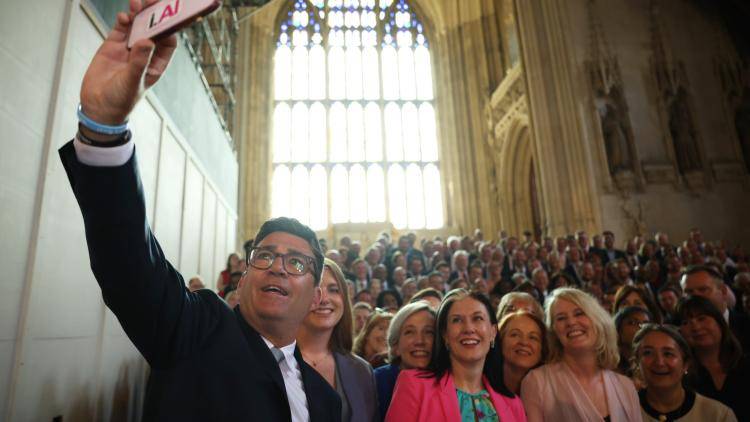
Keir Starmer has released the long-awaited Defence Investment Plan (DIP), which sets out the UK’s military spending plans, ahead of the NATO summit next week. The DIP also contains a commitment to a ‘national conversation campaign on defence and security’.
However, this plan for a ‘national conversation’ was already adopted by Starmer’s government in the Strategic Defence Review (SDR) of 2025. The conversation was to focus on the rationale for investing more in defence, the role of the public in support of national security and resilience, and countering misinformation.
The review recommended it take the form of a ‘two-year series of public outreach events across the UK, explaining current threats and future trends’. This has not yet happened.
Meanwhile, intelligence services have warned that Russian sabotage, hostile reconnaissance, cyber-attacks and disinformation campaigns are increasingly directed at the UK, a country viewed as ‘enemy number one’ and a ‘soft target’. The first step in countering these ‘hybrid’ attacks targeting the UK’s political stability is for a new prime minister to inform the public and build a societal response.
Building trust and consent
The commitment from the Starmer government in 2025 reflects UK and NATO doctrine, which emphasize the ‘central proactive element’ of strategic communications in countering hybrid threats. Increased public awareness can spur civil society action to recognise hybrid threats and address vulnerabilities, acting as a deterrence by denying or reducing the impact of such threats.
However, the UK government faces a strategic challenge: low public trust. According to 2024 polling, the UK government is one of the least trusted by the public among OECD countries. A ‘national conversation’ could be an important way to improve the public’s trust in the government.
Allowing the public to feel they are part of a dialogue with authorities and including them in decision-making can build long-term public trust. Communications can foster cohesion through values-led narratives which promote civic unity.
Sharing more about security also requires government to trust the public. The UK government has been accused of a ‘Stalinist’ culture of excessive official secrecy, with information either not shared due to fear of public and media panic, or a desire to control the narrative of the threat.
Withholding information on threats can however negatively impact public confidence, especially if the British public perceives allied governments or independent media as offering greater candour than official UK sources.
In turn, a national conversation that builds trust and explains the level of threat facing the UK will help the government to secure public approval for increased defence spending as outlined in the DIP. This is vital considering that higher defence spending generally requires a combination of cuts elsewhere, tax rises, or borrowing – all options that could prove unpopular with the public if the government doesn’t better explain and justify its decisions.
What role should the public play?
A key element of the conversation is to engage the public in supporting national security and resilience. To send a clear demand signal to society through outreach activities, the government must first organize and articulate policy on the public’s role.
According to Dr Fiona Hill, a co-author of the SDR, civil aid organizations currently feel ‘there is no green light from above’ and ‘a sense of inaction’ in planning to support emergency responses. While the government is researching policy options on aspects of societal resilience, there appears to be limited political direction or ownership with no single minister responsible.

The SDR also recommended the conversation should support ‘efforts to counter threats to information integrity as a critical component of national cohesion’. This reflects an online information ecosystem which is becoming easier to manipulate, with impacts offline. Violent disorder has occurred every summer since 2024, fuelled in part by misinformation on platforms including Elon Musk’s X and Meta’s Facebook.
Possible calls to action might include asking the broader public to engage in media literacy initiatives, such as those available in libraries and online, for example via civic organizations in Finland and Sweden.
Given the potential of misinformation to cause polarization and destabilization, the UK government has taken some limited steps to improve resilience, but actions on media literacy are focussed on parents and limited to a government campaign rather than a broader civic coalition.
Strategic questions
Attempts to destabilize UK society currently exist in a ‘space between peace and war’, with attacks seeking to exploit vulnerabilities across the full spectrum of societal functions.
Europe’s Centre of Excellence in Countering Hybrid Threats therefore recommends a ‘whole-of-government’ approach, using societal resilience as an organizing framework to cohere other disparate policy areas. In Nordic states, this has extended to social, cultural, and constitutional policy, while the German zeitenwende (turning point) shift since 2022 has linked investment in the military with infrastructure resilience and economic development.